

New Math: Division & Multiplication Problems
July 25, 2017
By Jack Roberts
MHSAA Executive Director
This is the second part in a series on MHSAA tournament classification, past and present, that will be published over the next two weeks. This series originally ran in this spring's edition of MHSAA benchmarks.
High school tournament classifications went viral before there was social media and most of us knew what “viral” meant.
Much as a virus infects computers today or has created epidemics of disease around the world for centuries, high school tournament classification – once introduced – tends to spread uncontrollably. Once started, it tends to keep expanding and rarely contracts.
While we are still some distance from providing every team a trophy as a result of expanding high school tournament classification across the country, there is criticism nevertheless that we are headed in that direction – a philosophy which is supposed to exist only in local youth sports for our youngest children.
Michigan could be blamed for all this. Michigan is generally accepted as the first state to provide different classifications for season-ending tournaments for different sized schools. It started a century ago. Today, every state has various classifications for its tournaments in most if not all sports. And it is a bit ironic that Michigan – creator of the classification chaos – more than most other states has kept the number of tournament classes or divisions under control.
Yes, there is evidence that tournament classifications have expanded over the years in Michigan, especially with the relatively recent introduction of tournaments in football and the late 1990s’ move from classes to divisions in most MHSAA tournaments. But the MHSAA Representative Council has held true to its word when it expanded the playoffs for football from four classes to eight divisions: this is needed because of unique factors of football, factors that exist in no other sport; and all other sports should be capped at a maximum of four classes or divisions.
Kentucky is the preeminent defender of single-class basketball. All of its 276 high schools compete for the single state championship for each gender. In Indiana, there are still open wounds from its move in 1998 from one to four classes for its 400 schools in basketball.
Multi-class tournaments have tended to increase the number of non-public school champions, which some states are trying to lower through enrollment “multipliers,” and also tend to increase the number of repeat champions, which some states are trying to affect with “success factors” which lift smaller schools into classifications for larger schools if they take home too many trophies.
While there is considerable evidence that state tournaments do as much bad as good for educational athletics, state associations persist in providing postseason tournaments because, on balance, the experiences are supposed to be good for student-athletes. And once we reach that conclusion it is just a small leap to believe that if the tournaments are good for a few, they must be better for more – which leads to creating more and more tournament classifications. One becomes two classes, then three, then four and so forth.
While the argument is that more classifications or divisions provides more students with opportunities to compete and win, it is undeniable that the experience changes as the number of tournament classifications expands. It is not possible for state associations to provide the same level of support when tournament classifications expand to multiple venues playing simultaneously. For example, there is less audio and video broadcast potential at each venue, and less media coverage to each venue. Focus is diluted and fans diminished at each championship.
No one can argue reasonably that today's two-day MHSAA Football Finals of eight championship games has the same pizazz as the one-day, four-games event conducted prior to 1990.
In some states the number of divisions has grown so much that it is difficult to see much difference between the many season-ending state championship games and a regular-season event in the same sport.
It is a balancing act. And Michigan has been studying that balance longer than any other state, and charting a steadier course than most.
Addition by Division
The shift to Divisions for MHSAA Tournament play in numerous sports has added up to a greater number of champions for teams and individuals across the state. Following are the sports currently employing a divisional format, and the procedures for determining enrollment and classification.
In 23 statewide or Lower Peninsula tournaments, schools which sponsor the sport are currently divided into nearly equal divisions. They are:
- Baseball - 4 Divisions
- Boys Bowling - 4 Divisions
- Girls Bowling - 4 Divisions
- Girls Competitive Cheer - 4 Divisions
- LP Boys Cross Country - 4 Divisions
- LP Girls Cross Country - 4 Divisions
- LP Boys Golf - 4 Divisions
- LP Girls Golf - 4 Divisions
- Ice Hockey - 3 Divisions
- Boys Lacrosse - 2 Divisions
- Girls Lacrosse - 2 Divisions
- Boys Skiing - 2 Divisions
- Girls Skiing - 2 Divisions
- LP Boys Soccer - 4 Divisions LP
- Girls Soccer - 4 Divisions
- Girls Softball - 4 Divisions
- LP Boys Swimming & Diving - 3 Divisions
- LP Girls Swimming & Diving - 3 Divisions
- LP Boys Tennis - 4 Divisions
- LP Girls Tennis - 4 Divisions
- LP Boys Track & Field - 4 Divisions
- LP Girls Track & Field - 4 Divisions
- Wrestling - 4 Divisions
Lists of schools for each division of these 23 tournaments are posted on MHSAA.com approximately April 1. Listings of schools in Upper Peninsula tournaments for their sports are also posted on MHSAA.com. The lists are based on school memberships and sports sponsorships in effect or anticipated for the following school year, as known to the MHSAA office as of a date in early March.
In football, the 256 schools which qualify for MHSAA 11-player playoffs are placed in eight equal divisions annually on Selection Sunday. Beginning in 2017, the 8-player divisions will be determined in a like manner on Selection Sunday as well, with 32 qualifying schools placed in two divisions.
Schools have the option to play in any higher division in one or more sports for a minimum of two years.
The deadlines for "opt-ups" are as follows:
- Applications for fall sports must be submitted by April 15
- Applications for winter sports must be submitted by Aug. 15
- Applications for spring sports must be submitted by Oct. 15
Subsequent to the date of these postings for these tournaments, no school will have its division raised or lowered by schools opening or closing, schools adding or dropping sports, schools exercising the option to play in a higher division, or approval or dissolution of cooperative programs.
When the same sport is conducted for boys and girls in the same season (e.g., track & field and cross country), the gender that has the most sponsoring schools controls the division breaks for both genders.
Hockey Players Transferring Winter Puck Skills to Spring Golf Swings
By
Tom Lang
Special for MHSAA.com
May 26, 2023
When the Michigan seasons shift from winter to spring, some high school golf teams are a little more eager than others for the hockey season to officially end.
This is especially true for the school golf programs in Brighton, Hartland and Muskegon Mona Shores – examples of boys teams that love having hockey players transition from the indoor frozen ice to play golf outdoors on the lush green grass.
“I would take a golf team full of hockey players any day,” said Hartland golf coach Nathan Oake. “I love them.”
We can tell, because his program is full of them.
Hartland and Brighton each have eight hockey players on their 16-golfer varsity and JV rosters.
Mona Shores has three hockey players this year, but usually has more. In 2023 it’s Oliver MacDonald (all-state honorable mention in hockey), Nathan McNarland and Nicholas Taylor, who was voted Division 1 all-state golf last spring, then leading his team to fifth place at the MHSAA Lower Peninsula Division 1 Final.
 Brighton golfer Winston Lerch was also Division 1 all-state last year in golf and an assistant captain on the hockey team this winter that finished Division 1 runner-up to Detroit Catholic Central. Here in 2023, he shot a 65 to open the season at Oakland University for medalist and has committed to Grand Valley State for golf with his 72-stroke average.
Joining Lerch in the Bulldogs boys golf program are hockey players like Levi Pennala, winner of hockey’s Wall Award sponsored by State Champs as the top high school goalie. Pennala – who recently shot 72 at the Kensington Lakes Activities Association championship tournament, his career low for high school golf – finished in the top 30 last year at the LPD1 Final. Then early this spring when he was away at a high-level junior hockey tournament, freshman hockey player Adam Forcier stepped in and shot a school record 18-hole round for a freshman at 73. Jacob Daavetilla also works into the starting lineup at times.
Forcier tied the record of Davis Codd – who, as a pro hockey player on leave from the Saginaw Spirit OHL hockey team when COVID-19 shut down the league, won the LPD1 Final in 2021 for Brighton.
Brighton golf coach Jimmy Dewling said Codd was one of the earliest to prove to others you can play both hockey and golf and excel. In fact, that June in 2021, Codd went to an NHL scouting camp in Pennsylvania before the Golf Finals, drove overnight back to Forest Akers to play the two championship rounds, won the title, then immediately returned to Pennsylvania to resume the hockey camp.
“On our team, we believe, and TBone (Codd) was a perfect example of it, if there’s any time you have the opportunity to be competitive, it is going to make you a more well-rounded competitor and therefore better at your particular sport,” Dewling said.
“We like hockey players. In the winter, they have to think to where the puck is going, be smart enough to react, and understand how that emotion is going to carry over from one play to the next. When it’s your shift you have to forget about the last shift, or take something from the last shift and put it into the next shift, to have consistent play.
“It’s the same on the golf course,” Dewling continued. “It’s one hole to the next, one shot at a time, being tough, and that’s only going to come from competition reps. We love the athletic ability more so than anything; the toughness and competitiveness all year.”
In addition to Lerch and Pennala starting on varsity golf, they are joined by traditional golfers Matt Doyle, Riley Morton and Andrew Daily, who is committed to Wayne State and finished LPD1 runner-up last spring.
 Going into the 2023 golf postseason, Brighton is ranked No. 2 in Division 1. The Bulldogs have won the Next Tee Invite at Oakland Hills, the North Star Invite at Plum Hollow and the KLAA Conference Championship – earning Brighton’s first conference title since 2007. The Bulldogs also were runners-up at The Meadows Invite at Grand Valley State University. The team is averaging 297 for 18 holes.
Oake admitted this is a rebuilding year for Hartland’s golf program. The varsity lineup has only two returning players with varsity golf experience – Keller King and Brady Betteley.
“So, we opted to keep a group of tough competitors with a solid combination of speed and strength – and who are not concerned about the cold conditions that we play in,” Oake quipped.
Five others rotate into the Eagles’ golf starting lineup with King and Betteley: Isaac Frantti is an all-state hockey defensemen playing his first season of golf but shot a career-low 79 at American Dunes recently. He just signed a United State Premier Hockey League tender to play in Connecticut next year. Ian Kastamo scored the winning goal in Hartland’s Division 2 hockey championship victory in 2022, and LJ Sabala is a varsity hockey player as well.
Then there are two non-hockey freshmen getting shots to start occasionally – Dallas Korponic, who finished third at his weight at the Individual Wrestling Finals, and Michael Maurin. Five more sophomores and juniors are hockey players on the JV golf team.
“We hope to be competitive with (Brighton) again soon, but they have the talent to make a big splash this year,” Oake said. “I also play golf at the same club as many Brighton players, so I see them quite a bit and we are friendly. When the Brighton team walked by our team on a recent Monday and all said hello to me and our guys, one of my players looked at me and said that this was the biggest difference between hockey and golf. In hockey, the small talk would be (traded) for the ice, and it would not be very nice out there.
“Either way, I believe both sports are filled with fierce competitors and respect, but when the game is over a handshake and a golf hat tip are offered to the victor.”
This story was updated and reposted with permission of MIGolfJournal.com.
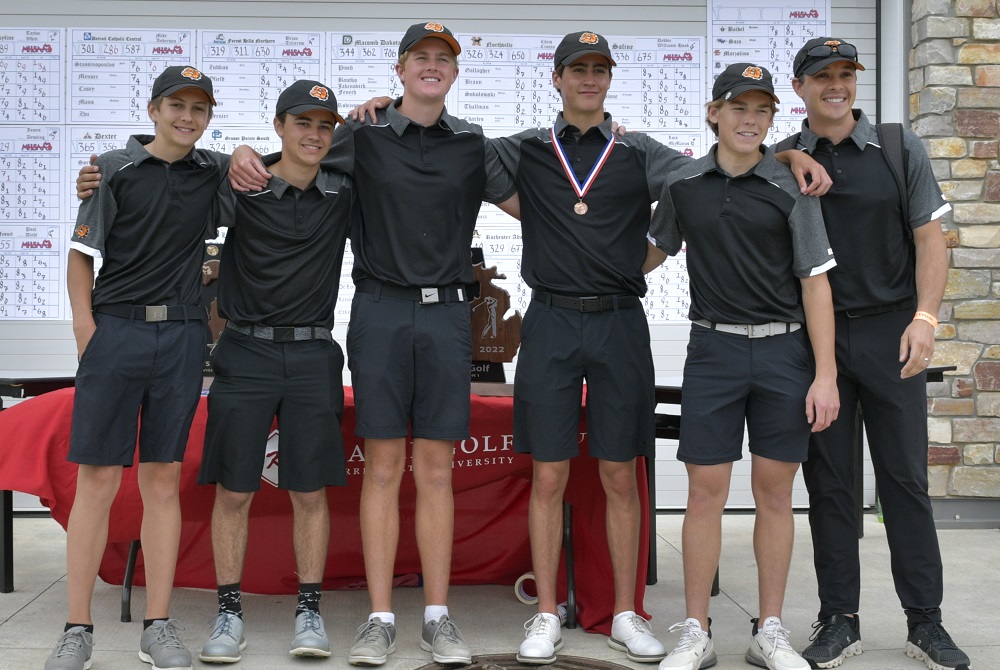
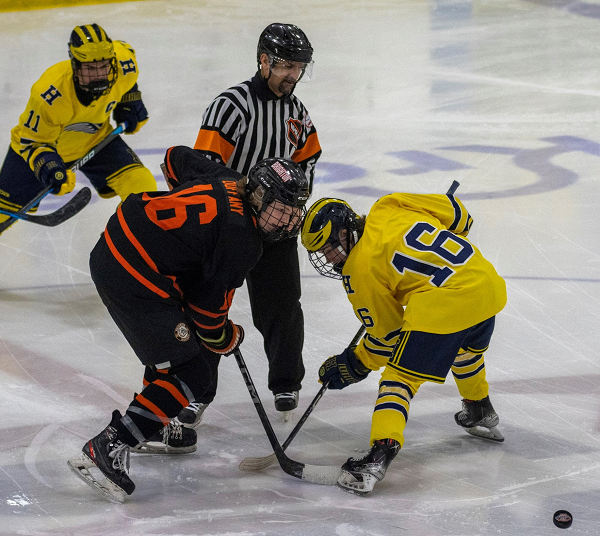
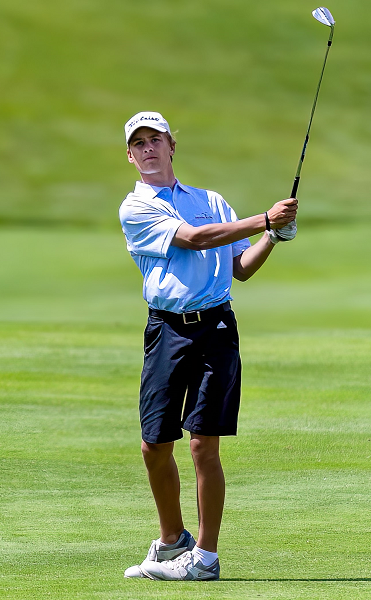
PHOTOS (Top) Brighton takes a team photo after finishing third at last season’s LPD1 Final, and all five golfers are back this season including hockey players Levi Pennala (second from left) and Winston Lerch (second from right.) (Middle) Hartland’s Ian Kastamo (16) takes a faceoff against Brighton this winter. (Below) Mona Shores’ Nicholas Taylor fires an iron shot. (Photos courtesy of High School Sports Scene, Sapshots Photography and Mona Shores’ athletic department, respectively.)