


New Math: Division & Multiplication Problems
July 25, 2017
By Jack Roberts
MHSAA Executive Director
This is the second part in a series on MHSAA tournament classification, past and present, that will be published over the next two weeks. This series originally ran in this spring's edition of MHSAA benchmarks.
High school tournament classifications went viral before there was social media and most of us knew what “viral” meant.
Much as a virus infects computers today or has created epidemics of disease around the world for centuries, high school tournament classification – once introduced – tends to spread uncontrollably. Once started, it tends to keep expanding and rarely contracts.
While we are still some distance from providing every team a trophy as a result of expanding high school tournament classification across the country, there is criticism nevertheless that we are headed in that direction – a philosophy which is supposed to exist only in local youth sports for our youngest children.
Michigan could be blamed for all this. Michigan is generally accepted as the first state to provide different classifications for season-ending tournaments for different sized schools. It started a century ago. Today, every state has various classifications for its tournaments in most if not all sports. And it is a bit ironic that Michigan – creator of the classification chaos – more than most other states has kept the number of tournament classes or divisions under control.
Yes, there is evidence that tournament classifications have expanded over the years in Michigan, especially with the relatively recent introduction of tournaments in football and the late 1990s’ move from classes to divisions in most MHSAA tournaments. But the MHSAA Representative Council has held true to its word when it expanded the playoffs for football from four classes to eight divisions: this is needed because of unique factors of football, factors that exist in no other sport; and all other sports should be capped at a maximum of four classes or divisions.
Kentucky is the preeminent defender of single-class basketball. All of its 276 high schools compete for the single state championship for each gender. In Indiana, there are still open wounds from its move in 1998 from one to four classes for its 400 schools in basketball.
Multi-class tournaments have tended to increase the number of non-public school champions, which some states are trying to lower through enrollment “multipliers,” and also tend to increase the number of repeat champions, which some states are trying to affect with “success factors” which lift smaller schools into classifications for larger schools if they take home too many trophies.
While there is considerable evidence that state tournaments do as much bad as good for educational athletics, state associations persist in providing postseason tournaments because, on balance, the experiences are supposed to be good for student-athletes. And once we reach that conclusion it is just a small leap to believe that if the tournaments are good for a few, they must be better for more – which leads to creating more and more tournament classifications. One becomes two classes, then three, then four and so forth.
While the argument is that more classifications or divisions provides more students with opportunities to compete and win, it is undeniable that the experience changes as the number of tournament classifications expands. It is not possible for state associations to provide the same level of support when tournament classifications expand to multiple venues playing simultaneously. For example, there is less audio and video broadcast potential at each venue, and less media coverage to each venue. Focus is diluted and fans diminished at each championship.
No one can argue reasonably that today's two-day MHSAA Football Finals of eight championship games has the same pizazz as the one-day, four-games event conducted prior to 1990.
In some states the number of divisions has grown so much that it is difficult to see much difference between the many season-ending state championship games and a regular-season event in the same sport.
It is a balancing act. And Michigan has been studying that balance longer than any other state, and charting a steadier course than most.
Addition by Division
The shift to Divisions for MHSAA Tournament play in numerous sports has added up to a greater number of champions for teams and individuals across the state. Following are the sports currently employing a divisional format, and the procedures for determining enrollment and classification.
In 23 statewide or Lower Peninsula tournaments, schools which sponsor the sport are currently divided into nearly equal divisions. They are:
- Baseball - 4 Divisions
- Boys Bowling - 4 Divisions
- Girls Bowling - 4 Divisions
- Girls Competitive Cheer - 4 Divisions
- LP Boys Cross Country - 4 Divisions
- LP Girls Cross Country - 4 Divisions
- LP Boys Golf - 4 Divisions
- LP Girls Golf - 4 Divisions
- Ice Hockey - 3 Divisions
- Boys Lacrosse - 2 Divisions
- Girls Lacrosse - 2 Divisions
- Boys Skiing - 2 Divisions
- Girls Skiing - 2 Divisions
- LP Boys Soccer - 4 Divisions LP
- Girls Soccer - 4 Divisions
- Girls Softball - 4 Divisions
- LP Boys Swimming & Diving - 3 Divisions
- LP Girls Swimming & Diving - 3 Divisions
- LP Boys Tennis - 4 Divisions
- LP Girls Tennis - 4 Divisions
- LP Boys Track & Field - 4 Divisions
- LP Girls Track & Field - 4 Divisions
- Wrestling - 4 Divisions
Lists of schools for each division of these 23 tournaments are posted on MHSAA.com approximately April 1. Listings of schools in Upper Peninsula tournaments for their sports are also posted on MHSAA.com. The lists are based on school memberships and sports sponsorships in effect or anticipated for the following school year, as known to the MHSAA office as of a date in early March.
In football, the 256 schools which qualify for MHSAA 11-player playoffs are placed in eight equal divisions annually on Selection Sunday. Beginning in 2017, the 8-player divisions will be determined in a like manner on Selection Sunday as well, with 32 qualifying schools placed in two divisions.
Schools have the option to play in any higher division in one or more sports for a minimum of two years.
The deadlines for "opt-ups" are as follows:
- Applications for fall sports must be submitted by April 15
- Applications for winter sports must be submitted by Aug. 15
- Applications for spring sports must be submitted by Oct. 15
Subsequent to the date of these postings for these tournaments, no school will have its division raised or lowered by schools opening or closing, schools adding or dropping sports, schools exercising the option to play in a higher division, or approval or dissolution of cooperative programs.
When the same sport is conducted for boys and girls in the same season (e.g., track & field and cross country), the gender that has the most sponsoring schools controls the division breaks for both genders.
Aspirations High as Reigning Champion Hackett Vaults Into New Season
By
Pam Shebest
Special for MHSAA.com
March 14, 2023
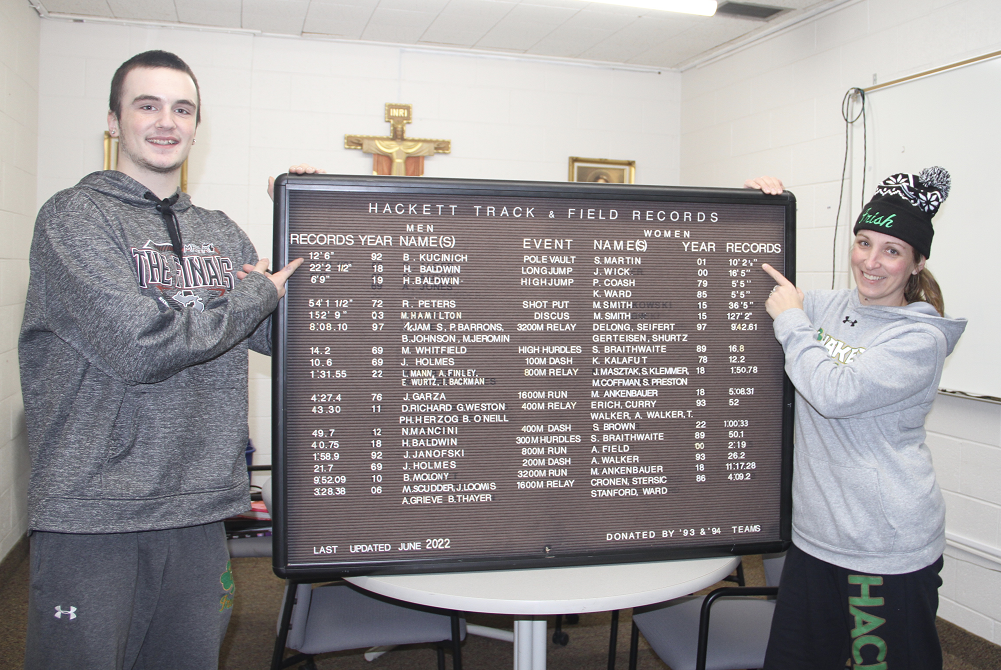
KALAMAZOO — Harrison Wheeler has not been a pole vaulter for very long – two weeks to be exact – but he already has some lofty goals.
 The sophomore is aiming for the Kalamazoo Hackett Catholic Prep record board and, if he makes it, he will be in good company.
Coach Shelly (Martin) Germinder, a 2001 Hackett graduate, still holds the girls record of 10 feet, 2½ inches.
“I’m hoping to have my name next to hers (on the record board),” Wheeler said.
The sophomore has a few feet to go before surpassing current record holder Brian Kucinich, who vaulted 12 feet, 6 inches in 1992.
Wheeler’s unofficial best is 9 feet; officially it is 8 feet, 6 inches.
“That is going to be a very big jump in my pole vaulting career,” he said.
Wheeler is one of 42 athletes on the reigning MHSAA Lower Peninsula Division 4 champion boys team, which includes 12 seniors and 13 juniors. Besides Wheeler, the team has six sophomores and 10 freshmen.
One of the returners is senior Liam Mann, who helped lead the Irish to the Finals title last year.
Mann, Andrew Finley, Evan Wurtz and Isaac Backman won the 800-meter relay with a time of 1:31.55 last season, setting a school record as well.
While he lost his relay mates, Mann said there are good runners to replace them.
“(Senior) Brice Brown is coming out to do track, and I’ve been working with him this winter,” Mann said. “Jude Coffman, who is a sophomore, is coming out this year. I think he’s going to be a good addition to our 4-by-1.
“(Junior) Gabe Oeurn, last year he was running solid times, but this year he’s been putting in the work and I think he’ll be able to break that 12-second barrier.”
Mann, who will attend Ashland (Ohio) University on a track scholarship in the fall, also added gold in the 200-meter dash (22.82) last season.
“Last year, I played basketball and was able to lift to keep in shape,” he said. “This year, I wanted to focus all my time on track, so I’ve been doing indoor track, practicing once a week and going to meets on weekends.”
He continued to put his skills on display as a running back during football season with Kalamazoo United, ending the fall with 1,413 rushing yards on 177 carries and 267 receiving yards on 10 catches.
Opportunities & possibilities
The biggest group of competitors impacted by graduation are the sprinters, coach Charissa Dean said.
“Hackett’s been really big on sprinting talent in general,” she said. “But track has 17 events, and only two of them are open sprint events and two are relays.
 “The other 13 are wide open for possibilities, and there’s a lot of younger talent that’s coming back this year. While they didn’t go to the state meet, they are the next generation of athletes coming up.”
Among that next generation are freshmen Marek Butkiewicz and Sean Siems, who “are incredibly talented athletes,” Dean said.
“(Junior) Gavin Sehy figured out how to do the distance thing this year in cross country.”
Sehy said he wanted to run track, but wasn’t sure where he fit.
“I thought I was mid-distance when I was younger, but my dad forced me to do cross country my sixth-grade year and it turned out I was decent at it so I kept doing (long distance) in track,” he said.
“It’s kind of brutal at times to train for long distance, mentally and physically, because you have to go on long runs, but I have fun with it. At the cross country state finals, I hit an 11 flat split at the two-mile, which beat my 3,200 best from last season, so we have yet to see my best times.”
Butkiewicz and Sehy have been running consistently six days a week all winter to prepare for their first meet, March 22.
“I’ve never done track,” the freshman said. “I know I can perform well. I know my times compared to other people.”
A sophomore this year, Alex Dumont had a 400-meter time that “came out of nowhere,” Dean said. “Toward the end of the season we recruited him to do the 4x8, so an 800-meter runner. That kid came through.
‘We actually took him to the state meet in the 4x8. He did the lead leg, and I clocked him at a 2:07. He was sprinting. It was an amazing leg in that relay.”
Seeing potential
It was Germinder who converted Wheeler to the pole vault last year.
“Harrison’s a strong athlete, and just the way his mind works in that he asks questions and he wants to learn and he wants to improve,” she said.
“He wants to work hard, and he wants to put in the time. That’s something you need for that, along with the athletic component.”
 Wheeler, who said he was shocked at being successful right away, competed for two weeks last season before a foot injury suffered on a vault sidelined him.
“It took her a whole season to finally convince me to do it,” he said. “I grabbed a pole one day and ended up being really good at it. Ever since, I’ve had a love of it.
“The feeling I have once I get in the air is almost like I’m just floating. When you get really good vaults and you get that nice height and good form, you get what we call a ‘stall.’ You just feel like you’re sitting up in the air for a second. It’s gotta be the coolest thing ever.”
Germinder has the background to help the Irish vaulters.
While at Hackett, she competed in the AAU National Championships and said she learned from the best, Oran Mitchell, a noted pole vaulting coach.
Her own coaching style revolves around the safety of the athletes.
“You can teach a lot of people to grab hold of a pole and pop yourself over,” she said. “But I want to make sure my athletes are safe. That’s really, really important to me, and that’s something that was instilled in me.
“When you’re jumping 6 to 16 feet, that’s a long way to fall. Safety is very important to me. If you’re not willing to put in the time, then I’m not the coach for you.”
Germinder said one of the foundations on which the team is built is leadership, which was instilled in the younger athletes by last year’s seniors.
“That’s one of the things our program is built on,” she said. “If you’re there because you want to get ready for the next sports season, we’ll coach you for that.
“If you want to be a state champion, we’ll coach you for that. That’s the really unique thing about track. There’s something for everyone, whatever that might be.”
As for the girls team, numbers are steadily climbing.
Five years ago, the team had just two girls. This year, 25 girls are on the team.
No matter girls or boys, track or field events, one thing is common for all the athletes.
“We pray before every meet, we put God first, and all those pieces have fallen into place for us.” Germinder said.
“I really believe that foundation is what is going to be our success this year. It’s there, it’s just a different team.”
 Pam Shebest served as a sportswriter at the Kalamazoo Gazette from 1985-2009 after 11 years part-time with the Gazette while teaching French and English at White Pigeon High School. She can be reached at [email protected] with story ideas for Calhoun, Kalamazoo and Van Buren counties.
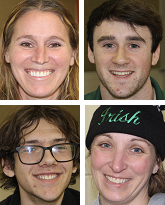
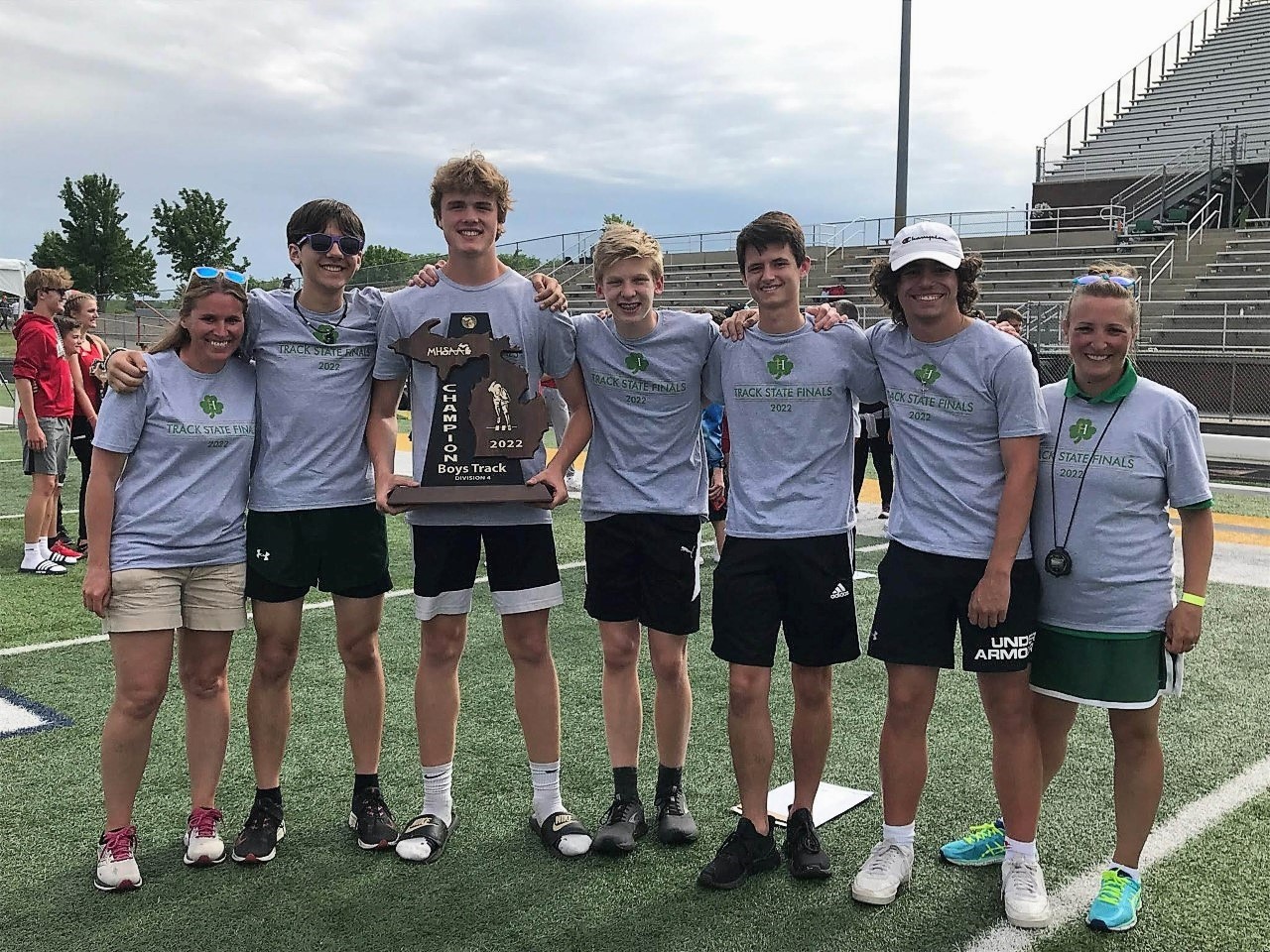
PHOTOS (Top) Hackett's Harrison Wheeler points to the pole vaulting record he hopes to break this season, while pole vaulting coach Shelly (Martin) Germinder points to the record she still holds at the school. (Middle) Clockwise from top left: Hackett head track & field coach Charissa Dean, Liam Mann, Germinder and Gavin Sehy. (Below) The Irish celebrate last season’s Finals championship, from left: Dean, Sehy, Logan St. Martin, Alex Dumont, Mitch Eastman, Nick Doerr and Germinder. (Top photo and head shots by Pam Shebest; team photo courtesy of Hackett track & field.)