

New Math: Division & Multiplication Problems
July 25, 2017
By Jack Roberts
MHSAA Executive Director
This is the second part in a series on MHSAA tournament classification, past and present, that will be published over the next two weeks. This series originally ran in this spring's edition of MHSAA benchmarks.
High school tournament classifications went viral before there was social media and most of us knew what “viral” meant.
Much as a virus infects computers today or has created epidemics of disease around the world for centuries, high school tournament classification – once introduced – tends to spread uncontrollably. Once started, it tends to keep expanding and rarely contracts.
While we are still some distance from providing every team a trophy as a result of expanding high school tournament classification across the country, there is criticism nevertheless that we are headed in that direction – a philosophy which is supposed to exist only in local youth sports for our youngest children.
Michigan could be blamed for all this. Michigan is generally accepted as the first state to provide different classifications for season-ending tournaments for different sized schools. It started a century ago. Today, every state has various classifications for its tournaments in most if not all sports. And it is a bit ironic that Michigan – creator of the classification chaos – more than most other states has kept the number of tournament classes or divisions under control.
Yes, there is evidence that tournament classifications have expanded over the years in Michigan, especially with the relatively recent introduction of tournaments in football and the late 1990s’ move from classes to divisions in most MHSAA tournaments. But the MHSAA Representative Council has held true to its word when it expanded the playoffs for football from four classes to eight divisions: this is needed because of unique factors of football, factors that exist in no other sport; and all other sports should be capped at a maximum of four classes or divisions.
Kentucky is the preeminent defender of single-class basketball. All of its 276 high schools compete for the single state championship for each gender. In Indiana, there are still open wounds from its move in 1998 from one to four classes for its 400 schools in basketball.
Multi-class tournaments have tended to increase the number of non-public school champions, which some states are trying to lower through enrollment “multipliers,” and also tend to increase the number of repeat champions, which some states are trying to affect with “success factors” which lift smaller schools into classifications for larger schools if they take home too many trophies.
While there is considerable evidence that state tournaments do as much bad as good for educational athletics, state associations persist in providing postseason tournaments because, on balance, the experiences are supposed to be good for student-athletes. And once we reach that conclusion it is just a small leap to believe that if the tournaments are good for a few, they must be better for more – which leads to creating more and more tournament classifications. One becomes two classes, then three, then four and so forth.
While the argument is that more classifications or divisions provides more students with opportunities to compete and win, it is undeniable that the experience changes as the number of tournament classifications expands. It is not possible for state associations to provide the same level of support when tournament classifications expand to multiple venues playing simultaneously. For example, there is less audio and video broadcast potential at each venue, and less media coverage to each venue. Focus is diluted and fans diminished at each championship.
No one can argue reasonably that today's two-day MHSAA Football Finals of eight championship games has the same pizazz as the one-day, four-games event conducted prior to 1990.
In some states the number of divisions has grown so much that it is difficult to see much difference between the many season-ending state championship games and a regular-season event in the same sport.
It is a balancing act. And Michigan has been studying that balance longer than any other state, and charting a steadier course than most.
Addition by Division
The shift to Divisions for MHSAA Tournament play in numerous sports has added up to a greater number of champions for teams and individuals across the state. Following are the sports currently employing a divisional format, and the procedures for determining enrollment and classification.
In 23 statewide or Lower Peninsula tournaments, schools which sponsor the sport are currently divided into nearly equal divisions. They are:
- Baseball - 4 Divisions
- Boys Bowling - 4 Divisions
- Girls Bowling - 4 Divisions
- Girls Competitive Cheer - 4 Divisions
- LP Boys Cross Country - 4 Divisions
- LP Girls Cross Country - 4 Divisions
- LP Boys Golf - 4 Divisions
- LP Girls Golf - 4 Divisions
- Ice Hockey - 3 Divisions
- Boys Lacrosse - 2 Divisions
- Girls Lacrosse - 2 Divisions
- Boys Skiing - 2 Divisions
- Girls Skiing - 2 Divisions
- LP Boys Soccer - 4 Divisions LP
- Girls Soccer - 4 Divisions
- Girls Softball - 4 Divisions
- LP Boys Swimming & Diving - 3 Divisions
- LP Girls Swimming & Diving - 3 Divisions
- LP Boys Tennis - 4 Divisions
- LP Girls Tennis - 4 Divisions
- LP Boys Track & Field - 4 Divisions
- LP Girls Track & Field - 4 Divisions
- Wrestling - 4 Divisions
Lists of schools for each division of these 23 tournaments are posted on MHSAA.com approximately April 1. Listings of schools in Upper Peninsula tournaments for their sports are also posted on MHSAA.com. The lists are based on school memberships and sports sponsorships in effect or anticipated for the following school year, as known to the MHSAA office as of a date in early March.
In football, the 256 schools which qualify for MHSAA 11-player playoffs are placed in eight equal divisions annually on Selection Sunday. Beginning in 2017, the 8-player divisions will be determined in a like manner on Selection Sunday as well, with 32 qualifying schools placed in two divisions.
Schools have the option to play in any higher division in one or more sports for a minimum of two years.
The deadlines for "opt-ups" are as follows:
- Applications for fall sports must be submitted by April 15
- Applications for winter sports must be submitted by Aug. 15
- Applications for spring sports must be submitted by Oct. 15
Subsequent to the date of these postings for these tournaments, no school will have its division raised or lowered by schools opening or closing, schools adding or dropping sports, schools exercising the option to play in a higher division, or approval or dissolution of cooperative programs.
When the same sport is conducted for boys and girls in the same season (e.g., track & field and cross country), the gender that has the most sponsoring schools controls the division breaks for both genders.
Leland's Glass Childress Selected as 11th Michigan Inductee Into NFHS Hall of Fame
By
Geoff Kimmerly
MHSAA.com senior editor
March 9, 2026
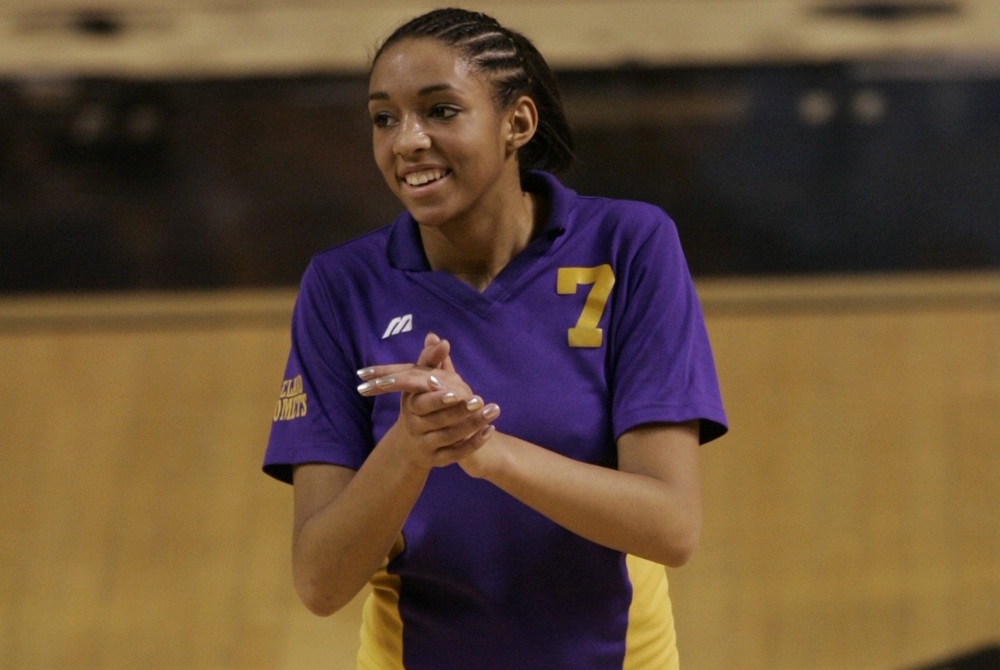
More than two decades have passed since Alisha Glass took her final swing at a volleyball in a Leland High School uniform, and yet her accomplishments for her small-town school in Northern Michigan remain among the most notable in that sport’s history not just statewide, but at the national level.
Glass, now Alisha Glass Childress – who went on to star on three Penn State national championship teams and help the U.S. national team to a bronze medal at the 2016 Olympics – will have her record-setting high school career enshrined this summer as one of 12 honorees announced today as this year’s inductees into the National High School Hall of Fame by the National Federation of State High School Associations (NFHS).
 Childress will be inducted as part of the 43rd Hall of Fame class at a ceremony during the NFHS summer meeting June 29 in Salt Lake City. The rest of the class is made up of four more athletes, three coaches, two game officials, one former state association administrator and one former fine arts educator. Childress was nominated by the Michigan High School Athletic Association.
She will become the Hall of Fame’s 11th inductee from Michigan, joining the MHSAA’s first full-time Executive Director Charles E. Forsythe (inducted 1983), River Rouge boys basketball coach Lofton Greene (1986), Warren Regina athletic director, softball and basketball coach Diane Laffey (2000), Fennville basketball and baseball standout Richie Jordan (2001), Grosse Pointe Woods University Liggett boys and girls tennis coach Bob Wood (2005), Bloomfield Hills Cranbrook hockey standout Jim Johnson (2007), Owosso football, basketball and baseball all-stater Brad Van Pelt (2011); Vermontville Maple Valley baseball national record holder Ken Beardslee (2016), retired MHSAA Executive Director John E. “Jack” Roberts (2022) and Dearborn Heights Robichaud football, basketball and track & field star Tyrone Wheatley (2024).
“My high school career at Leland, surrounded by such an amazing support system and community, was the essential first chapter of my story. It cultivated the grit and the fundamental love for the game that allowed me to reach the highest levels of athletics,” Childress said. “I’m proud of every medal and trophy, but I’m just as proud of the roots I planted back in high school that made them all possible.”
Childress graduated from Leland in 2006 with national high school career records of 3,584 kills, 680 blocks and 937 aces, and 296 aces for one season as a junior. Her aces records still stand, her career kills record stood until broken in 2024 by Shelby’s Navea Gauthier, and she remains third on the career blocks list. Glass continues to hold MHSAA records for single-season and career aces and also for her 48 kills in Leland’s 2005-06 Class D Final win over Battle Creek St. Philip. Childress also led Leland to a Class D runner-up finish in 2004-05 and the Semifinals in 2003-04. (All three tournament runs took place while girls volleyball was still played during the winter season before moving to the fall to begin the 2007-08 school year).
Childress earned the Miss Volleyball Award and Gatorade Player of the Year Award for Michigan as a senior, and her name is listed 19 times throughout the MHSAA girls volleyball record book. She also made Michigan's Class D all-state first team on the basketball court as both a junior and senior, averaging 18 points and 11 rebounds per game as a junior and 16 points, 10 rebounds and 3.7 blocked shots per game as a senior while leading her basketball team to Class D Quarterfinals both of those seasons.
“As our staff researched our first 50 years of female sports for our ‘Title IX at 50’ celebration during the 2021-22 school year, they told stories of several standouts who went on to collegiate, Olympic and professional stardom – and Alisha Glass stands out even among the greats,” MHSAA Executive Director Mark Uyl said. “Taking into account everything she accomplished individually and with her teams, and not just in volleyball but basketball as well, it’s a strong argument that Alisha Glass continues to set the bar as not only our state’s best female athlete all-time, but arguably the most accomplished volleyball player in national high school history. We are thrilled that she will be inducted into the National High School Hall of Fame.”
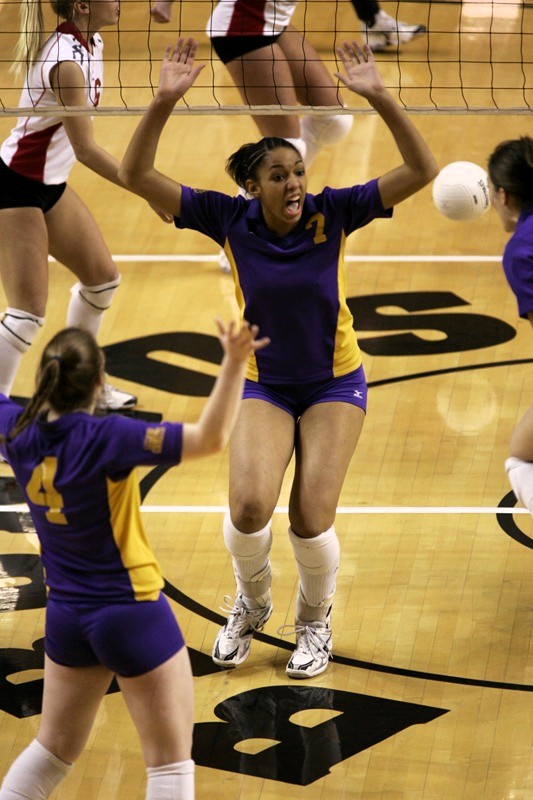 Also during high school, Childress played on the 2004 and 2005 USA youth national volleyball teams and helped the 2004 team to the North, Central America and Caribbean Volleyball Confederation (NORECA) championship, and was named Best Server at that event. After high school, she started all four seasons at national power Penn State and set the Nittany Lions to three straight NCAA championships, being named to the American Volleyball Coaches Association (AVCA) All-America first team twice and second team once.
Childress continued her career professionally and internationally, playing professionally in the United States and Puerto Rico, Italy, Turkey, Poland and Brazil and being named USA Volleyball Indoor Female Athlete of the Year for both 2013 and 2014. She led the U.S. national team to bronze at 2016 Olympics and was named Best Setter of the tournament, after being selected as an alternate for the 2012 Olympic team.
Most recently, Childress played for the Pro Volleyball Federation's Vegas Thrill in 2024 and 2025 and played in the league's first All-Star Match last season. She’s currently the head coach of the San Diego Mojo of Major League Volleyball and last summer also completed her first season as a coach with Athletes Unlimited. She previously served as an assistant coach with the Stanford University women’s volleyball program from 2019-21 – including during the team’s run to the Division I national title in 2019 – and also served as an assistant for the gold medal-winning U.S. national team during the 2018 Pan American Cup.
Childress is the daughter of Laurie Glass, who retired from coaching Leland after the 2023 season and ranks seventh in MHSAA girls volleyball coaching history for victories with a career record of 1,259-410-124. Glass led Leland to three Class D championships and five runner-up finishes. Childress’ grandfather Larry Glass ranks on the MHSAA girls basketball coaching victory list with a 388-110 record and led Leland to three straight Class D titles from 1980-82. He also coached the Northwestern University men’s basketball team for six seasons.
Additionally, Childress is married to past Stanford basketball star Josh Childress, who went on to play eight seasons in the NBA and several more overseas. They have three daughters, Maya, Mina and Amara.
The National High School Hall of Fame was started in 1982 by the NFHS. The 12 individuals were chosen after a two-level selection process involving a screening committee composed of active high school state association administrators, coaches and officials, and a final selection committee composed of coaches, former athletes, state association officials, media representatives and educational leaders. Nominations were made through NFHS member associations. Also chosen for this class were athletes Joe Carter (Oklahoma), Jordan Larson (Nebraska), Krissy Wendell-Pohl (Minnesota) and Patrick Willis (Tennessee); sport coaches Jan Barker (Texas), David Gentry (North Carolina) and Flo Valdez (New Mexico); game officials Burney Jenkins (Kentucky) and Mary Lou Thimas (Massachusetts), former state association administrator Steve Savarese (Alabama) and former fine arts educator Craig Ihnen (Iowa).
For more on this year’s Hall of Fame class, visit the NFHS Website.