

New Math: Division & Multiplication Problems
July 25, 2017
By Jack Roberts
MHSAA Executive Director
This is the second part in a series on MHSAA tournament classification, past and present, that will be published over the next two weeks. This series originally ran in this spring's edition of MHSAA benchmarks.
High school tournament classifications went viral before there was social media and most of us knew what “viral” meant.
Much as a virus infects computers today or has created epidemics of disease around the world for centuries, high school tournament classification – once introduced – tends to spread uncontrollably. Once started, it tends to keep expanding and rarely contracts.
While we are still some distance from providing every team a trophy as a result of expanding high school tournament classification across the country, there is criticism nevertheless that we are headed in that direction – a philosophy which is supposed to exist only in local youth sports for our youngest children.
Michigan could be blamed for all this. Michigan is generally accepted as the first state to provide different classifications for season-ending tournaments for different sized schools. It started a century ago. Today, every state has various classifications for its tournaments in most if not all sports. And it is a bit ironic that Michigan – creator of the classification chaos – more than most other states has kept the number of tournament classes or divisions under control.
Yes, there is evidence that tournament classifications have expanded over the years in Michigan, especially with the relatively recent introduction of tournaments in football and the late 1990s’ move from classes to divisions in most MHSAA tournaments. But the MHSAA Representative Council has held true to its word when it expanded the playoffs for football from four classes to eight divisions: this is needed because of unique factors of football, factors that exist in no other sport; and all other sports should be capped at a maximum of four classes or divisions.
Kentucky is the preeminent defender of single-class basketball. All of its 276 high schools compete for the single state championship for each gender. In Indiana, there are still open wounds from its move in 1998 from one to four classes for its 400 schools in basketball.
Multi-class tournaments have tended to increase the number of non-public school champions, which some states are trying to lower through enrollment “multipliers,” and also tend to increase the number of repeat champions, which some states are trying to affect with “success factors” which lift smaller schools into classifications for larger schools if they take home too many trophies.
While there is considerable evidence that state tournaments do as much bad as good for educational athletics, state associations persist in providing postseason tournaments because, on balance, the experiences are supposed to be good for student-athletes. And once we reach that conclusion it is just a small leap to believe that if the tournaments are good for a few, they must be better for more – which leads to creating more and more tournament classifications. One becomes two classes, then three, then four and so forth.
While the argument is that more classifications or divisions provides more students with opportunities to compete and win, it is undeniable that the experience changes as the number of tournament classifications expands. It is not possible for state associations to provide the same level of support when tournament classifications expand to multiple venues playing simultaneously. For example, there is less audio and video broadcast potential at each venue, and less media coverage to each venue. Focus is diluted and fans diminished at each championship.
No one can argue reasonably that today's two-day MHSAA Football Finals of eight championship games has the same pizazz as the one-day, four-games event conducted prior to 1990.
In some states the number of divisions has grown so much that it is difficult to see much difference between the many season-ending state championship games and a regular-season event in the same sport.
It is a balancing act. And Michigan has been studying that balance longer than any other state, and charting a steadier course than most.
Addition by Division
The shift to Divisions for MHSAA Tournament play in numerous sports has added up to a greater number of champions for teams and individuals across the state. Following are the sports currently employing a divisional format, and the procedures for determining enrollment and classification.
In 23 statewide or Lower Peninsula tournaments, schools which sponsor the sport are currently divided into nearly equal divisions. They are:
- Baseball - 4 Divisions
- Boys Bowling - 4 Divisions
- Girls Bowling - 4 Divisions
- Girls Competitive Cheer - 4 Divisions
- LP Boys Cross Country - 4 Divisions
- LP Girls Cross Country - 4 Divisions
- LP Boys Golf - 4 Divisions
- LP Girls Golf - 4 Divisions
- Ice Hockey - 3 Divisions
- Boys Lacrosse - 2 Divisions
- Girls Lacrosse - 2 Divisions
- Boys Skiing - 2 Divisions
- Girls Skiing - 2 Divisions
- LP Boys Soccer - 4 Divisions LP
- Girls Soccer - 4 Divisions
- Girls Softball - 4 Divisions
- LP Boys Swimming & Diving - 3 Divisions
- LP Girls Swimming & Diving - 3 Divisions
- LP Boys Tennis - 4 Divisions
- LP Girls Tennis - 4 Divisions
- LP Boys Track & Field - 4 Divisions
- LP Girls Track & Field - 4 Divisions
- Wrestling - 4 Divisions
Lists of schools for each division of these 23 tournaments are posted on MHSAA.com approximately April 1. Listings of schools in Upper Peninsula tournaments for their sports are also posted on MHSAA.com. The lists are based on school memberships and sports sponsorships in effect or anticipated for the following school year, as known to the MHSAA office as of a date in early March.
In football, the 256 schools which qualify for MHSAA 11-player playoffs are placed in eight equal divisions annually on Selection Sunday. Beginning in 2017, the 8-player divisions will be determined in a like manner on Selection Sunday as well, with 32 qualifying schools placed in two divisions.
Schools have the option to play in any higher division in one or more sports for a minimum of two years.
The deadlines for "opt-ups" are as follows:
- Applications for fall sports must be submitted by April 15
- Applications for winter sports must be submitted by Aug. 15
- Applications for spring sports must be submitted by Oct. 15
Subsequent to the date of these postings for these tournaments, no school will have its division raised or lowered by schools opening or closing, schools adding or dropping sports, schools exercising the option to play in a higher division, or approval or dissolution of cooperative programs.
When the same sport is conducted for boys and girls in the same season (e.g., track & field and cross country), the gender that has the most sponsoring schools controls the division breaks for both genders.
Breslin Bound: 2025-26 Girls Regional Preview
By
Geoff Kimmerly
MHSAA.com senior editor
March 9, 2026
After more than three months of working to get to this point, 128 girls basketball teams need to win only three more games to make it to MHSAA Finals weekend.

The next steps will come this week in Regionals, and we look closer at 12 of those below along with five District Finals among several that jumped off the page Friday.
Find everything you need to know this week about tickets, brackets and more as the tournament continues on the Girls Basketball page. To watch any of several games online, visit the NFHS Network. Host sites are in bold below.
“Breslin Bound” is powered by MI Student Aid and based on results and schedules posted for each school at MHSAA.com.
Week in Review
The countdown of last week’s five most intriguing results:
1. Muskegon 35, Rockford 27 The Big Reds (21-2) won their first Division 1 District title since 2023 and guaranteed Rockford (21-3) won’t play at Breslin Center this season for the first time since 2021.
2. Evart 45, McBain 37 The top two teams from the Highland Conference met one more time, and runner-up Evart (18-3) avenged losses of 24 and 11 points to the champion Ramblers (21-1) by handing them their lone defeat in this Division 3 District Final.
3. Jackson Lumen Christi 64, Grass Lake 53 The Titans (20-3) won this Division 3 matchup of league champions, downing Grass Lake (21-3) for the second-straight season in a District Final.
4. Petersburg Summerfield 37, Adrian Lenawee Christian 31 Two weeks after losing to Lenawee Christian (17-6) for the second time this season, Summerfield (18-6) avenged both defeats in a Division 4 District Final.
5. Livonia Stevenson 58, Farmington Hills Mercy 53 The Spartans (19-5) finished third behind perennial state powers Belleville and Wayne Memorial in the Kensington Lakes Activities Association East, but brought home a trophy by downing Mercy (19-5) in Division 1.
Regionals at a Glance
These could be among our most competitive brackets. Host sites are in bold:
DIVISION 1
Detroit Renaissance
Detroit Renaissance (19-2) vs. Livonia Stevenson (19-5)
Wayne Memorial (20-2) vs. Birmingham Groves (18-6)
Renaissance is coming off another Detroit Public School League championship, with both of its losses coming in December – the second to reigning Division 1 champion Belleville (23-1) and the first 55-33 to Wayne, its potential opponent Thursday. To set up that repeat of last year’s Regional Final – won by Wayne – the Phoenix must defeat a Groves team that has enjoyed one of the best turnaround seasons in the state after going 6-16 a year ago. The Zebras – who have lost only to Belleville this season – have defeated Stevenson by 15 and 22 but still must be wary of the familiar Spartans, who have added to their win total now five straight seasons.
Houghton Lake
Marquette (8-14) vs. Midland (19-5)
Saginaw Heritage (18-6) vs. Muskegon (21-2)
Muskegon has gone from 11-12 a year ago to losing this season to only Wayne Memorial (20-2) and Grand Haven (21-3) – and the District Final win over Rockford had statewide reverberations. Heritage and Midland finished first and second, respectively, in the Saginaw Valley League North and split during the regular season, with Midland winning the most recent meeting 46-41 on Jan. 30. Marquette is 6-5 over the second half of the season and coming off its first District title since 2020.
Northville
Saline (21-3) vs. South Lyon East (23-1)
Howell (23-1) vs. Belleville (23-1)
Howell’s 59-51 win over reigning Division 1 champion Belleville on Feb. 26 ended the Tigers’ 35-game winning streak and took this forecasted rematch to another level. But whichever team emerges from that side of the bracket will have to rev back up immediately as Saline and South Lyon East are both capable of moving on to next week as well. Saline’s losses all came to teams still alive – including 58-44 to South Lyon East on Dec. 12. East’s only loss was to Farmington Hills Mercy (19-5), and one more win will give the Cougars twice as many as a season ago.
DIVISION 2
Allendale
Grand Rapids West Catholic (18-5) vs. Spring Lake (15-7)
Sparta (6-18) vs. Grand Rapids Catholic Central (20-4)
An anticipated Regional Final between 2025 Division 2 runner-up West Catholic and Catholic Central makes this bracket jump off the page, as the Cougars won the Ottawa-Kent Conference White and West Catholic finished second in the Gold and won their Feb. 19 matchup 53-40. But the other two contenders this week definitely have earned some notice as well. Spring Lake finished third in the O-K Black but has won five of its last seven games (with a 47-38 loss to West Catholic mixed in) and dominated its District with 39 and 43-point victories. Sparta had one win since Jan. 2 before last week, but earned four and 27-point victories to advance.
Alma
Flint Powers Catholic (21-3) vs. Frankenmuth (16-8)
Alma (17-6) vs. Portland (20-4)
Powers is seeking its second Regional championship over the last three seasons and has lost only to Division 1 Detroit Renaissance, Midland and Utica Eisenhower while defeating several Division 1 opponents as well. The Chargers also downed Frankenmuth 69-45 on Dec. 15, but the Eagles have won 13 of their last 16 games after playing several more top teams from across the state. Alma finished third in the Tri-Valley Conference Red won by Frankenmuth, but defeated league runner-up Freeland on Friday to earn this Regional game on its home court. The Panthers have won 12 of their last 14. Portland won the Capital Area Activities Conference White with its only losses to Haslett, Frankenmuth and Division 1 Holt and East Lansing. The Frankenmuth defeat was by only two points in their season opener.
Tecumseh
Parma Western (17-7) vs. Ann Arbor Father Gabriel Richard (16-8)
Haslett (22-2) vs. Tecumseh (22-2)
Reigning Division 2 champion Tecumseh has hardly been slowed again this season, falling to West Catholic by two points on Jan. 3 and then to Ohio power program Cincinnati West Clermont on Jan. 19. But Haslett, playing in its third-straight Regional, should provide another challenge with its only losses this season to Division 1 DeWitt and Rockford. The Vikings’ run has included a 64-41 win over Parma Western in their regular-season finale. Western topped a strong Michigan Center team 56-42 to win its District last week and has faced several of the state’s best as well, and will take on a Father Gabriel Richard team that has navigated the same with three of its losses to Division 1 teams and two more to Division 3 contender Lumen Christi.
DIVISION 3
Bangor
Niles Brandywine (23-1) vs. Gobles (15-7)
Kalamazoo Christian (18-4) vs. Schoolcraft (16-7)
Brandywine has reached at least the Division 3 Semifinals the last two seasons and is a combined 50-2 over the last two with that lone loss this winter to Division 2 Otsego (19-2). The Bobcats’ schedule was filled with larger opponents and included a 73-14 win over Gobles from Jan. 6. The Tigers rebounded from three straight losses to end the regular season to win their District, and two of their defeats also game to Saugatuck (23-1) in Southwestern Athletic Conference Central play. K-Christian was first and Schoolcraft third in the SAC Valley, with Christian winning their games by 29 but then only two points Feb. 13. Schoolcraft impressively downed Centreville (18-5) and Union City (17-7) to win its District, while the Comets have won 11 of their last 12 games and surely have been circling this week after losing the Brandywine in Regional Finals the last two years.
Burton Bendle
Otisville LakeVille Memorial (19-5) vs. Cass City (17-5)
Sandusky (22-1) vs. Genesee (18-6)
The fact Otisville LakeVille finished only third in the Mid-Michigan Activities Conference speaks well to the strength of that league, and that no doubt prepared the Falcons well although they now must face a Cass City team that finished second in the Big Thumb Conference White but downed league champion Caro 61-37 in their District Final rematch. Sandusky defeated Cass City 49-32 in its regular-season finale just 11 days ago and won the BTC Black, with its only loss this winter to Division 2 Yale (21-3). Sandusky will see a somewhat familiar opponent in Genesee, which Sandusky defeated in last year’s Regional Final. But Genesee also is a league champion this winter, from the Genesee Area Conference Red, and is keyed by 2,000-point scorer Averie Zinn.
New Lothrop
Laingsburg (20-4) vs. Pewamo-Westphalia (22-2)
New Lothrop (22-2) vs. Stockbridge (18-6)
As noted above with Otisville LakeVille, the MMAC as a league was powerful especially at the top this season, and New Lothrop won it with a 16-0 record. The Hornets’ only losses were to Division 1 Midland and Division 2 Freeland. Stockbridge has made an impressive jump this season after going 11-13 a year ago, and the Panthers finished behind only Division 4 contender Concord (22-2) in the Big 8 Conference. On the other side of the bracket are representatives from another top league, the Central Michigan Athletic Conference, which has sent three teams into Regionals and was won by P-W with an 18-0 record including victories of 13 and 23 over Laingsburg. The Pirates certainly are being cautious seeing Laingsburg for the third time, as the Wolfpack finished third in the CMAC but defeated runner-up Bath (19-5) to win their District.
DIVISION 4
Akron-Fairgrove
Kingston (24-0) vs. Sterling Heights Parkway Christian (16-4)
Clarkston Everest Collegiate (17-5) vs. Deckerville (20-4)
A pair of 20-win teams from the BTC Blue could meet again in the Regional Final as league champ Kingston would be seeking to add to 19 and seven-point wins over runner-up Deckerville – which otherwise lost to only Division 2 Yale and Division 3 Cass City this winter. But neither should look ahead. Parkway Christian won the Michigan Independent Athletic Conference Red ahead of Southfield Christian, which is also still playing this week. Everest Collegiate won the Catholic High School League Intersectional #1 title and the St. Anne Tournament, and total has 15 victories over its last 16 games after opening this winter with four losses over the first month including three to Division 1 and 2 teams.
Fowler
Portland St. Patrick (19-5) vs. Climax-Scotts (17-6)
Muskegon Catholic Central (15-5) vs. Whitmore Lake (18-7)
Three of these teams finished fourth in their leagues during the regular season, and the fourth – Climax-Scotts – was a league runner-up. But they all emerged with trophies last week and one will claim another over the next four days. The Panthers have won 10 of their last 11 games after finishing second in the Southern Central Athletic Association West to Mendon, which is also playing this week. Muskegon Catholic Central emerged from the middle of the Alliance League to defeat both co-champions – Byron Center Zion Christian (17-4) and Wyoming Tri-unity Christian (15-6) – to win their District. Whitmore Lake was fourth in the MIAC Blue but repeated as a District champ, and St. Patrick was fourth in the CMAC but also is a repeat District winner and has lost to only Division 3 opponents from its league this winter.
Johannesburg-Lewiston
Buckley (20-4) vs. Gaylord St. Mary (23-1)
Mio (20-4) vs. Frankfort (15-7)
This Regional features three league champs and a team that finished one game out of first place, plus another of the all-time leading scorers in Michigan history. Buckley – which has made an impressive climb after finishing 9-15 just two seasons ago – shared the Northwest Conference title and will take on Ski Valley Conference champion Gaylord St. Mary, which lost to only Division 2 Petoskey (20-3) two months ago. St. Mary has reached at least the Regional Final the last four seasons and fell to Frankfort the last two. Frankfort finished third in the Northwest Conference but only a game off the lead with two and seven-point losses to Buckley. The Panthers will be next to attempt to slow down Mio and Mia McGregor, who is averaging more than 40 points per game. The Thunderbolts have won 11 of their last 12 games and are making their third-straight Regional appearance.
MHSAA.com's weekly “Breslin Bound” reports are powered by MI Student Aid, a division within the Department of Lifelong Education, Advancement, and Potential (MiLEAP). MI Student Aid encourages students to pursue postsecondary education by providing access to student financial resources and information. MI Student Aid administers the state’s scholarship and grant programs that help make college Accessible, Affordable and Attainable for you. Click to connect with MI Student Aid and find more information on Facebook and X @mistudentaid.
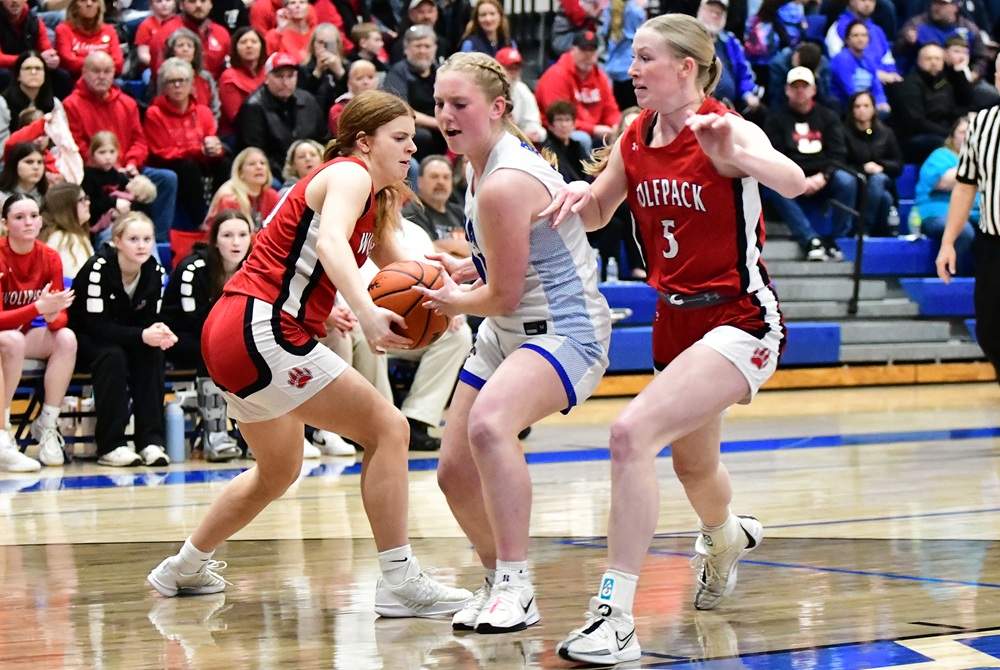
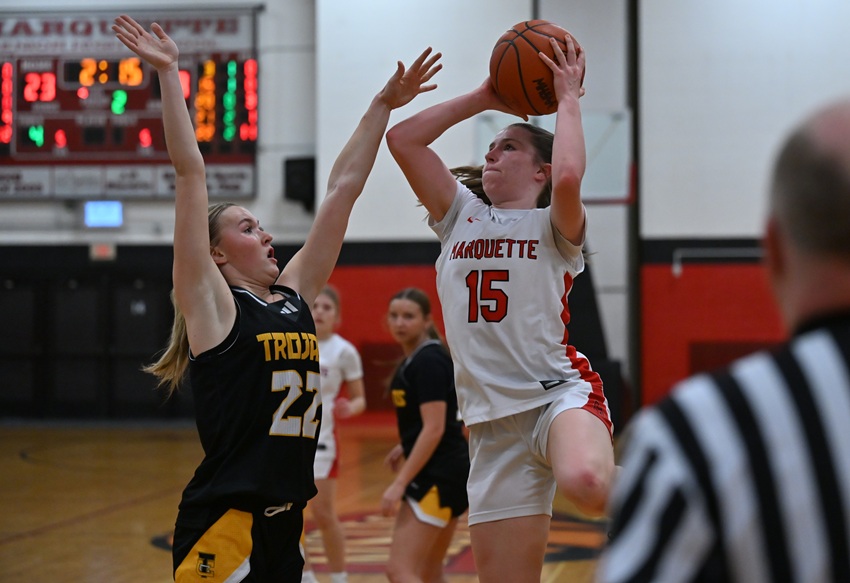
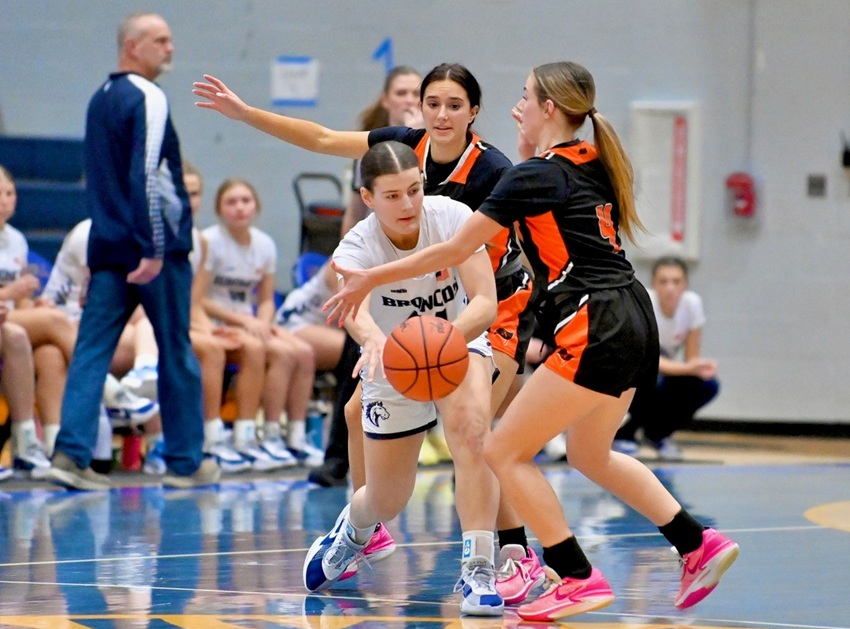
PHOTOS (Top) Laingsburg’s Mallory Woodbury (10) pulls away the ball and Harper Strouse (5) also defends during the Wolfpack’s 40-23 Division 3 District Final win over Bath on Friday. (Middle) Marquette's Avery Osborne goes up for a shot against Traverse City Central's Sienna Slack during the Sentinels’ 51-43 District Final victory in Division 1. (Below) A pair of Almont defenders block the passing lanes against North Branch during the Broncos' 47-44 Division 2 District win.(Laingsburg/Bath photo by John Johnson. Marquette/Traverse City Central photo by Cara Kamps. North Branch/Almont photo by Terry Lyons.)