

New Math: Division & Multiplication Problems
July 25, 2017
By Jack Roberts
MHSAA Executive Director
This is the second part in a series on MHSAA tournament classification, past and present, that will be published over the next two weeks. This series originally ran in this spring's edition of MHSAA benchmarks.
High school tournament classifications went viral before there was social media and most of us knew what “viral” meant.
Much as a virus infects computers today or has created epidemics of disease around the world for centuries, high school tournament classification – once introduced – tends to spread uncontrollably. Once started, it tends to keep expanding and rarely contracts.
While we are still some distance from providing every team a trophy as a result of expanding high school tournament classification across the country, there is criticism nevertheless that we are headed in that direction – a philosophy which is supposed to exist only in local youth sports for our youngest children.
Michigan could be blamed for all this. Michigan is generally accepted as the first state to provide different classifications for season-ending tournaments for different sized schools. It started a century ago. Today, every state has various classifications for its tournaments in most if not all sports. And it is a bit ironic that Michigan – creator of the classification chaos – more than most other states has kept the number of tournament classes or divisions under control.
Yes, there is evidence that tournament classifications have expanded over the years in Michigan, especially with the relatively recent introduction of tournaments in football and the late 1990s’ move from classes to divisions in most MHSAA tournaments. But the MHSAA Representative Council has held true to its word when it expanded the playoffs for football from four classes to eight divisions: this is needed because of unique factors of football, factors that exist in no other sport; and all other sports should be capped at a maximum of four classes or divisions.
Kentucky is the preeminent defender of single-class basketball. All of its 276 high schools compete for the single state championship for each gender. In Indiana, there are still open wounds from its move in 1998 from one to four classes for its 400 schools in basketball.
Multi-class tournaments have tended to increase the number of non-public school champions, which some states are trying to lower through enrollment “multipliers,” and also tend to increase the number of repeat champions, which some states are trying to affect with “success factors” which lift smaller schools into classifications for larger schools if they take home too many trophies.
While there is considerable evidence that state tournaments do as much bad as good for educational athletics, state associations persist in providing postseason tournaments because, on balance, the experiences are supposed to be good for student-athletes. And once we reach that conclusion it is just a small leap to believe that if the tournaments are good for a few, they must be better for more – which leads to creating more and more tournament classifications. One becomes two classes, then three, then four and so forth.
While the argument is that more classifications or divisions provides more students with opportunities to compete and win, it is undeniable that the experience changes as the number of tournament classifications expands. It is not possible for state associations to provide the same level of support when tournament classifications expand to multiple venues playing simultaneously. For example, there is less audio and video broadcast potential at each venue, and less media coverage to each venue. Focus is diluted and fans diminished at each championship.
No one can argue reasonably that today's two-day MHSAA Football Finals of eight championship games has the same pizazz as the one-day, four-games event conducted prior to 1990.
In some states the number of divisions has grown so much that it is difficult to see much difference between the many season-ending state championship games and a regular-season event in the same sport.
It is a balancing act. And Michigan has been studying that balance longer than any other state, and charting a steadier course than most.
Addition by Division
The shift to Divisions for MHSAA Tournament play in numerous sports has added up to a greater number of champions for teams and individuals across the state. Following are the sports currently employing a divisional format, and the procedures for determining enrollment and classification.
In 23 statewide or Lower Peninsula tournaments, schools which sponsor the sport are currently divided into nearly equal divisions. They are:
- Baseball - 4 Divisions
- Boys Bowling - 4 Divisions
- Girls Bowling - 4 Divisions
- Girls Competitive Cheer - 4 Divisions
- LP Boys Cross Country - 4 Divisions
- LP Girls Cross Country - 4 Divisions
- LP Boys Golf - 4 Divisions
- LP Girls Golf - 4 Divisions
- Ice Hockey - 3 Divisions
- Boys Lacrosse - 2 Divisions
- Girls Lacrosse - 2 Divisions
- Boys Skiing - 2 Divisions
- Girls Skiing - 2 Divisions
- LP Boys Soccer - 4 Divisions LP
- Girls Soccer - 4 Divisions
- Girls Softball - 4 Divisions
- LP Boys Swimming & Diving - 3 Divisions
- LP Girls Swimming & Diving - 3 Divisions
- LP Boys Tennis - 4 Divisions
- LP Girls Tennis - 4 Divisions
- LP Boys Track & Field - 4 Divisions
- LP Girls Track & Field - 4 Divisions
- Wrestling - 4 Divisions
Lists of schools for each division of these 23 tournaments are posted on MHSAA.com approximately April 1. Listings of schools in Upper Peninsula tournaments for their sports are also posted on MHSAA.com. The lists are based on school memberships and sports sponsorships in effect or anticipated for the following school year, as known to the MHSAA office as of a date in early March.
In football, the 256 schools which qualify for MHSAA 11-player playoffs are placed in eight equal divisions annually on Selection Sunday. Beginning in 2017, the 8-player divisions will be determined in a like manner on Selection Sunday as well, with 32 qualifying schools placed in two divisions.
Schools have the option to play in any higher division in one or more sports for a minimum of two years.
The deadlines for "opt-ups" are as follows:
- Applications for fall sports must be submitted by April 15
- Applications for winter sports must be submitted by Aug. 15
- Applications for spring sports must be submitted by Oct. 15
Subsequent to the date of these postings for these tournaments, no school will have its division raised or lowered by schools opening or closing, schools adding or dropping sports, schools exercising the option to play in a higher division, or approval or dissolution of cooperative programs.
When the same sport is conducted for boys and girls in the same season (e.g., track & field and cross country), the gender that has the most sponsoring schools controls the division breaks for both genders.
Lees Becomes 1st from Detroit Catholic Central to Win 4 Team, 4 Individual Titles
By
Paul Costanzo
Special for MHSAA.com
March 8, 2026
DETROIT – There aren’t many opportunities for wrestlers to become the first to accomplish something at Detroit Catholic Central anymore, but Wyatt Lees found a way.
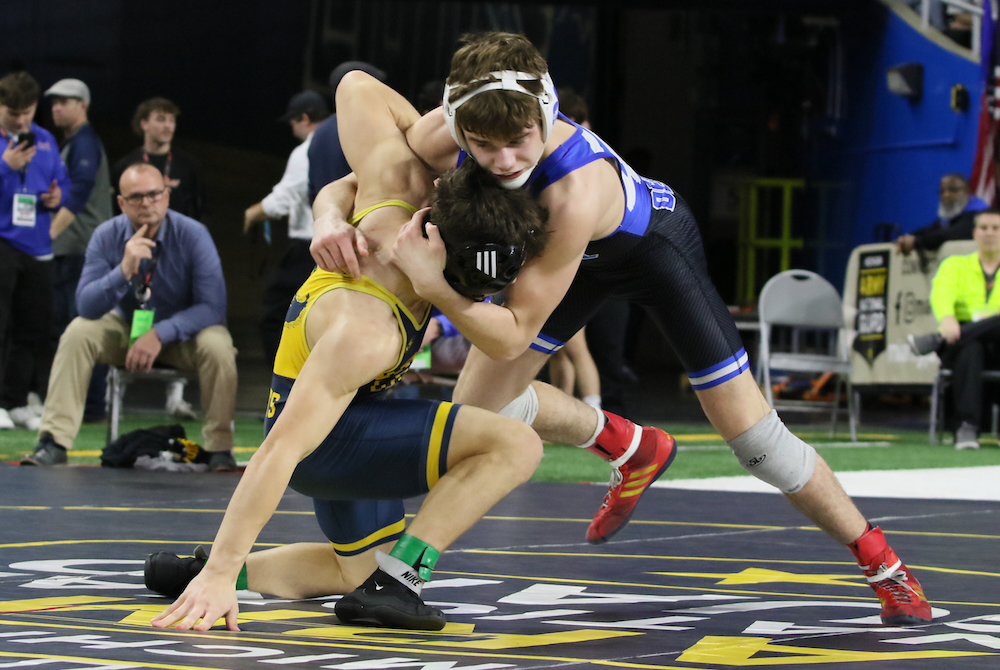
He defeated Eden Abdo of Grand Ledge 7-1 on Saturday in the 132-pound title match of the Division 1 Individual Wrestling Finals, becoming the first Catholic Central wrestler to win eight Finals titles – four team and four individual – and fourth to win four individual titles, joining Darius Marines (2021-24), Dylan Gilcher (2020-23) and Kevon Davenport (2016-19).
“It’s pretty awesome,” Lees said. “I got to follow Darius, Dylan and Kevon, and now I get to start a new trend of four and four, which hopefully Grayson Fuchs can get next year.”
Lees was one of five wrestlers to win a fourth title Saturday, joining a list of 46 in Michigan history. He is just the ninth wrestler to ever reach eight total titles, as Hudson’s Nicholas Sorrow accomplished the feat just minutes before him.
“Before the match, he was messing with me saying, ‘Hey, whoever finishes their match first gets on the board first – did he finish before me?’” Lees said, before feigning disappointment and laughing when the answer was yes.
Lees previously had won titles at 106, 113 and 120, and this year he pinned his way into the finale. He was able to get an early takedown against Abdo and controlled the match from there.
Lees said he entered the Finals match with a bit of nerves, as he felt the weight of what he was about to accomplish.
“At first, I was doing a pretty good job blocking it out,” Lees said. “But I was kind of warming up and I felt it, it hit me. I said a prayer, ‘God help me. Help me channel my nervousness to good energy.’ Once I was out there, I was fine.”
106
Champion: Brody Compau, Rockford, Fr. (51-0)
Technical Fall (18-2, 3:03) over Grayson Van Valken, Grandville, Fr. (42-6)
Compau finished off a remarkable freshman season with another dominant victory.
“It feels great man,” he said. “Just knowing my work’s been paying off. I wrestled him at District and Regionals, so the plan was the same thing – keep pushing the pace, keep scoring. Just make sure I get the tech.”
Compau had a fall and two technical falls on his way to the championship match, and said he felt no added pressure as an unbeaten freshman.
“I know all the work that I’ve done to get here. I just had to show up and show people,” he said. “I think I can get four. Second one in Rockford after Kyle Waldo, just gotta do that again.”
113
Champion: Cyrus Woodberry, Detroit Cass Tech, Soph. (41-4)
Decision, 4-0, over Jase Sensor, Hartland, Soph. (49-9)
With the city of Detroit on his back – the skyline is literally printed on his singlet – Woodberry again came up big, claiming his second Finals title in as many tries.
“I feel like I’m representing all of Cass Tech, all of Detroit,” he said. “Showing people that Detroit wrestling is on the come-up, and I’m here to lead it.”
Woodberry entered the third period and rode Sensor out to complete the victory.
“Just to keep pressure on him,” Woodberry said. “It took everything out of me to keep him down, and when I finally got up, it felt great.”
Woodberry was the champ at 106 last year.
120
Champion: Layne Martin, Rockford, Jr. (51-0)
Technical Fall (19-4, 5:04) Matthew Quigley, Traverse City West, Jr. (51-1)
Martin dominated this matchup of unbeatens to claim his second-straight title.
“I felt pretty confident,” he said. “I was able to get to my attacks. Those high-Cs and those fireman’s, they were there the whole match.”
Martin claimed the 113-pound title a year ago, and after leading just 3-1 early Saturday, scored 16 points in the second and third periods to close out title No. 2.
“Coming in a little more used to the crowd and everything,” he said. “It’s just a little easier the second time.”
126
Champion: Jamison Gregory, Detroit Catholic Central, Jr. (34-7)
Major Decision, 8-0, over Steve Vaughn, Davison, Jr. (28-12)
Gregory was the first of six Catholic Central wrestlers to hit the mat on the night and set quite a tone by winning his first individual title.
“It felt pretty good,” he said. “I’ve been chasing it for a while. My coaches have been telling me all year that I’m a tone setter, and I just feel so glad that I’m able to set that tone here in this tournament.”
He scored a takedown and escape in both the second and third periods to win by major decision.
“The strategy was just kind of let him come toward me and find my offense,” Gregory said. “Then go out and win the state title.”
138
Champion: Bohdan Abbey, Hartland, Sr. (51-1)
Technical Fall (19-4, 3:18) over Carl Nihranz, Macomb Dakota, Sr. (52-4)
In his fourth Finals appearance, Abbey claimed title No. 3 with a dominant performance.
“It’s fun getting the third state title,” Abbey said. “It’s just another day to give the glory to God for what he’s gifted you with out there on the mat.”
He teched his way through the tournament, closing out an illustrious career. He was champion at 113 as a freshman, second at 126 as a sophomore, and champion at 132 a year ago.
“First one, I had to work for it really hard,” Abbey said. “Then obviously came up short my sophomore year, but the next two you have to find the Lord, and if you’re not wrestling for the Lord, you’re wrestling for yourself, and you can’t do anything by yourself.”
144
Champion: Nate Carter, Clarkston, Sr. (44-3)
Decision, 7-5, over Deacon Morgan, Rochester Adams, Jr. (27-3)
Carter and Morgan battled every second of the six minutes in their title bout, but after claiming his first Finals title, Carter still had plenty of energy.
“I’m feeling great, pumped up, excited,” Carter said. “Went full six minutes, me and my coaches we had a gameplan. We didn’t really strategize too much coming into the state tournament, because it goes match by match, one by one, but we came back right before Finals started and had a gameplan. Just stay basic and fire when it’s open, and that’s what I did.”
Carter hit a big move in the second period to take the lead over Morgan, who was runner-up at 126 a year ago.
“He was just pressuring, and I know I got some of the best hips in the country,” Carter said. “I know if someone is pressure too much, and I got that chance and opportunity – it was on the edge of the mat, so I was like, ‘Why not?’ Worse comes to worse, we go out of bounds.”
150
Champion: Grayson Fuchs, Detroit Catholic Central, Jr. (29-1)
Decision, 8-6, over Deacon MacNeill, Bloomfield Hills Brother Rice, Sr. (48-2)
Fuchs claimed his third individual title and sixth overall while battling through a laundry list of injuries.
“I’m wrestling through a sprained MCL, meniscus, my hand is like a little bit out of place, I’m going to get it fixed up after the season,” Fuchs said. “It’s another stepping stone, battling through adversity. This sport, it teaches you a lot of stuff, and it’s definitely bringing me closer to God, too.”
Fuchs won his first title at 126 pounds as a freshman and his second at 144 a year ago. If he can repeat the feat a year from now, and the Shamrocks can win their fifth-straight Team Finals title, he’ll join Lees and become the state’s 10th eight-time champ.
“That’s the goal next season,” Fuchs said. “Just stick to the process, do what I’ve been doing, get another team title, be a leader again. Just show the younger freshmen and stuff what it takes to be the best. I’m excited for the four and four.”
157
Champion: Dallas Korponic, Hartland, Sr. (54-2)
Decision, 8-4, over Alexander Buskirk, Detroit Catholic Central, Sr. (37-8)
Korponic won title No. 3 and claimed his 200th career victory at the same time. Fittingly, it ended with a takedown in the final seconds, keeping him on top.
“I know it was a close match in the state championship. He’s a great wrestler,” Korponic said. “It just feels good to kind of seal the deal there at the end for the crowd.”
Korponic won at 132 pounds as a sophomore and 150 as a junior, and now joins his teammate Abbey as the only three-time champions in Hartland history.
“Growing up with him, he’s my best friend, we do everything in life together,” Korponic said. “Just being able to complete that with each other is just unreal.”
165
Champion: Jay’Den Williams, Roseville, Sr. (41-1)
Technical Fall (20-3, 2:56) over Anthony Madafferi, Novi, Sr. (49-3)
The king of the technical fall got another one to close out his illustrious career and become a two-time champion. Williams, who holds the state record for most techs in a season (48 in 2024-25), won that way at the Finals for the second-straight year.
“I just know one thing, I worked hard for this,” Williams said. “Throughout this whole week, I’ve been practicing three to four times a day, pushing my stamina to where I get tired, so when I get tired out here I’m used to it. I’ve been here before. I’ve been in this same place multiple times. I just know I gotta push my guy to my standard.”
Williams started relatively slow for his standards, but scored 17 points in 95 seconds to finish off the victory. As his hand was raised, the crowd acknowledged the four-time finalist with an ovation typically reserved for four-time champs.
“I’m thankful for everyone here that’s watching me,” Williams said. “It feels exciting and builds momentum. I know I’m getting in my opponent’s head, too, with them, and it makes it easier for me.”
175
Champion: Braxten Roche, Detroit Catholic Central, Soph. (28-7)
Major Decision, 23-11, over Zach Miracle, Temperance Bedford, Sr. (47-3)
Roche was emotional following his match after sharing a long hug with his grandfather near the edge of the mat.
“It’s been a grind,” he said. “I came from a wrestling family, and all of our goals were to be a state champion and a DI wrestler. Unfortunately we had never became a state champ in my family; I was the first to be a state champ in my family. We’ve had lots of DI wrestlers, but never a state champ. So, it means a lot to me and my family.”
Miracle, who was runner-up at 165 a year ago, took an early 7-0 lead in the match, but Roche hit some big moves himself to get back in it. He also was dealing with a bloody nose that required tape to be wrapped around his face.
“That was very annoying, it definitely was not comfortable,” Roche said. “It’s OK, you have to persevere through, and I had to go through a couple times of adversity in the match. You just have to keep pushing through, and you’ll love the outcome.”
190
Champion: Caden Krueger, Detroit Catholic Central, Jr. (42-4)
Decision, 7-5, over Dominic Nauss, Brighton, Soph. (38-5)
Krueger built a big lead and held off Nauss to claim his first Finals title.
“It feels great,” Krueger said. “It’s unlike anything I’ve ever felt before. I’ve always been stuck at second my whole life at all these tournaments, and to finally get that victory, that was well-deserved.”
Krueger led 7-2 after the second period and played defense in the third, not allowing Nauss to hit any of the big throws for which he’s known.
“I knew he was going to go big – he’s a great thrower, great Greco guy,” Krueger said. “I just had to stay on my defense, stay in good position, with a good base, and I knew he wouldn’t get to me.”
215
Champion: Tyler Meeuwsen, East Kentwood, Jr. (31-1)
Decision, 14-8 (SV), over Hadi Mazraani, Dearborn, Sr. (49-2)
Meeuwsen rallied to force overtime and finished off his first Finals title with a cradle, giving the fans in attendance one last thrill in the final match of the night.
“I just knew that I had to use my hips,” Meeuwsen said. “I saw the cradle opportunity and I wasn’t going to let go. It was a blessing. I’ve worked so hard for this the past few years, and I’m just so happy I was able to get my goal.”
Mazraani built a 7-1 lead during the first period, but Meeuwsen pushed the pace the rest of the way, forcing two stalling calls and two separate grabs of the singlet by his opponent to tie the match.
“We go hard in the room every day,” Meeuwsen said. “I know in matches like this when you go down early and make a mistake, you gotta battle back. I just had to keep fighting through it and battle through adversity, and this time I came out on top.”
285
Champion: Logan Tollison, Grand Ledge, Sr. (55-0)
Major Decision, 8-0, over Jase Fuller, Lapeer, Jr. (49-4)
Tollison capped off an unbeaten senior season, claiming his second-straight Finals title.
“It means a lot,” Tollison said. “I worked hard to get here. It definitely does mean a lot to me.”
Tollison also won at 285 a year ago after finishing as runner-up at 215 the year before. On Saturday, he opened up a scoreless match by getting an escape and a takedown in the second period, adding another takedown in the third for the major decision.
“He wasn’t doing anything on bottom, and got me a little upset,” Tollison said. “But, I just kept wrestling.”
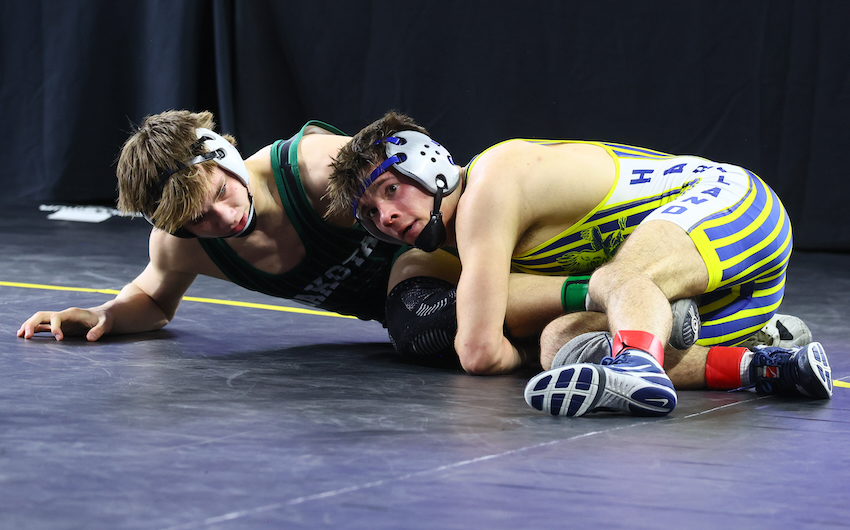
PHOTOS (Top) Detroit Catholic Central's Wyatt Lees, top, locks up Grand Ledge's Eden Abdo during their Division 1 championship match Saturday at Ford Field. (Middle) Hartland’s Bohdan Abbey, right, wraps up the legs of his opponent. (Click for more from High School Sports Scene.)