

New Math: Division & Multiplication Problems
July 25, 2017
By Jack Roberts
MHSAA Executive Director
This is the second part in a series on MHSAA tournament classification, past and present, that will be published over the next two weeks. This series originally ran in this spring's edition of MHSAA benchmarks.
High school tournament classifications went viral before there was social media and most of us knew what “viral” meant.
Much as a virus infects computers today or has created epidemics of disease around the world for centuries, high school tournament classification – once introduced – tends to spread uncontrollably. Once started, it tends to keep expanding and rarely contracts.
While we are still some distance from providing every team a trophy as a result of expanding high school tournament classification across the country, there is criticism nevertheless that we are headed in that direction – a philosophy which is supposed to exist only in local youth sports for our youngest children.
Michigan could be blamed for all this. Michigan is generally accepted as the first state to provide different classifications for season-ending tournaments for different sized schools. It started a century ago. Today, every state has various classifications for its tournaments in most if not all sports. And it is a bit ironic that Michigan – creator of the classification chaos – more than most other states has kept the number of tournament classes or divisions under control.
Yes, there is evidence that tournament classifications have expanded over the years in Michigan, especially with the relatively recent introduction of tournaments in football and the late 1990s’ move from classes to divisions in most MHSAA tournaments. But the MHSAA Representative Council has held true to its word when it expanded the playoffs for football from four classes to eight divisions: this is needed because of unique factors of football, factors that exist in no other sport; and all other sports should be capped at a maximum of four classes or divisions.
Kentucky is the preeminent defender of single-class basketball. All of its 276 high schools compete for the single state championship for each gender. In Indiana, there are still open wounds from its move in 1998 from one to four classes for its 400 schools in basketball.
Multi-class tournaments have tended to increase the number of non-public school champions, which some states are trying to lower through enrollment “multipliers,” and also tend to increase the number of repeat champions, which some states are trying to affect with “success factors” which lift smaller schools into classifications for larger schools if they take home too many trophies.
While there is considerable evidence that state tournaments do as much bad as good for educational athletics, state associations persist in providing postseason tournaments because, on balance, the experiences are supposed to be good for student-athletes. And once we reach that conclusion it is just a small leap to believe that if the tournaments are good for a few, they must be better for more – which leads to creating more and more tournament classifications. One becomes two classes, then three, then four and so forth.
While the argument is that more classifications or divisions provides more students with opportunities to compete and win, it is undeniable that the experience changes as the number of tournament classifications expands. It is not possible for state associations to provide the same level of support when tournament classifications expand to multiple venues playing simultaneously. For example, there is less audio and video broadcast potential at each venue, and less media coverage to each venue. Focus is diluted and fans diminished at each championship.
No one can argue reasonably that today's two-day MHSAA Football Finals of eight championship games has the same pizazz as the one-day, four-games event conducted prior to 1990.
In some states the number of divisions has grown so much that it is difficult to see much difference between the many season-ending state championship games and a regular-season event in the same sport.
It is a balancing act. And Michigan has been studying that balance longer than any other state, and charting a steadier course than most.
Addition by Division
The shift to Divisions for MHSAA Tournament play in numerous sports has added up to a greater number of champions for teams and individuals across the state. Following are the sports currently employing a divisional format, and the procedures for determining enrollment and classification.
In 23 statewide or Lower Peninsula tournaments, schools which sponsor the sport are currently divided into nearly equal divisions. They are:
- Baseball - 4 Divisions
- Boys Bowling - 4 Divisions
- Girls Bowling - 4 Divisions
- Girls Competitive Cheer - 4 Divisions
- LP Boys Cross Country - 4 Divisions
- LP Girls Cross Country - 4 Divisions
- LP Boys Golf - 4 Divisions
- LP Girls Golf - 4 Divisions
- Ice Hockey - 3 Divisions
- Boys Lacrosse - 2 Divisions
- Girls Lacrosse - 2 Divisions
- Boys Skiing - 2 Divisions
- Girls Skiing - 2 Divisions
- LP Boys Soccer - 4 Divisions LP
- Girls Soccer - 4 Divisions
- Girls Softball - 4 Divisions
- LP Boys Swimming & Diving - 3 Divisions
- LP Girls Swimming & Diving - 3 Divisions
- LP Boys Tennis - 4 Divisions
- LP Girls Tennis - 4 Divisions
- LP Boys Track & Field - 4 Divisions
- LP Girls Track & Field - 4 Divisions
- Wrestling - 4 Divisions
Lists of schools for each division of these 23 tournaments are posted on MHSAA.com approximately April 1. Listings of schools in Upper Peninsula tournaments for their sports are also posted on MHSAA.com. The lists are based on school memberships and sports sponsorships in effect or anticipated for the following school year, as known to the MHSAA office as of a date in early March.
In football, the 256 schools which qualify for MHSAA 11-player playoffs are placed in eight equal divisions annually on Selection Sunday. Beginning in 2017, the 8-player divisions will be determined in a like manner on Selection Sunday as well, with 32 qualifying schools placed in two divisions.
Schools have the option to play in any higher division in one or more sports for a minimum of two years.
The deadlines for "opt-ups" are as follows:
- Applications for fall sports must be submitted by April 15
- Applications for winter sports must be submitted by Aug. 15
- Applications for spring sports must be submitted by Oct. 15
Subsequent to the date of these postings for these tournaments, no school will have its division raised or lowered by schools opening or closing, schools adding or dropping sports, schools exercising the option to play in a higher division, or approval or dissolution of cooperative programs.
When the same sport is conducted for boys and girls in the same season (e.g., track & field and cross country), the gender that has the most sponsoring schools controls the division breaks for both genders.
Fast-Building Fowlerville Bowling Program Growing Into Striking Success
By
Geoff Kimmerly
MHSAA.com senior editor
January 26, 2023
HOWELL – The Fowlerville bowling program started with a question.
 Brent Wood was an eighth grader, bowling in the local rec department junior high league, when he saw the Howell High School team practicing a few lanes over one afternoon. He’d enjoyed bowling with his family growing up, but what grabbed his attention that day was the friendly atmosphere at the Highlanders’ practice – everyone seemed to be having fun.
So he asked his mom Denise, a speech therapist in the Fowlerville district, why their school didn’t have a team too.
She went to athletic director Brian Osborn for the answer, and it was a pretty simple one – the athletic department hadn’t been able to find a coach to start one up.
“I’m the kind of mom that if my kid wants it, I’ll see how I can make it happen,” Denise Wood said. “And when Brent is driven by something, I know he’ll do well at it.”
Denise Wood figured out how to bring high school bowling to Fowlerville – and then some.
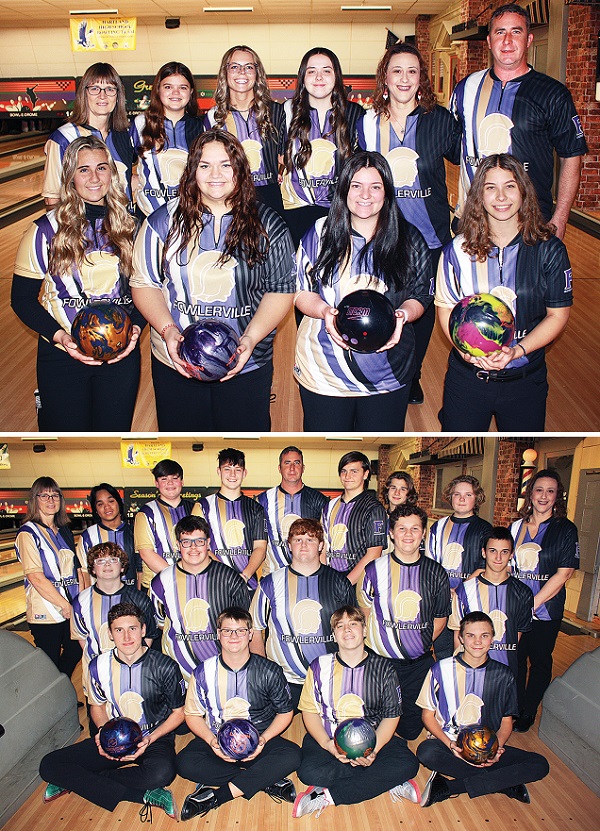
Never before a coach, nor a bowler outside of family fun, she agreed to start a Gladiators high school bowling program – one that four years later has two varsities and a JV team and had to make cuts this winter for the first time.
Building any program from ground level is full of challenges. Throw in a pandemic, and it gets tougher for sure. But knocking down obstacles has been like knocking down pins – it’s a bit of a theme for the quickly-growing program, its coach and the now-senior who got things rolling.
Bowling began for Brent
Brent Wood had played baseball and flag football and wrestled growing up. He tried everything his mom would let him, and that’s impressive enough – he doesn’t have a complete right hip, just bone on bone where the femur and pelvis meet.
 Considering that challenge, opportunities in those other sports faded as he grew older. And he wasn’t a big fan of school either. But Denise Wood knew a bowling team would motivate Brent to stay active and do well academically.
Does it hurt where that hip padding should be? Brent said no – it just feels like what he knows to be normal. But Mom said she can tell when it does, and he’s had 13 surgeries over the years. Brent still managed to play those sports and learn how to ride a bike with just his left leg – “and I still manage to bowl somewhat decent some days,” he said.
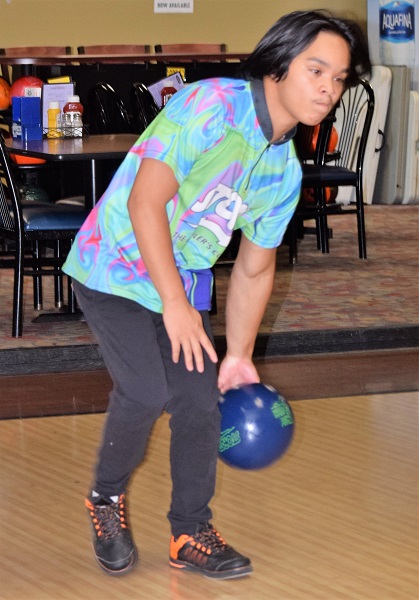
He’s actually become an all-league bowler – most recently finishing ninth at the White Lake Lakeland Invitational last weekend – while employing an uncommon style.
Generally, a left-handed bowler will land on the right foot when releasing the ball. Wood instead lands on his left, or opposite foot, to stay off the right one.
Denise Wood describes it as being a “very non-traditional single-handed lefty who has figured out how to make it work.” Brent said when he first started this bowling style, it was a little complicated – but last summer he took lessons and upped his knowledge by competing in a number of tournaments and against a variety of oil patterns. Additionally, “Over the summer I’ve seen one or two people land on the wrong foot like I do,” Wood said, “so I know I’m not the only one who does it.”
He'll be the second Fowlerville bowler to continue at the college level. He’ll join friend Trevor Cockerill, who graduated last year, at nearby Cleary University where he’ll compete for coach Hayley Dann – who impressed the family by telling them that instead of trying to change Brent’s style, she’ll “work with him with what he’s got,” Denise Wood recalled.
“That’s the coach I need, because that’s what Brent does – he works with what he’s got,” Denise said. “Brent is naturally athletically talented, and when it comes to stuff that’s athletic he’s quite the problem solver. He figures out how to do things.”
Starting from scratch
Mom figured things out, too.
Denise Wood calls herself a “google coach” – as in, she googles to learn drills and pick up tips on how to better guide the Gladiators. But considering the system she and her assistants have built over a short time, she’s not giving herself enough credit.
When Wood first asked Osborn why there wasn’t a program, she followed up by asking if a potential coach needed to be a good bowler. Osborn said not necessarily – if she was willing to learn the bowling side, he would help with how school-based sports work and take care of as much paperwork as possible.
 Challenge accepted.
First, the team needed somewhere to bowl. Fowlerville has made its home at Howell’s Bowl-E-Drome, about a 20-minute drive for practices twice a week.
The bowlers arrived. Fowlerville’s first season in 2019-20 saw 10 boys and two girls come out, making up a co-ed varsity and boys junior varsity team.
Next came “learning the bowling side” – and definitely, the internet helped. Mining various bowling websites and coaching resources, she’s put together a series of drills – all of her bowlers have copies of each in a folder they keep on hand – and with assistants Kelli Wilbur and Kevin Mahon designed practices to begin at the start of the season with skills assessments and then be organized by ability level to provide for more focused attention and instruction. The bowlers also make use of the school’s weight room one day a way – adjusting all of this around schedules for students who also dance, play in the band and train for other sports.
Wilbur and Mahon are experienced bowlers, and their additions have allowed Wood the last few years to focus more on team-building activities and administrative responsibilities like signing up for tournaments and data collection. For competitions, the three coaches take turns coaching each team so that all three become familiar with all of the Gladiators’ styles.
The majority of the bowlers are newcomers to the sport. Junior Emma Wilbur – Kelli’s daughter and the top roller on the girls team – counted herself and two more teammates who had grown up bowling.
“A lot of kids that come in, come in with no bowling experience whatsoever. They just heard it was fun, they wanted to be part of a team,” Wood said. “So this year we actually did an interview for the kids – they had to fill out a personal interview for why they came out for bowling. A lot of it was to have fun, become part of a team, and some kids said to become a better bowler.”
Turning to Paige
After a promising start, the program simply had to survive its second year.
With COVID-19 making everything more complicated, Fowlerville found itself with only five bowlers for the 2020-21 season – and couldn’t even bowl as a team at its Regional with Emma Wilbur in quarantine. Families weren’t allowed to watch competitions, and just getting the word out was a challenge.
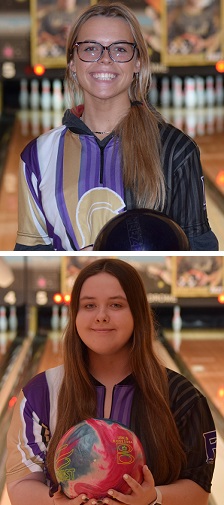 But Paige Frazier saved the day, figuratively speaking – and more realistically, potentially the program.
She solved some of the information block by starting Facebook and Instagram feeds for the bowling program that included video streams of competitions and updated information on cancelations and quarantines. “It definitely brought in a lot of attention,” Frazier remembered.
“If we hadn’t had Paige our COVID year, we wouldn’t have had a season at all,” Wood said. “Paige, I call her my female rock, because she kept the team alive.”
The work done during the COVID season paid off as the team got back in gear for last winter. The bowlers added to their social media marketing by hanging up fliers and getting word out on the program in the school’s morning announcements, and for 2021-22 enough bowlers came out to have separate girls and boys varsities for the first time.
“I had a lot of people ask me about it. A lot of people didn’t even know about it for a good two years,” Emma Wilbur said. “I had a couple friends who said they would try it out.”
Off and rolling again
The interview results from tryouts this season check out. While the team is serious about competing and succeeding, having fun and being part of a team are top priorities for most. The car rides to practices and bus rides to competitions are the best parts.
There’s still some convincing to do among classmates who might not consider bowling a sport. “They laugh about it until they find out we have a 1:30 dismissal for all the meets,” Wilbur said. But she and Frazier both play other sports too – Wilbur soccer and Frazier tennis – and realize the value in what they’ve helped create.
“I think being able to do something that you love to do, with all of your friends, a sport that you can go and do on the weekends and go and do after school … anytime that you want to you can go and do that,” Wilbur noted.
“Bowling's a really social sport,” Frazier added, “so you just learn to get along really well with your teammates, and just kinda relax and enjoy it.”
The Gladiators bowl in league matches once a week and have tournaments most January and February weekends through the regular season. Osborn said he’s excited to see so much interest at each grade level and is hopeful the program will continue to grow.
Brent Wood asked a winning question. The answer has been even better.
“It’s nice to see that we got everyone together that loves to do what we love to do,” Brent Wood said.
“Just seeing everyone enjoy the moment.”
 Geoff Kimmerly joined the MHSAA in Sept. 2011 after 12 years as Prep Sports Editor of the Lansing State Journal. He is a senior editor of MHSAA.com's editorial content and has served as MHSAA Communications Director since January 2021. Contact him at [email protected] with story ideas for the Barry, Eaton, Ingham, Livingston, Ionia, Clinton, Shiawassee, Gratiot, Isabella, Clare and Montcalm counties.
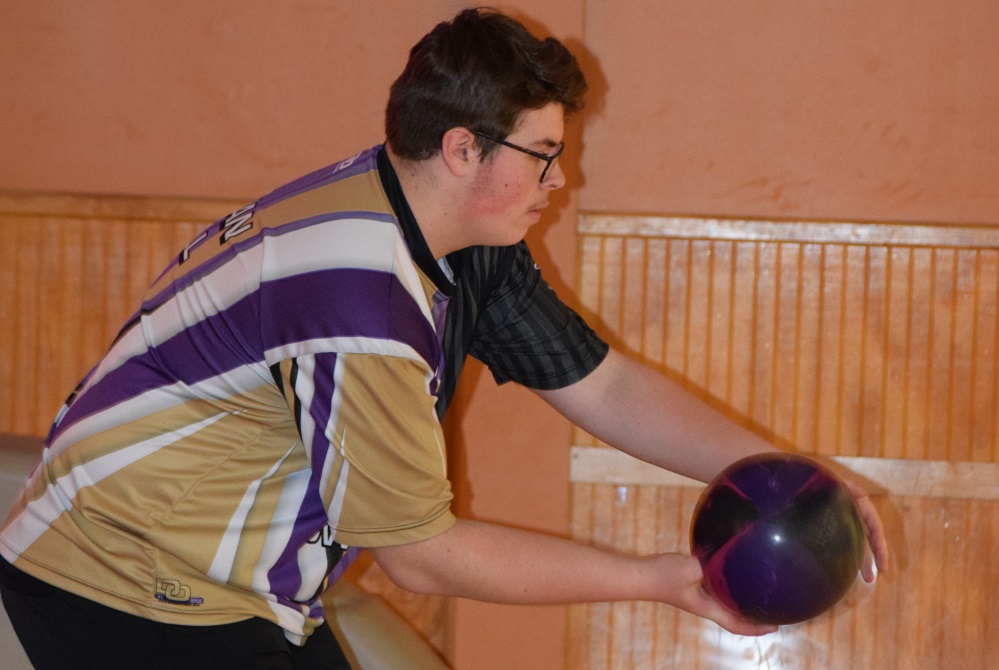
PHOTOS (Top) Fowlerville bowler Ethan Hall begins his approach. (2) Brent Wood shows his left-handed, left-footed bowling style. (3) Fowlerville’s Paige Frazier, top, and Emma Wilbur. (4) Fowlerville’s girls and boys teams this season, including head coach Denise Wood, top row far left, and assistants Kevin Mahon and Kelli Wilbur. (Photos courtesy of the Fowlerville bowling program.)