

New Math: Division & Multiplication Problems
July 25, 2017
By Jack Roberts
MHSAA Executive Director
This is the second part in a series on MHSAA tournament classification, past and present, that will be published over the next two weeks. This series originally ran in this spring's edition of MHSAA benchmarks.
High school tournament classifications went viral before there was social media and most of us knew what “viral” meant.
Much as a virus infects computers today or has created epidemics of disease around the world for centuries, high school tournament classification – once introduced – tends to spread uncontrollably. Once started, it tends to keep expanding and rarely contracts.
While we are still some distance from providing every team a trophy as a result of expanding high school tournament classification across the country, there is criticism nevertheless that we are headed in that direction – a philosophy which is supposed to exist only in local youth sports for our youngest children.
Michigan could be blamed for all this. Michigan is generally accepted as the first state to provide different classifications for season-ending tournaments for different sized schools. It started a century ago. Today, every state has various classifications for its tournaments in most if not all sports. And it is a bit ironic that Michigan – creator of the classification chaos – more than most other states has kept the number of tournament classes or divisions under control.
Yes, there is evidence that tournament classifications have expanded over the years in Michigan, especially with the relatively recent introduction of tournaments in football and the late 1990s’ move from classes to divisions in most MHSAA tournaments. But the MHSAA Representative Council has held true to its word when it expanded the playoffs for football from four classes to eight divisions: this is needed because of unique factors of football, factors that exist in no other sport; and all other sports should be capped at a maximum of four classes or divisions.
Kentucky is the preeminent defender of single-class basketball. All of its 276 high schools compete for the single state championship for each gender. In Indiana, there are still open wounds from its move in 1998 from one to four classes for its 400 schools in basketball.
Multi-class tournaments have tended to increase the number of non-public school champions, which some states are trying to lower through enrollment “multipliers,” and also tend to increase the number of repeat champions, which some states are trying to affect with “success factors” which lift smaller schools into classifications for larger schools if they take home too many trophies.
While there is considerable evidence that state tournaments do as much bad as good for educational athletics, state associations persist in providing postseason tournaments because, on balance, the experiences are supposed to be good for student-athletes. And once we reach that conclusion it is just a small leap to believe that if the tournaments are good for a few, they must be better for more – which leads to creating more and more tournament classifications. One becomes two classes, then three, then four and so forth.
While the argument is that more classifications or divisions provides more students with opportunities to compete and win, it is undeniable that the experience changes as the number of tournament classifications expands. It is not possible for state associations to provide the same level of support when tournament classifications expand to multiple venues playing simultaneously. For example, there is less audio and video broadcast potential at each venue, and less media coverage to each venue. Focus is diluted and fans diminished at each championship.
No one can argue reasonably that today's two-day MHSAA Football Finals of eight championship games has the same pizazz as the one-day, four-games event conducted prior to 1990.
In some states the number of divisions has grown so much that it is difficult to see much difference between the many season-ending state championship games and a regular-season event in the same sport.
It is a balancing act. And Michigan has been studying that balance longer than any other state, and charting a steadier course than most.
Addition by Division
The shift to Divisions for MHSAA Tournament play in numerous sports has added up to a greater number of champions for teams and individuals across the state. Following are the sports currently employing a divisional format, and the procedures for determining enrollment and classification.
In 23 statewide or Lower Peninsula tournaments, schools which sponsor the sport are currently divided into nearly equal divisions. They are:
- Baseball - 4 Divisions
- Boys Bowling - 4 Divisions
- Girls Bowling - 4 Divisions
- Girls Competitive Cheer - 4 Divisions
- LP Boys Cross Country - 4 Divisions
- LP Girls Cross Country - 4 Divisions
- LP Boys Golf - 4 Divisions
- LP Girls Golf - 4 Divisions
- Ice Hockey - 3 Divisions
- Boys Lacrosse - 2 Divisions
- Girls Lacrosse - 2 Divisions
- Boys Skiing - 2 Divisions
- Girls Skiing - 2 Divisions
- LP Boys Soccer - 4 Divisions LP
- Girls Soccer - 4 Divisions
- Girls Softball - 4 Divisions
- LP Boys Swimming & Diving - 3 Divisions
- LP Girls Swimming & Diving - 3 Divisions
- LP Boys Tennis - 4 Divisions
- LP Girls Tennis - 4 Divisions
- LP Boys Track & Field - 4 Divisions
- LP Girls Track & Field - 4 Divisions
- Wrestling - 4 Divisions
Lists of schools for each division of these 23 tournaments are posted on MHSAA.com approximately April 1. Listings of schools in Upper Peninsula tournaments for their sports are also posted on MHSAA.com. The lists are based on school memberships and sports sponsorships in effect or anticipated for the following school year, as known to the MHSAA office as of a date in early March.
In football, the 256 schools which qualify for MHSAA 11-player playoffs are placed in eight equal divisions annually on Selection Sunday. Beginning in 2017, the 8-player divisions will be determined in a like manner on Selection Sunday as well, with 32 qualifying schools placed in two divisions.
Schools have the option to play in any higher division in one or more sports for a minimum of two years.
The deadlines for "opt-ups" are as follows:
- Applications for fall sports must be submitted by April 15
- Applications for winter sports must be submitted by Aug. 15
- Applications for spring sports must be submitted by Oct. 15
Subsequent to the date of these postings for these tournaments, no school will have its division raised or lowered by schools opening or closing, schools adding or dropping sports, schools exercising the option to play in a higher division, or approval or dissolution of cooperative programs.
When the same sport is conducted for boys and girls in the same season (e.g., track & field and cross country), the gender that has the most sponsoring schools controls the division breaks for both genders.
Bloomingdale Trainer Performing Invaluable Role in Keeping Athletes Playing
By
Pam Shebest
Special for MHSAA.com
November 22, 2022
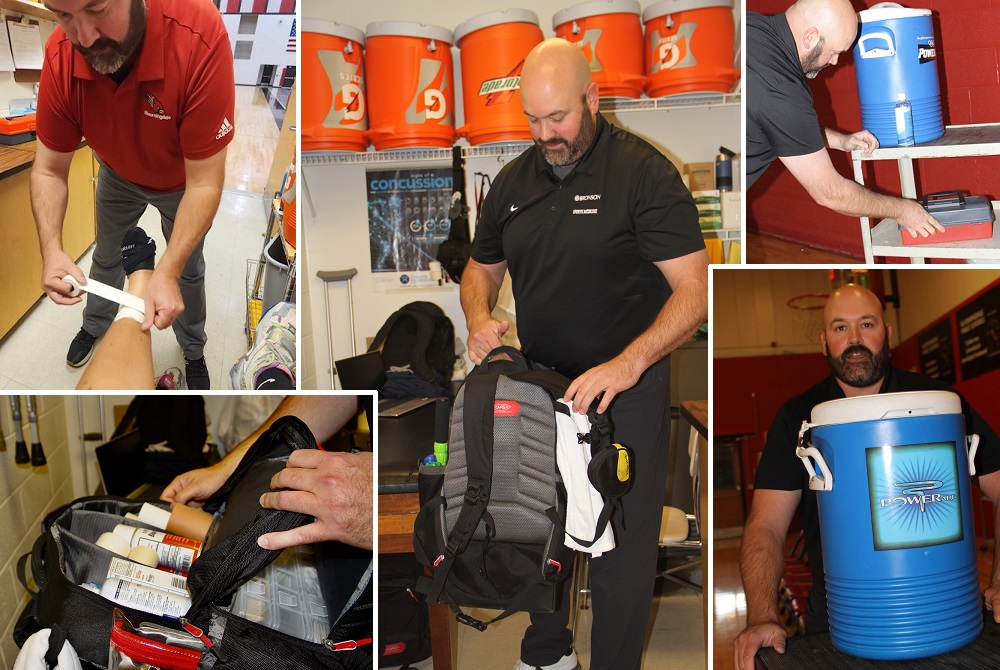
BLOOMINGDALE — If Scott Allison looks bored during one of Bloomingdale’s sporting events, that is a good thing.
 “Trainers like to be behind the scenes and in the shadows,” the certified athletic trainer said. “We’re only needed in emergencies.
“It’s one of those jobs that if we’re sitting around looking bored, then things are going well.”
But if an athlete goes down with an injury, Allison is quick to run onto the court or field.
In his first year at Bloomingdale, he has found that working with middle and high school students is a lot different than his previous work with the minor-league hockey Kalamazoo Wings.
Treating the hockey team, with whom he spent much of his 22 years, “There was a lot of traumatic stuff like lacerations or deep contusions, overuse injuries like hip flexors or core injuries or broken bones.
“Everything’s acute and fast. It’s a different animal. In hockey, they’re all pro athletes so they know their bodies really well.”
However, high school and middle school athletes are still in a growing phase.
“These kids don’t really know what’s going on a lot of times, so it’s a lot more education on what’s happening,” Allison said.
“Is it an injury, or is it just soreness? You get a lot of kids that don’t understand the difference between aches and pains or an injury. We see a lot of ankle sprains or shin splints because they’re just developing. They’re in that awkward range where their bodies try to grow too fast.”
 Allison is the Cardinals’ first certified athletic trainer, a new position for which athletic director Jason Hayes campaigned.
“What we notice is that if a kid’s injured, they’re out a lot less if you have a trainer because it speeds up recovery time,” said Hayes, who also coaches varsity football and is an assistant wrestling coach. “It’s like having a built-in physical therapist on your staff, too.”
Studies support Hayes’ statements.
According to information from The Sports Institute at University of Washington, “‘The athletic trainers know the athletes,” says Stan Herring, M.D., cofounder of The Sports Institute at (University of Washington) Medicine and a team physician for the Seattle Seahawks and Seattle Mariners. “They see the athletes frequently, if not every day. They know when something is wrong. They are medical professionals who evaluate, treat and rehabilitate athletes.’”
The article continued: “Three recent studies suggest that athletic trainers are linked to significant improvements in the diagnosis of concussion in young athletes and significant reductions in ‘time-loss’ injuries that require athletes to take time away from sports.”
Allison sees himself as a teacher as well as a trainer.
“We see a lot more strains or growth issues,” he said. “A lot of it is maintenance and teaching kids what’s going on with their bodies or what they need to do to change things.”
He also meets with parents and coaches to talk about the best way to prevent injuries.
Allison’s day begins about 1:30 or 2 p.m., giving athletes a chance to talk with him before practices or games.
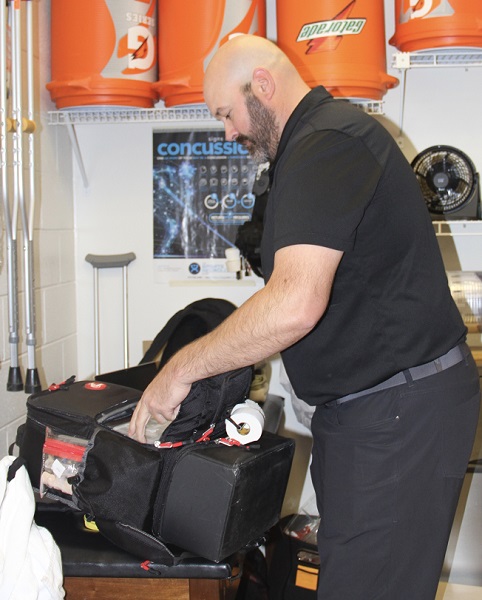
During the action, he always has his first aid backpack filled with the basics: air splints for fractures or dislocations, AED, EpiPens, and bench kits (with taping and bandaging supplies, splints, gauze, ACE wraps, ice bags, latex gloves and other basic first aid supplies.)
He travels with the teams when they are involved in high-impact sports, such as football, and many times he is also called to treat an opposing player if that team has no trainer.
 Allison is a perfect fit with Bloomingdale, Hayes said.
His wife, Kirsten, coached the Cardinals girls basketball team for seven years. His daughter Emma, now at Glen Oaks Community College, graduated from there, and his daughter Bailey is an eighth grader.
“We are a very lucky town,” Hayes said. “We had Doc (Robert) Stevens, who had been volunteering as our athletic trainer for 15 years. He’s just aging out.
“About a year ago, he came to me and said that it was his last year. Scott has 22 years experience, and he has relationships here. To me, it was a no-brainer.”
Assistant varsity football coach Lance Flynn, who also coaches the middle school football team, saw Allison in action during competition in the fall.
“First quarter in a middle school football game, a kid broke his arm,” Flynn said. “My own son, Ryder, was on the varsity team and he sprained his AC socket and Scott took care of him.
“If something happens during a game, they can go see him and I don’t have to worry much because I know they’re in good hands.”
Allison’s affiliation with Bronson Sports Medicine is also a plus, the trainer said.
“With Bronson, we can offer a lot more and expedite getting in to see doctors or specialists if we need to,” he said. “We’re on the same system as the doctors, so we can diagnose and send notes to the doctors and they can send notes back to us.
“If there’s anybody we need to keep track of with the doctors, I can talk with the doctors and figure out how that’s going. If anybody needs to see me, they know I’m here early if they just want to come down to talk.”
Bronson also provides certified athletic trainers at 21 other southwest Michigan high schools: Brooke Vandepolder (Battle Creek Central), Lindsay Aarseth-Lindhorst (Climax-Scotts), Amanda Monsivaes (Comstock), Makenzie Hodgson (Delton Kellogg), Salvador Robles-Soriano (Gobles), Holly Ives (Richland Gull Lake), Katelyn Baker-Contreras (Kalamazoo Hackett Catholic Prep), Lizzy Smith (Kalamazoo Central), Emma Beener (Kalamazoo Christian), Holly Sisson (Kalamazoo Loy Norrix), Nico Talentino (Mattawan), Aaron Eickhoff (Otsego), Quincey Powell (Parchment), Malorie Most (Paw Paw), Jessica Bakhuyzen (Plainwell), Lance LeTourneau (Portage Central), Janelle Currie (Portage Northern), Carrie Calhoun (Schoolcraft), Chelsea Harrison (South Haven), Alexis Walters (Three Rivers) and Natalie McClish (Vicksburg).
 Pam Shebest served as a sportswriter at the Kalamazoo Gazette from 1985-2009 after 11 years part-time with the Gazette while teaching French and English at White Pigeon High School. She can be reached at [email protected] with story ideas for Calhoun, Kalamazoo and Van Buren counties.
PHOTOS (Top) Bloomingdale trainer Scott Allison has several tasks as he works to keep the school’s student-athletes healthy and pain-free. (Middle) Bloomingdale athletic director Jason Hayes, left, and assistant varsity football coach Lance Flynn. (Below) Allison packs his bag for another full afternoon. (Ankle-taping photo by Andreya Robinson; all other photos by Pam Shebest.)