

New Math: Division & Multiplication Problems
July 25, 2017
By Jack Roberts
MHSAA Executive Director
This is the second part in a series on MHSAA tournament classification, past and present, that will be published over the next two weeks. This series originally ran in this spring's edition of MHSAA benchmarks.
High school tournament classifications went viral before there was social media and most of us knew what “viral” meant.
Much as a virus infects computers today or has created epidemics of disease around the world for centuries, high school tournament classification – once introduced – tends to spread uncontrollably. Once started, it tends to keep expanding and rarely contracts.
While we are still some distance from providing every team a trophy as a result of expanding high school tournament classification across the country, there is criticism nevertheless that we are headed in that direction – a philosophy which is supposed to exist only in local youth sports for our youngest children.
Michigan could be blamed for all this. Michigan is generally accepted as the first state to provide different classifications for season-ending tournaments for different sized schools. It started a century ago. Today, every state has various classifications for its tournaments in most if not all sports. And it is a bit ironic that Michigan – creator of the classification chaos – more than most other states has kept the number of tournament classes or divisions under control.
Yes, there is evidence that tournament classifications have expanded over the years in Michigan, especially with the relatively recent introduction of tournaments in football and the late 1990s’ move from classes to divisions in most MHSAA tournaments. But the MHSAA Representative Council has held true to its word when it expanded the playoffs for football from four classes to eight divisions: this is needed because of unique factors of football, factors that exist in no other sport; and all other sports should be capped at a maximum of four classes or divisions.
Kentucky is the preeminent defender of single-class basketball. All of its 276 high schools compete for the single state championship for each gender. In Indiana, there are still open wounds from its move in 1998 from one to four classes for its 400 schools in basketball.
Multi-class tournaments have tended to increase the number of non-public school champions, which some states are trying to lower through enrollment “multipliers,” and also tend to increase the number of repeat champions, which some states are trying to affect with “success factors” which lift smaller schools into classifications for larger schools if they take home too many trophies.
While there is considerable evidence that state tournaments do as much bad as good for educational athletics, state associations persist in providing postseason tournaments because, on balance, the experiences are supposed to be good for student-athletes. And once we reach that conclusion it is just a small leap to believe that if the tournaments are good for a few, they must be better for more – which leads to creating more and more tournament classifications. One becomes two classes, then three, then four and so forth.
While the argument is that more classifications or divisions provides more students with opportunities to compete and win, it is undeniable that the experience changes as the number of tournament classifications expands. It is not possible for state associations to provide the same level of support when tournament classifications expand to multiple venues playing simultaneously. For example, there is less audio and video broadcast potential at each venue, and less media coverage to each venue. Focus is diluted and fans diminished at each championship.
No one can argue reasonably that today's two-day MHSAA Football Finals of eight championship games has the same pizazz as the one-day, four-games event conducted prior to 1990.
In some states the number of divisions has grown so much that it is difficult to see much difference between the many season-ending state championship games and a regular-season event in the same sport.
It is a balancing act. And Michigan has been studying that balance longer than any other state, and charting a steadier course than most.
Addition by Division
The shift to Divisions for MHSAA Tournament play in numerous sports has added up to a greater number of champions for teams and individuals across the state. Following are the sports currently employing a divisional format, and the procedures for determining enrollment and classification.
In 23 statewide or Lower Peninsula tournaments, schools which sponsor the sport are currently divided into nearly equal divisions. They are:
- Baseball - 4 Divisions
- Boys Bowling - 4 Divisions
- Girls Bowling - 4 Divisions
- Girls Competitive Cheer - 4 Divisions
- LP Boys Cross Country - 4 Divisions
- LP Girls Cross Country - 4 Divisions
- LP Boys Golf - 4 Divisions
- LP Girls Golf - 4 Divisions
- Ice Hockey - 3 Divisions
- Boys Lacrosse - 2 Divisions
- Girls Lacrosse - 2 Divisions
- Boys Skiing - 2 Divisions
- Girls Skiing - 2 Divisions
- LP Boys Soccer - 4 Divisions LP
- Girls Soccer - 4 Divisions
- Girls Softball - 4 Divisions
- LP Boys Swimming & Diving - 3 Divisions
- LP Girls Swimming & Diving - 3 Divisions
- LP Boys Tennis - 4 Divisions
- LP Girls Tennis - 4 Divisions
- LP Boys Track & Field - 4 Divisions
- LP Girls Track & Field - 4 Divisions
- Wrestling - 4 Divisions
Lists of schools for each division of these 23 tournaments are posted on MHSAA.com approximately April 1. Listings of schools in Upper Peninsula tournaments for their sports are also posted on MHSAA.com. The lists are based on school memberships and sports sponsorships in effect or anticipated for the following school year, as known to the MHSAA office as of a date in early March.
In football, the 256 schools which qualify for MHSAA 11-player playoffs are placed in eight equal divisions annually on Selection Sunday. Beginning in 2017, the 8-player divisions will be determined in a like manner on Selection Sunday as well, with 32 qualifying schools placed in two divisions.
Schools have the option to play in any higher division in one or more sports for a minimum of two years.
The deadlines for "opt-ups" are as follows:
- Applications for fall sports must be submitted by April 15
- Applications for winter sports must be submitted by Aug. 15
- Applications for spring sports must be submitted by Oct. 15
Subsequent to the date of these postings for these tournaments, no school will have its division raised or lowered by schools opening or closing, schools adding or dropping sports, schools exercising the option to play in a higher division, or approval or dissolution of cooperative programs.
When the same sport is conducted for boys and girls in the same season (e.g., track & field and cross country), the gender that has the most sponsoring schools controls the division breaks for both genders.
Hall, Stevens Teaming Up to Continue Dundee Championship Tradition
By
Doug Donnelly
Special for MHSAA.com
November 22, 2022
DUNDEE – How do you replace a legendary coach?
 For the Dundee Vikings wrestling program, it takes two.
Nate Hall and Garrett Stevens opened practice last week as the new co-coaches of the ultra-successful Dundee wrestling program, taking the reins from Tim Roberts, one of the winningest coaches in state wrestling history.
“From day one, we’ve done a really good job of pushing each other and staying focused,” Stevens said. “The kids have been getting after it. Things are going well.”
Dundee’s wrestling program is a rich one. Roberts stepped down with a state-record 10 MHSAA Finals titles over his 23 seasons as head coach. In all 23 of those years, Dundee won District championships, and in 22 of those 23 years the Vikings won Regional titles. Roberts not only accumulated 10 Finals championship trophies, but he also won more than 500 dual matches.
Hall and Stevens have coached together for several years on the Dundee staff. Now they are dividing up duties and looking to start the next era of Vikings wrestling.
“We know what we are up against,” Hall said. “We have a strong tradition to keep on. We understand two people going at it is probably the better route.”
The move is not without precedent. In the conference that Dundee competes in – the Lenawee County Athletic Association – Clinton had co-coaches lead the Redwolves to the Division 4 championship two seasons ago. Division 3 powerhouse Richmond has utilized co-coaches in the sport as well.
“We sort of applied together,” Stevens said. “We thought we could do this.”
Dundee Athletic Director Ross Crow said he was hesitant at first to consider the co-coach idea, but after meeting with both realized it could work.
 span>“After sitting down with them and having a lengthy discussion, I realized they have an extremely organized and articulated plan as to how they are carrying the torch moving forward,” Crow said. “Whenever I have a question, I either text or e-mail both of them on a group thread. They both chime in and more often than not, the answer is exactly the same for both of them. It's a really good fit, as they are close friends and have no egos.”
Stevens is a 2007 Dundee graduate. He wrestled for Roberts. His dad was a Dundee wrestler as well, graduating in the 1970s. Stevens brings his connection to the Dundee wrestling community to the table as well as years of coaching experience.
Hall is from nearby Blissfield, where he was an all-state wrestler. He wrestled for Grand Valley State’s club program and was a coach there as well. He returned to southeast Michigan to coach with his father – Adrian Madison head coach Scott Hall – and joined the Dundee staff when he became a physical education teacher at the middle school about five years ago.
As co-head coach, Nate Hall handles a lot of the organizational duties, especially anything involving the school district, since he works there. Stevens brings a technical side of the sport with him.
The duo believe they can make it work because of the chemistry between them.
“I was always more of a technical wrestler,” Stevens said. “I think Tim (Roberts) felt I could help connect with the kids and teach them how to do a few things differently.
“After I graduated from high school, I got away from wrestling for a while, but in 2011, Tim reached out to me and asked if I wanted to get back involved and it seemed like a no-brainer. I missed it. I liked being around him and there were some things I could bring to the table. I was chomping at the bit once the opportunity opened for me.”
Stevens said Roberts was wonderful to learn from because he was such a great person and sought out input from his staff.
“Tim’s approach to coaching was unique,” Stevens said. “He’s very open-minded and understands there is so much more to learn. You constantly want your kids and program to grow. Every year I coached with him, he changed something every year. He was constantly modifying, tweaking, and seeking out help and advice from others.”
Hall likes how things have started.
“It’s going very well so far,” Hall said. “Tim didn’t leave the well dry. He’s got an established program and an established wrestling community that has been supportive of both Garrett and I so far.
 “We’ve got a tremendous senior class – three state champions and another kid that was third in the state last year. Their leadership is really going to be a huge aspect of our success this year.”
The Vikings also have 14 freshmen.
“We’ve hit the ground running,” Hall said. “We provide a lot of opportunities in the offseason for kids to get into the wrestling room and stay active. Most of our guys are active throughout. The freshmen are a real promising group that we can keep the ball rolling,” Hall said.
The veterans in the wrestling room include Kaden Chinavare, a Central Michigan University signee who won an Individual Finals title as a sophomore; Aiden Davis, a two-time Finals champ headed to Bucknell; and Braeden Davis, a Penn State University recruit looking for a fourth consecutive Finals title in 2023.
“The biggest thing with this group, I would say, is their willingness to push each other in the right manner,” Hall said. “We’ve got a lot of successful individuals, and they are already going out of their way to make sure each person around them is getting the most out of their reps they can get.
“The team chemistry is already a big part of it.”
Both coaches admit there is pressure to maintain a program that is not just known at the state level, but nationally.
“If you’re not feeling that pressure, maybe you’re not taking it as seriously as it needs to be taken,” Hall said. “We are here to help kids accomplish their goals, and pressure is a part of that – especially at the elite level a lot of our wrestlers want to compete at.”
Despite the turnover in coaching, Dundee’s goals remain high.
Dundee opens with the Grappler Gold, will go to Davison, then compete at a big invitational in Ohio. They Vikings will compete at Detroit Catholic Central and the Hudson Super 16 in late January.
“We always want to aim high,” Stevens said.
 Doug Donnelly has served as a sports and news reporter and city editor over 25 years, writing for the Daily Chief-Union in Upper Sandusky, Ohio from 1992-1995, the Monroe Evening News from 1995-2012 and the Adrian Daily Telegram since 2013. He's also written a book on high school basketball in Monroe County and compiles record books for various schools in southeast Michigan. E-mail him at [email protected] with story ideas for Jackson, Washtenaw, Hillsdale, Lenawee and Monroe counties.
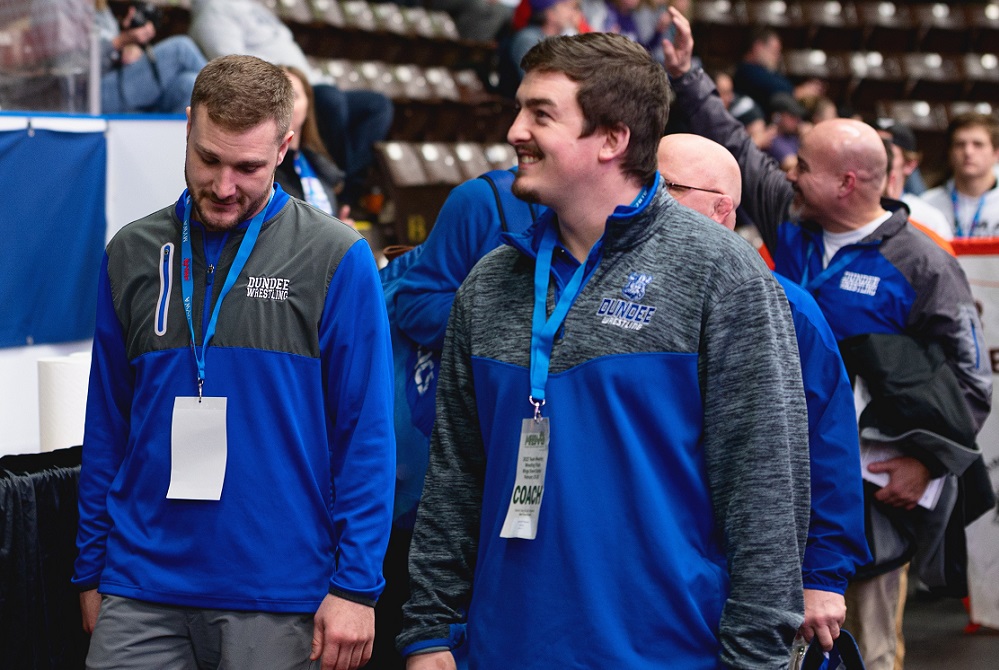
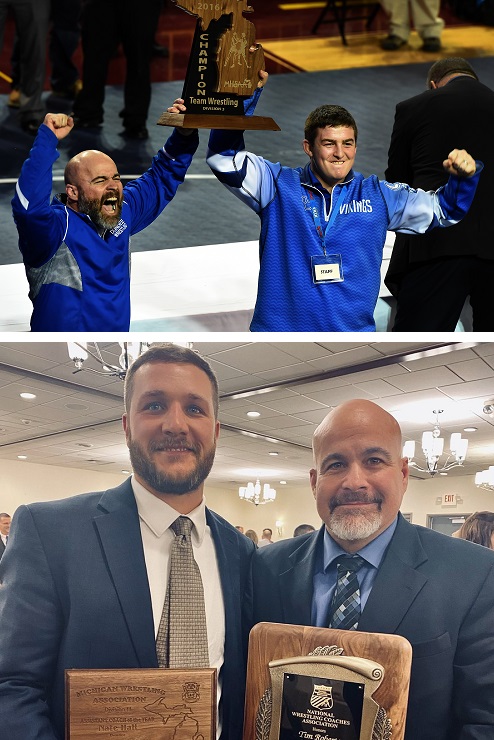
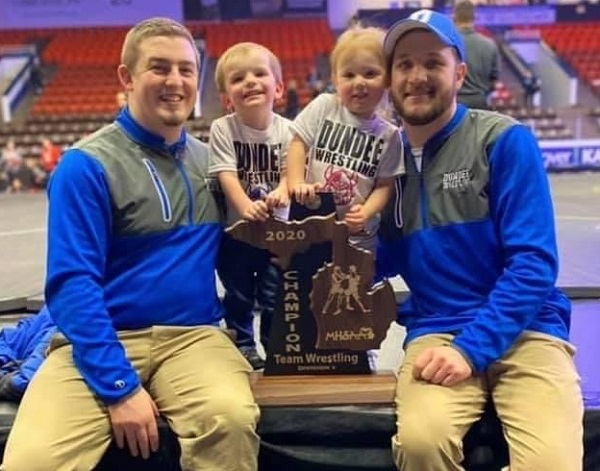
PHOTOS (Top) Nate Hall, left, and Garrett Stevens walk together during the opening march at an MHSAA Team Finals; retired coach Tim Roberts is behind them, waving. (Middle) Stevens, top, and Hall stand with their retired coach and mentor at various events. (Below) Stevens and son Brady, and Hall and daughter Kimberly, celebrate the 2020 championship. (Top and below photos by Kathy Killion.)