

New Math: Division & Multiplication Problems
July 25, 2017
By Jack Roberts
MHSAA Executive Director
This is the second part in a series on MHSAA tournament classification, past and present, that will be published over the next two weeks. This series originally ran in this spring's edition of MHSAA benchmarks.
High school tournament classifications went viral before there was social media and most of us knew what “viral” meant.
Much as a virus infects computers today or has created epidemics of disease around the world for centuries, high school tournament classification – once introduced – tends to spread uncontrollably. Once started, it tends to keep expanding and rarely contracts.
While we are still some distance from providing every team a trophy as a result of expanding high school tournament classification across the country, there is criticism nevertheless that we are headed in that direction – a philosophy which is supposed to exist only in local youth sports for our youngest children.
Michigan could be blamed for all this. Michigan is generally accepted as the first state to provide different classifications for season-ending tournaments for different sized schools. It started a century ago. Today, every state has various classifications for its tournaments in most if not all sports. And it is a bit ironic that Michigan – creator of the classification chaos – more than most other states has kept the number of tournament classes or divisions under control.
Yes, there is evidence that tournament classifications have expanded over the years in Michigan, especially with the relatively recent introduction of tournaments in football and the late 1990s’ move from classes to divisions in most MHSAA tournaments. But the MHSAA Representative Council has held true to its word when it expanded the playoffs for football from four classes to eight divisions: this is needed because of unique factors of football, factors that exist in no other sport; and all other sports should be capped at a maximum of four classes or divisions.
Kentucky is the preeminent defender of single-class basketball. All of its 276 high schools compete for the single state championship for each gender. In Indiana, there are still open wounds from its move in 1998 from one to four classes for its 400 schools in basketball.
Multi-class tournaments have tended to increase the number of non-public school champions, which some states are trying to lower through enrollment “multipliers,” and also tend to increase the number of repeat champions, which some states are trying to affect with “success factors” which lift smaller schools into classifications for larger schools if they take home too many trophies.
While there is considerable evidence that state tournaments do as much bad as good for educational athletics, state associations persist in providing postseason tournaments because, on balance, the experiences are supposed to be good for student-athletes. And once we reach that conclusion it is just a small leap to believe that if the tournaments are good for a few, they must be better for more – which leads to creating more and more tournament classifications. One becomes two classes, then three, then four and so forth.
While the argument is that more classifications or divisions provides more students with opportunities to compete and win, it is undeniable that the experience changes as the number of tournament classifications expands. It is not possible for state associations to provide the same level of support when tournament classifications expand to multiple venues playing simultaneously. For example, there is less audio and video broadcast potential at each venue, and less media coverage to each venue. Focus is diluted and fans diminished at each championship.
No one can argue reasonably that today's two-day MHSAA Football Finals of eight championship games has the same pizazz as the one-day, four-games event conducted prior to 1990.
In some states the number of divisions has grown so much that it is difficult to see much difference between the many season-ending state championship games and a regular-season event in the same sport.
It is a balancing act. And Michigan has been studying that balance longer than any other state, and charting a steadier course than most.
Addition by Division
The shift to Divisions for MHSAA Tournament play in numerous sports has added up to a greater number of champions for teams and individuals across the state. Following are the sports currently employing a divisional format, and the procedures for determining enrollment and classification.
In 23 statewide or Lower Peninsula tournaments, schools which sponsor the sport are currently divided into nearly equal divisions. They are:
- Baseball - 4 Divisions
- Boys Bowling - 4 Divisions
- Girls Bowling - 4 Divisions
- Girls Competitive Cheer - 4 Divisions
- LP Boys Cross Country - 4 Divisions
- LP Girls Cross Country - 4 Divisions
- LP Boys Golf - 4 Divisions
- LP Girls Golf - 4 Divisions
- Ice Hockey - 3 Divisions
- Boys Lacrosse - 2 Divisions
- Girls Lacrosse - 2 Divisions
- Boys Skiing - 2 Divisions
- Girls Skiing - 2 Divisions
- LP Boys Soccer - 4 Divisions LP
- Girls Soccer - 4 Divisions
- Girls Softball - 4 Divisions
- LP Boys Swimming & Diving - 3 Divisions
- LP Girls Swimming & Diving - 3 Divisions
- LP Boys Tennis - 4 Divisions
- LP Girls Tennis - 4 Divisions
- LP Boys Track & Field - 4 Divisions
- LP Girls Track & Field - 4 Divisions
- Wrestling - 4 Divisions
Lists of schools for each division of these 23 tournaments are posted on MHSAA.com approximately April 1. Listings of schools in Upper Peninsula tournaments for their sports are also posted on MHSAA.com. The lists are based on school memberships and sports sponsorships in effect or anticipated for the following school year, as known to the MHSAA office as of a date in early March.
In football, the 256 schools which qualify for MHSAA 11-player playoffs are placed in eight equal divisions annually on Selection Sunday. Beginning in 2017, the 8-player divisions will be determined in a like manner on Selection Sunday as well, with 32 qualifying schools placed in two divisions.
Schools have the option to play in any higher division in one or more sports for a minimum of two years.
The deadlines for "opt-ups" are as follows:
- Applications for fall sports must be submitted by April 15
- Applications for winter sports must be submitted by Aug. 15
- Applications for spring sports must be submitted by Oct. 15
Subsequent to the date of these postings for these tournaments, no school will have its division raised or lowered by schools opening or closing, schools adding or dropping sports, schools exercising the option to play in a higher division, or approval or dissolution of cooperative programs.
When the same sport is conducted for boys and girls in the same season (e.g., track & field and cross country), the gender that has the most sponsoring schools controls the division breaks for both genders.
Preview: Benzie's Jones, Team Favorites Among Several Chasing History
By
Geoff Kimmerly
MHSAA.com senior editor
November 2, 2022
Three of four teams entering Saturday's MHSAA Lower Peninsula Boys Cross Country Finals ranked No. 1 in their respective divisions are hoping to complete the day at Michigan International Speedway as first-time MHSAA Finals champions.
Northville in Division 1, Hart in Division 3 and Wyoming Potter's House Christian in Division 4 are those hopefuls, with the top-ranked team in Division 2 – Pinckney – merely seeking its first team championship since 2007.
And yet, amid the possibility of so many first-time team title winners, the biggest story this weekend might be Benzie Central senior Hunter Jones' pursuit of his fourth individual Finals title. He has the fastest time in Michigan this season, 14.32.1 run at his school's Pete Moss Invitational on Aug. 27, and if he can add another Division 3 Finals title to last week's Regional win he'll complete his high school cross country career as the second Lower Peninsula runner to claim four Finals titles. The only other was Central Lake's Ryan Shay, who won four straight in Lower Peninsula Class D from 1993-96. Potter's House Christian senior Lezawe Osterink also is back seeking a repeat individual title in Division 4.
See below for more on several team and individual contenders Saturday. The "season bests" list referred to frequently is a ranking list of every runner's best time this season, maintained by Athletic.net. The first race begins at 9:30 a.m.; click here for the full schedule and ticket information. Additionally, all eight races Saturday at MIS will be streamed live and viewable with subscription on MHSAA.tv.
Division 1
Reigning champion: Brighton
2021 runner-up: Caledonia
2022 top-ranked: 1. Northville, 2. Saline, 3. Traverse City Central.
Northville’s lone top-two Finals finish came in 2015, when the Mustangs placed runner-up, and they were fourth last year. But they are coming off a Regional title that saw them place four racers among the top seven despite running against a field including No. 4 Plymouth. Junior Brendan Herger’s 15:23.9 to win that Regional ranks 14th on the statewide bests list this fall, and senior Brady Heron was fourth at that Regional and also has posted a top-50 time. Herger placed 18th at last year’s Final. Saline is coming off an eighth-place team finish last season and is seeking its first Finals championship as well to go with four runner-up finishes, the most recent in 2016. Senior Samuel Jackson won his Regional in 15:29.38, the 17th-fastest time on the best-times list, and he’s joined by junior Truman Johnson among the top 50. Traverse City Central also is seeking its first team title and first top-two finish since placing Class A runner-up (while still Traverse City High) in 1996. Senior Joe Muha made the best times top-50 list with his Regional runner-up time of 15:41.8, and five Trojans finished among the top 13 as they won the team championship. Central finished sixth at the Final last season.
Individuals: From last season’s top 15 Finals finishers, 12 graduated but two of the top three are back. Grand Haven junior Seth Norder finished runner-up to Hartland’s Riley Hough with a 15:19.91 last fall, and Norder has the third-fastest best time statewide this season at 14:45.4. Grand Rapids Ottawa Hills senior Benne Anderson was third at the 2021 Final and has the second-fastest best time at 14:44.1 – they ran those in finishing third and second, respectively, to Benzie Central’s Hunter Jones on Oct. 8 at the Portage Invitational. New Baltimore Anchor Bay junior Thomas Westphal is another contender coming off a personal-record 15:12.2 to win his Regional, and he and Utica senior Trent McFarland have run some fantastic races against each other over the last month especially. McFarland, Norder, Anderson, Ann Arbor Skyline senior Nicolas Fry, Berkley senior Matthew Short and Traverse City West senior Jonah Hochstetler also were Regional champions, and Kalamazoo Central junior Jasper Cane ran one of the top times in LPD1 this season as runner-up to Anderson last weekend.
Division 2
Reigning champion: Otsego
2021 runner-up: Chelsea
2022 top-ranked: 1. Pinckney, 2. Chelsea, 3. East Grand Rapids.
Pinckney is in position to win its first championship since claiming three straight from 2005-07, and after finishing fifth a year ago. The Pirates graduated individual champion Caleb Jarema but return five of their top seven racers and placed four among the top 10 in winning last week’s Regional at Waterford Mott. Junior Evan Loughridge’s 15:20.9 at the Portage Invite is tied for 10th on the statewide best times list. Chelsea finished team runner-up last season and previously won Division 2 in 2017 and 2018. Junior Connell Alford has run the fourth-fastest time on the statewide list at 14:53.1, and he finished fourth at last year’s Final. Chelsea total returns its top four and five of its top six from 2021, with senior Bram Hartsuff having finished 14th individually a year ago. East Grand Rapids was fifth as a team last season with only two seniors, and its top four from that lineup are back led by junior Alex Thole, who finished second at last weekend’s Regional at Grand Rapids South Christian.
Individuals: Alford and Hartsuff are joined as returnees from last year’s top 15 by Dearborn Divine Child senior Michael Hegarty (third), St. Johns senior Joey Bowman (10th) and Freeland sophomore TJ Hansen (12th). Hegarty’s 15:03.7 to finish second to Alford at the Milan Regional also is the fifth-best time on the statewide bests list, and Bowman and Hansen both have season-best times among the top 30. Monroe Jefferson senior Carter McCalister ran third at Milan, but his 15:07.4 is seventh on the statewide bests list and third among Division 2 runners to Alford and Hegarty. Bowman and Hansen also were Regional champs, joined by Loughridge, Otsego senior Colin Wesseldyk, Ada Forest Hills Eastern senior Aiden Sullivan, Grand Rapids Christian sophomore Simon Triezenberg and Cadillac junior Nolan Nixon.
Division 3
Reigning champion: St. Louis
2021 runner-up: Hart
2022 top-ranked: 1. Hart, 2. Traverse City St. Francis, 3. Hanover-Horton
St. Louis has won the last two championships and Hart finished runner-up both years, but the Pirates enter with the top ranking this time as they seek their first Finals team title. Hart won a Regional including No. 7 Reed City and No. 11 Benzie Central with five placers among the top 12, and seniors Clayton Ackley and Wyatt Dean are among five returnees to the Finals lineup after finishing 10th and 26th, respectively, a year ago. St. Francis is expected to be in the mix for its first top-two team finish returning five runners from last season’s sixth-place team and after placing seven among the top 12 to win a Regional at East Jordan that included No. 9 Clare and No. 13 Elk Rapids. Hanover-Horton is seeking its third championship in six seasons after winning Division 3 in 2017 and 2019. The Comets were 16th last season but return three of their top four led by senior Rogan Melling, who placed seventh individually in 2021. St. Louis is ranked No. 4 and returns four of last year’s top six including junior Ben March, who ran ninth individually.
Individuals: Benzie Central’s Jones is arguably the biggest story going into the weekend, and he’ll have an experienced group attempting to push him. Melling, March and Ackley were among the top 10 a year ago, with Ithaca senior Parks Allen (11th), Quincy senior Rhett Reif (13th), Bloomingdale junior Jaden Barnes (14th) and Pewamo-Westphalia junior Collin Farmer (15th) among other high Finals placers heading back to MIS. Joining Jones among Regional champs were Melling, Allen, March, Dansville sophomore Thomas Davis, Parchment senior William Winter, Grandville Calvin Christian senior Nathan Jenkins and Clare junior Brad White. Davis finished fifth in Division 4 last season.
Division 4
Reigning champion: Hillsdale Academy
2021 runner-up: Concord
2022 top-ranked: 1. Wyoming Potter’s House Christian, 2. Johannesburg-Lewiston, 3. Petoskey St. Michael
Six schools have won Division 4 championships over the last six years, and Potter’s House Christian could run that streak to seven if it can make the jump from last season’s 12th-place finish. The reigning individual champion, now-senior Lezawe Osterink, leads three Potter’s House returnees followed by senior Logan Swiney who placed 25th a year ago. Potter’s House, Johannesburg-Lewiston and St. Michael are among teams seeking a first Finals championship. Johannesburg-Lewiston finished ninth last season with three top-23 individual finishers, and all three are back – senior Jacob Wartenberg (10th), junior Malaki Gascho (21st) and junior Blake Fox (23rd). St. Michael was sixth last season with only one senior, and now-senior Macartan Moore sets the pace among returnees after finishing 17th a year ago.
Individuals: Osterink won last season by nearly 24 seconds, and his best time this fall of 15:05 (run at the Portage Invite) ranks sixth on the statewide season bests list with the next-best time in Division 4 a 15:50. Four more runners are back from last season’s top 15 – Reading senior Tyler Bays (seventh), Wartenberg, Kalamazoo Christian senior Isaac Bogard (12th) and Riverview Gabriel Richard senior Alex Meszaros (14th). Wartenberg, Osterink and Bays were joined as Regional champions last weekend by Mason County Eastern senior Nathan Wing, Blanchard Montabella senior Dakota Dykhuis, Concord senior Adair Artis, Whitmore Lake senior Braylan Majesky, Kingston senior Ethan Green and Allen Park Cabrini senior Christopher Russelburg.
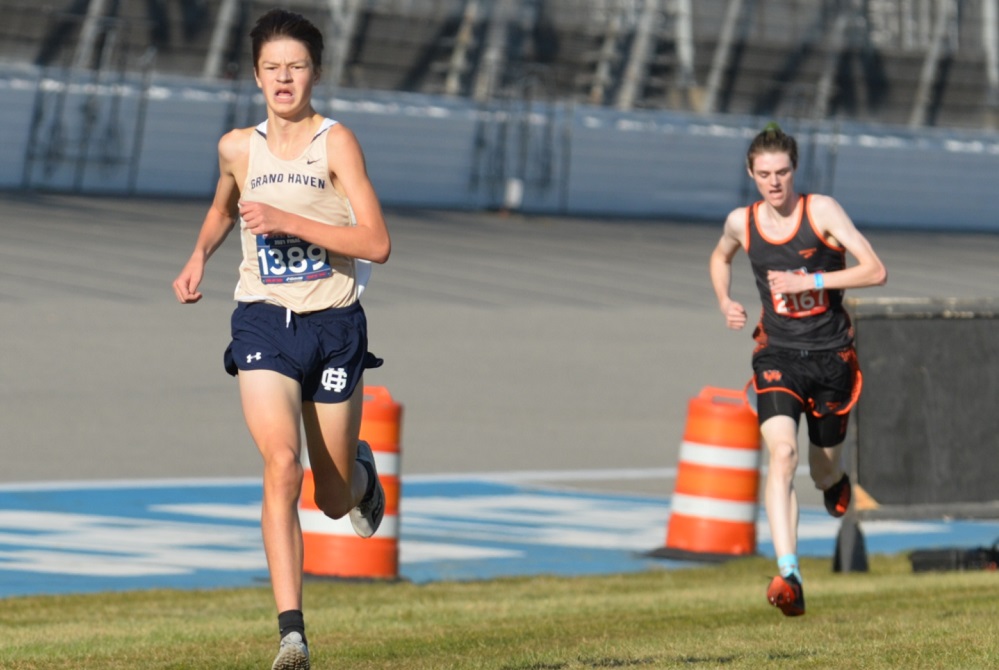
PHOTO Grand Haven’s Seth Norder, left, and Grand Rapids Ottawa Hills’ Benne Anderson enter the final stretch during last season’s LPD1 Final. (Click for more from RunMichigan.com.)