


New Math: Division & Multiplication Problems
July 25, 2017
By Jack Roberts
MHSAA Executive Director
This is the second part in a series on MHSAA tournament classification, past and present, that will be published over the next two weeks. This series originally ran in this spring's edition of MHSAA benchmarks.
High school tournament classifications went viral before there was social media and most of us knew what “viral” meant.
Much as a virus infects computers today or has created epidemics of disease around the world for centuries, high school tournament classification – once introduced – tends to spread uncontrollably. Once started, it tends to keep expanding and rarely contracts.
While we are still some distance from providing every team a trophy as a result of expanding high school tournament classification across the country, there is criticism nevertheless that we are headed in that direction – a philosophy which is supposed to exist only in local youth sports for our youngest children.
Michigan could be blamed for all this. Michigan is generally accepted as the first state to provide different classifications for season-ending tournaments for different sized schools. It started a century ago. Today, every state has various classifications for its tournaments in most if not all sports. And it is a bit ironic that Michigan – creator of the classification chaos – more than most other states has kept the number of tournament classes or divisions under control.
Yes, there is evidence that tournament classifications have expanded over the years in Michigan, especially with the relatively recent introduction of tournaments in football and the late 1990s’ move from classes to divisions in most MHSAA tournaments. But the MHSAA Representative Council has held true to its word when it expanded the playoffs for football from four classes to eight divisions: this is needed because of unique factors of football, factors that exist in no other sport; and all other sports should be capped at a maximum of four classes or divisions.
Kentucky is the preeminent defender of single-class basketball. All of its 276 high schools compete for the single state championship for each gender. In Indiana, there are still open wounds from its move in 1998 from one to four classes for its 400 schools in basketball.
Multi-class tournaments have tended to increase the number of non-public school champions, which some states are trying to lower through enrollment “multipliers,” and also tend to increase the number of repeat champions, which some states are trying to affect with “success factors” which lift smaller schools into classifications for larger schools if they take home too many trophies.
While there is considerable evidence that state tournaments do as much bad as good for educational athletics, state associations persist in providing postseason tournaments because, on balance, the experiences are supposed to be good for student-athletes. And once we reach that conclusion it is just a small leap to believe that if the tournaments are good for a few, they must be better for more – which leads to creating more and more tournament classifications. One becomes two classes, then three, then four and so forth.
While the argument is that more classifications or divisions provides more students with opportunities to compete and win, it is undeniable that the experience changes as the number of tournament classifications expands. It is not possible for state associations to provide the same level of support when tournament classifications expand to multiple venues playing simultaneously. For example, there is less audio and video broadcast potential at each venue, and less media coverage to each venue. Focus is diluted and fans diminished at each championship.
No one can argue reasonably that today's two-day MHSAA Football Finals of eight championship games has the same pizazz as the one-day, four-games event conducted prior to 1990.
In some states the number of divisions has grown so much that it is difficult to see much difference between the many season-ending state championship games and a regular-season event in the same sport.
It is a balancing act. And Michigan has been studying that balance longer than any other state, and charting a steadier course than most.
Addition by Division
The shift to Divisions for MHSAA Tournament play in numerous sports has added up to a greater number of champions for teams and individuals across the state. Following are the sports currently employing a divisional format, and the procedures for determining enrollment and classification.
In 23 statewide or Lower Peninsula tournaments, schools which sponsor the sport are currently divided into nearly equal divisions. They are:
- Baseball - 4 Divisions
- Boys Bowling - 4 Divisions
- Girls Bowling - 4 Divisions
- Girls Competitive Cheer - 4 Divisions
- LP Boys Cross Country - 4 Divisions
- LP Girls Cross Country - 4 Divisions
- LP Boys Golf - 4 Divisions
- LP Girls Golf - 4 Divisions
- Ice Hockey - 3 Divisions
- Boys Lacrosse - 2 Divisions
- Girls Lacrosse - 2 Divisions
- Boys Skiing - 2 Divisions
- Girls Skiing - 2 Divisions
- LP Boys Soccer - 4 Divisions LP
- Girls Soccer - 4 Divisions
- Girls Softball - 4 Divisions
- LP Boys Swimming & Diving - 3 Divisions
- LP Girls Swimming & Diving - 3 Divisions
- LP Boys Tennis - 4 Divisions
- LP Girls Tennis - 4 Divisions
- LP Boys Track & Field - 4 Divisions
- LP Girls Track & Field - 4 Divisions
- Wrestling - 4 Divisions
Lists of schools for each division of these 23 tournaments are posted on MHSAA.com approximately April 1. Listings of schools in Upper Peninsula tournaments for their sports are also posted on MHSAA.com. The lists are based on school memberships and sports sponsorships in effect or anticipated for the following school year, as known to the MHSAA office as of a date in early March.
In football, the 256 schools which qualify for MHSAA 11-player playoffs are placed in eight equal divisions annually on Selection Sunday. Beginning in 2017, the 8-player divisions will be determined in a like manner on Selection Sunday as well, with 32 qualifying schools placed in two divisions.
Schools have the option to play in any higher division in one or more sports for a minimum of two years.
The deadlines for "opt-ups" are as follows:
- Applications for fall sports must be submitted by April 15
- Applications for winter sports must be submitted by Aug. 15
- Applications for spring sports must be submitted by Oct. 15
Subsequent to the date of these postings for these tournaments, no school will have its division raised or lowered by schools opening or closing, schools adding or dropping sports, schools exercising the option to play in a higher division, or approval or dissolution of cooperative programs.
When the same sport is conducted for boys and girls in the same season (e.g., track & field and cross country), the gender that has the most sponsoring schools controls the division breaks for both genders.
D-Coach Stratton, QB Son Leaving Family Mark on Whitehall's Undefeated Run
By
Tom Kendra
Special for MHSAA.com
November 2, 2022
Keith Stratton may be an assistant coach, but that doesn’t necessarily mean he has the best vantage point of his son Kyle, Whitehall’s standout junior quarterback.
 “I actually miss most of his plays,” explained Keith Stratton, who is in his 10th year as the Vikings’ defensive coordinator.
“I usually have my back to the field, talking to my (defensive) guys. I know he did something good from the roar of the crowd or the PA announcer.”
Kyle Stratton – whose trademark, flowing blonde locks seem to atone for his dad’s bald look – has done plenty of good this fall, leading his team to a West Michigan Conference Lakes title, a No. 2 ranking in Division 4 and a 10-0 record. The Vikings’ closest game since Labor Day was a 42-12 win over Big Rapids in last week’s playoff opener.
Whitehall will face a stiffer challenge in Friday’s Division 4 District title game against Fruitport (8-2), winner of six in a row and tri-champions of the Ottawa-Kent Conference Blue.
“It’s been a great season, but we still have a lot of unfinished business,” said Kyle, 17, who also plays basketball and baseball. “We’re motivated to bring new things to Whitehall which we haven’t had before.”
Whitehall’s longest postseason runs came in 2003 and 2014, both ending in Regional Finals. The goal this year is to sail into uncharted waters – i.e., the Semifinals and then the Finals at Ford Field, for the first time in school history.
Stratton (5-foot-8, 170 pounds) gives the Vikings a great shot with his ability to run and pass out of the veer offense. He has been a great runner since earning the starting QB job as a sophomore, and is the team’s leading rusher with 99 carries for 802 yards and 14 TDs. But his emergence as a highly-accurate passer has elevated Whitehall’s offense to a new level, as he’s completed 72-of-112 passes (64 percent) for 1,362 yards, with 24 TDs and six interceptions.
Stratton uses all of his weapons through the air, including wideouts Trannon Aylor and Camden Thompson and slotbacks Nate Bolley, Malcolm Earvin and Ca’Mar Ready.
“Kyle has worked so hard and essentially doubled his statistics from a year ago,” said 10th-year Whitehall coach Tony Sigmon, a former standout linebacker at DeWitt and Alma College. “He always has the ability to take off and run, but he now has the patience to scramble and still be looking downfield for his receivers.”
 Whitehall’s offense, directed by Kyle Stratton and averaging 51 points per game, has received plenty of accolades this fall. But the Vikings’ stingy defense, under the tutelage of Keith Stratton, might be the key to a postseason run.
Keith Stratton, known for his backwards baseball cap and hands-on-his-knees stance before each play, directs an ultra-aggressive unit which has allowed a total of 40 points over the past two months.
“I don’t wear a headset; it clouds my brain,” Keith said with a laugh.
His blue-collar mentality is instilled in his defense, which is led by senior inside linebackers Graycen Shepherd and Jackson Cook.
“People ask me what it’s like to coach my son, but really, I look at all of these kids like my sons,” said Stratton, who is married to Jodi, and the couple has two older sons, Caleb and Andrew. “They are all thinkers. They come up to me and ask questions. They have exceeded my expectations.”
Stratton, a 1990 graduate of Muskegon Catholic Central, walked-on to the football team at Grand Valley State and was one of eight walk-ons out of 50 to earn a spot on the roster, playing backup fullback and on the scout team.
He majored in criminal justice and went on to work for the City of Muskegon Police Department for 25 years, retiring last year. Early in his career as a cop, he coached eight years of junior varsity football at Muskegon Catholic, then started coaching at Whitehall in 2010. When Sigmon took the head coaching job in 2013, one of the first things he did was name Stratton his defensive coordinator.
“We had been coaching defense together (under previous coach Cliff Sandee), and when we would compare notes before practice, it was like looking in a mirror,” said Sigmon, who is also aided by offensive coordinator CJ VanWieren. “So I was very comfortable putting Keith in charge of the defense. We’ve been at it for 10 years now, and he’s done a great job of growing and progressing as a coach.”
Stratton’s defense will be put to the test against a Fruitport offense which features a big offensive line and the senior twin duo of running back Paschal Jolman and quarterback Collin Jolman.
Paschal already has eclipsed 2,000 rushing yards through 10 games, with 146 carries for 2,028 yards (13.8 per carry) and 25 TDs. Collin has completed 65-of-111 passes for 1,284 yards and 14 TDS, while also scrambling 96 times for 825 yards and 17 TDs.
“Fruitport is balanced and tricky and fast and big,” said Keith Stratton, who grew up in Fruitport. “They break a ton of big plays. We need to limit those big plays and make them work for everything.”
Fruitport turned some heads and gained major respect back on Oct. 7, when it upset then-undefeated and Division 6 top-ranked Grand Rapids West Catholic, 28-20. Since that thrilling signature win, the Trojans have been riding high, scoring an average of 56 points over the past three weeks.
The only time Keith Stratton ever puts on a headset is when his son is on the field directing the Vikings’ offense. While he said it would be nice to watch his son live, his time is better used talking to the other coaches in the booth to make defensive adjustments.
Kyle, meanwhile, said he is motivated by his dad and wants to follow in his footsteps as a college football player and then taking up a career in law enforcement.
“I respect him a lot,” said Kyle. “He’s told me a lot of stories about his time as a cop – going out at 2 a.m. and risking his life. That motivates me more than he even knows.
“If he can do that, I can go out there every Friday night and give every ounce of what I have for my town, and my team, and my friends.”
 Tom Kendra worked 23 years at The Muskegon Chronicle, including five as assistant sports editor and the final six as sports editor through 2011. E-mail him at [email protected] with story ideas for Muskegon, Oceana, Mason, Lake, Oceola, Mecosta and Newaygo counties.
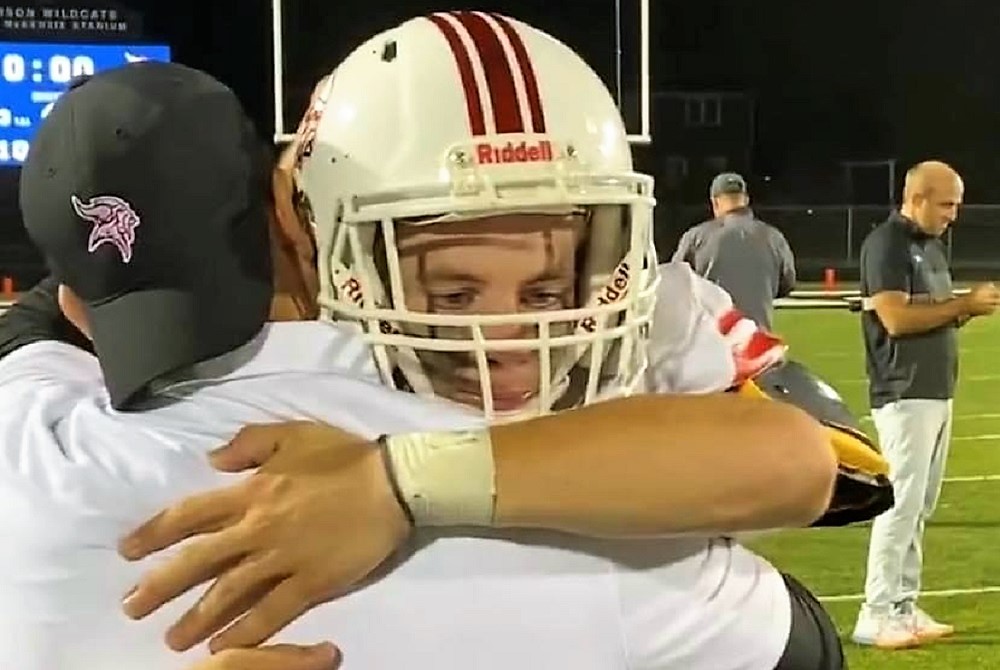
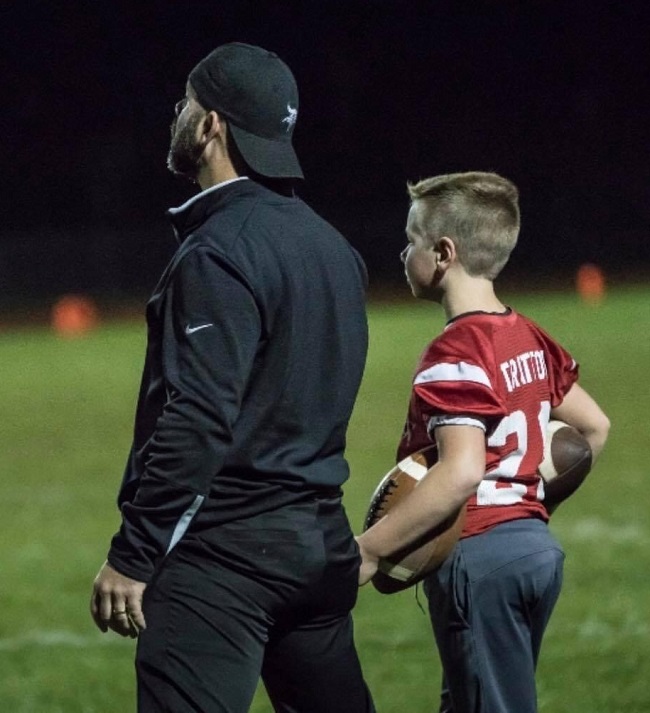
PHOTOS (Top) Whitehall quarterback Kyle Stratton embraces his father Keith after a game this season. (Middle) Keith Stratton, left, and Kyle man the sidelines during Kyle’s younger years supporting the program. (Photos courtesy of Jodi Stratton.)