

New Math: Division & Multiplication Problems
July 25, 2017
By Jack Roberts
MHSAA Executive Director
This is the second part in a series on MHSAA tournament classification, past and present, that will be published over the next two weeks. This series originally ran in this spring's edition of MHSAA benchmarks.
High school tournament classifications went viral before there was social media and most of us knew what “viral” meant.
Much as a virus infects computers today or has created epidemics of disease around the world for centuries, high school tournament classification – once introduced – tends to spread uncontrollably. Once started, it tends to keep expanding and rarely contracts.
While we are still some distance from providing every team a trophy as a result of expanding high school tournament classification across the country, there is criticism nevertheless that we are headed in that direction – a philosophy which is supposed to exist only in local youth sports for our youngest children.
Michigan could be blamed for all this. Michigan is generally accepted as the first state to provide different classifications for season-ending tournaments for different sized schools. It started a century ago. Today, every state has various classifications for its tournaments in most if not all sports. And it is a bit ironic that Michigan – creator of the classification chaos – more than most other states has kept the number of tournament classes or divisions under control.
Yes, there is evidence that tournament classifications have expanded over the years in Michigan, especially with the relatively recent introduction of tournaments in football and the late 1990s’ move from classes to divisions in most MHSAA tournaments. But the MHSAA Representative Council has held true to its word when it expanded the playoffs for football from four classes to eight divisions: this is needed because of unique factors of football, factors that exist in no other sport; and all other sports should be capped at a maximum of four classes or divisions.
Kentucky is the preeminent defender of single-class basketball. All of its 276 high schools compete for the single state championship for each gender. In Indiana, there are still open wounds from its move in 1998 from one to four classes for its 400 schools in basketball.
Multi-class tournaments have tended to increase the number of non-public school champions, which some states are trying to lower through enrollment “multipliers,” and also tend to increase the number of repeat champions, which some states are trying to affect with “success factors” which lift smaller schools into classifications for larger schools if they take home too many trophies.
While there is considerable evidence that state tournaments do as much bad as good for educational athletics, state associations persist in providing postseason tournaments because, on balance, the experiences are supposed to be good for student-athletes. And once we reach that conclusion it is just a small leap to believe that if the tournaments are good for a few, they must be better for more – which leads to creating more and more tournament classifications. One becomes two classes, then three, then four and so forth.
While the argument is that more classifications or divisions provides more students with opportunities to compete and win, it is undeniable that the experience changes as the number of tournament classifications expands. It is not possible for state associations to provide the same level of support when tournament classifications expand to multiple venues playing simultaneously. For example, there is less audio and video broadcast potential at each venue, and less media coverage to each venue. Focus is diluted and fans diminished at each championship.
No one can argue reasonably that today's two-day MHSAA Football Finals of eight championship games has the same pizazz as the one-day, four-games event conducted prior to 1990.
In some states the number of divisions has grown so much that it is difficult to see much difference between the many season-ending state championship games and a regular-season event in the same sport.
It is a balancing act. And Michigan has been studying that balance longer than any other state, and charting a steadier course than most.
Addition by Division
The shift to Divisions for MHSAA Tournament play in numerous sports has added up to a greater number of champions for teams and individuals across the state. Following are the sports currently employing a divisional format, and the procedures for determining enrollment and classification.
In 23 statewide or Lower Peninsula tournaments, schools which sponsor the sport are currently divided into nearly equal divisions. They are:
- Baseball - 4 Divisions
- Boys Bowling - 4 Divisions
- Girls Bowling - 4 Divisions
- Girls Competitive Cheer - 4 Divisions
- LP Boys Cross Country - 4 Divisions
- LP Girls Cross Country - 4 Divisions
- LP Boys Golf - 4 Divisions
- LP Girls Golf - 4 Divisions
- Ice Hockey - 3 Divisions
- Boys Lacrosse - 2 Divisions
- Girls Lacrosse - 2 Divisions
- Boys Skiing - 2 Divisions
- Girls Skiing - 2 Divisions
- LP Boys Soccer - 4 Divisions LP
- Girls Soccer - 4 Divisions
- Girls Softball - 4 Divisions
- LP Boys Swimming & Diving - 3 Divisions
- LP Girls Swimming & Diving - 3 Divisions
- LP Boys Tennis - 4 Divisions
- LP Girls Tennis - 4 Divisions
- LP Boys Track & Field - 4 Divisions
- LP Girls Track & Field - 4 Divisions
- Wrestling - 4 Divisions
Lists of schools for each division of these 23 tournaments are posted on MHSAA.com approximately April 1. Listings of schools in Upper Peninsula tournaments for their sports are also posted on MHSAA.com. The lists are based on school memberships and sports sponsorships in effect or anticipated for the following school year, as known to the MHSAA office as of a date in early March.
In football, the 256 schools which qualify for MHSAA 11-player playoffs are placed in eight equal divisions annually on Selection Sunday. Beginning in 2017, the 8-player divisions will be determined in a like manner on Selection Sunday as well, with 32 qualifying schools placed in two divisions.
Schools have the option to play in any higher division in one or more sports for a minimum of two years.
The deadlines for "opt-ups" are as follows:
- Applications for fall sports must be submitted by April 15
- Applications for winter sports must be submitted by Aug. 15
- Applications for spring sports must be submitted by Oct. 15
Subsequent to the date of these postings for these tournaments, no school will have its division raised or lowered by schools opening or closing, schools adding or dropping sports, schools exercising the option to play in a higher division, or approval or dissolution of cooperative programs.
When the same sport is conducted for boys and girls in the same season (e.g., track & field and cross country), the gender that has the most sponsoring schools controls the division breaks for both genders.
Several Northern Michigan Hopefuls Setting Up for Potential Postseason Success
By
Tom Spencer
Special for MHSAA.com
September 9, 2022
Not a whole lot is changing — yet — in the Big North, Northwest and Lake Michigan soccer conferences this year.
 Traverse City Christian, an independent, is taking on schools from all three and wants a different District result to get back to Regionals this fall. And, perhaps surprisingly, Kalkaska is looking to change things too.
Traverse City West, Elk Rapids and Christian loaded up their early season with strong nonconference competition. Nothing new. And Leland and Buckley, fast becoming arguably the biggest rivals in northern Michigan, did the best they could to schedule nonconference competition aimed at leading to yet another deep postseason run.
Of course West and Elk Rapids have their eyes on the postseason — again — as well.
West, coming off its annual Labor Day weekend tournament hosting Grand Haven, Midland Dow and Mason, is off to a 6-1 start, posting shutouts in its first four contests. Christian is 5-1-1.
Elk Rapids is off to a 2-5-1 start. That’s not a misprint.
And, by the way, Kalkaska is undefeated in regulation in its first six games.
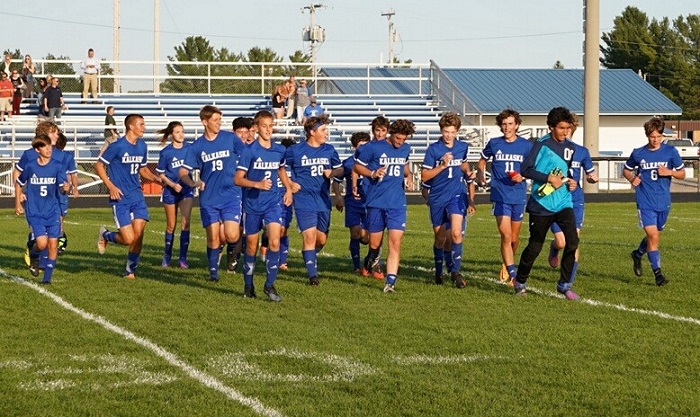
That’s not an error either. Third-year coach David Wagner has his Blazers playing well and has seen some stellar goaltending by junior Kayden Dueweke-Gonzales. A shootout loss is the only blemish.
Wagner is hoping his team can pick up more wins than has been the case for some time for the Blazers in the Lake Michigan Conference.
“I think we will be much more competitive than we were last year,” Wagner said of the Blazers, who are 5-1 overall and 2-0 in Lake Michigan play.
 Nate Plum, now is his 15th year at the helm of Elk Rapids, is not overly concerned about his team’s win-loss record at this moment. He’s more concerned with the Elks learning from their experiences and hopes he will see stronger competition in the Lake Michigan Conference this year from teams like Kalkaska.
Despite what many would call a slow start, the Elks are still rated among the state’s top Division 3 soccer teams and are drawing the attention of the soccer community across the state.
Elk Rapids has made many postseason runs under Plum, who came into this fall with a 241-102-33 record as the Elks coach. Elk Rapids reached the Division 3 Semifinals last season before losing a shootout to the eventual champion, Grand Rapids South Christian. The Elks also reached the Semifinals in 2020, falling to South Christian. Elk Rapids has won four straight District titles, the last two in part because of one-goal and shootout wins over TC Christian.
The Elks prioritize playing teams like they may see at the end of the season, allowing the competition and conditions to force improvements. Teams are getting stronger in the Lake Michigan Conference, Plum is excited to note, but Elk Rapids hasn’t lost a league game in five years.
So the Elks have looked for opportunities to play on turf and tough environments like TC West and East Grand Rapids.
“The boys would rather be playing in late October than racking up wins now,” Plum said. “I know I’ve got to put them in situations where they have to get better — the only way the boys can get better sometimes is play games we’re not going to have the ball the entire time and they’re going to challenge us and put us in uncomfortable spots.
“When the games really matter at the end of the year and we find ourself in tough situations, we can say, ‘We’ve been in something like this, and we’ve seen it before,’” he continued. “Maybe putting us in those situations are more important to me than wins.”
TC Christian, a long-time regular and postseason opponent of the Elks, has its eyes set on knocking off the Elks in the District this time.
 The Sabres are getting closer, but they haven’t made a Regional appearance since 2010. They will host the Elks on Sept. 20.
Roy Jay Montney, who owns a 37-10-3 record with the Sabres, said since they are independent, his program schedules every game with the postseason in mind.
“We are not in a league, so we are thinking of the postseason,” Montney said. “We’re preparing for the postseason each game.”
The coaches share mutual respect.
“Elk Rapids is great program,” Montney said. “They’ve put together a consistent team and program for years.
“They will be strong and they will come out to play, and hopefully we’ll be ready for it.”
Christian is not ready to focus on the Elks yet. They will play Holland, Midland and Traverse City Central before that Sept. 20 meeting on the pitch.
“They’re (Sabres) tough competition, no question about that,” said Plum. “A lot of times I feel the one during the season is a soccer game and the next one is a bunch of emotion.
“Nobody wants to lose come October, and everyone is playing like it’s their last game,” Plum continued. “They have to make it really tough to win the District and you’ve got to give them credit for that.”
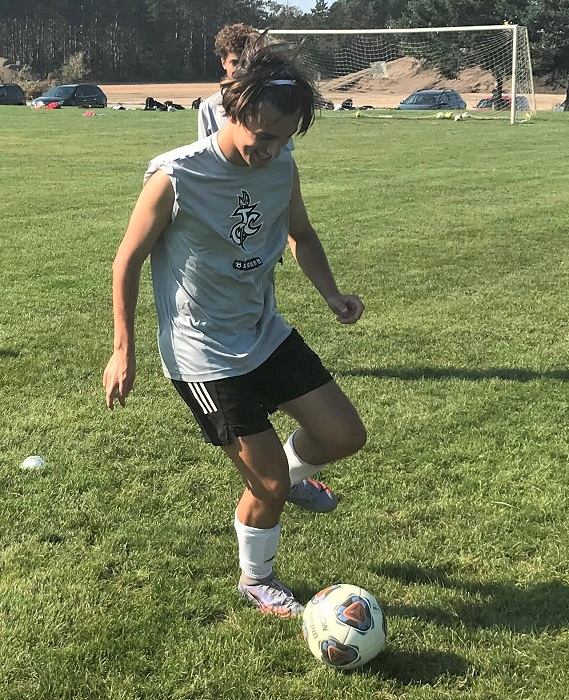
The Elks have been led by junior Alex Smith, who has four goals and two assists so far. The Sabres have been led by senior Henry Reineck’s six goals and one assist.
Buckley, coming off its first Northwest Conference championship won last fall, is hoping to repeat but again must get past perennial league champ Leland (2-2-1), which has made many deep postseason runs including to the Division 4 championship in 2018.
Leland reached the Regionals in 2019 and 2020 before suffering a 1-0 District championship loss to Buckley in 2021. Rob Sirrine, now in his second year as the head coach, was an assistant coach for the Comets during those runs.
“We’ve got a really young team this year and are excited to see which underclassmen step up and contribute,” said Sirrine. “Our goal is to make it to Regional Finals at a minimum.
 “We’ve had a few solid games and a few lackluster games so far, but it’s early,” he continued. “We’ll be working out the kinks over the next several weeks to be ready for playoffs this year.”
The playoffs will come after home and away games with Buckley in league play. The Bears and Comets are competing in different Division 4 Districts this year. Instead of loading up the nonleague schedule, capturing a league crown is critical to the Bears’ postseason preparation, veteran coach John Vermilya pointed out.
“We haven’t gone to the lengths of like Elk Rapids, TC Christian and Leland,” he said. “They’re always playing the biggest dog they can get.
“We’re trying to get a flavor of what is outside of our conference,” he continued. “We are just trying to win games and get one of the two seeds in District play.”
The Bears are going into a game today with Manistee, a Division 3 team, at 4-3-1. They’ve recently benefited from two Spanish and one Italian exchange student entering the district.
Buckley lost to eventual Division 4 champion Wyoming Potter’s House Christian in a Regional Semifinal last year.
Meanwhile, Traverse City West (6-1) is eying another postseason run and taking on Holland on Saturday. The Titans picked up a win in their conference opener Thursday over Petoskey.
Since taking over the West helm in 2015, Matt Griesinger has guided the Titans to a 123-30-15 record, District championships the last three seasons and Division 1 Finals appearances in 2019 and 2020.
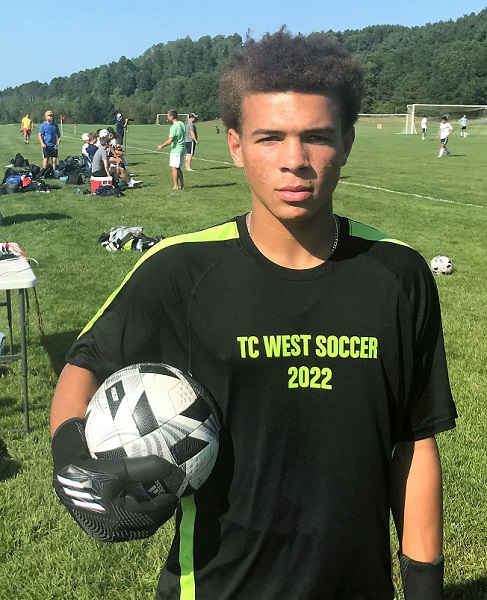
The Titans have won the Big North Conference the last 12 years. Griesinger credits senior goalie Trae Collins for much of the early success this fall. Collins has a goals-against average of 0.81 through seven games.
Petoskey dropped to 6-5 overall with the West loss.
 Tom Spencer is a longtime MHSAA-registered basketball and soccer official, and former softball and baseball official, and he also has coached in the northern Lower Peninsula area. He previously has written for the Saginaw News, Bay County Sports Page and Midland Daily News. He can be reached at [email protected] with story ideas for Manistee, Wexford, Missaukee, Roscommon, Ogemaw, Iosco, Alcona, Oscoda, Crawford, Kalkaska, Grand Traverse, Benzie, Leelanau, Antrim, Otsego, Montmorency, Alpena, Presque Isle, Cheboygan, Charlevoix and Emmet counties.
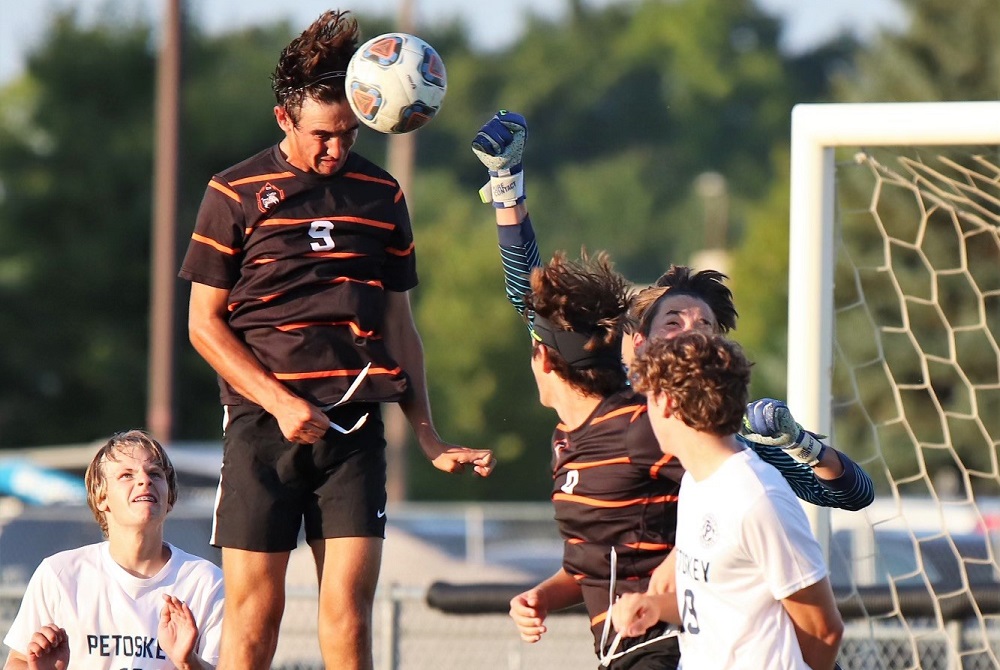
PHOTOS (Top) Elk Rapids' Caden Moore (9) gets his head on the ball during an Aug. 23 game against Petoskey. (2) Keeper Kayden Dueweke-Gonzales leads Kalkaska in its warm up before Thursday’s win over Boyne City. (3) Henry Reineck kicks the ball around during a Traverse City Christian practice. (4) Traverse City West keeper Trae Collins takes a moment during his school’s junior varsity game. (Top photo by Kate Parrish, Kalkaska photo courtesy of the Blazers’ athletic department, and Traverse City Christian and West photos by Tom Spencer.)