


New Math: Division & Multiplication Problems
July 25, 2017
By Jack Roberts
MHSAA Executive Director
This is the second part in a series on MHSAA tournament classification, past and present, that will be published over the next two weeks. This series originally ran in this spring's edition of MHSAA benchmarks.
High school tournament classifications went viral before there was social media and most of us knew what “viral” meant.
Much as a virus infects computers today or has created epidemics of disease around the world for centuries, high school tournament classification – once introduced – tends to spread uncontrollably. Once started, it tends to keep expanding and rarely contracts.
While we are still some distance from providing every team a trophy as a result of expanding high school tournament classification across the country, there is criticism nevertheless that we are headed in that direction – a philosophy which is supposed to exist only in local youth sports for our youngest children.
Michigan could be blamed for all this. Michigan is generally accepted as the first state to provide different classifications for season-ending tournaments for different sized schools. It started a century ago. Today, every state has various classifications for its tournaments in most if not all sports. And it is a bit ironic that Michigan – creator of the classification chaos – more than most other states has kept the number of tournament classes or divisions under control.
Yes, there is evidence that tournament classifications have expanded over the years in Michigan, especially with the relatively recent introduction of tournaments in football and the late 1990s’ move from classes to divisions in most MHSAA tournaments. But the MHSAA Representative Council has held true to its word when it expanded the playoffs for football from four classes to eight divisions: this is needed because of unique factors of football, factors that exist in no other sport; and all other sports should be capped at a maximum of four classes or divisions.
Kentucky is the preeminent defender of single-class basketball. All of its 276 high schools compete for the single state championship for each gender. In Indiana, there are still open wounds from its move in 1998 from one to four classes for its 400 schools in basketball.
Multi-class tournaments have tended to increase the number of non-public school champions, which some states are trying to lower through enrollment “multipliers,” and also tend to increase the number of repeat champions, which some states are trying to affect with “success factors” which lift smaller schools into classifications for larger schools if they take home too many trophies.
While there is considerable evidence that state tournaments do as much bad as good for educational athletics, state associations persist in providing postseason tournaments because, on balance, the experiences are supposed to be good for student-athletes. And once we reach that conclusion it is just a small leap to believe that if the tournaments are good for a few, they must be better for more – which leads to creating more and more tournament classifications. One becomes two classes, then three, then four and so forth.
While the argument is that more classifications or divisions provides more students with opportunities to compete and win, it is undeniable that the experience changes as the number of tournament classifications expands. It is not possible for state associations to provide the same level of support when tournament classifications expand to multiple venues playing simultaneously. For example, there is less audio and video broadcast potential at each venue, and less media coverage to each venue. Focus is diluted and fans diminished at each championship.
No one can argue reasonably that today's two-day MHSAA Football Finals of eight championship games has the same pizazz as the one-day, four-games event conducted prior to 1990.
In some states the number of divisions has grown so much that it is difficult to see much difference between the many season-ending state championship games and a regular-season event in the same sport.
It is a balancing act. And Michigan has been studying that balance longer than any other state, and charting a steadier course than most.
Addition by Division
The shift to Divisions for MHSAA Tournament play in numerous sports has added up to a greater number of champions for teams and individuals across the state. Following are the sports currently employing a divisional format, and the procedures for determining enrollment and classification.
In 23 statewide or Lower Peninsula tournaments, schools which sponsor the sport are currently divided into nearly equal divisions. They are:
- Baseball - 4 Divisions
- Boys Bowling - 4 Divisions
- Girls Bowling - 4 Divisions
- Girls Competitive Cheer - 4 Divisions
- LP Boys Cross Country - 4 Divisions
- LP Girls Cross Country - 4 Divisions
- LP Boys Golf - 4 Divisions
- LP Girls Golf - 4 Divisions
- Ice Hockey - 3 Divisions
- Boys Lacrosse - 2 Divisions
- Girls Lacrosse - 2 Divisions
- Boys Skiing - 2 Divisions
- Girls Skiing - 2 Divisions
- LP Boys Soccer - 4 Divisions LP
- Girls Soccer - 4 Divisions
- Girls Softball - 4 Divisions
- LP Boys Swimming & Diving - 3 Divisions
- LP Girls Swimming & Diving - 3 Divisions
- LP Boys Tennis - 4 Divisions
- LP Girls Tennis - 4 Divisions
- LP Boys Track & Field - 4 Divisions
- LP Girls Track & Field - 4 Divisions
- Wrestling - 4 Divisions
Lists of schools for each division of these 23 tournaments are posted on MHSAA.com approximately April 1. Listings of schools in Upper Peninsula tournaments for their sports are also posted on MHSAA.com. The lists are based on school memberships and sports sponsorships in effect or anticipated for the following school year, as known to the MHSAA office as of a date in early March.
In football, the 256 schools which qualify for MHSAA 11-player playoffs are placed in eight equal divisions annually on Selection Sunday. Beginning in 2017, the 8-player divisions will be determined in a like manner on Selection Sunday as well, with 32 qualifying schools placed in two divisions.
Schools have the option to play in any higher division in one or more sports for a minimum of two years.
The deadlines for "opt-ups" are as follows:
- Applications for fall sports must be submitted by April 15
- Applications for winter sports must be submitted by Aug. 15
- Applications for spring sports must be submitted by Oct. 15
Subsequent to the date of these postings for these tournaments, no school will have its division raised or lowered by schools opening or closing, schools adding or dropping sports, schools exercising the option to play in a higher division, or approval or dissolution of cooperative programs.
When the same sport is conducted for boys and girls in the same season (e.g., track & field and cross country), the gender that has the most sponsoring schools controls the division breaks for both genders.
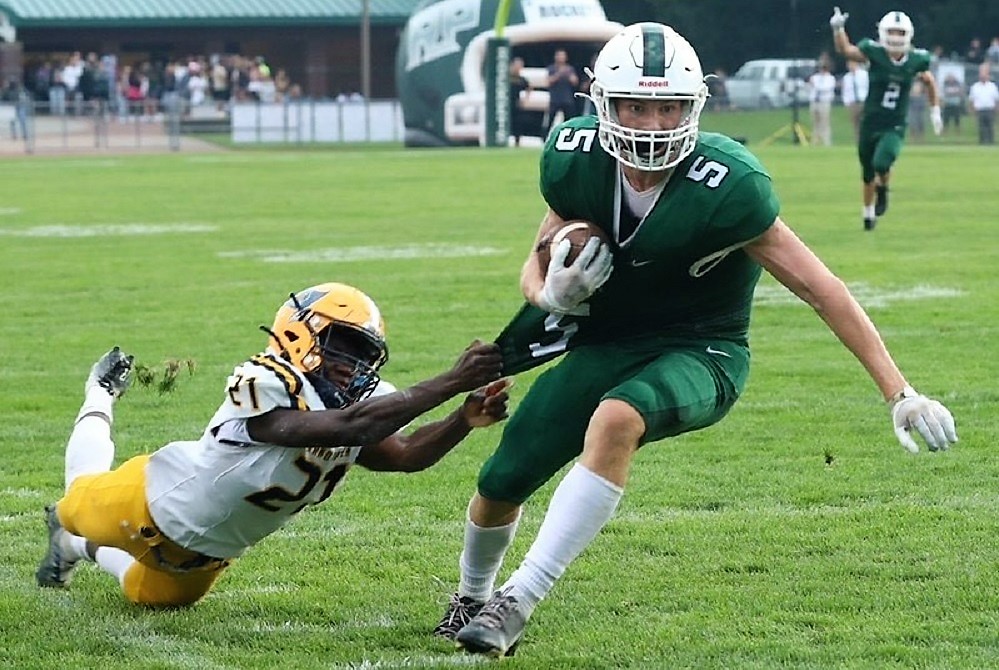
VanderLeest Working to Help Reeths-Puffer Make Most of Opportunities Ahead
By
Tom Kendra
Special for MHSAA.com
September 7, 2022
Tayte VanderLeest is a prototypical receiver and safety, with great size (6-foot-4, 200 pounds) and speed (4.5 seconds in the 40-yard dash).
 Muskegon Reeths-Puffer first-year coach Cody Kater also gushes about the senior’s work ethic and attitude, and concludes by saying, “He’s the kind of kid you want to date your daughter.”
Weaknesses?
“I would say he’s too nice,” said Kater, a two-time all-stater at Montague who went on to play quarterback at Grand Rapids Community College and Central Michigan. “We’d like to see him a little grittier, but he’s a gamer and I have seen him flip that switch. I expect him to do that this Friday night.”
Reeths-Puffer (2-0) plays one of its biggest football games in years Friday, when it travels across town to face Muskegon (1-1) in the Ottawa-Kent Conference Green opener for both teams.
Historically, it hasn’t been much of a game, with Muskegon holding a lopsided 22-1-1 edge in the all-time series, and with most of those games in the blowout category. Muskegon has won the past nine games by an average of 44 points.
That puts the Rockets into a somewhat ideal position – no pressure, but with the opportunity to make a huge statement.
“It’s very exciting,” said VanderLeest, a returning all-conference receiver who has received interest from several Mid-American Conference schools including Central Michigan, Eastern Michigan and Miami (Ohio). “We are 2-0, which is great, but this is the kind of game where we can really prove ourselves. We want to show that we belong in big games like this.”
Puffer opened the season with a convincing 32-20 win over visiting Grand Haven, then hit the road last Thursday for a 38-14 win over St. Johns.
Muskegon, meanwhile, has not looked like its normal dominating self thus far (although playing a pair of strong opponents certainly has been a contributing factor). The Big Reds rallied from an eight-point, fourth-quarter deficit for a 20-14 win over visiting East Kentwood in the opener, then lost 49-16 on Friday to reigning Division 2 champion Warren De La Salle Collegiate. East Kentwood bounced back last week to defeat Bloomfield Hills Brother Rice, and De La Salle hasn’t lost since the 2020 Division 2 championship game.
Some of the issues for Muskegon are injuries and youth, with 13th-year head coach Shane Fairfield looking for more seniors to step up in leadership roles.
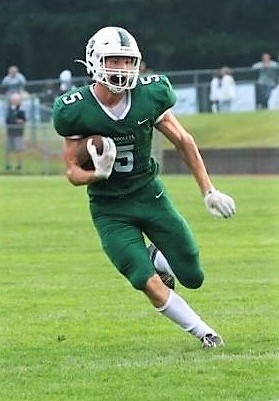 VanderLeest and other strong senior leaders like quarterback Brady Ross and center/defensive tackle Hunter Allison have sparked the Rockets’ quick start. The soft-spoken VanderLeest is more of a leader-by-example, although Kater said he has noticed him becoming more vocal with the younger receivers and defensive backs.
VanderLeest is one of those players who has football in his blood, literally, as his father Rob VanderLeest was an all-state lineman at Muskegon Catholic Central and went on to play four years at Michigan under Gary Moeller and Lloyd Carr.
“Football is in my DNA,” explained Tayte VanderLeest. “It’s been part of my life as long as I can remember. Now I’m a senior, and I feel the pressure on me to live up to the standards that my dad set.”
He will play a key role defensively from his strong safety spot, where one of his main duties will be trying to tackle Muskegon’s dynamic junior duo of running back Jakob Price and slotback Destin Piggee, preventing long TD runs and forcing the Big Reds to march the ball down the field.
VanderLeest had five tackles and an interception last week at St. Johns, in a game that was tied at halftime before Puffer pulled away with a 24-0 scoring edge in the second half.
“He has a knack defensively for knowing where he needs to be and always ending up around the ball,” explained Kater, who also was the offensive coordinator at Montague during the 2020 season, helping the Wildcats to an undefeated record and the Division 6 championship. “A lot of that stuff you can’t really teach. Because of that, we’re letting him roam around a little bit back there.”
On offense, VanderLeest and fellow senior wideout Clyde Bartee are the Rockets’ home run threats. Kater also lauded the stalk blocking of that duo during the first two games, allowing Ross and junior running back Brody Johnson to find running room downfield.
VanderLeest, who had five touchdown receptions last year en route to first-team all-OK Green honors, had a big game offensively in the opener against Grand Haven, making six catches for 106 yards – highlighted by a 47-yard touchdown reception.
Another storyline going into Friday’s game involves Kater, who played for former Muskegon coach Tony Annese at GRCC and was hired last spring as Muskegon’s offensive coordinator. However, Kater departed shortly thereafter to join former Lowell coach Noel Dean’s staff in Tipton, Ga. Kater then returned to West Michigan on Dec. 31, when he was named Puffer’s new coach.
Kater, 30, is calling the offensive plays for R-P, while his former CMU teammate Alex Smith – who most recently served as head coach at Holton – is the defensive coordinator.
The bigger goal for the Rockets, beyond this week’s showdown at historic Hackley Stadium, is to get into the playoffs and then win a playoff game – something they have not done in 30 years since their memorable, undefeated 1992 season, which ended with a Class A title.
Puffer has qualified for the playoffs five times since that championship season, but each of those postseason appearances were “one and done.”
Kater is encouraged that R-P has enough high school football players to field freshman, junior varsity and varsity teams – something that less than half of the teams in the O-K Green can claim. He also notes that the Rockets have good athletes and numbers in their middle school and youth programs.
He believes this year’s senior leaders like VanderLeest, who hung in there through a 3-6 junior season and a coaching change, will be remembered as the ones who turned the tide.
“I don’t think you’ve seen the best of Tayte yet,” said Kater, the sixth head coach for the Rockets since Hall of Famer Pete Kutches led them to that 1992 title. “We are coaching him extremely hard, and he is getting better. He is a pillar of our team.”
 Tom Kendra worked 23 years at The Muskegon Chronicle, including five as assistant sports editor and the final six as sports editor through 2011. E-mail him at [email protected] with story ideas for Muskegon, Oceana, Mason, Lake, Oceola, Mecosta and Newaygo counties.
PHOTOS (Top) Muskegon Reeths-Puffer’s Tayte VanderLeest (5) works to break away from a Grand Haven defender during an opening-night win. (Middle) VanderLeest cuts upfield during the 32-20 victory. (Photos by Joe Lane.)