

New Math: Division & Multiplication Problems
July 25, 2017
By Jack Roberts
MHSAA Executive Director
This is the second part in a series on MHSAA tournament classification, past and present, that will be published over the next two weeks. This series originally ran in this spring's edition of MHSAA benchmarks.
High school tournament classifications went viral before there was social media and most of us knew what “viral” meant.
Much as a virus infects computers today or has created epidemics of disease around the world for centuries, high school tournament classification – once introduced – tends to spread uncontrollably. Once started, it tends to keep expanding and rarely contracts.
While we are still some distance from providing every team a trophy as a result of expanding high school tournament classification across the country, there is criticism nevertheless that we are headed in that direction – a philosophy which is supposed to exist only in local youth sports for our youngest children.
Michigan could be blamed for all this. Michigan is generally accepted as the first state to provide different classifications for season-ending tournaments for different sized schools. It started a century ago. Today, every state has various classifications for its tournaments in most if not all sports. And it is a bit ironic that Michigan – creator of the classification chaos – more than most other states has kept the number of tournament classes or divisions under control.
Yes, there is evidence that tournament classifications have expanded over the years in Michigan, especially with the relatively recent introduction of tournaments in football and the late 1990s’ move from classes to divisions in most MHSAA tournaments. But the MHSAA Representative Council has held true to its word when it expanded the playoffs for football from four classes to eight divisions: this is needed because of unique factors of football, factors that exist in no other sport; and all other sports should be capped at a maximum of four classes or divisions.
Kentucky is the preeminent defender of single-class basketball. All of its 276 high schools compete for the single state championship for each gender. In Indiana, there are still open wounds from its move in 1998 from one to four classes for its 400 schools in basketball.
Multi-class tournaments have tended to increase the number of non-public school champions, which some states are trying to lower through enrollment “multipliers,” and also tend to increase the number of repeat champions, which some states are trying to affect with “success factors” which lift smaller schools into classifications for larger schools if they take home too many trophies.
While there is considerable evidence that state tournaments do as much bad as good for educational athletics, state associations persist in providing postseason tournaments because, on balance, the experiences are supposed to be good for student-athletes. And once we reach that conclusion it is just a small leap to believe that if the tournaments are good for a few, they must be better for more – which leads to creating more and more tournament classifications. One becomes two classes, then three, then four and so forth.
While the argument is that more classifications or divisions provides more students with opportunities to compete and win, it is undeniable that the experience changes as the number of tournament classifications expands. It is not possible for state associations to provide the same level of support when tournament classifications expand to multiple venues playing simultaneously. For example, there is less audio and video broadcast potential at each venue, and less media coverage to each venue. Focus is diluted and fans diminished at each championship.
No one can argue reasonably that today's two-day MHSAA Football Finals of eight championship games has the same pizazz as the one-day, four-games event conducted prior to 1990.
In some states the number of divisions has grown so much that it is difficult to see much difference between the many season-ending state championship games and a regular-season event in the same sport.
It is a balancing act. And Michigan has been studying that balance longer than any other state, and charting a steadier course than most.
Addition by Division
The shift to Divisions for MHSAA Tournament play in numerous sports has added up to a greater number of champions for teams and individuals across the state. Following are the sports currently employing a divisional format, and the procedures for determining enrollment and classification.
In 23 statewide or Lower Peninsula tournaments, schools which sponsor the sport are currently divided into nearly equal divisions. They are:
- Baseball - 4 Divisions
- Boys Bowling - 4 Divisions
- Girls Bowling - 4 Divisions
- Girls Competitive Cheer - 4 Divisions
- LP Boys Cross Country - 4 Divisions
- LP Girls Cross Country - 4 Divisions
- LP Boys Golf - 4 Divisions
- LP Girls Golf - 4 Divisions
- Ice Hockey - 3 Divisions
- Boys Lacrosse - 2 Divisions
- Girls Lacrosse - 2 Divisions
- Boys Skiing - 2 Divisions
- Girls Skiing - 2 Divisions
- LP Boys Soccer - 4 Divisions LP
- Girls Soccer - 4 Divisions
- Girls Softball - 4 Divisions
- LP Boys Swimming & Diving - 3 Divisions
- LP Girls Swimming & Diving - 3 Divisions
- LP Boys Tennis - 4 Divisions
- LP Girls Tennis - 4 Divisions
- LP Boys Track & Field - 4 Divisions
- LP Girls Track & Field - 4 Divisions
- Wrestling - 4 Divisions
Lists of schools for each division of these 23 tournaments are posted on MHSAA.com approximately April 1. Listings of schools in Upper Peninsula tournaments for their sports are also posted on MHSAA.com. The lists are based on school memberships and sports sponsorships in effect or anticipated for the following school year, as known to the MHSAA office as of a date in early March.
In football, the 256 schools which qualify for MHSAA 11-player playoffs are placed in eight equal divisions annually on Selection Sunday. Beginning in 2017, the 8-player divisions will be determined in a like manner on Selection Sunday as well, with 32 qualifying schools placed in two divisions.
Schools have the option to play in any higher division in one or more sports for a minimum of two years.
The deadlines for "opt-ups" are as follows:
- Applications for fall sports must be submitted by April 15
- Applications for winter sports must be submitted by Aug. 15
- Applications for spring sports must be submitted by Oct. 15
Subsequent to the date of these postings for these tournaments, no school will have its division raised or lowered by schools opening or closing, schools adding or dropping sports, schools exercising the option to play in a higher division, or approval or dissolution of cooperative programs.
When the same sport is conducted for boys and girls in the same season (e.g., track & field and cross country), the gender that has the most sponsoring schools controls the division breaks for both genders.
'Go-To Guy' Kanitz Sets Selfless Example in Helping Make St. Francis Sports Go
By
Tom Spencer
Special for MHSAA.com
August 26, 2022
Traverse City has had a few head football coaches named Kanitz.
 But Mike Kanitz has no interest in becoming a head football coach. In fact, no interest in being a head coach of any sport.
So far he’s worked for nine head coaches. He’s seen what it takes to be a head varsity coach and he’ll stay where he is, which is pretty much anywhere there is a high school sporting event.
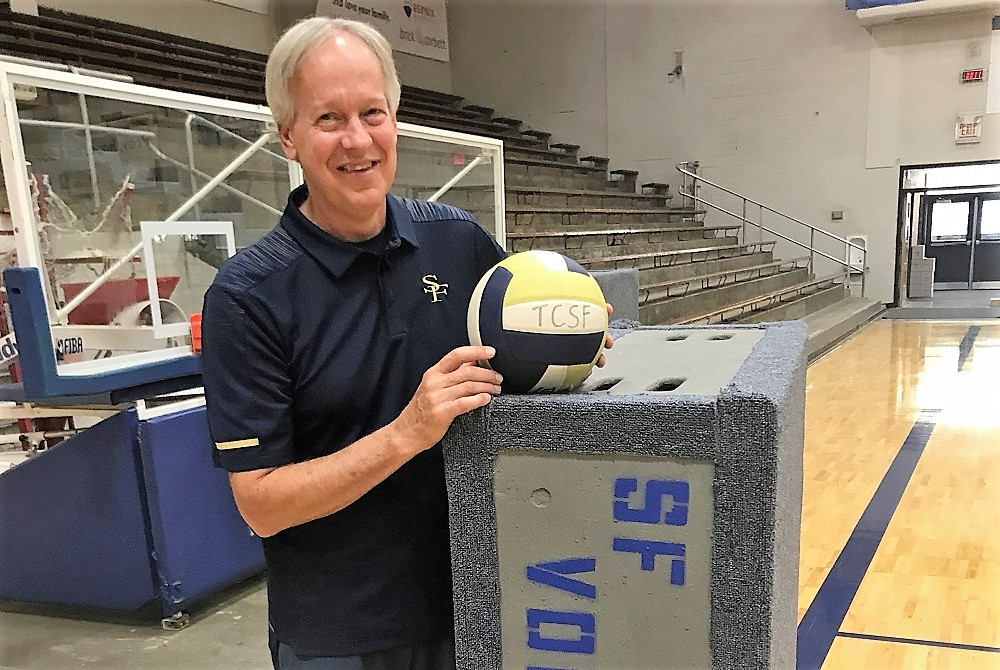
Kanitz spends his days and nights dedicated to the Traverse City St. Francis student-athletes, staff, administration and Gladiators community. He is the junior varsity girls basketball coach, volleyball game manager, volleyball announcer and volleyball scorekeeper, football press box manager, and the Glads’ soccer game manager. Additionally, as director of basketball operations at St. Francis, he finds himself at the scorer’s table for boys basketball games.
The volleyball, soccer and football duties are performed at every home game. He doesn’t take a paycheck for any of it. If the school does pay for his services, he promptly donates the funds to the source.
The soft-spoken and renowned St. Francis supporter is not the slightest bit interested in getting any recognition for his efforts.
Tonight he’ll run the Thirlby Field press box as the Gladiators host Ogemaw Heights. And, he’s ready for the Glads’ first home volleyball match Sept. 8.
“He is one of those unique people that shies away from the spotlight — he is a pure servant, said Aaron Biggar, St. Francis’ athletic director. “He doesn’t want any accolades or anything like that.”
Kanitz’ father, Hugo Kanitz – who also went by Mike all his life – was the head football coach of Traverse City St. Francis during the 1960s. Another Kanitz, Dutch — not related to the father-son combo —was at the helm of the Traverse City Central High School football program.
 Mike Kanitz finds himself regularly receiving phone calls and letters from former players intended for the Kanitz coaches. He has to explain he’s not the deceased Central coach, nor his father. And he’s glad he gets to pass on positive feedback to his father, also a former athletic director for St. Francis.
“My grandmother said, ‘Never call him Hugo – his name is Mike,’” Kanitz said. “Don’t ask me where it came from, but he was Mike his whole life.
“I am junior in most people’s minds,” Kanitz went on. “Traverse City was a small town back then; to have two Coach Kanitz was confusing.”
His father now lives in Traverse City after retiring as a teacher and professor. The son enjoys picking his brain.
“I am blessed to still be able to run stuff by him (because) that’s really where I got my coaching start,” he said. “I used to get calls after coming back to Traverse City and the callers would say, ‘Is this Coach Kanitz?’ and I started to catch on that these were his former students.
“I don’t think my dad ever knew the impact he was having on kids,” Kanitz continued. “I don’t think coaches really know what an impact they have on kids.”
Hearing from his father’s former players helped shape his coaching.
“It made me realize as a coach you have the ability every time you open your mouth to either hurt a kid or help a kid,” he said. “So helping a kid is my desire.”
Officials, media and visiting coaches for many sports have noted Kanitz’ demeanor and contributions. They also know he’ll do anything to make sure they have a good experience at St. Francis.
Among other things, Mike reportedly once became a makeshift tailor when a basketball official showed up without his referee pants. Mostly using safety pins, a borrowed pair of pants went from 2XL to large in time for tip-off.
“Mike Kanitz should have a name tag that says, ‘Nicest Man on the Planet,’” said former St. Francis AD Tom Hardy. “Mike is the perfect representative that you can have for any event at school.
 “He greets every team, official, and spectator with such grace and compassion, which leads to a very positive experience for all involved,” Hardy continued. “Mike has volunteered too many hours to count at basketball and soccer games as a game manager and coach.”
Hardy believes all sports fans need to follow Kanitz’ lead.
“Mike Kanitz is the example of how people should treat each other at any athletic event,” he said. “You truly would have to look long and hard to find a more compassionate and caring individual, and I would challenge anyone to find a person that has a negative thing to say about him.”
Barb Becket, a longtime MHSAA official and assignor, has similar views of Kanitz. She’s worked with him while he’s served as a coach, game manager and during community activities through her role with the Grand Traverse YMCA.
“Mike is the go-to guy,” she said. “He is a servant in the true sense of the word.
“Besides being the go-to guy for coaches, admin, and players, Mike also acts as the liaison between the sports officials and the sports participants,” she continued. “Mike handles his responsibilities with grace, humility, common sense, and accountability.”
Kanitz’ favorite sport to play is baseball, but his favorite sport to coach is basketball. After graduating from Alma College where he competed in track & field, he was thrilled to move back to Traverse City to start a family with his wife Marcy, a Traverse City obstetrician.
The couple’s three children graduated from St. Francis, and Kanitz first focused on elementary baseball. He was able to step away from his pharmaceutical career to step in and fill pretty much any need the St. Francis community had.
Kanitz points to his wife’s passion for caring for women as a motivator for him to get more girls involved in sports and receiving the benefits they provide.
“Marcy spent her whole life taking care of women,” he said. “So she sees the side effects of women not being given opportunities.
“So we’ve got to correct that stuff.”
Kanitz’s first job was as a water boy, along with his siblings born to Hugo and Margo Kanitz. If he ever can’t coach or serve in other capacities for the Gladiators, he hopes to return to the very first job he had as a preschooler.
“I am sincere when I say I started as a water boy, and I am going to finish as a water boy,” Kanitz said. “I am very blessed and I am thankful for the life I’ve had here in Traverse City.
“I am thankful for the school allowing me to be a part of it.”
 Tom Spencer is a longtime MHSAA-registered basketball and soccer official, and former softball and baseball official, and he also has coached in the northern Lower Peninsula area. He previously has written for the Saginaw News, Bay County Sports Page and Midland Daily News. He can be reached at [email protected] with story ideas for Manistee, Wexford, Missaukee, Roscommon, Ogemaw, Iosco, Alcona, Oscoda, Crawford, Kalkaska, Grand Traverse, Benzie, Leelanau, Antrim, Otsego, Montmorency, Alpena, Presque Isle, Cheboygan, Charlevoix and Emmet counties.
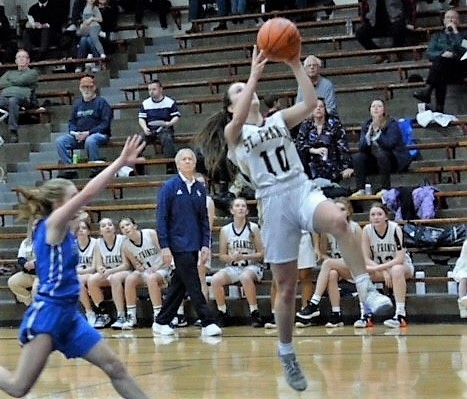
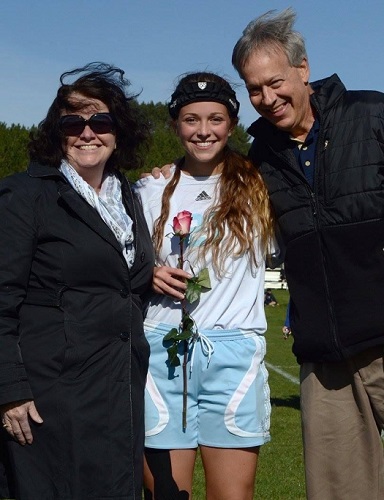
PHOTOS (Top) Mike Kanitz fills many roles for Traverse City St. Francis including girls junior varsity basketball coach and game manager for a variety of sports including volleyball. (Middle) Kanitz walks the sideline during one of his games leading the JV Gladiators. (Below) Mike Kanitz enjoys his daughter Delin’s Senior Night game with wife Marcy Verplank-Kanitz. (Top photo by Mike Spencer; middle and below photos by Julie English.)