

New Math: Division & Multiplication Problems
July 25, 2017
By Jack Roberts
MHSAA Executive Director
This is the second part in a series on MHSAA tournament classification, past and present, that will be published over the next two weeks. This series originally ran in this spring's edition of MHSAA benchmarks.
High school tournament classifications went viral before there was social media and most of us knew what “viral” meant.
Much as a virus infects computers today or has created epidemics of disease around the world for centuries, high school tournament classification – once introduced – tends to spread uncontrollably. Once started, it tends to keep expanding and rarely contracts.
While we are still some distance from providing every team a trophy as a result of expanding high school tournament classification across the country, there is criticism nevertheless that we are headed in that direction – a philosophy which is supposed to exist only in local youth sports for our youngest children.
Michigan could be blamed for all this. Michigan is generally accepted as the first state to provide different classifications for season-ending tournaments for different sized schools. It started a century ago. Today, every state has various classifications for its tournaments in most if not all sports. And it is a bit ironic that Michigan – creator of the classification chaos – more than most other states has kept the number of tournament classes or divisions under control.
Yes, there is evidence that tournament classifications have expanded over the years in Michigan, especially with the relatively recent introduction of tournaments in football and the late 1990s’ move from classes to divisions in most MHSAA tournaments. But the MHSAA Representative Council has held true to its word when it expanded the playoffs for football from four classes to eight divisions: this is needed because of unique factors of football, factors that exist in no other sport; and all other sports should be capped at a maximum of four classes or divisions.
Kentucky is the preeminent defender of single-class basketball. All of its 276 high schools compete for the single state championship for each gender. In Indiana, there are still open wounds from its move in 1998 from one to four classes for its 400 schools in basketball.
Multi-class tournaments have tended to increase the number of non-public school champions, which some states are trying to lower through enrollment “multipliers,” and also tend to increase the number of repeat champions, which some states are trying to affect with “success factors” which lift smaller schools into classifications for larger schools if they take home too many trophies.
While there is considerable evidence that state tournaments do as much bad as good for educational athletics, state associations persist in providing postseason tournaments because, on balance, the experiences are supposed to be good for student-athletes. And once we reach that conclusion it is just a small leap to believe that if the tournaments are good for a few, they must be better for more – which leads to creating more and more tournament classifications. One becomes two classes, then three, then four and so forth.
While the argument is that more classifications or divisions provides more students with opportunities to compete and win, it is undeniable that the experience changes as the number of tournament classifications expands. It is not possible for state associations to provide the same level of support when tournament classifications expand to multiple venues playing simultaneously. For example, there is less audio and video broadcast potential at each venue, and less media coverage to each venue. Focus is diluted and fans diminished at each championship.
No one can argue reasonably that today's two-day MHSAA Football Finals of eight championship games has the same pizazz as the one-day, four-games event conducted prior to 1990.
In some states the number of divisions has grown so much that it is difficult to see much difference between the many season-ending state championship games and a regular-season event in the same sport.
It is a balancing act. And Michigan has been studying that balance longer than any other state, and charting a steadier course than most.
Addition by Division
The shift to Divisions for MHSAA Tournament play in numerous sports has added up to a greater number of champions for teams and individuals across the state. Following are the sports currently employing a divisional format, and the procedures for determining enrollment and classification.
In 23 statewide or Lower Peninsula tournaments, schools which sponsor the sport are currently divided into nearly equal divisions. They are:
- Baseball - 4 Divisions
- Boys Bowling - 4 Divisions
- Girls Bowling - 4 Divisions
- Girls Competitive Cheer - 4 Divisions
- LP Boys Cross Country - 4 Divisions
- LP Girls Cross Country - 4 Divisions
- LP Boys Golf - 4 Divisions
- LP Girls Golf - 4 Divisions
- Ice Hockey - 3 Divisions
- Boys Lacrosse - 2 Divisions
- Girls Lacrosse - 2 Divisions
- Boys Skiing - 2 Divisions
- Girls Skiing - 2 Divisions
- LP Boys Soccer - 4 Divisions LP
- Girls Soccer - 4 Divisions
- Girls Softball - 4 Divisions
- LP Boys Swimming & Diving - 3 Divisions
- LP Girls Swimming & Diving - 3 Divisions
- LP Boys Tennis - 4 Divisions
- LP Girls Tennis - 4 Divisions
- LP Boys Track & Field - 4 Divisions
- LP Girls Track & Field - 4 Divisions
- Wrestling - 4 Divisions
Lists of schools for each division of these 23 tournaments are posted on MHSAA.com approximately April 1. Listings of schools in Upper Peninsula tournaments for their sports are also posted on MHSAA.com. The lists are based on school memberships and sports sponsorships in effect or anticipated for the following school year, as known to the MHSAA office as of a date in early March.
In football, the 256 schools which qualify for MHSAA 11-player playoffs are placed in eight equal divisions annually on Selection Sunday. Beginning in 2017, the 8-player divisions will be determined in a like manner on Selection Sunday as well, with 32 qualifying schools placed in two divisions.
Schools have the option to play in any higher division in one or more sports for a minimum of two years.
The deadlines for "opt-ups" are as follows:
- Applications for fall sports must be submitted by April 15
- Applications for winter sports must be submitted by Aug. 15
- Applications for spring sports must be submitted by Oct. 15
Subsequent to the date of these postings for these tournaments, no school will have its division raised or lowered by schools opening or closing, schools adding or dropping sports, schools exercising the option to play in a higher division, or approval or dissolution of cooperative programs.
When the same sport is conducted for boys and girls in the same season (e.g., track & field and cross country), the gender that has the most sponsoring schools controls the division breaks for both genders.
Lessons Learned on Track Have Jibowu's Business Surging to Quick Success
By
Paul Costanzo
Special for MHSAA.com
August 1, 2022
Athletics showed Soj Jibowu just how far he could push himself.
All the time spent on the track, working to become the state’s best high school 400-meter runner, and then more than that, taught him to stretch beyond what he thought were his limits.
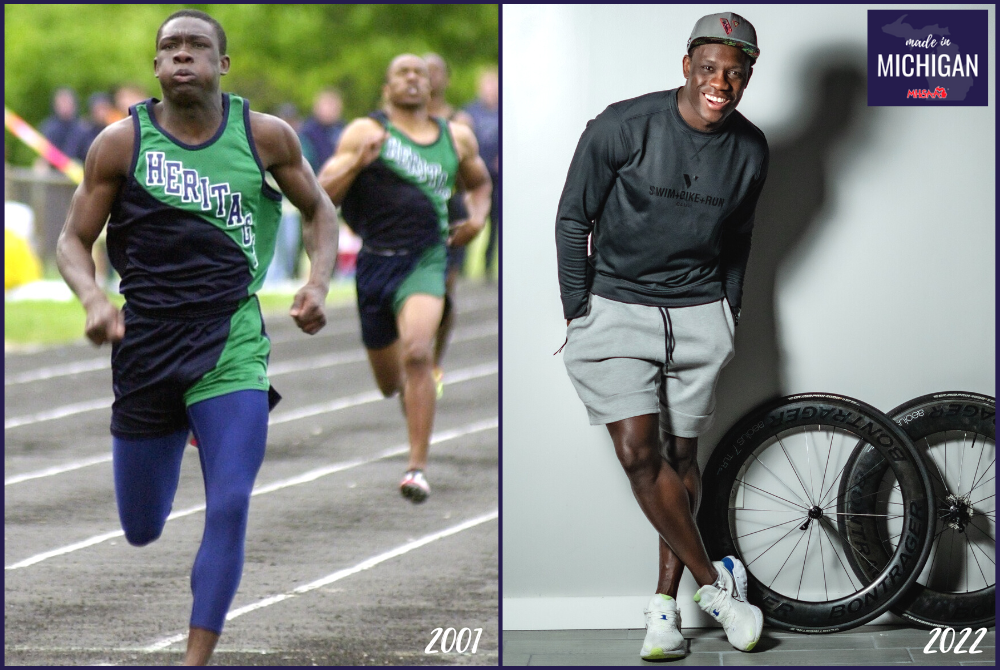
So, when it came time to make a decision on whether to jump fully into his apparel company, Varlo, or keep it as a part-time side venture, the 2001 Saginaw Heritage graduate knew he could take himself to another level if needed.
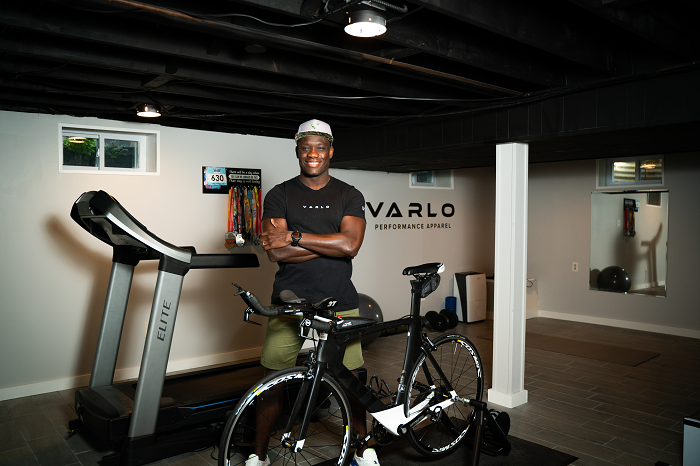
Jibowu is the founder and CEO of Varlo, a clothing company that specializes in outfitting triathletes, but also offers casual wear for men and women. The company is just over three years old, but its clientele includes hundreds of triathletes, eight professionals, three NCAA programs and even hospitals. Merchandise is sold in eight countries.
All of that is validation for Jibowu, who took the leap to pursuing the company full-time just one year into its existence.
“When I resigned (from a medical sales job) to do this full-time, my wife was pregnant with our second child, my daughter wasn’t even walking yet,” said Jibowu, who now lives in Cherry Hill, N.J., with his wife and two young children. “Where was my state of mind to leave my very comfortable, high-paying job to pursue this – to sell clothes?”
His mind was in the same place that helped him reach tremendous heights as a runner, both at Heritage and Central Michigan University.
Jibowu, who was born in Nigeria and spent much of his childhood in Huntsville, Ala., was part of some incredible Heritage teams. He graduated a year behind eventual NFL safety Stuart Schweigert, who he ran with on the Finals-winning 1,600 relay in 2000. Another member of that relay was Derold Sligh, who won the 400-meter Finals title that year, setting the Lower Peninsula Division 1 Finals record in the process. The Hawks were LP Division 1 runners-up as a team that season.
“I ran track when I was younger, and I was terrible,” Jibowu said. “In high school, if I look back at it, I probably would have called it impostor syndrome. I think that was me up until maybe like somewhere in my senior year when I started to think, ‘I’m pretty fast.’ … I had so many dominant people around me, in my mind, I was still the slow guy.”
 As a senior, Jibowu erased that self-doubt. He led Heritage to its first, and still only, Division 1 Finals title, running the 400 in 48.28 and breaking the record Sligh had set the year prior.
It was working to get to that point that Jibowu still credits with his ability to push himself in all things.
“I preach this all the time: if you have the ability to be involved in sports at a young age, do it,” Jibowu said. “It’s a gift, first of all. You don’t know any better when you’re young, you think you’re just training your body, but what’s really, truly occurring is you’re training your mind and building discipline. You’re building your character as far as who you are as a person. What is your will? How far are you willing to push? Am I able to be coached? Am I able to learn? Am I able to lose over and over again and keep going? Am I able to navigate to feel what it’s like to win? What you’re truly developing is how to manage and handle life.”
Jibowu said he didn’t finalize his college decision until late in the process, as he had to work on his test scores into the summer. While at CMU, he majored in biomedical science and chemistry, and he excelled, admitting he was a much better student in college than in high school.
He was also reunited with Sligh on the Chippewas track team, and had a successful career. He was regularly within the top five in the 200 and 400 in the Mid-American Conference, and won a MAC title in the 400 at the 2004 indoor championships. His personal bests in the races were 21.19 and 46.81, respectively.
After graduating from CMU, Jibowu began working as a pharmaceutical rep, then moved into medical sales.
While he remained active, it wasn’t until he took a trip to Chicago that he discovered triathlons.
“I remember seeing these really cool bikes and these really fit people, and then they jumped into Lake Michigan,” he said. “And I didn’t know that was possible, because I didn’t grow up swimming. I didn’t know that volume of people knew how to swim like that. Then they get out of Lake Michigan, jump on their bikes and they’re flying. Then they’re sprinting a 6K and I remember thinking, ‘Oh my God, these guys are the real freaking deal.’ I was hooked and wanted to start competing.”
As he began competing, the wheels for his current venture began turning. At this point, Jibowu was living out east and had worked for a pair of successful start-ups in the medical industry. That helped give him knowledge, and confidence, to make his own moves.
“I had always been into clothes and fashion, and how you express yourself with what you wear,” Jibowu said. “There was an opportunity there. The sport of triathlon is as old as me; it started in (1983). That’s a baby. That’s like basketball without the 3-point line. There’s so much opportunity for innovation.”
With that, Varlo was born, and it has since thrived, with Jibowu and the lessons he learned on a track in Saginaw paving the way.
“If you are in high school and have the ability to be in a sport, it’s a gift,” he said. “At that young of an age, truly learning to manage the trials and tribulations of life. That is a gift.”
2021-22 Made in Michigan
July 28: Running Set Life's Stage for Grosse Pointe South's Record-Setting Meier Sisters - Read
July 25: 2005 Miss Basketball DeHaan Cherishing Newest Title: 1st-Time Mom - Read
July 21: Championship Memories Still Resonate with St. Thomas Star Lillard - Read
July 14: Portage Central Champ Rolls to Vanderbilt, Writing Next Chapter in Alabama - Read
July 12: Coaching Couple Passing On Knowledge, Providing Opportunities for Frankfort Wrestlers - Read
June 30: Hrynewich's Star Continuing to Rise with Olympic, Pro Sports Arrivals - Read
PHOTOS (Top) At left, Heritage’s Soj Jibowu wins the 400 meters during the 2001 Saginaw Valley League championship meet. At right, Jibowu is the founder and CEO of the Varlo clothing company. (Middle) Jibowu’s company specializes in outfitting triathletes, and he has taken up the sport after a successful college track & field career. (Heritage photo courtesy of Saginaw News/MLive; current photos courtesy of Soj Jibowu.)