

New Math: Division & Multiplication Problems
July 25, 2017
By Jack Roberts
MHSAA Executive Director
This is the second part in a series on MHSAA tournament classification, past and present, that will be published over the next two weeks. This series originally ran in this spring's edition of MHSAA benchmarks.
High school tournament classifications went viral before there was social media and most of us knew what “viral” meant.
Much as a virus infects computers today or has created epidemics of disease around the world for centuries, high school tournament classification – once introduced – tends to spread uncontrollably. Once started, it tends to keep expanding and rarely contracts.
While we are still some distance from providing every team a trophy as a result of expanding high school tournament classification across the country, there is criticism nevertheless that we are headed in that direction – a philosophy which is supposed to exist only in local youth sports for our youngest children.
Michigan could be blamed for all this. Michigan is generally accepted as the first state to provide different classifications for season-ending tournaments for different sized schools. It started a century ago. Today, every state has various classifications for its tournaments in most if not all sports. And it is a bit ironic that Michigan – creator of the classification chaos – more than most other states has kept the number of tournament classes or divisions under control.
Yes, there is evidence that tournament classifications have expanded over the years in Michigan, especially with the relatively recent introduction of tournaments in football and the late 1990s’ move from classes to divisions in most MHSAA tournaments. But the MHSAA Representative Council has held true to its word when it expanded the playoffs for football from four classes to eight divisions: this is needed because of unique factors of football, factors that exist in no other sport; and all other sports should be capped at a maximum of four classes or divisions.
Kentucky is the preeminent defender of single-class basketball. All of its 276 high schools compete for the single state championship for each gender. In Indiana, there are still open wounds from its move in 1998 from one to four classes for its 400 schools in basketball.
Multi-class tournaments have tended to increase the number of non-public school champions, which some states are trying to lower through enrollment “multipliers,” and also tend to increase the number of repeat champions, which some states are trying to affect with “success factors” which lift smaller schools into classifications for larger schools if they take home too many trophies.
While there is considerable evidence that state tournaments do as much bad as good for educational athletics, state associations persist in providing postseason tournaments because, on balance, the experiences are supposed to be good for student-athletes. And once we reach that conclusion it is just a small leap to believe that if the tournaments are good for a few, they must be better for more – which leads to creating more and more tournament classifications. One becomes two classes, then three, then four and so forth.
While the argument is that more classifications or divisions provides more students with opportunities to compete and win, it is undeniable that the experience changes as the number of tournament classifications expands. It is not possible for state associations to provide the same level of support when tournament classifications expand to multiple venues playing simultaneously. For example, there is less audio and video broadcast potential at each venue, and less media coverage to each venue. Focus is diluted and fans diminished at each championship.
No one can argue reasonably that today's two-day MHSAA Football Finals of eight championship games has the same pizazz as the one-day, four-games event conducted prior to 1990.
In some states the number of divisions has grown so much that it is difficult to see much difference between the many season-ending state championship games and a regular-season event in the same sport.
It is a balancing act. And Michigan has been studying that balance longer than any other state, and charting a steadier course than most.
Addition by Division
The shift to Divisions for MHSAA Tournament play in numerous sports has added up to a greater number of champions for teams and individuals across the state. Following are the sports currently employing a divisional format, and the procedures for determining enrollment and classification.
In 23 statewide or Lower Peninsula tournaments, schools which sponsor the sport are currently divided into nearly equal divisions. They are:
- Baseball - 4 Divisions
- Boys Bowling - 4 Divisions
- Girls Bowling - 4 Divisions
- Girls Competitive Cheer - 4 Divisions
- LP Boys Cross Country - 4 Divisions
- LP Girls Cross Country - 4 Divisions
- LP Boys Golf - 4 Divisions
- LP Girls Golf - 4 Divisions
- Ice Hockey - 3 Divisions
- Boys Lacrosse - 2 Divisions
- Girls Lacrosse - 2 Divisions
- Boys Skiing - 2 Divisions
- Girls Skiing - 2 Divisions
- LP Boys Soccer - 4 Divisions LP
- Girls Soccer - 4 Divisions
- Girls Softball - 4 Divisions
- LP Boys Swimming & Diving - 3 Divisions
- LP Girls Swimming & Diving - 3 Divisions
- LP Boys Tennis - 4 Divisions
- LP Girls Tennis - 4 Divisions
- LP Boys Track & Field - 4 Divisions
- LP Girls Track & Field - 4 Divisions
- Wrestling - 4 Divisions
Lists of schools for each division of these 23 tournaments are posted on MHSAA.com approximately April 1. Listings of schools in Upper Peninsula tournaments for their sports are also posted on MHSAA.com. The lists are based on school memberships and sports sponsorships in effect or anticipated for the following school year, as known to the MHSAA office as of a date in early March.
In football, the 256 schools which qualify for MHSAA 11-player playoffs are placed in eight equal divisions annually on Selection Sunday. Beginning in 2017, the 8-player divisions will be determined in a like manner on Selection Sunday as well, with 32 qualifying schools placed in two divisions.
Schools have the option to play in any higher division in one or more sports for a minimum of two years.
The deadlines for "opt-ups" are as follows:
- Applications for fall sports must be submitted by April 15
- Applications for winter sports must be submitted by Aug. 15
- Applications for spring sports must be submitted by Oct. 15
Subsequent to the date of these postings for these tournaments, no school will have its division raised or lowered by schools opening or closing, schools adding or dropping sports, schools exercising the option to play in a higher division, or approval or dissolution of cooperative programs.
When the same sport is conducted for boys and girls in the same season (e.g., track & field and cross country), the gender that has the most sponsoring schools controls the division breaks for both genders.
2005 Miss Basketball DeHaan Cherishing Newest Title: 1st-Time Mom
By
Dean Holzwarth
Special for MHSAA.com
July 25, 2022
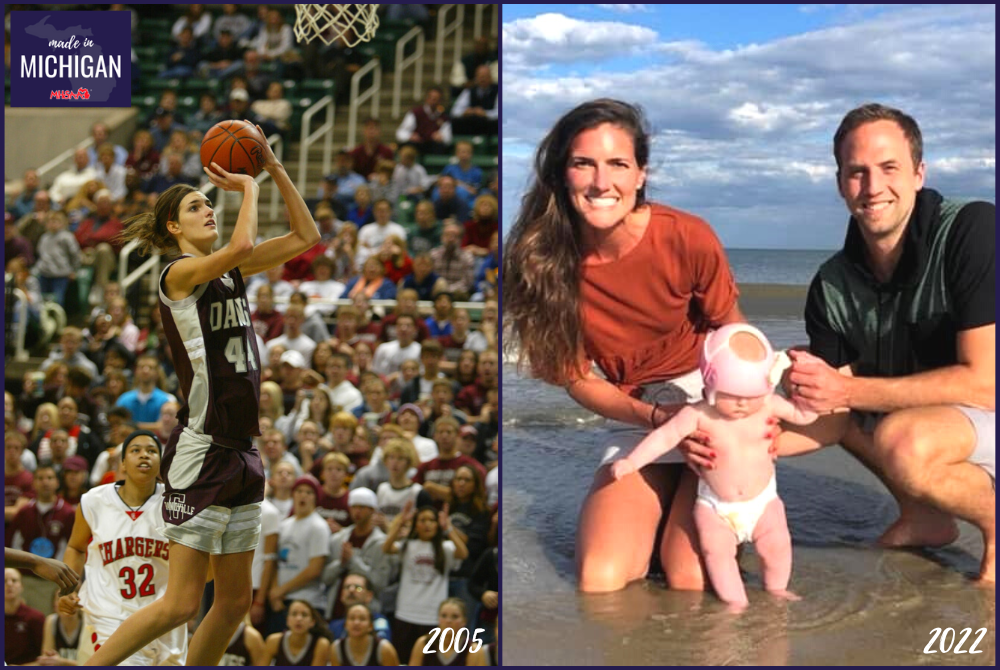
JENISON – Allyssa DeHaan-Clark remains one of the greatest shot blockers in national high school and college basketball history.
Recently, the former Grandville High School and Michigan State University standout became a mother for the first time.
DeHaan-Clark, and her husband Aaron, adopted a baby girl last September.
Bradley Noelle Clark was born on Sept. 29, 2021, at 36 weeks.
When the Clarks found out about the impending delivery, they drove straight to the hospital from their vacation in Tennessee to meet her. They took her home a few days later.
“Parenthood is awesome, hard, wonderful and beautiful,” DeHaan-Clark said. “She’s 9½ months old, and she just lost her first tooth and is starting to crawl. She says, ‘Da, Da’ a lot, even though I’m with her most of the time during the day.”
DeHaan-Clark, who turned 34 last month, married in 2012. She and her husband had aspirations to raise a family.
Unfortunately, the road to parenthood was more difficult than they envisioned.
“We tried to get pregnant for six years,” DeHaan-Clark said. “We went through a lot of testing and different fertility procedures, but nothing took. We never had one positive pregnancy test.”
Although disappointed and frustrated, the Clarks pursued another avenue.
“Adoption was always in the back of our mind, and it came to a point where I didn’t know what to do,” DeHaan-Clark said. “One night we prayed to God for clarity and wisdom and just some direction. He answered that prayer the next morning with a text message, and that put us on a fast track to adoption.”
 The Clarks went through the application process last June. Four months later, Bradley was born. She officially became a Clark in May.
“It was awesome for God to answer that prayer so quickly,” DeHaan-Clark said. “After six years of struggle, she was meant to be in our family. We love her so much and adore her to pieces.
“She’s loved by so many, and we are very thankful that the birth family chose us. After all that pain and suffering, God made something beautiful through that.”
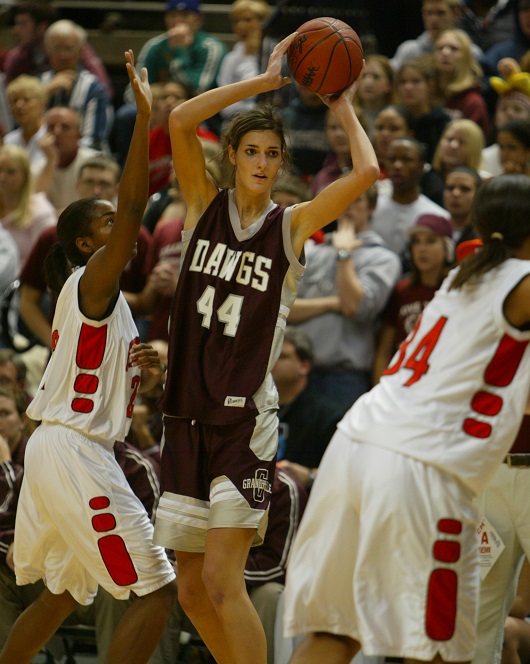
DeHaan-Clark was a four-year towering presence at Grandville. As a junior in 2004, she set the MHSAA record for blocks in a single season with 236 and averaged nearly a triple-double (27 points, 13 rebounds and 9.5 blocks per game).
As a senior, she helped lead the Bulldogs to a 25-2 record and their first Class A Semifinal appearance. She was named the 2005 Miss Basketball Award winner by the Basketball Coaches Association of Michigan.
DeHaan-Clark grew six inches during middle school and entered her high school freshman year at 6-foot-6. She was 6-9 as a senior before taking her talents to East Lansing.
“Middle school was tough for everyone, but it was extremely tough for me,” DeHaan-Clark said. “I was entering a new school system, and I had just started playing basketball a year or two before that and had a huge growth spurt. Learning how to be coordinated and play the game took a while.”
DeHaan-Clark was a part of three consecutive Ottawa-Kent Conference Red championship teams. The Bulldogs won District and Regional titles in 2005 before defeating previously-unbeaten Benton Harbor in a Class A Quarterfinal. Grandville’s run ended with an overtime loss to Southfield-Lathrup in the Semifinal at Breslin Center.
“My senior year was the best,” DeHaan-Clark said. “It was so much fun with the championships and all the wins. Playing with the same girls for four years and then finally having a successful team was amazing.”
DeHaan-Clark made the MHSAA’s single-season scoring list as a senior with 710 points, having averaged 26.3 per game that fall. She also finished with 718 career blocks, setting an MHSAA record later broken by Kalamazoo Central’s Asia Robeson (723) in 2014. Still, DeHaan-Clark remains seventh all-time nationally for career blocks, with Robeson sixth on the list.
DeHaan-Clark arrived at Michigan State with high aspirations.
“I had big goals of playing in the Olympics and playing professionally, but obviously those didn’t come to fruition,” she said. “I learned to dream big, so I set big goals from the beginning.”
DeHaan-Clark emerged as a dominating shot blocker for the Spartans, and was Big Ten Freshman of the Year in 2006-07 as she set the conference record with 145 blocks.
As a sophomore she re-established the Big Ten record for single-season blocks with 150. She was named Big Ten Defensive Player of the Year as a senior in 2009-10.
She ended her career as Michigan State’s all-time blocks leader with 503 – with that total also second in Division I history at that time and now third on the NCAA DI list – to go with career averages of 12.1 points and 6.8 rebounds per game.
“It was a big transition from high school to college, but I wanted to be a contributor,” DeHaan-Clark said. “I had amazing coaches and teammates, and my freshman year turned out better than I thought it would.
“My big goal was to be a key defensive player and break as many records as I could with blocked shots because of my height.”
In 2009, DeHaan-Clark was the catalyst in Michigan State’s run to the Sweet 16. The Spartans upset top-ranked Duke in the second round before losing to Iowa State, 69-68.
But DeHaan-Clark suffered a back injury during the Big Ten Tournament that winter which ultimately ended her hopes of playing beyond college.
“I never recovered from that, so I didn’t enter the WNBA draft,” DeHaan-Clark said. “I ended up having back surgery and finished my remaining classes before graduating.”
DeHaan-Clark returned home and worked in the medical field while also helping lead a sports ministry program at Grand Valley State University.
 She received an intriguing opportunity to continue playing college sports as part of the Lakers volleyball program.
“I needed to take more graduate classes, and I had one more season of college eligibility other than basketball,” she said. “My skill level wasn’t to the level of basketball, but it was still really fun to play and compete and be a part of a team because those are things I still love doing today.”
DeHaan-Clark changed her focus from medicine to continuing her work in sports ministry, as well as for a non-profit organization.
She also got her real estate license in 2015, and she and her husband began flipping houses on the side.
“It brings me a lot of joy to cast a vision of what a home could look like after a lot of blood, sweat and tears,” she said. “I love that kind of work.”
The projects allowed the Clarks to spend meaningful time together.
“It was a lot of nights and weekends, and we just had to learn things as we went,” DeHaan-Clark said. “The one thing we learned is we cannot do drywall. It’s not our skill set, so in order to save our marriage and our relationship we would hire it out.
“We did a lot of it ourselves, and we like seeing the transformation from old to new. It’s really fun, and hopefully we can do it again.”
The Clarks currently reside in Jenison and have been embraced by their community and friends. They live on a lake, enjoying water sports in their free time. Allyssa was inducted into the Grandville High School Athletic Hall of Fame in March.
As for the future, DeHaan-Clark said nothing is set in stone.
“We take it one day at a time,” she said. “I still have my real estate license, so we’re hoping to renovate and invest. I’m sure in the future there will be more kids added to the Clark clan, but right now we’re very happy and content with just one.”
2021-22 Made in Michigan
July 21: Championship Memories Still Resonate with St. Thomas Star Lillard - Read
July 14: Portage Central Champ Rolls to Vanderbilt, Writing Next Chapter in Alabama - Read
July 12: Coaching Couple Passing On Knowledge, Providing Opportunities for Frankfort Wrestlers - Read
June 30: Hrynewich's Star Continuing to Rise with Olympic, Pro Sports Arrivals - Read
PHOTOS (Top) At left, Allyssa DeHaan puts up a shot during Grandville’s 2005 Class A Semifinal against Southfield-Lathrup. At right, the Clark family including Allyssa, husband Aaron Clark and daughter Bradley. (Middle) DeHaan looks for an open teammate while playing her high school finale at her future college home, the Breslin Center. (Below) The Clarks enjoy a moment together. (Basketball photos from MHSAA archives; Clark photos courtesy of Allyssa DeHaan-Clark.)