

New Math: Division & Multiplication Problems
July 25, 2017
By Jack Roberts
MHSAA Executive Director
This is the second part in a series on MHSAA tournament classification, past and present, that will be published over the next two weeks. This series originally ran in this spring's edition of MHSAA benchmarks.
High school tournament classifications went viral before there was social media and most of us knew what “viral” meant.
Much as a virus infects computers today or has created epidemics of disease around the world for centuries, high school tournament classification – once introduced – tends to spread uncontrollably. Once started, it tends to keep expanding and rarely contracts.
While we are still some distance from providing every team a trophy as a result of expanding high school tournament classification across the country, there is criticism nevertheless that we are headed in that direction – a philosophy which is supposed to exist only in local youth sports for our youngest children.
Michigan could be blamed for all this. Michigan is generally accepted as the first state to provide different classifications for season-ending tournaments for different sized schools. It started a century ago. Today, every state has various classifications for its tournaments in most if not all sports. And it is a bit ironic that Michigan – creator of the classification chaos – more than most other states has kept the number of tournament classes or divisions under control.
Yes, there is evidence that tournament classifications have expanded over the years in Michigan, especially with the relatively recent introduction of tournaments in football and the late 1990s’ move from classes to divisions in most MHSAA tournaments. But the MHSAA Representative Council has held true to its word when it expanded the playoffs for football from four classes to eight divisions: this is needed because of unique factors of football, factors that exist in no other sport; and all other sports should be capped at a maximum of four classes or divisions.
Kentucky is the preeminent defender of single-class basketball. All of its 276 high schools compete for the single state championship for each gender. In Indiana, there are still open wounds from its move in 1998 from one to four classes for its 400 schools in basketball.
Multi-class tournaments have tended to increase the number of non-public school champions, which some states are trying to lower through enrollment “multipliers,” and also tend to increase the number of repeat champions, which some states are trying to affect with “success factors” which lift smaller schools into classifications for larger schools if they take home too many trophies.
While there is considerable evidence that state tournaments do as much bad as good for educational athletics, state associations persist in providing postseason tournaments because, on balance, the experiences are supposed to be good for student-athletes. And once we reach that conclusion it is just a small leap to believe that if the tournaments are good for a few, they must be better for more – which leads to creating more and more tournament classifications. One becomes two classes, then three, then four and so forth.
While the argument is that more classifications or divisions provides more students with opportunities to compete and win, it is undeniable that the experience changes as the number of tournament classifications expands. It is not possible for state associations to provide the same level of support when tournament classifications expand to multiple venues playing simultaneously. For example, there is less audio and video broadcast potential at each venue, and less media coverage to each venue. Focus is diluted and fans diminished at each championship.
No one can argue reasonably that today's two-day MHSAA Football Finals of eight championship games has the same pizazz as the one-day, four-games event conducted prior to 1990.
In some states the number of divisions has grown so much that it is difficult to see much difference between the many season-ending state championship games and a regular-season event in the same sport.
It is a balancing act. And Michigan has been studying that balance longer than any other state, and charting a steadier course than most.
Addition by Division
The shift to Divisions for MHSAA Tournament play in numerous sports has added up to a greater number of champions for teams and individuals across the state. Following are the sports currently employing a divisional format, and the procedures for determining enrollment and classification.
In 23 statewide or Lower Peninsula tournaments, schools which sponsor the sport are currently divided into nearly equal divisions. They are:
- Baseball - 4 Divisions
- Boys Bowling - 4 Divisions
- Girls Bowling - 4 Divisions
- Girls Competitive Cheer - 4 Divisions
- LP Boys Cross Country - 4 Divisions
- LP Girls Cross Country - 4 Divisions
- LP Boys Golf - 4 Divisions
- LP Girls Golf - 4 Divisions
- Ice Hockey - 3 Divisions
- Boys Lacrosse - 2 Divisions
- Girls Lacrosse - 2 Divisions
- Boys Skiing - 2 Divisions
- Girls Skiing - 2 Divisions
- LP Boys Soccer - 4 Divisions LP
- Girls Soccer - 4 Divisions
- Girls Softball - 4 Divisions
- LP Boys Swimming & Diving - 3 Divisions
- LP Girls Swimming & Diving - 3 Divisions
- LP Boys Tennis - 4 Divisions
- LP Girls Tennis - 4 Divisions
- LP Boys Track & Field - 4 Divisions
- LP Girls Track & Field - 4 Divisions
- Wrestling - 4 Divisions
Lists of schools for each division of these 23 tournaments are posted on MHSAA.com approximately April 1. Listings of schools in Upper Peninsula tournaments for their sports are also posted on MHSAA.com. The lists are based on school memberships and sports sponsorships in effect or anticipated for the following school year, as known to the MHSAA office as of a date in early March.
In football, the 256 schools which qualify for MHSAA 11-player playoffs are placed in eight equal divisions annually on Selection Sunday. Beginning in 2017, the 8-player divisions will be determined in a like manner on Selection Sunday as well, with 32 qualifying schools placed in two divisions.
Schools have the option to play in any higher division in one or more sports for a minimum of two years.
The deadlines for "opt-ups" are as follows:
- Applications for fall sports must be submitted by April 15
- Applications for winter sports must be submitted by Aug. 15
- Applications for spring sports must be submitted by Oct. 15
Subsequent to the date of these postings for these tournaments, no school will have its division raised or lowered by schools opening or closing, schools adding or dropping sports, schools exercising the option to play in a higher division, or approval or dissolution of cooperative programs.
When the same sport is conducted for boys and girls in the same season (e.g., track & field and cross country), the gender that has the most sponsoring schools controls the division breaks for both genders.
Hrynewich's Star Continuing to Rise with Olympic, Pro Sports Arrivals
By
Tom Kendra
Special for MHSAA.com
June 30, 2022
Hailey Hrynewich is only 27, and she’s already worked as an on-camera reporter for NBC at the recent Winter Olympics and for The Golf Channel at last month’s Canadian Open.
Hrynewich, who goes by the name Hailey Hunter in her broadcasting career, gives much of the credit for her early success to her parents, her twin brother Reed, her teachers and her coaches.
But she learned even more from a game.
“I have learned so many life lessons from golf,” explained Hailey, who was an all-state golfer at Muskegon Mona Shores and led the Sailors to Lower Peninsula Division 2 championships all four years of high school, from 2009 to 2012.
“I learned how to prepare, to work hard, and I learned discipline. But I think the biggest thing golf taught me is how to be coachable and take criticism. I can honestly say that I love criticism. I need it to get better.”
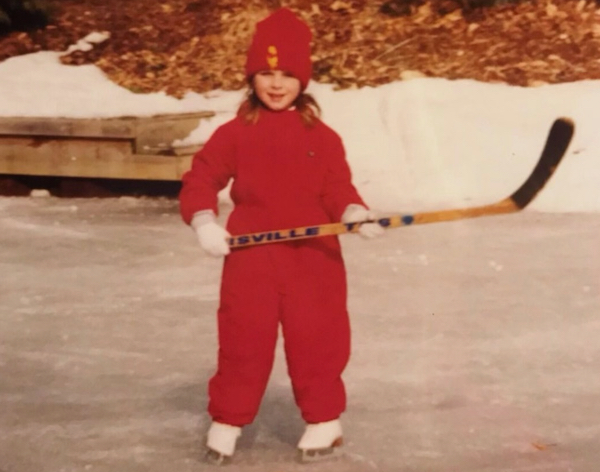
Hrynewich, who also played soccer and ran track for one year at Mona Shores, grew up playing hockey on a homemade rink in her backyard and was a competitive figure skater. But it was golf that captured her heart.
Even though she is right-handed, she “wanted to play golf like my dad and brother,” who are both left-handed. So she started mimicking their swings, and not only got good at it, she became one of the top female left-handed golfers in the state.
In addition to the four team state titles, Hrynewich earned Division 2 all-state honors all four years and was a Super Team selection as a senior, given to the top eight golfers in the state, regardless of division.
But with her combination of smarts, a heavy dose of sports in her DNA and charismatic personality, Hrynewich was ready for her next challenge.
“I had a great high school experience,” said Hrynewich, who did journalism work and was a regular on Mona Shores morning announcements during the school days. “I learned so much and had so much fun. It made me want to learn more and go places.”
Golf & broadcasting
Hrynewich was one of those rare high school seniors who knew exactly what she wanted to do in college:
Play golf and study sports broadcasting.
With that in mind, she sat down during her senior year at Mona Shores with her father, Tim, who played nine years of professional hockey including two with the Pittsburgh Penguins, and did research to identify the top 10 sports broadcasting schools in the country.
 That search led Hailey to Ohio University in Athens, Ohio, where she was a four-year standout for the Division I Bobcats and a two-time academic all-Mid-American Conference selection.
Reed, who was an all-state golfer and hockey player at Mona Shores, chose to stay in-state and play golf at University of Michigan. His success on and off the course mirrored his sister – and they remain each other’s biggest fans.
“So many people in that industry get in because of their family or who they know, but that wasn’t the case with Hailey,” said Reed, who is four minutes younger than his twin sister. “When she gets a freelance gig, she will study non-stop for days and days to be 100-percent prepared. She has gotten where she is through hard work.”
Hailey said she gets her analytical side from her dad. When she was 12, she memorized the statistics of the top 50 golfers and hockey players.
“I thought that was fun,” Hrynewich explained.
Her outgoing personality and courage in new situations come from her mother Susan – and those traits come in handy as she juggles freelance broadcasting opportunities from all over the world, including getting set in front of the camera earlier this month at the RBC Canadian Open with stars such as Rory McIlroy, Justin Thomas and Scottie Scheffler.
“I watch her clips and I see her talking to these famous people, and she’s so comfortable,” said Tim Hrynewich, who now works in real estate in Muskegon. “That’s the most impressive part of it to me. Her confidence. I could never do that.”
Proving herself
After graduating from Ohio University in 2017, Hailey still had the same two passions as when she graduated from Mona Shores four years earlier – golf and sports broadcasting.
The only difference is that she was now at the point where she had to choose between the two.
Hailey, who played in the prestigious U.S. Women’s Amateur in 2015, moved to Florida after graduation and turned pro for a short period – even shooting a career-best 66 in her first professional tournament.
 Ultimately, she decided that the time requirement and uncertainty of professional golf was too much, and she focused on broadcasting.
Her initial job was working for what is now Amalie Arena in Tampa, covering the Tampa Bay Lightning of the NHL and the Tampa Bay Storm of the Arena Football League.
That gave way to an internship with the LPGA Tour, which turned into a full-time job as a content producer and host, which she did for almost three years.
She estimates that during her time at the LPGA, her work was “30 percent on camera and 70 percent off camera.” Wanting more on-camera experience, she took a job as a sports reporter and weekend sports anchor at WJTV-12 in Jackson, Miss., where she learned a variety of skills necessary to put together a broadcast and covered SEC football and basketball.
Three weeks after she moved to Mississippi, the COVID-19 pandemic hit and she was quarantined in a city where she knew nobody.
Hrynewich describes her time as a small-town, Southern TV reporter as a “humbling grind” of shooting her own footage and even doing a live report from outside of the Alabama at Ole Miss football game during a tropical storm.
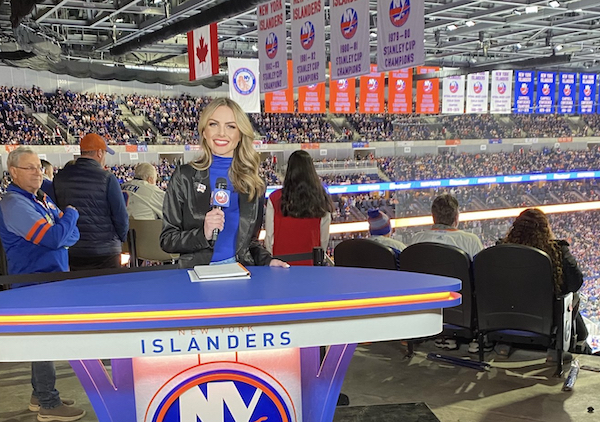
During this time, she made it a goal to work for an NHL team. After several near-misses, she landed a job with the New York Islanders as a team reporter and studio host, and in November of last year, she was off to Long Island.
“I went from one of the least-populated states in the country to one of the most populated – from Southern to big city,” Hrynewich said with a laugh. “But it was fun, and it was time.”
Just a couple of months into her gig with the Islanders, Hailey received a dream-come-true opportunity and set the stage for a crazy 2022 (which is only at the halfway point).
Olympics, PGA and beyond
The call came from Molly Solomon, who Hrynewich got to know when she was working for the LPGA Tour, and was now NBC’s Executive Producer for the Winter Olympic Games in Beijing, China, which started Feb. 4.
Basically, one week before the Games, one of the reporters dropped out, so Solomon asked Hrynewich if she would step in.
 “Of course, I said yes,” said Hrynewich, who was granted a leave of absence by the Islanders to go to Beijing. “Then I stressed myself out getting over there and studying everything I possibly could about sports I knew nothing about.”
She was assigned as NBC’s on-site reporter for four sports – moguls, aerials, ski cross and snowboard cross – and, as fate would have it, she covered one of the most compelling stories of the entire Games. Hrynewich drew praise for her handling of an emotional interview with Nick Baumgartner of Iron River, who failed to make the finals in snowboard cross in his fifth Olympic Games. Then she was there two days later when he redeemed himself with a gold medal in the team competition.
“It was raw emotion,” Hrynewich recalled. “He went from low to high, but I had to stay in the middle. I will never forget that interview.”
Both of those clips, along with many other highlights of her young career, are featured on her web site – haileyhunter.com.
Since the Olympics, Hrynewich has been pin-balling all over North America. She covered track & field for NBC Sports, then did the ACC Track & Field Championships for the ACC Network, the U.S. Women’s Open for the USGA and the Canadian Open for The Golf Channel.
She is momentarily catching her breath at home in Jackson, Miss., and is looking forward to coming back to Muskegon to see family and friends for the Fourth of July.
But she doesn’t expect to be sitting still for too long, with several more exciting projects in the hopper.
“I can’t believe everything I’ve done already this year,” Hailey said. “I’m really thankful and blessed and can’t wait to see what’s around the corner. Golf has opened up so many doors for me.”
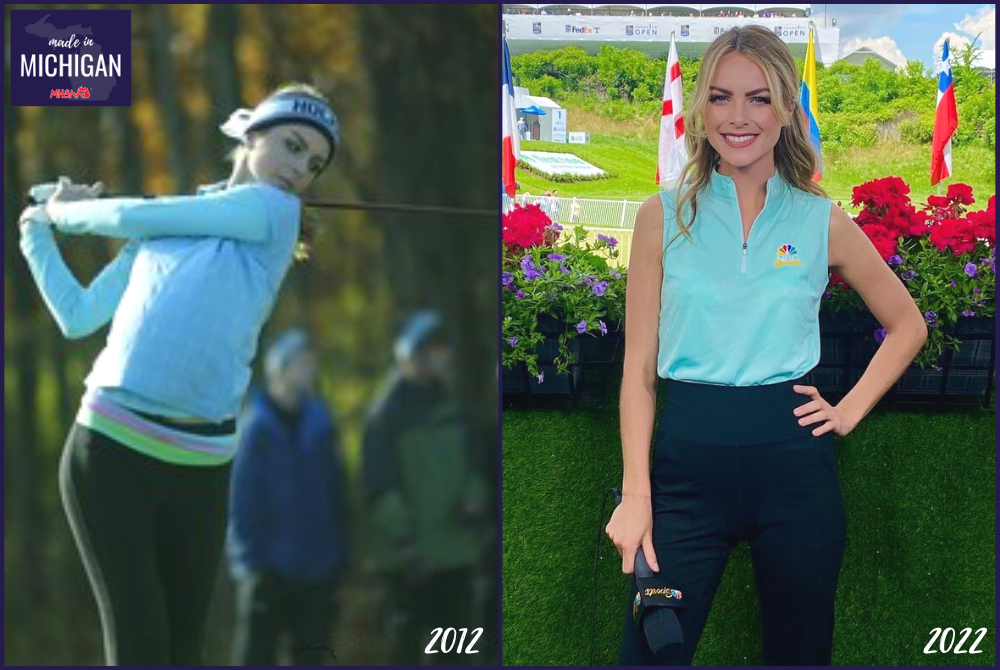
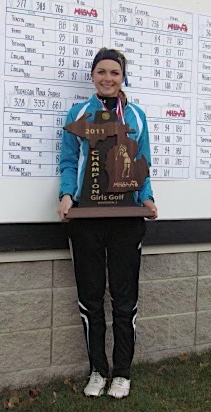
PHOTOS (Top) From left, Mona Shores' Hailey Hrynewich watches a drive during the 2012 MHSAA Lower Peninsula Division 2 Final, and at right Hrynewich hosts during a PGA event. (2) Hrynewich skates as a child. (3) Hrynewich poses with the leaderboard after her team collects the 2021 championship trophy. (4) On set with the Islanders, Hrynewich provides her knowledge as a team reporter and studio host. (Photos provided by Hailey Hrynewich.)