

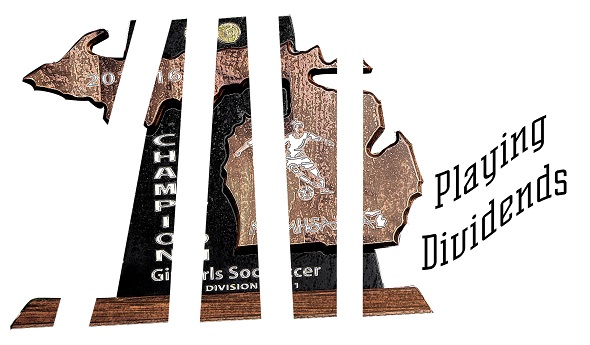
New Math: Division & Multiplication Problems
July 25, 2017
By Jack Roberts
MHSAA Executive Director
This is the second part in a series on MHSAA tournament classification, past and present, that will be published over the next two weeks. This series originally ran in this spring's edition of MHSAA benchmarks.
High school tournament classifications went viral before there was social media and most of us knew what “viral” meant.
Much as a virus infects computers today or has created epidemics of disease around the world for centuries, high school tournament classification – once introduced – tends to spread uncontrollably. Once started, it tends to keep expanding and rarely contracts.
While we are still some distance from providing every team a trophy as a result of expanding high school tournament classification across the country, there is criticism nevertheless that we are headed in that direction – a philosophy which is supposed to exist only in local youth sports for our youngest children.
Michigan could be blamed for all this. Michigan is generally accepted as the first state to provide different classifications for season-ending tournaments for different sized schools. It started a century ago. Today, every state has various classifications for its tournaments in most if not all sports. And it is a bit ironic that Michigan – creator of the classification chaos – more than most other states has kept the number of tournament classes or divisions under control.
Yes, there is evidence that tournament classifications have expanded over the years in Michigan, especially with the relatively recent introduction of tournaments in football and the late 1990s’ move from classes to divisions in most MHSAA tournaments. But the MHSAA Representative Council has held true to its word when it expanded the playoffs for football from four classes to eight divisions: this is needed because of unique factors of football, factors that exist in no other sport; and all other sports should be capped at a maximum of four classes or divisions.
Kentucky is the preeminent defender of single-class basketball. All of its 276 high schools compete for the single state championship for each gender. In Indiana, there are still open wounds from its move in 1998 from one to four classes for its 400 schools in basketball.
Multi-class tournaments have tended to increase the number of non-public school champions, which some states are trying to lower through enrollment “multipliers,” and also tend to increase the number of repeat champions, which some states are trying to affect with “success factors” which lift smaller schools into classifications for larger schools if they take home too many trophies.
While there is considerable evidence that state tournaments do as much bad as good for educational athletics, state associations persist in providing postseason tournaments because, on balance, the experiences are supposed to be good for student-athletes. And once we reach that conclusion it is just a small leap to believe that if the tournaments are good for a few, they must be better for more – which leads to creating more and more tournament classifications. One becomes two classes, then three, then four and so forth.
While the argument is that more classifications or divisions provides more students with opportunities to compete and win, it is undeniable that the experience changes as the number of tournament classifications expands. It is not possible for state associations to provide the same level of support when tournament classifications expand to multiple venues playing simultaneously. For example, there is less audio and video broadcast potential at each venue, and less media coverage to each venue. Focus is diluted and fans diminished at each championship.
No one can argue reasonably that today's two-day MHSAA Football Finals of eight championship games has the same pizazz as the one-day, four-games event conducted prior to 1990.
In some states the number of divisions has grown so much that it is difficult to see much difference between the many season-ending state championship games and a regular-season event in the same sport.
It is a balancing act. And Michigan has been studying that balance longer than any other state, and charting a steadier course than most.
Addition by Division
The shift to Divisions for MHSAA Tournament play in numerous sports has added up to a greater number of champions for teams and individuals across the state. Following are the sports currently employing a divisional format, and the procedures for determining enrollment and classification.
In 23 statewide or Lower Peninsula tournaments, schools which sponsor the sport are currently divided into nearly equal divisions. They are:
- Baseball - 4 Divisions
- Boys Bowling - 4 Divisions
- Girls Bowling - 4 Divisions
- Girls Competitive Cheer - 4 Divisions
- LP Boys Cross Country - 4 Divisions
- LP Girls Cross Country - 4 Divisions
- LP Boys Golf - 4 Divisions
- LP Girls Golf - 4 Divisions
- Ice Hockey - 3 Divisions
- Boys Lacrosse - 2 Divisions
- Girls Lacrosse - 2 Divisions
- Boys Skiing - 2 Divisions
- Girls Skiing - 2 Divisions
- LP Boys Soccer - 4 Divisions LP
- Girls Soccer - 4 Divisions
- Girls Softball - 4 Divisions
- LP Boys Swimming & Diving - 3 Divisions
- LP Girls Swimming & Diving - 3 Divisions
- LP Boys Tennis - 4 Divisions
- LP Girls Tennis - 4 Divisions
- LP Boys Track & Field - 4 Divisions
- LP Girls Track & Field - 4 Divisions
- Wrestling - 4 Divisions
Lists of schools for each division of these 23 tournaments are posted on MHSAA.com approximately April 1. Listings of schools in Upper Peninsula tournaments for their sports are also posted on MHSAA.com. The lists are based on school memberships and sports sponsorships in effect or anticipated for the following school year, as known to the MHSAA office as of a date in early March.
In football, the 256 schools which qualify for MHSAA 11-player playoffs are placed in eight equal divisions annually on Selection Sunday. Beginning in 2017, the 8-player divisions will be determined in a like manner on Selection Sunday as well, with 32 qualifying schools placed in two divisions.
Schools have the option to play in any higher division in one or more sports for a minimum of two years.
The deadlines for "opt-ups" are as follows:
- Applications for fall sports must be submitted by April 15
- Applications for winter sports must be submitted by Aug. 15
- Applications for spring sports must be submitted by Oct. 15
Subsequent to the date of these postings for these tournaments, no school will have its division raised or lowered by schools opening or closing, schools adding or dropping sports, schools exercising the option to play in a higher division, or approval or dissolution of cooperative programs.
When the same sport is conducted for boys and girls in the same season (e.g., track & field and cross country), the gender that has the most sponsoring schools controls the division breaks for both genders.

When Can I Walk Off Knee Pain — And When Should I See A Doctor?
June 7, 2022

Whether you wake up with a stiff knee, sustain an injury, or start feeling knee pain for seemingly no good reason, you might wonder what to do. Should you immediately rush off to the doctor? Can you just ignore it and hope it will get better? Can you treat it yourself? Knowing when you need a doctor’s intervention can be a tricky decision to make.
We see people at the start of injuries and after they’ve been ongoing,” says Nancy White, M.D., a sports medicine physician at Henry Ford Health. “While the sooner you see an expert, the better, there’s really no right or wrong to it. However, there are a few key signs that it’s a good idea to get it checked out.”
Dr. White recommends seeing a doctor if:
► You are waking up with consistent knee stiffness. If there’s no history of an injury involved, it could be due to osteoarthritis or rheumatoid arthritis.
► If your knee pain isn’t going away.
► Your knee is swollen and you can’t bear weight on it.
► You can’t fully flex or extend your knee.
► Your knee is warm to the touch. This could signal inflammation.
If your pain is mild — or you’re trying to decide whether to see someone — Dr. White recommends icing it on a scheduled basis. “That means two to three times a day,” she says. “Apply the ice to your knee. It will get cold. It will burn, then it will get numb. Remove the ice when it gets to the numb stage.”
She also recommends elevating your leg and putting a compression wrap or sleeve on your knee. If the pain is bad, you can try taking ibuprofen or naproxen for a few days.
Common Causes of Knee Pain
But if your knee is not getting better, it’s a good idea to see a doctor, as common causes of knee pain include:
► ACL sprains and tears. Short for anterior cruciate ligament, the ACL is one of four ligaments in the knee that allows it to flex and extend. The ACL can tear when your foot is firmly planted in place, and the knee locks and twists or pivots at the same time.
► MCL sprains and tears. Short for medial collateral ligament, the MCL connects your shinbone to your thighbone. It can tear when landing after a jump, or after an exterior blow to the knee (usually during contact sports). Luckily, most MCL injuries heal on their own.
► Meniscal tears. The menisci are your knee’s shock absorbers; they're two discs made of soft cartilage. Abrupt movements (like pivots, stops, turns, squats or lifts) can cause them to tear.
► Kneecap dislocation. A direct hit to the knee — or a sudden twist or pivoting of the leg — can make the kneecap can shift out of place.
► Patellar tendonitis. This is also known as Jumper’s Knee, as it’s a common injury in basketball and volleyball players. The patellar tendon connects the bottom of the kneecap to the top of the shinbone, and can become inflamed from overuse, excessive force or repetitive stress.
Knee bursitis. The bursa is a small, fluid-filled sac located near the knee joint. Knee bursitis occurs when the bursa becomes inflamed, often because of a knee injury or overuse from frequent kneeling.
How to Help Prevent Knee Pain
And if you want to help prevent knee pain in the future? “Exercise regularly so that you’re strengthening your quadriceps, hamstrings and gluteal muscles,” says Dr. White. “It’s also important to stretch to increase quadricep and hamstring flexibility.”
Wearing shoes with sturdy soles and proper arch support can also help ease pain and issues you may already have, says Dr. White. “I would say the top reasons people get into trouble with their knees are things they could prevent by changing lifestyle habits. This includes maintaining a healthy weight, as being overweight can also lead to increased wear and tear on the joints.
To learn more about your orthopedic condition or to find a provider, visit henryford.com/ortho.
Dr. Nancy White is a sports medicine physician at Henry Ford Health. She sees patients at Henry Ford Medical Center – Novi, and Henry Ford Medical Center — Bloomfield Township.