

New Math: Division & Multiplication Problems
July 25, 2017
By Jack Roberts
MHSAA Executive Director
This is the second part in a series on MHSAA tournament classification, past and present, that will be published over the next two weeks. This series originally ran in this spring's edition of MHSAA benchmarks.
High school tournament classifications went viral before there was social media and most of us knew what “viral” meant.
Much as a virus infects computers today or has created epidemics of disease around the world for centuries, high school tournament classification – once introduced – tends to spread uncontrollably. Once started, it tends to keep expanding and rarely contracts.
While we are still some distance from providing every team a trophy as a result of expanding high school tournament classification across the country, there is criticism nevertheless that we are headed in that direction – a philosophy which is supposed to exist only in local youth sports for our youngest children.
Michigan could be blamed for all this. Michigan is generally accepted as the first state to provide different classifications for season-ending tournaments for different sized schools. It started a century ago. Today, every state has various classifications for its tournaments in most if not all sports. And it is a bit ironic that Michigan – creator of the classification chaos – more than most other states has kept the number of tournament classes or divisions under control.
Yes, there is evidence that tournament classifications have expanded over the years in Michigan, especially with the relatively recent introduction of tournaments in football and the late 1990s’ move from classes to divisions in most MHSAA tournaments. But the MHSAA Representative Council has held true to its word when it expanded the playoffs for football from four classes to eight divisions: this is needed because of unique factors of football, factors that exist in no other sport; and all other sports should be capped at a maximum of four classes or divisions.
Kentucky is the preeminent defender of single-class basketball. All of its 276 high schools compete for the single state championship for each gender. In Indiana, there are still open wounds from its move in 1998 from one to four classes for its 400 schools in basketball.
Multi-class tournaments have tended to increase the number of non-public school champions, which some states are trying to lower through enrollment “multipliers,” and also tend to increase the number of repeat champions, which some states are trying to affect with “success factors” which lift smaller schools into classifications for larger schools if they take home too many trophies.
While there is considerable evidence that state tournaments do as much bad as good for educational athletics, state associations persist in providing postseason tournaments because, on balance, the experiences are supposed to be good for student-athletes. And once we reach that conclusion it is just a small leap to believe that if the tournaments are good for a few, they must be better for more – which leads to creating more and more tournament classifications. One becomes two classes, then three, then four and so forth.
While the argument is that more classifications or divisions provides more students with opportunities to compete and win, it is undeniable that the experience changes as the number of tournament classifications expands. It is not possible for state associations to provide the same level of support when tournament classifications expand to multiple venues playing simultaneously. For example, there is less audio and video broadcast potential at each venue, and less media coverage to each venue. Focus is diluted and fans diminished at each championship.
No one can argue reasonably that today's two-day MHSAA Football Finals of eight championship games has the same pizazz as the one-day, four-games event conducted prior to 1990.
In some states the number of divisions has grown so much that it is difficult to see much difference between the many season-ending state championship games and a regular-season event in the same sport.
It is a balancing act. And Michigan has been studying that balance longer than any other state, and charting a steadier course than most.
Addition by Division
The shift to Divisions for MHSAA Tournament play in numerous sports has added up to a greater number of champions for teams and individuals across the state. Following are the sports currently employing a divisional format, and the procedures for determining enrollment and classification.
In 23 statewide or Lower Peninsula tournaments, schools which sponsor the sport are currently divided into nearly equal divisions. They are:
- Baseball - 4 Divisions
- Boys Bowling - 4 Divisions
- Girls Bowling - 4 Divisions
- Girls Competitive Cheer - 4 Divisions
- LP Boys Cross Country - 4 Divisions
- LP Girls Cross Country - 4 Divisions
- LP Boys Golf - 4 Divisions
- LP Girls Golf - 4 Divisions
- Ice Hockey - 3 Divisions
- Boys Lacrosse - 2 Divisions
- Girls Lacrosse - 2 Divisions
- Boys Skiing - 2 Divisions
- Girls Skiing - 2 Divisions
- LP Boys Soccer - 4 Divisions LP
- Girls Soccer - 4 Divisions
- Girls Softball - 4 Divisions
- LP Boys Swimming & Diving - 3 Divisions
- LP Girls Swimming & Diving - 3 Divisions
- LP Boys Tennis - 4 Divisions
- LP Girls Tennis - 4 Divisions
- LP Boys Track & Field - 4 Divisions
- LP Girls Track & Field - 4 Divisions
- Wrestling - 4 Divisions
Lists of schools for each division of these 23 tournaments are posted on MHSAA.com approximately April 1. Listings of schools in Upper Peninsula tournaments for their sports are also posted on MHSAA.com. The lists are based on school memberships and sports sponsorships in effect or anticipated for the following school year, as known to the MHSAA office as of a date in early March.
In football, the 256 schools which qualify for MHSAA 11-player playoffs are placed in eight equal divisions annually on Selection Sunday. Beginning in 2017, the 8-player divisions will be determined in a like manner on Selection Sunday as well, with 32 qualifying schools placed in two divisions.
Schools have the option to play in any higher division in one or more sports for a minimum of two years.
The deadlines for "opt-ups" are as follows:
- Applications for fall sports must be submitted by April 15
- Applications for winter sports must be submitted by Aug. 15
- Applications for spring sports must be submitted by Oct. 15
Subsequent to the date of these postings for these tournaments, no school will have its division raised or lowered by schools opening or closing, schools adding or dropping sports, schools exercising the option to play in a higher division, or approval or dissolution of cooperative programs.
When the same sport is conducted for boys and girls in the same season (e.g., track & field and cross country), the gender that has the most sponsoring schools controls the division breaks for both genders.
Mason County Central's Quinn Wins for Team, Family, Community
By
Drew Ellis
Special for MHSAA.com
March 5, 2022
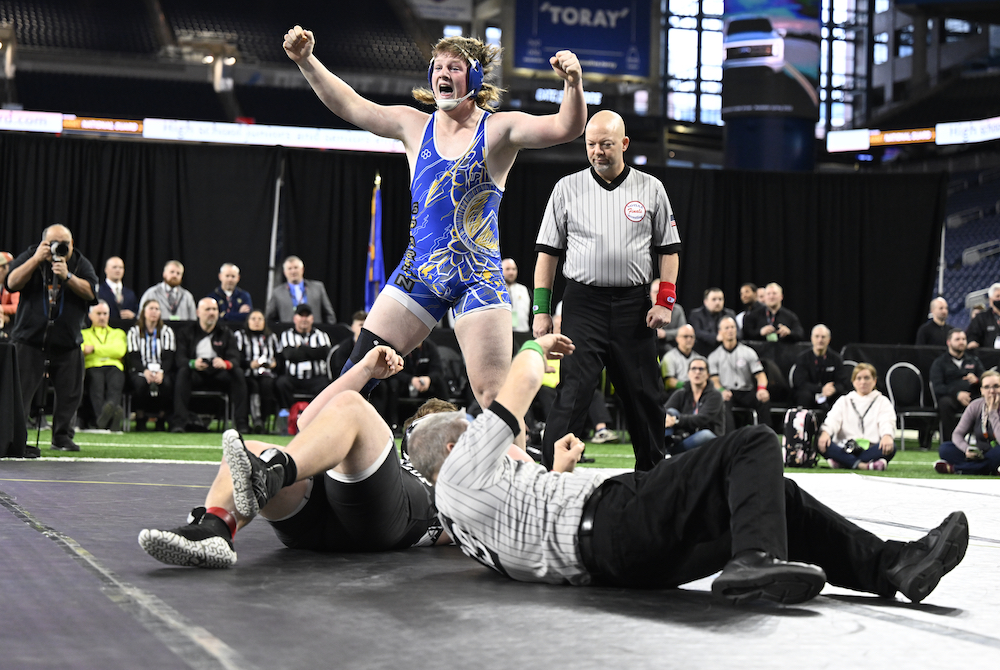
DETROIT – Standing across from Mason County Central’s Andrew Quinn on Saturday was the reigning Division 4 champion at 285 pounds, who also hadn’t lost in two seasons.
Despite a near-perfect record of his own, Quinn likely wasn’t the favorite to most. But he had other ideas.
The senior scored a reversal in the second period and quickly transitioned it into a pinfall against New Lothrop’s Isiah Pasik to earn his first MHSAA Finals title.
Dealing with a small team at Mason County Central, Quinn (51-1) credited the victory over Pasik (46-1) to his coaching staff, family, and friends who have all put time on the mat with him.
“I’ve got three older brothers up there watching me. They have pushed me my whole life,” Quinn said. “There’s tons of people that came to the wrestling room to help me out. We don’t have a big team, so I get to beat up on these guys (the coaches) every day.
“There’s tons of people to thank. I didn’t do it alone.”
103
Champion: Logan Gilbert, Martin/Climax-Scotts, Fr. (41-6)
Decision, 10-5, over Logan Mears, Union City, Fr. (45-5)
Gilbert knew what he needed to do to come away with the 103-pound title.
Having faced Mears three previous times this season, and winning all three, he just stuck to his game plan.
“I was just trying to stop the switch on bottom. (Mears) loves to hit that, and he’s really good at it. In neutral, he likes to hit the slot, but I tried to tie him up with my right arm,” Gilbert said. “I was ready for him.”
Gilbert kept the pressure and scored five takedowns during the match.
“I don’t think it has hit me yet,” Gilbert said of winning a title. “I don’t know what I am feeling right now, but it feels good.”
112
Champion: Jacob Bunn, Manchester, Sr. (46-2)
Decision, 5-2, over Trent Kimmel, Martin/Climax-Scotts, Sr. (37-3)
Making his fourth Finals appearance, Bunn finally got through to the top of the mountain.
“It’s something I have been working toward for 14 years now,” Bunn said. “I am just glad that I was able to get to the top in my senior year.”
It was a hard-fought win for the Manchester senior, as he held off a late surge from Kimmel.
“Even before the match, I just was thinking that it was another match and I couldn’t change up my style because it was a state final,” Bunn said. “I went out there and just didn’t let the pressure get to me and stayed focused.”
119
Champion: Shawn McGuire, Iron Mountain, Jr. (39-2)
Decision, 5-0, over Tyler Winch, Iron Mountain, Soph. (32-14)
It was a bittersweet championship victory for McGuire, the junior, as he dispatched of his Iron Mountain sophomore teammate for the title.
“It’s tough. It’s like your worst nightmare,” McGuire said. “I can never imagine going against my teammate, especially in a state final. It was difficult.”
McGuire controlled the match from start to finish, scoring a pair of takedowns and adding an escape while keeping Winch from getting on the scoreboard.
“It does feel great to be a champion. I’ve worked really hard for this,” McGuire said. “I’ve come close in the past and lost, but I just kept working toward this goal. It’s hard to put into words.”
125
Champion: Landyn Crance, Union City, Soph. (45-3)
Decision, 8-1, over Austin Marry, Hudson, Soph. (27-12)
As a freshman, Crance saw his chances at competing for a Finals title ended by COVID-19. This year, he made sure to make the most of his opportunity.
“Last year was devastating, having it all taken away from me because of COVID. But, I knew I just wanted to work harder this year to make up for it,” Crance said.
Crance started fast and never looked back, maintaining control of Marry throughout the six minutes.
“I knew I had to ride tight and stay on top,” Crance said. “I knew getting off the bottom would be difficult with (Marry), so I just had to keep control of him.”
130
Champion: Derek Mayle, Breckenridge, Sr. (38-3)
Major Decision, 14-1, over Dalton Birchmeier, New Lothrop, Fr. (31-13)
Mayle made sure his last match was one of his best.
The Breckenridge senior came within inches of a pinfall victory, but still came away with a 14-1 win.
“This was the last match of my life, so I just wanted to go out and have fun and end it on a bang,” Mayle said. “I wanted to make sure that I didn’t leave anything on the mat.”
Mayle overwhelmed Birchmeier, whom he had seen before in Regional competition. Still, the New Lothrop freshman fought hard to see the full six minutes.
“I was pretty confident, but I didn’t want to take the match lightly,” Mayle said. “I just needed to stay disciplined and keep attacking.”
135
Champion: River Roberson, Hesperia, Sr. (45-2)
Decision, 10-7, over Payton Rogers, Hudson, Sr. (33-7)
In one of the more back-and-forth matches of the Division 4 Finals, Roberson grinded out a 10-7 win.
“It’s hard to believe, but it’s an amazing feeling,” Roberson said. “I’ve worked so hard for this, it’s hard to believe it’s actually happened.”
Roberson found himself in a nearfall situation early in the match, but battled back to take control. Once he got it, he didn’t allow Rogers to get it back.
“When (Rogers) got the first takedown, it kind of made me nervous. But, I knew what I have been through to get here,” Roberson said. “My coaches put me through a lot of intense training to be ready for matches like this.”
140
Champion: Manus Bennett, Marlette, Jr. (43-0)
Decision, 2-0, over Bronson Marry, Hudson, Sr. (27-3)
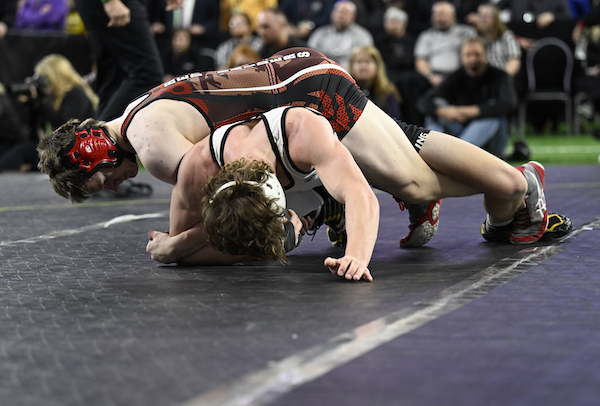
In a matchup of two past champions, Bennett scored a takedown in the second period to find a way past Marry.
“A lot of it was just mental technique for me. I knew if I could get the takedown, I am really good at riding legs,” Bennett said. “I knew he was a good wrestler. I just had to not allow him to work his strengths, and find a way to work mine.”
The 103-pound champion in 2020, Bennett used his riding ability and endurance to hang on for his second title.
“Wrestling is the longest six minutes of your life. Two minutes can feel like years,” Bennett said. “Seeing that clock finally hit zero, it was a lot of relief.”
145
Champion: Sebastian Martinez, Riverview Gabriel Richard, Fr. (33-4)
Decision, 4-1, over Dillon Raab, Bark River-Harris, Jr. (34-3)
Martinez became the first Finals champion in the young history of the Gabriel Richard program by scoring a pair of key takedowns.
“I am starting a new legacy for future Pioneers coming to this school,” Martinez said of being the first champion. “This program is going to be something great, and I am just glad I got to be the first.”
Leading 2-1 entering the third period, Martinez didn’t get passive. He made an aggressive shot on Raab and earned a powerful takedown to lock up the victory.
“I was just trying to hold on, but the best defense is a great offense,” Martinez said. “I decided to take the shot in the third and managed to get the takedown to really secure the win.”
152
Champion: Parker Stroud, Iron Mountain, Sr. (41-6)
Decision, 11-9, over Josh Collins, Hemlock, Sr. (41-5)
Stroud ended his prep wrestling career with a championship, but wasn’t too thrilled with his performance in an exciting 11-9 victory over Collins.
“It feels pretty good, but I didn’t really wrestle my best. It takes a little away from it, but it still feels good to be a champion,” Stroud said.
Stroud was getting a number of takedowns, but Collins would respond with reversals and threaten to take the victory. It took an explosive takedown from Stroud to get the go-ahead points in the closing seconds.
“I was wrestling pretty well, but I wasn’t getting much done on top,” Stroud said. “I just managed to get the score in the end.”
160
Champion: Shenard Foster, Detroit Loyola, Sr. (17-0)
Decision, 5-4, over Gavin Wilmoth, Traverse City St. Francis, Sr. (39-3)
After losing in overtime of last year’s championship match, Foster was determined to not let that happen again this year.
The Detroit Loyola senior used his explosiveness and athleticism to top Wilmoth, last year’s 152-pound champion.
“It feels great. I fell short last year, so it feels great to win (a title) this year,” Foster said. “It motivated me a lot, because I knew I could do it.”
Foster was able to score two takedowns in the match while adding an escape. That’s all he needed, as Wilmoth was unable to get him to the ground.
“I just had to stay smart. I am used to wrestling guys that are taller than me. (Wilmoth) was my height, so I just had to be aggressive. I knew he couldn’t stop my shots,” Foster said.
171
Champion: Cole Hopkins, Evart, Jr. (54-0)
Major Decision, 15-7, over Noah Etnyre, Lutheran Westland, Jr. (48-5)
Hopkins completed an unbeaten junior season and avenged his lone loss in the 2021 Finals by scoring a major decision in the 171-pound championship match.
“That is the greatest feeling in the world,” Hopkins said. “Since that day (last year’s loss), it’s been eating me alive. Every time I wake up, that’s what I have been thinking about and it made me go harder.”
It was all about the takedowns for Hopkins, as he repeatedly got Etnyre to the ground. He scored a quick takedown in the first and never trailed in the match.
“I just had to not wrestle scared,” Hopkins said. “I had been here before, so that gave me the confidence to wrestle that much harder and get the job done.”
189
Champion: Drew Allgeyer, Bark River-Harris, Jr. (40-4)
Decision, 9-5, over Cameron Kimble, Hudson, Sr. (43-2)
It wasn’t always easy for Allgeyer, but he led throughout the match to kick off the Division 4 Finals and earn his first championship.
“It feels amazing,” Allgeyer said. “I am on top of the world.”
Allgeyer secured some early takedowns, but Kimble put up a game effort with a reversal in the second period to keep things interesting. In the end, Allgeyer pushed a pace that Kimble couldn’t quite match.
“When I was warming up, I just kept telling myself that these six minutes were going to be mine,” Allgeyer said. “That’s the way that I wrestle every single match.”
215
Champion: Caden Ferris, Delton Kellogg, Sr. (49-0)
Major Decision, 10-2, over Grayson Orr, New Lothrop, Jr. (47-6)
Caden Ferris will be a name the Orr family is likely never to forget.
The Delton Kellogg senior won a second consecutive title at 215 pounds with a dominant 10-2 win over Grayson Orr on Saturday.
Last year, Ferris defeated Grayson’s brother, Camden Orr, in the 215-pound final by a score of 13-11 in OT.
“It’s pretty cool,” Ferris said of winning another title. “I’m feeling pretty good about it. I was pretty focused on winning.”
PHOTOS (Top) Mason County Central’s Andrew Quinn, standing, celebrates his win at 285 pounds Saturday at Ford Field. (Middle) Marlette’s Manus Bennett, top, works toward a win at 140 pounds. (Click for more from HighSchoolSportsScene.com.)