

New Math: Division & Multiplication Problems
July 25, 2017
By Jack Roberts
MHSAA Executive Director
This is the second part in a series on MHSAA tournament classification, past and present, that will be published over the next two weeks. This series originally ran in this spring's edition of MHSAA benchmarks.
High school tournament classifications went viral before there was social media and most of us knew what “viral” meant.
Much as a virus infects computers today or has created epidemics of disease around the world for centuries, high school tournament classification – once introduced – tends to spread uncontrollably. Once started, it tends to keep expanding and rarely contracts.
While we are still some distance from providing every team a trophy as a result of expanding high school tournament classification across the country, there is criticism nevertheless that we are headed in that direction – a philosophy which is supposed to exist only in local youth sports for our youngest children.
Michigan could be blamed for all this. Michigan is generally accepted as the first state to provide different classifications for season-ending tournaments for different sized schools. It started a century ago. Today, every state has various classifications for its tournaments in most if not all sports. And it is a bit ironic that Michigan – creator of the classification chaos – more than most other states has kept the number of tournament classes or divisions under control.
Yes, there is evidence that tournament classifications have expanded over the years in Michigan, especially with the relatively recent introduction of tournaments in football and the late 1990s’ move from classes to divisions in most MHSAA tournaments. But the MHSAA Representative Council has held true to its word when it expanded the playoffs for football from four classes to eight divisions: this is needed because of unique factors of football, factors that exist in no other sport; and all other sports should be capped at a maximum of four classes or divisions.
Kentucky is the preeminent defender of single-class basketball. All of its 276 high schools compete for the single state championship for each gender. In Indiana, there are still open wounds from its move in 1998 from one to four classes for its 400 schools in basketball.
Multi-class tournaments have tended to increase the number of non-public school champions, which some states are trying to lower through enrollment “multipliers,” and also tend to increase the number of repeat champions, which some states are trying to affect with “success factors” which lift smaller schools into classifications for larger schools if they take home too many trophies.
While there is considerable evidence that state tournaments do as much bad as good for educational athletics, state associations persist in providing postseason tournaments because, on balance, the experiences are supposed to be good for student-athletes. And once we reach that conclusion it is just a small leap to believe that if the tournaments are good for a few, they must be better for more – which leads to creating more and more tournament classifications. One becomes two classes, then three, then four and so forth.
While the argument is that more classifications or divisions provides more students with opportunities to compete and win, it is undeniable that the experience changes as the number of tournament classifications expands. It is not possible for state associations to provide the same level of support when tournament classifications expand to multiple venues playing simultaneously. For example, there is less audio and video broadcast potential at each venue, and less media coverage to each venue. Focus is diluted and fans diminished at each championship.
No one can argue reasonably that today's two-day MHSAA Football Finals of eight championship games has the same pizazz as the one-day, four-games event conducted prior to 1990.
In some states the number of divisions has grown so much that it is difficult to see much difference between the many season-ending state championship games and a regular-season event in the same sport.
It is a balancing act. And Michigan has been studying that balance longer than any other state, and charting a steadier course than most.
Addition by Division
The shift to Divisions for MHSAA Tournament play in numerous sports has added up to a greater number of champions for teams and individuals across the state. Following are the sports currently employing a divisional format, and the procedures for determining enrollment and classification.
In 23 statewide or Lower Peninsula tournaments, schools which sponsor the sport are currently divided into nearly equal divisions. They are:
- Baseball - 4 Divisions
- Boys Bowling - 4 Divisions
- Girls Bowling - 4 Divisions
- Girls Competitive Cheer - 4 Divisions
- LP Boys Cross Country - 4 Divisions
- LP Girls Cross Country - 4 Divisions
- LP Boys Golf - 4 Divisions
- LP Girls Golf - 4 Divisions
- Ice Hockey - 3 Divisions
- Boys Lacrosse - 2 Divisions
- Girls Lacrosse - 2 Divisions
- Boys Skiing - 2 Divisions
- Girls Skiing - 2 Divisions
- LP Boys Soccer - 4 Divisions LP
- Girls Soccer - 4 Divisions
- Girls Softball - 4 Divisions
- LP Boys Swimming & Diving - 3 Divisions
- LP Girls Swimming & Diving - 3 Divisions
- LP Boys Tennis - 4 Divisions
- LP Girls Tennis - 4 Divisions
- LP Boys Track & Field - 4 Divisions
- LP Girls Track & Field - 4 Divisions
- Wrestling - 4 Divisions
Lists of schools for each division of these 23 tournaments are posted on MHSAA.com approximately April 1. Listings of schools in Upper Peninsula tournaments for their sports are also posted on MHSAA.com. The lists are based on school memberships and sports sponsorships in effect or anticipated for the following school year, as known to the MHSAA office as of a date in early March.
In football, the 256 schools which qualify for MHSAA 11-player playoffs are placed in eight equal divisions annually on Selection Sunday. Beginning in 2017, the 8-player divisions will be determined in a like manner on Selection Sunday as well, with 32 qualifying schools placed in two divisions.
Schools have the option to play in any higher division in one or more sports for a minimum of two years.
The deadlines for "opt-ups" are as follows:
- Applications for fall sports must be submitted by April 15
- Applications for winter sports must be submitted by Aug. 15
- Applications for spring sports must be submitted by Oct. 15
Subsequent to the date of these postings for these tournaments, no school will have its division raised or lowered by schools opening or closing, schools adding or dropping sports, schools exercising the option to play in a higher division, or approval or dissolution of cooperative programs.
When the same sport is conducted for boys and girls in the same season (e.g., track & field and cross country), the gender that has the most sponsoring schools controls the division breaks for both genders.
Rematch of Champs Brings Classic Conclusion to D1 Finals
By
Drew Ellis
Special for MHSAA.com
March 5, 2022
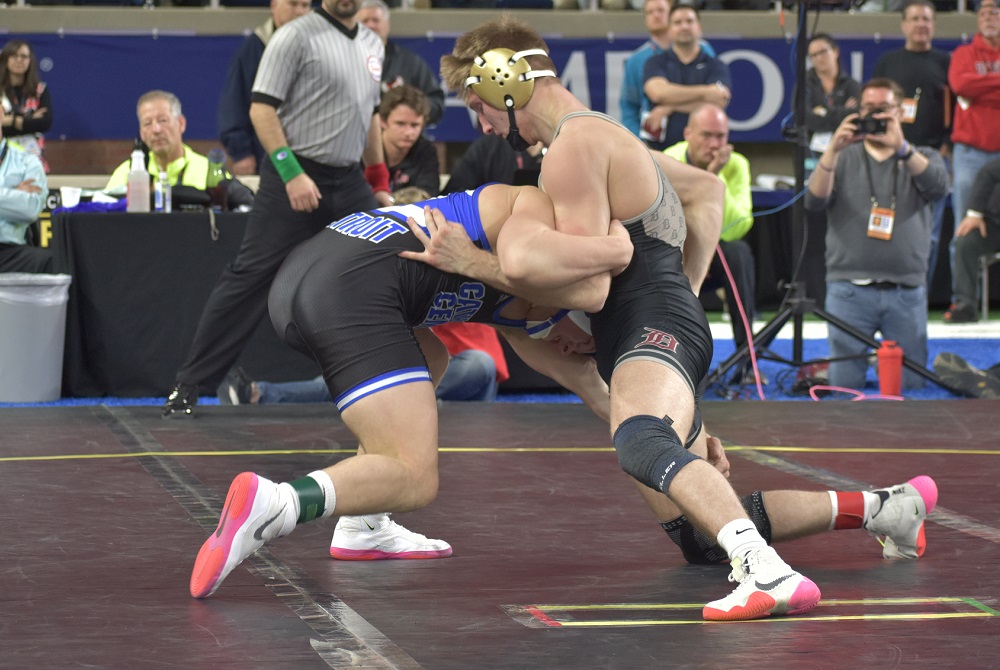
DETROIT – It was fitting that Josh Barr versus Manuel Rojas was the last bout of the night at Saturday’s Division 1 Individual Wrestling Finals, because that’s the match everyone was most excited to see.
Two of the best in the country at 171 pounds, with a combined four state titles between them, Davison’s Barr emerged victorious with a 5-2 win over Detroit Catholic Central’s Rojas, with all eyes on them.
“This is what I’ve been talking about for a long time. I couldn’t wait to be part of something like this. Practically main eventing the state championships against one of the best wrestlers in the state, it’s amazing,” Barr said. “Having all these people around watching, it was awesome.”
Barr (28-1), a junior, set the tone right away with a takedown in the first period to lead 2-0.
Rojas (37-3) managed an escape in the first and another in the second to even the match at 2-2. Barr would answer with an escape to start the third and then drive home the win with a takedown in the final minute to earn his third title.
“It means a lot,” Barr said of his third championship. “It means what we’re doing is right, it’s working. Going to bed early, waking up early, eating clean. It all adds up.”
Rojas had just two losses in-state during his senior season, both coming to Barr over the last eight days. Barr edged Rojas 4-3 in last weekend’s Division 1 Team Final while leading Davison to a 29-21 victory.
“I think it just shows my character. I got right back to it last week. Winning that team state title was cool, but as soon as I got in my car, it was over,” Barr said. “I started training again right away. I knew (Rojas) was going to be sitting here waiting for me, so I got right back to it.”
103
Champion: Conor McAlary, Hudsonville, Fr. (45-1)
Decision, 4-2 (OT), over Ozia Wilson, Macomb Dakota, Fr. (47-1)
In a thrilling finish, McAlary scored a takedown in sudden victory to hand Wilson his only loss of the season.
“I knew going into this match that I had to take (Wilson) into deep waters to win this match,” McAlary said. “Heading into overtime, my coach told me this is right where we wanted to be. I knew I had it.”
The first two periods were scoreless, but McAlary got a takedown in the third to counter a pair of escapes from Wilson. It then came down to a quick takedown from McAlary in OT to earn the state title.
“I still can’t believe it,” he said. “The goal is always to win, but sometimes you can’t really wrap your head around it even after you win. I don’t really know what to feel. It’s wild.”
112
Champion: Caleb Weiand, Macomb Dakota, Jr. (48-0)
Decision, 3-1, over Mariano Lopez, Holt, Jr. (35-5)
After suffering his only loss of the 2021 season in a championship match, Weiand was determined not to suffer the same fate this year.
“Losing in the state finals was the worst feeling I ever had. I didn’t want to experience that again,” Weiand said.
His takedown in the first period proved to be the difference, as he held off a game Lopez over the final minutes.
“I just had to stay tough,” Weiand said. “I knew I could ride him out for most of the period. I feel very confident on top.”
119
Champion: Drew Heethuis, Detroit Catholic Central, Jr. (32-3)
Decision, 4-1, over Justin Gates, Davison, Soph. (30-4)
In a match that featured a pair of 2021 champions, Heethuis scored a takedown in the first period and a reversal in the second to secure his second title.
“It’s awesome. I had a couple of bumps in the road earlier in the year, and I wasn’t in the right mindset,” Heethuis said. “Over the past couple of months, because of my coaches, I was able to dial it in for the last half of the year. It feels great.”
The two met in last week’s Division 1 Team Final, with Heethuis grinding out a 2-1 victory over Gates.
“We wrestled last weekend and I knew it would be a tough match this time, too,” Heethuis said. “I knew that if I was able to get into a good attack in the first, it would be key.”
125
Champion: Cade Horwath, Davison, Jr. (30-0)
Decision, 10-5, over Fritz Mueller, Macomb Dakota, Sr. (40-7)
Horvath earned his 100th career win and locked up his third championship while also capping his second-consecutive undefeated season.
“This one means a little more,” Horwath said of his third title. “We had some team adversity this year, so it took a lot of hard work by the team to get everyone at their best.”
Horwath scored two takedowns early in the first period to set the tone and never trailed in the match.
“Honestly, I just wanted to have fun and score some points,” Horwath said. “It was a nice environment, being able to wrestle in front of my family and fans.”
130
Champion: Clayton Jones, Detroit Catholic Central, Jr. (36-3)
Decision, 9-2, over Elijah Bunn, Rockford, Jr. (42-2)
Jones secured his first championship with a dominant effort at 130 pounds, earning a 9-2 win over the top-seeded Bunn.
“I’m just thinking that all the hard work that we’ve been putting in got (me) the state championship,” Jones said.
Jones came out aggressive with an early takedown in the first and added two more in the second to keep in control.
“I made sure to get the first takedown,” Jones said. “I came out the gates and just kept going at him, going at him.”
135
Champion: Aidan Smith, Brighton, Sr. (44-1)
Decision, 8-4, over Caleb Youngblood, Romeo, Sr. (26-4)
Smith added his name to Brighton’s championship history with a hard-fought win.
“I have waited for this for a very long time,” Smith said. “I had previous teammates ahead of me that won state titles, and that was a lot of pressure on me. I just feel like all of that pressure has been lifted.”
Smith never trailed, as he scored the opening takedown and sprinkled in a few more throughout the bout.
“I knew the match was going to be tough. I just had to wrestle all six minutes hard,” he said. “I felt like I was getting into my attacks really well, and I just kept chain wrestling. I was really happy with my performance.”
140
Champion: Dylan Gilcher, Detroit Catholic Central, Jr. (39-0)
Decision, 7-1, over Evan Herriman, Davison, Jr. (20-4)
A quiet and composed Gilcher won his third championship at a third different weight class Saturday.
After winning at 112 pounds in 2020 and 135 pounds in 2021, Gilcher controlled his match from start-to-finish to earn the 140-pound crown.
This Finals matchup was a rematch from the 135-pound final in 2021. Gilcher won that 3-0. These two also met in last weekend’s D1 Team Final, a 7-5 victory for Gilcher.
“I had him last week and last year. I’ve been wrestling him since we were little, growing up. He was always kind of bigger than me, so he could beat me up a little bit,” Gilcher said. “It feels good.”
145
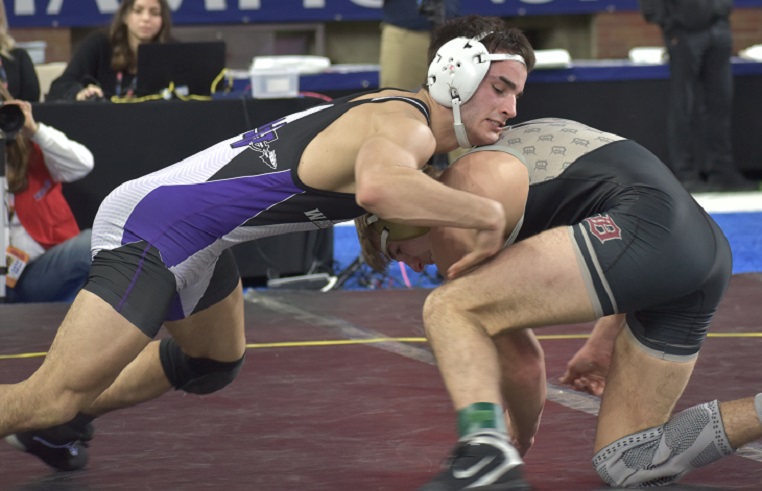
Champion: Nathan Jerore, Brownstown Woodhaven, Sr. (38-1)
Decision, 8-4, over Owen Payne, Davison, Sr. (15-2)
After seeing previous title bids ended prematurely by injuries and the pandemic, Jerore now can call himself a Finals champion.
“I literally can’t believe it. I wanted it so bad. It’s been taken from me for so long,” Jerore said. “Injuries and COVID, it’s been crazy, but I just kept working toward this goal.”
Jerore scored four takedowns in the match and was relentless on his feet against Payne.
“I knew he was going to be tough, but I knew that if I was as tough as I can be, anyone that I wrestled I could break,” Jerore said. “That’s what happened.”
152
Champion: Darius Marines, Detroit Catholic Central, Soph. (35-4)
Decision, 1-0, over Tatum Bunn, Detroit Catholic Central, Jr. (25-12)
For the second consecutive season, Marines had to face a teammate in a championship match.
For the second consecutive season, Marines came out victorious.
“It’s unfortunate, but it had to happen,” Marines said of facing a teammate in the final again. “(Bunn) was one of my best friends on the team. It kind of hurt. But, I had to set all that stuff aside.”
The match didn’t have much action. Marines rode out Bunn in the second period and then earned an escape in the third for the lone point.
“I felt pretty good (after the second period),” Marines said. “I’ve worked my whole life for this, so it feels pretty good (to win).”
160
Champion: Rollie Denker, Temperance Bedford, Sr. (55-2)
Decision, 3-1, over Brayden Mirjavadi, Romeo, Jr. (41-4)
A takedown in the closing second of the third period broke a 1-1 tie and gave Denker his first championship.
Mirjavadi got an escape in the second to take a 1-0 lead, and Denker answered with an escape of his own to start the third. He then turned up the heat late in the match to earn his title.
“I knew late in matches, we all get tired, but I knew (Mirjavadi) would be the exception, so I had to keep going and eventually I just got him,” Denker said.
189
Champion: Remey Cotton, Davison, Jr. (27-3)
Decision, 7-4, over Aidan Wardell, Midland Dow, Sr. (44-4)
Cotton got a takedown early in the bout and built a 5-1 lead in the second period before hanging on for the victory.
“I’ve trained for this my whole life,” Cotton said of the win. “Being able to come out here and get it done just feels amazing.”
Along with his first championship, Cotton also avenged a prior loss to Wardell to cap off his season.
“I practice every day to win every match,” Cotton said. “If I lose one match, I just look forward to the next one to be able to move that to the past.”
215
Champion: Jimmy Colley, Davison, Sr. (32-2)
Decision, 14-7, over Avery Dickerson, Hartland, Sr. (45-2)
Colley collected his second consecutive championship at 215 pounds in a wild scramble of a match.
“It feels great to come back here and end your career as a state champ two times in a row, as well as a team champ two times in a row,” Colley said. “It shows you are one of the best.”
The two contenders traded position often, but it was Colley who found himself with the advantage more consistently. He led 8-5 after two periods and then handled his business in the third.
“We both had that same funky style, and we always put on an exciting match,” Colley said. “You never know what (Dickerson) is going to do. It looks like we are just rolling around sometimes.”
285
Champion: Joshua Terrill, Holt, Sr. (43-2)
Decision, 6-2, over Giulian Bodiu, Canton, Sr. (28-1)
After finishing runner-up in 2021, Terrill grinded his way to a championship.
“I just kept telling myself to not be content. I wasn’t content, and I just won a state title,” Terrill said.
After a scoreless opening period, Terrill turned up the aggression and scored a pair of takedowns in the second period to take control. He credited his coaches for his strong finish.
“This means a whole lot to me, but this really goes to my coaches,” Terrill said. “None of this is about me, it’s about the coaches that got me here.”
PHOTOS (Top) Davison’s Josh Barr (right) and Detroit Catholic Central’s Manuel Rojas contend for the 171-pound title Saturday at Ford Field. (Middle) Woodhaven’s Nathan Jerore, left, works toward a win at 145 pounds. (Click for more from HighSchoolSportsScene.com.)