


New Math: Division & Multiplication Problems
July 25, 2017
By Jack Roberts
MHSAA Executive Director
This is the second part in a series on MHSAA tournament classification, past and present, that will be published over the next two weeks. This series originally ran in this spring's edition of MHSAA benchmarks.
High school tournament classifications went viral before there was social media and most of us knew what “viral” meant.
Much as a virus infects computers today or has created epidemics of disease around the world for centuries, high school tournament classification – once introduced – tends to spread uncontrollably. Once started, it tends to keep expanding and rarely contracts.
While we are still some distance from providing every team a trophy as a result of expanding high school tournament classification across the country, there is criticism nevertheless that we are headed in that direction – a philosophy which is supposed to exist only in local youth sports for our youngest children.
Michigan could be blamed for all this. Michigan is generally accepted as the first state to provide different classifications for season-ending tournaments for different sized schools. It started a century ago. Today, every state has various classifications for its tournaments in most if not all sports. And it is a bit ironic that Michigan – creator of the classification chaos – more than most other states has kept the number of tournament classes or divisions under control.
Yes, there is evidence that tournament classifications have expanded over the years in Michigan, especially with the relatively recent introduction of tournaments in football and the late 1990s’ move from classes to divisions in most MHSAA tournaments. But the MHSAA Representative Council has held true to its word when it expanded the playoffs for football from four classes to eight divisions: this is needed because of unique factors of football, factors that exist in no other sport; and all other sports should be capped at a maximum of four classes or divisions.
Kentucky is the preeminent defender of single-class basketball. All of its 276 high schools compete for the single state championship for each gender. In Indiana, there are still open wounds from its move in 1998 from one to four classes for its 400 schools in basketball.
Multi-class tournaments have tended to increase the number of non-public school champions, which some states are trying to lower through enrollment “multipliers,” and also tend to increase the number of repeat champions, which some states are trying to affect with “success factors” which lift smaller schools into classifications for larger schools if they take home too many trophies.
While there is considerable evidence that state tournaments do as much bad as good for educational athletics, state associations persist in providing postseason tournaments because, on balance, the experiences are supposed to be good for student-athletes. And once we reach that conclusion it is just a small leap to believe that if the tournaments are good for a few, they must be better for more – which leads to creating more and more tournament classifications. One becomes two classes, then three, then four and so forth.
While the argument is that more classifications or divisions provides more students with opportunities to compete and win, it is undeniable that the experience changes as the number of tournament classifications expands. It is not possible for state associations to provide the same level of support when tournament classifications expand to multiple venues playing simultaneously. For example, there is less audio and video broadcast potential at each venue, and less media coverage to each venue. Focus is diluted and fans diminished at each championship.
No one can argue reasonably that today's two-day MHSAA Football Finals of eight championship games has the same pizazz as the one-day, four-games event conducted prior to 1990.
In some states the number of divisions has grown so much that it is difficult to see much difference between the many season-ending state championship games and a regular-season event in the same sport.
It is a balancing act. And Michigan has been studying that balance longer than any other state, and charting a steadier course than most.
Addition by Division
The shift to Divisions for MHSAA Tournament play in numerous sports has added up to a greater number of champions for teams and individuals across the state. Following are the sports currently employing a divisional format, and the procedures for determining enrollment and classification.
In 23 statewide or Lower Peninsula tournaments, schools which sponsor the sport are currently divided into nearly equal divisions. They are:
- Baseball - 4 Divisions
- Boys Bowling - 4 Divisions
- Girls Bowling - 4 Divisions
- Girls Competitive Cheer - 4 Divisions
- LP Boys Cross Country - 4 Divisions
- LP Girls Cross Country - 4 Divisions
- LP Boys Golf - 4 Divisions
- LP Girls Golf - 4 Divisions
- Ice Hockey - 3 Divisions
- Boys Lacrosse - 2 Divisions
- Girls Lacrosse - 2 Divisions
- Boys Skiing - 2 Divisions
- Girls Skiing - 2 Divisions
- LP Boys Soccer - 4 Divisions LP
- Girls Soccer - 4 Divisions
- Girls Softball - 4 Divisions
- LP Boys Swimming & Diving - 3 Divisions
- LP Girls Swimming & Diving - 3 Divisions
- LP Boys Tennis - 4 Divisions
- LP Girls Tennis - 4 Divisions
- LP Boys Track & Field - 4 Divisions
- LP Girls Track & Field - 4 Divisions
- Wrestling - 4 Divisions
Lists of schools for each division of these 23 tournaments are posted on MHSAA.com approximately April 1. Listings of schools in Upper Peninsula tournaments for their sports are also posted on MHSAA.com. The lists are based on school memberships and sports sponsorships in effect or anticipated for the following school year, as known to the MHSAA office as of a date in early March.
In football, the 256 schools which qualify for MHSAA 11-player playoffs are placed in eight equal divisions annually on Selection Sunday. Beginning in 2017, the 8-player divisions will be determined in a like manner on Selection Sunday as well, with 32 qualifying schools placed in two divisions.
Schools have the option to play in any higher division in one or more sports for a minimum of two years.
The deadlines for "opt-ups" are as follows:
- Applications for fall sports must be submitted by April 15
- Applications for winter sports must be submitted by Aug. 15
- Applications for spring sports must be submitted by Oct. 15
Subsequent to the date of these postings for these tournaments, no school will have its division raised or lowered by schools opening or closing, schools adding or dropping sports, schools exercising the option to play in a higher division, or approval or dissolution of cooperative programs.
When the same sport is conducted for boys and girls in the same season (e.g., track & field and cross country), the gender that has the most sponsoring schools controls the division breaks for both genders.
1,000-Point Pair Setting Tone for Watervliet's Hoops League Champions
By
Wes Morgan
Special for MHSAA.com
March 1, 2022
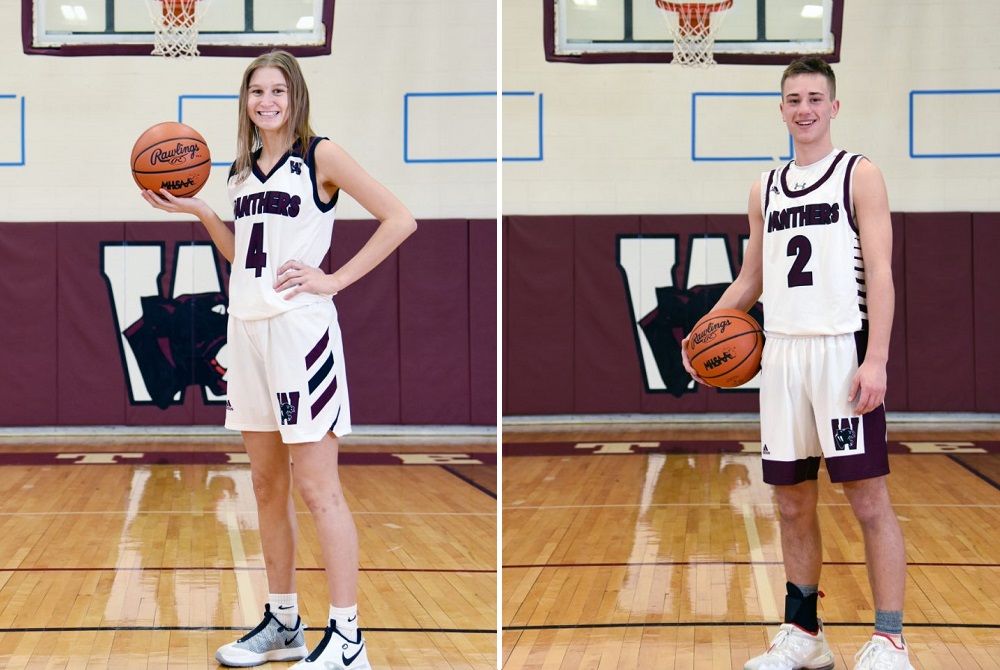
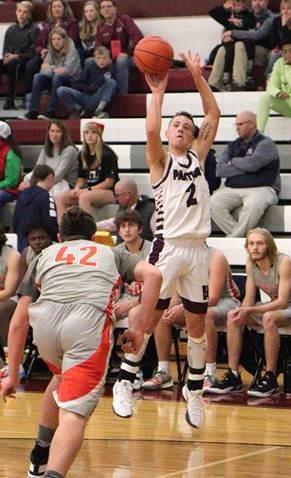
Watervliet High School’s varsity boys basketball team was trailing Fennville on the road Feb. 8 when senior shooting guard Andrew Chisek reached 1,000 career points. His milestone was acknowledged during the contest, but Chisek reduced the cheering to a low-frequency buzz as he went back to work — like that of the faint mechanical hum from furnaces and lights bouncing around the walls of an empty gymnasium.

Gym rats know that sound.
The Panthers (15-3) ended up losing that night, a rarity this season for coach Dan Hoff’s re-energized program, which shared the Southwestern Athletic Conference Lakeshore title. Watervliet won just nine games combined during Chisek’s first two seasons. The Panthers won 13 games during last year’s COVID-shortened slate and have a shot at 16 this winter with one regular-season game remaining.
Like all the hours spent with a shooting machine and no one there to witness it, Chisek wasn’t concerned about individual praise.
“I’ve just been focusing on the next game, but I’m sure it will hit me after the season how crazy that is,” Chisek said. “I just want to play more and more games. I haven’t really focused on my achievements as much as team achievements. It’s kind of a next-game mentality. It’s an effort thing. I’m hoping to win a District championship.”
Hoff, who took over in 2019-20, explained how Chisek’s example set the tone for a rebuilding process at Watervliet.
“The biggest adjustment for Andrew was he began playing with players who were capable of scoring like he was,” Hoff said. “He did a wonderful job of getting them more involved in the scoring part of the game. Previous to that he didn’t have to and shouldn’t have because he was such an important scorer for the team.”
Chisek’s production this season includes 13.4 points, 4.9 rebounds, 3.6 assists and 1.3 steals per game. He’s the third 1,000-point scorer on the boys side in Watervliet history, joining the likes of Kevin Bryce (1,114 points in 2009), Dan Hutchinson (1,016 points in 1983) and Jason Forrester (1,158 points in 1992).
 “To Andrew’s credit and the type of person he is, it appeared to me that he just wanted to help the team try to win the game (against Fennville),” Hoff added. “It was a brief moment of recognition, but his focus was immediately back on what we can do to be successful. The team approach of these guys has been remarkable. With all of my years of coaching I’ve had, I’ve been amazingly impressed with how these guys have buried their egos, buried their personal goals and really focused on what we can do every day to get better.
“When you’re working to start a new program like we have in my first three years, to have one of your best players be so dedicated to improving himself while having other kids join him, has been so instrumental in our progress.”
The student-athletes who do the extra work when nobody’s around are often the ones that require the least attention.
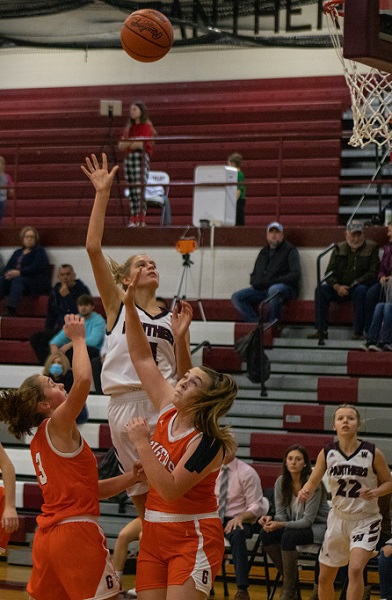
Samantha Dietz, a junior forward for the Watervliet girls squad, knew she was approaching the same feat this past Saturday after leading the team in scoring the last three seasons, needing eight points to join the exclusive club. After she knocked down a free throw in the second quarter at Paw Paw, the public address announcer made note of the accomplishment and Dietz admitted the pause in action rattled her. She missed the second free throw and was happy the moment had passed so she and the Panthers could get back to the task at hand. They closed out the game for a 54-37 win — their 18th of the year.
“It was cool that it happened,” she said. “I wasn’t really sure what to expect, I guess. It was good to get it out of the way before tournament time. Now I can just focus on that. What has helped the most is having those rough years. It was a struggle my freshman year. It helped to go through that. We all play all the sports we can, and we’ve all been together and work hard.”
Her father, Watervliet athletic director and varsity girls coach Ken Dietz, has had the best seat in the house during this journey. In an undoubtedly proud dad moment, he didn’t stray from his role of coach. The two can look back on the memory as father and daughter later.
 “It was just business,” said Ken Dietz, whose team is preparing for a Division 3 District Semifinal matchup Wednesday with Cassopolis. “I fist bumped her after the game and told her ‘Congratulations,’ but we keep it separate. We just keep it that way. It has worked that way. It sounds simple. It’s fun and it’s not stressful at all. I don’t think I treat her any different than anyone else on the team. I’m one of the blessed ones.
“I’m just so proud of her work ethic. If your best player doesn’t work hard every day in practice and doesn’t work hard in the game, it’s tough to get everybody to work hard. In high school, if you work harder than everybody, you’re going to be a better-than-average player. Her work ethic is impressive, and it has created a standard for our kids. She’s a good teammate. When she’s not playing, she’s cheering for the other kids. That’s infectious to everybody else.
Dietz is averaging 17.4 points and 13.3 rebounds per game this year, and she’s the sixth girls basketball player at Watervliet to eclipse 1,000 career points. She joins Nicole Winter (1,086 points in 2013), Rachel Sheffer (1,490 points in 2009), Kim Gear (1,062 points in 2005), Lisa Ashton (1,299 points in 1997) and Kim Carney (1,057 points in 1981) on the esteemed school list of all-time scorers.
But after experiencing only five wins as a freshman in 2019-20, it is how the program has made such a stunning turnaround that is most impressive.
“It wasn’t too long ago that we couldn’t get the ball across half court,” Ken Dietz said. “We played Schoolcraft four years ago when I first took over and we could not get the ball across half court in the first half. It was just ugly. So, we have come a long way in a few years. I’ve told the girls, ‘You’ve built this place, so live in it, enjoy it and have fun. You deserve to be here.’”
Putting his AD hat back on, Ken Dietz is thrilled to see where the school is as a whole.
“We’re headed in the right direction,” Ken Dietz said of Watervliet athletics. “One, we have great kids representing our school right now. Andrew and Sam are obviously two of those. There is nobody who has shot more baskets and put more time into boys basketball than Andrew the last few years. He has set that standard. They are leaders because they work hard and do the right things.”
 Wes Morgan has reported for the Kalamazoo Gazette, ESPN and ESPNChicago.com, 247Sports and Blue & Gold Illustrated over the last 12 years and is the publisher of JoeInsider.com. He can be reached at [email protected] with story ideas for Berrien, Cass, St. Joseph and Branch counties.
PHOTOS (Top) Samantha Dietz and Andrew Chisek both have reached 1,000 career points for Watervliet this season. (Middle) Chisek pulls up for a jumper; he’s averaging 13.4 points per game this season. (Below) Dietz gets a shot up over a pair of Gobles defenders. (Photos courtesy of the Watervliet athletic department.)