


New Math: Division & Multiplication Problems
July 25, 2017
By Jack Roberts
MHSAA Executive Director
This is the second part in a series on MHSAA tournament classification, past and present, that will be published over the next two weeks. This series originally ran in this spring's edition of MHSAA benchmarks.
High school tournament classifications went viral before there was social media and most of us knew what “viral” meant.
Much as a virus infects computers today or has created epidemics of disease around the world for centuries, high school tournament classification – once introduced – tends to spread uncontrollably. Once started, it tends to keep expanding and rarely contracts.
While we are still some distance from providing every team a trophy as a result of expanding high school tournament classification across the country, there is criticism nevertheless that we are headed in that direction – a philosophy which is supposed to exist only in local youth sports for our youngest children.
Michigan could be blamed for all this. Michigan is generally accepted as the first state to provide different classifications for season-ending tournaments for different sized schools. It started a century ago. Today, every state has various classifications for its tournaments in most if not all sports. And it is a bit ironic that Michigan – creator of the classification chaos – more than most other states has kept the number of tournament classes or divisions under control.
Yes, there is evidence that tournament classifications have expanded over the years in Michigan, especially with the relatively recent introduction of tournaments in football and the late 1990s’ move from classes to divisions in most MHSAA tournaments. But the MHSAA Representative Council has held true to its word when it expanded the playoffs for football from four classes to eight divisions: this is needed because of unique factors of football, factors that exist in no other sport; and all other sports should be capped at a maximum of four classes or divisions.
Kentucky is the preeminent defender of single-class basketball. All of its 276 high schools compete for the single state championship for each gender. In Indiana, there are still open wounds from its move in 1998 from one to four classes for its 400 schools in basketball.
Multi-class tournaments have tended to increase the number of non-public school champions, which some states are trying to lower through enrollment “multipliers,” and also tend to increase the number of repeat champions, which some states are trying to affect with “success factors” which lift smaller schools into classifications for larger schools if they take home too many trophies.
While there is considerable evidence that state tournaments do as much bad as good for educational athletics, state associations persist in providing postseason tournaments because, on balance, the experiences are supposed to be good for student-athletes. And once we reach that conclusion it is just a small leap to believe that if the tournaments are good for a few, they must be better for more – which leads to creating more and more tournament classifications. One becomes two classes, then three, then four and so forth.
While the argument is that more classifications or divisions provides more students with opportunities to compete and win, it is undeniable that the experience changes as the number of tournament classifications expands. It is not possible for state associations to provide the same level of support when tournament classifications expand to multiple venues playing simultaneously. For example, there is less audio and video broadcast potential at each venue, and less media coverage to each venue. Focus is diluted and fans diminished at each championship.
No one can argue reasonably that today's two-day MHSAA Football Finals of eight championship games has the same pizazz as the one-day, four-games event conducted prior to 1990.
In some states the number of divisions has grown so much that it is difficult to see much difference between the many season-ending state championship games and a regular-season event in the same sport.
It is a balancing act. And Michigan has been studying that balance longer than any other state, and charting a steadier course than most.
Addition by Division
The shift to Divisions for MHSAA Tournament play in numerous sports has added up to a greater number of champions for teams and individuals across the state. Following are the sports currently employing a divisional format, and the procedures for determining enrollment and classification.
In 23 statewide or Lower Peninsula tournaments, schools which sponsor the sport are currently divided into nearly equal divisions. They are:
- Baseball - 4 Divisions
- Boys Bowling - 4 Divisions
- Girls Bowling - 4 Divisions
- Girls Competitive Cheer - 4 Divisions
- LP Boys Cross Country - 4 Divisions
- LP Girls Cross Country - 4 Divisions
- LP Boys Golf - 4 Divisions
- LP Girls Golf - 4 Divisions
- Ice Hockey - 3 Divisions
- Boys Lacrosse - 2 Divisions
- Girls Lacrosse - 2 Divisions
- Boys Skiing - 2 Divisions
- Girls Skiing - 2 Divisions
- LP Boys Soccer - 4 Divisions LP
- Girls Soccer - 4 Divisions
- Girls Softball - 4 Divisions
- LP Boys Swimming & Diving - 3 Divisions
- LP Girls Swimming & Diving - 3 Divisions
- LP Boys Tennis - 4 Divisions
- LP Girls Tennis - 4 Divisions
- LP Boys Track & Field - 4 Divisions
- LP Girls Track & Field - 4 Divisions
- Wrestling - 4 Divisions
Lists of schools for each division of these 23 tournaments are posted on MHSAA.com approximately April 1. Listings of schools in Upper Peninsula tournaments for their sports are also posted on MHSAA.com. The lists are based on school memberships and sports sponsorships in effect or anticipated for the following school year, as known to the MHSAA office as of a date in early March.
In football, the 256 schools which qualify for MHSAA 11-player playoffs are placed in eight equal divisions annually on Selection Sunday. Beginning in 2017, the 8-player divisions will be determined in a like manner on Selection Sunday as well, with 32 qualifying schools placed in two divisions.
Schools have the option to play in any higher division in one or more sports for a minimum of two years.
The deadlines for "opt-ups" are as follows:
- Applications for fall sports must be submitted by April 15
- Applications for winter sports must be submitted by Aug. 15
- Applications for spring sports must be submitted by Oct. 15
Subsequent to the date of these postings for these tournaments, no school will have its division raised or lowered by schools opening or closing, schools adding or dropping sports, schools exercising the option to play in a higher division, or approval or dissolution of cooperative programs.
When the same sport is conducted for boys and girls in the same season (e.g., track & field and cross country), the gender that has the most sponsoring schools controls the division breaks for both genders.
Forest Area's Stremlow Never Far from Serving School Sports Community
By
Tom Spencer
Special for MHSAA.com
February 4, 2022
He hasn’t met a sport he can’t coach. And, he probably hasn’t turned down a team he’s met – yet.
 Many of the coaching jobs he’s taken were actually offered to him by him.
Whenever he’s started a new sport, he’s sought mentors in the form of successful veteran coaches. But make no mistake, if they made a movie in Northern Michigan called “The Mentor” – this Hall of Fame coach would be the star of the show.
He’s technically retired today. The teams he coaches don’t get TV cameras and other media present. He’s a middle school track and volleyball coach for Fife Lake Forest Area Community Schools.
He’s perhaps most well-known as the past volleyball coach at Forest Area. Don’t be surprised if you hear of graduated athletes – and current student-athletes – from Glen Lake, Manton, Kingsley and even McBain Northern Michigan Christian happily call him “Coach.”
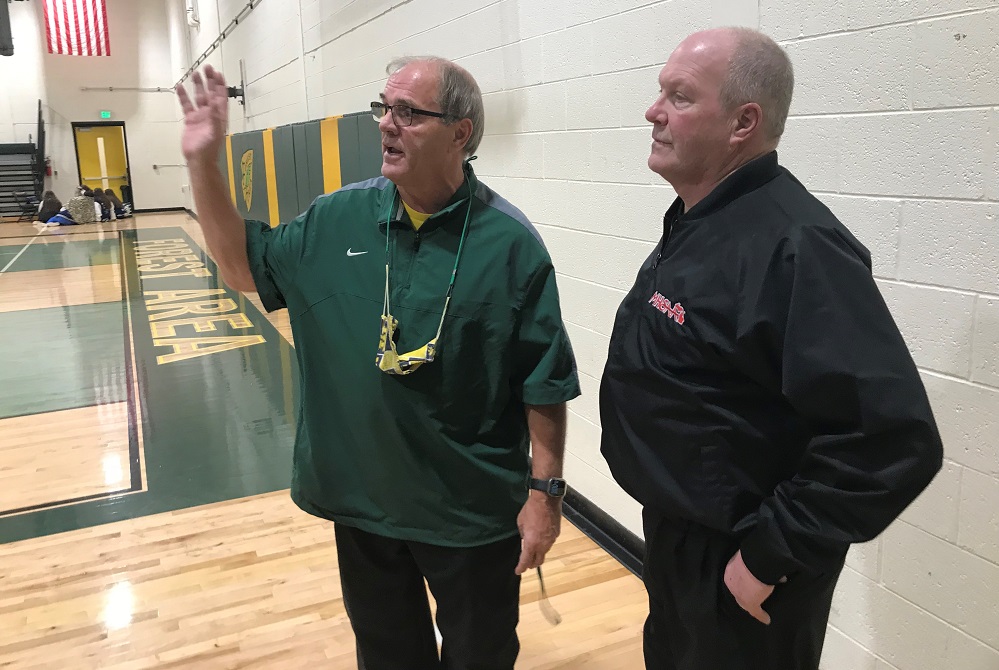
Name the coach? Ron Stremlow. He’s a retired physical education teacher, athletic director and coach. He came out of retirement to return as the part-time athletic director for Forest Area, a district he served 32 years as a teacher.
He’s also coaching a couple of middle school sports, just like he did when he was working full-time. Athletic directors often need to put themselves in tough-to-fill coaching slots.
“Ron Stremlow has been a tremendous ambassador of high school sports in Northern Michigan,” said Dave Jackson, athletic director of Frankfort-Alberta Schools. “The number of coaches, parents and athletes Ron has encouraged during his years of service are too many to count.
“He is an athletic administrator that has always been about service and what (he) can do to help.”
Help is exactly what he did once upon a time for then-new volleyball coach at McBain Northern Michigan Christian, Diane Eisenga. The call for help came from Eisenga’s players.
Today, Eisenga is an athletic assistant for the Comets and mother of five boys, her youngest still attending NMC. Like Stremlow, she has built a very successful program. Back then, she was just getting started, pregnant and a mother of two children, and unable to coach her team during a Ferris State University tournament that Stremlow had planned to scout with longtime friend and Kingsley 1,000-win volleyball coach Dave Hall.
Stremlow actually was planning to watch NMC at the tournament, anticipating the Comets would be a potential roadblock to a District title that upcoming season. (He was right: Forest Area would end up losing to NMC in a District Final as the Comets reached the Class D Quarterfinals.)
 What Stremlow did not anticipate was being asked by the Comets players to step in and coach them at the Ferris tourney. Stremlow was told Eisenga was not feeling well enough to guide the team at that moment.
Stremlow did not hesitate to help. He had previously leant his wisdom to the former Dordt University (Iowa) athlete with tryouts, cutting decisions and NMC’s summer camp.
“I had played in high school and college, but I was green,” Eisenga acknowledged. “He was a good mentor.”
She recalls her players asking for Stremlow’s help.
“I got real light-headed and wasn’t feeling well,” she said. “Because the girls had known him, he took over for me that day.”
It wasn’t a surprise for Eisenga to witness Stremlow’s contribution to her team’s success that year.
“I always saw him as more of a mentor and more of a friend (than an opposing coach),” Eisenga said. “He was happy with anyone’s success.
“He was always happy for any team that played well,” she continued. “Of course, he always wanted his own to win. … He was always respectful, and you never saw him cross the line.”
Stremlow, who jokes about maybe not having the most wins among hall of fame volleyball coaches while claiming the most losses amongst the elite group (he still ranks 17th in MHSAA history with 944 volleyball wins despite retiring from the Forest Area varsity after the 2018 season), spends his days taking care of Forest Area boys and girls basketball, completive cheer and the Warriors co-ed wresting teams. Many a night he does whatever it takes to run an event, including running the scoreboard for basketball.
In the fall, Forest Area offers 8-player football, cross country and volleyball. He’s in the midst of finalizing spring softball, track and baseball.
Basketball is perhaps his favorite sport, but he loves the change of seasons.
“Once that season’s up, I am ready to rock and roll and get into another,” Stremlow noted.
Giving back is what keeps the 62-year-old Stremlow going. He sees at least three years of involvement ahead.
“A lot of kids do not get good role models or good coaches. And I thought if I can help kids out, I am going to,” Stremlow said.
Today Stremlow wears many school colors, especially the Warriors’ forest green. You also often can find him in Kingsley orange, or perhaps it is actually the Manton orange.
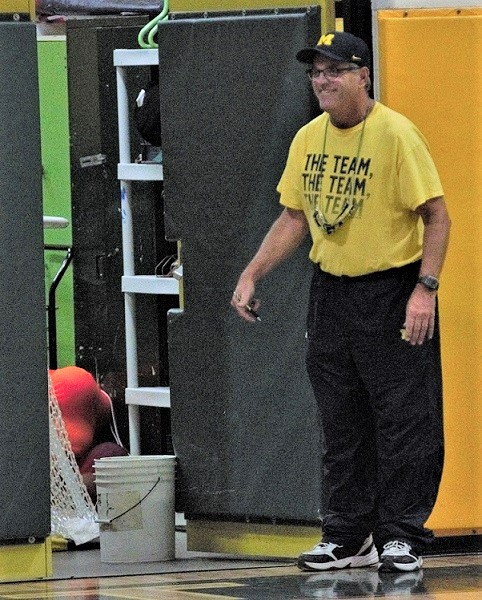
You will definitely find him in his favorite, maize and blue. His forest green should never be confused with the Michigan State green. The Wolverines became the favorite of the Central Michigan grad when he got into the Big House as a high school student with a $2 ticket to watch Michigan take on Navy.
“I have green, but it is not the Michigan State green,” Stremlow said he often jokes with fans of the Spartans and Warriors.
Stremlow uses all his team colors as he follows another passion, photography. He got a camera for college graduation, and student-athletes all over Northern Michigan have benefited.
“There are thousands of former players from Forest Area and Kingsley that can point to pictures in their homes that Ron has taken of them playing sports,” Jackson said. “These pictures are not just cute shots, but pictures that were used to teach form and techniques.”
Stremlow takes satisfaction from capturing sports on film, rather digitally, as he does today.
“I take a lot of pictures – I‘ve always liked it,” he said. “That’s the best gift you can give any kid and parents – just getting pictures.
“It really helps, plus I like doing it.”
 Tom Spencer is a longtime MHSAA-registered basketball and soccer official, and former softball and baseball official, and he also has coached in the northern Lower Peninsula area. He previously has written for the Saginaw News, Bay County Sports Page and Midland Daily News. He can be reached at [email protected] with story ideas for Manistee, Wexford, Missaukee, Roscommon, Ogemaw, Iosco, Alcona, Oscoda, Crawford, Kalkaska, Grand Traverse, Benzie, Leelanau, Antrim, Otsego, Montmorency, Alpena, Presque Isle, Cheboygan, Charlevoix and Emmet counties.
PHOTOS (Top) Fife Lake Forest Area athletic director Ron Stremlow talks with official Chuck Bott (right) before a basketball game against Indian River Inland Lakes this season. (Middle) Stremlow shows support for his favorite college team while prepping before a game against Johannesburg-Lewiston. (Top photo by Tom Spencer; middle photo by Andrew Fish/Gaylord Herald-Times.)