


New Math: Division & Multiplication Problems
July 25, 2017
By Jack Roberts
MHSAA Executive Director
This is the second part in a series on MHSAA tournament classification, past and present, that will be published over the next two weeks. This series originally ran in this spring's edition of MHSAA benchmarks.
High school tournament classifications went viral before there was social media and most of us knew what “viral” meant.
Much as a virus infects computers today or has created epidemics of disease around the world for centuries, high school tournament classification – once introduced – tends to spread uncontrollably. Once started, it tends to keep expanding and rarely contracts.
While we are still some distance from providing every team a trophy as a result of expanding high school tournament classification across the country, there is criticism nevertheless that we are headed in that direction – a philosophy which is supposed to exist only in local youth sports for our youngest children.
Michigan could be blamed for all this. Michigan is generally accepted as the first state to provide different classifications for season-ending tournaments for different sized schools. It started a century ago. Today, every state has various classifications for its tournaments in most if not all sports. And it is a bit ironic that Michigan – creator of the classification chaos – more than most other states has kept the number of tournament classes or divisions under control.
Yes, there is evidence that tournament classifications have expanded over the years in Michigan, especially with the relatively recent introduction of tournaments in football and the late 1990s’ move from classes to divisions in most MHSAA tournaments. But the MHSAA Representative Council has held true to its word when it expanded the playoffs for football from four classes to eight divisions: this is needed because of unique factors of football, factors that exist in no other sport; and all other sports should be capped at a maximum of four classes or divisions.
Kentucky is the preeminent defender of single-class basketball. All of its 276 high schools compete for the single state championship for each gender. In Indiana, there are still open wounds from its move in 1998 from one to four classes for its 400 schools in basketball.
Multi-class tournaments have tended to increase the number of non-public school champions, which some states are trying to lower through enrollment “multipliers,” and also tend to increase the number of repeat champions, which some states are trying to affect with “success factors” which lift smaller schools into classifications for larger schools if they take home too many trophies.
While there is considerable evidence that state tournaments do as much bad as good for educational athletics, state associations persist in providing postseason tournaments because, on balance, the experiences are supposed to be good for student-athletes. And once we reach that conclusion it is just a small leap to believe that if the tournaments are good for a few, they must be better for more – which leads to creating more and more tournament classifications. One becomes two classes, then three, then four and so forth.
While the argument is that more classifications or divisions provides more students with opportunities to compete and win, it is undeniable that the experience changes as the number of tournament classifications expands. It is not possible for state associations to provide the same level of support when tournament classifications expand to multiple venues playing simultaneously. For example, there is less audio and video broadcast potential at each venue, and less media coverage to each venue. Focus is diluted and fans diminished at each championship.
No one can argue reasonably that today's two-day MHSAA Football Finals of eight championship games has the same pizazz as the one-day, four-games event conducted prior to 1990.
In some states the number of divisions has grown so much that it is difficult to see much difference between the many season-ending state championship games and a regular-season event in the same sport.
It is a balancing act. And Michigan has been studying that balance longer than any other state, and charting a steadier course than most.
Addition by Division
The shift to Divisions for MHSAA Tournament play in numerous sports has added up to a greater number of champions for teams and individuals across the state. Following are the sports currently employing a divisional format, and the procedures for determining enrollment and classification.
In 23 statewide or Lower Peninsula tournaments, schools which sponsor the sport are currently divided into nearly equal divisions. They are:
- Baseball - 4 Divisions
- Boys Bowling - 4 Divisions
- Girls Bowling - 4 Divisions
- Girls Competitive Cheer - 4 Divisions
- LP Boys Cross Country - 4 Divisions
- LP Girls Cross Country - 4 Divisions
- LP Boys Golf - 4 Divisions
- LP Girls Golf - 4 Divisions
- Ice Hockey - 3 Divisions
- Boys Lacrosse - 2 Divisions
- Girls Lacrosse - 2 Divisions
- Boys Skiing - 2 Divisions
- Girls Skiing - 2 Divisions
- LP Boys Soccer - 4 Divisions LP
- Girls Soccer - 4 Divisions
- Girls Softball - 4 Divisions
- LP Boys Swimming & Diving - 3 Divisions
- LP Girls Swimming & Diving - 3 Divisions
- LP Boys Tennis - 4 Divisions
- LP Girls Tennis - 4 Divisions
- LP Boys Track & Field - 4 Divisions
- LP Girls Track & Field - 4 Divisions
- Wrestling - 4 Divisions
Lists of schools for each division of these 23 tournaments are posted on MHSAA.com approximately April 1. Listings of schools in Upper Peninsula tournaments for their sports are also posted on MHSAA.com. The lists are based on school memberships and sports sponsorships in effect or anticipated for the following school year, as known to the MHSAA office as of a date in early March.
In football, the 256 schools which qualify for MHSAA 11-player playoffs are placed in eight equal divisions annually on Selection Sunday. Beginning in 2017, the 8-player divisions will be determined in a like manner on Selection Sunday as well, with 32 qualifying schools placed in two divisions.
Schools have the option to play in any higher division in one or more sports for a minimum of two years.
The deadlines for "opt-ups" are as follows:
- Applications for fall sports must be submitted by April 15
- Applications for winter sports must be submitted by Aug. 15
- Applications for spring sports must be submitted by Oct. 15
Subsequent to the date of these postings for these tournaments, no school will have its division raised or lowered by schools opening or closing, schools adding or dropping sports, schools exercising the option to play in a higher division, or approval or dissolution of cooperative programs.
When the same sport is conducted for boys and girls in the same season (e.g., track & field and cross country), the gender that has the most sponsoring schools controls the division breaks for both genders.
Jackson's Janke Recalled as 'Larger than Life,' Always Willing to Help
By
Doug Donnelly
Special for MHSAA.com
January 26, 2022
JACKSON – A few days before Christmas, Jackson boys track & field head coach Corey Pryor was called to meet with Charles Janke, the longtime former Jackson coach and teacher.
 Janke was very ill and in the final days of his life. Janke, it turns out, wasn’t leaving anything to chance.
“He asked me if the stadium was ready for our big track meet, the one named after him,” Pryor said. “Believe it or not, that’s what he asked. He was always so organized and meticulous. He wanted to make sure everything was always on schedule.
“I am grateful for getting the chance to spend a few more moments with him.”
Janke, 85, died Dec. 30 at Henry Ford Allegiance Hospice Home in Jackson.
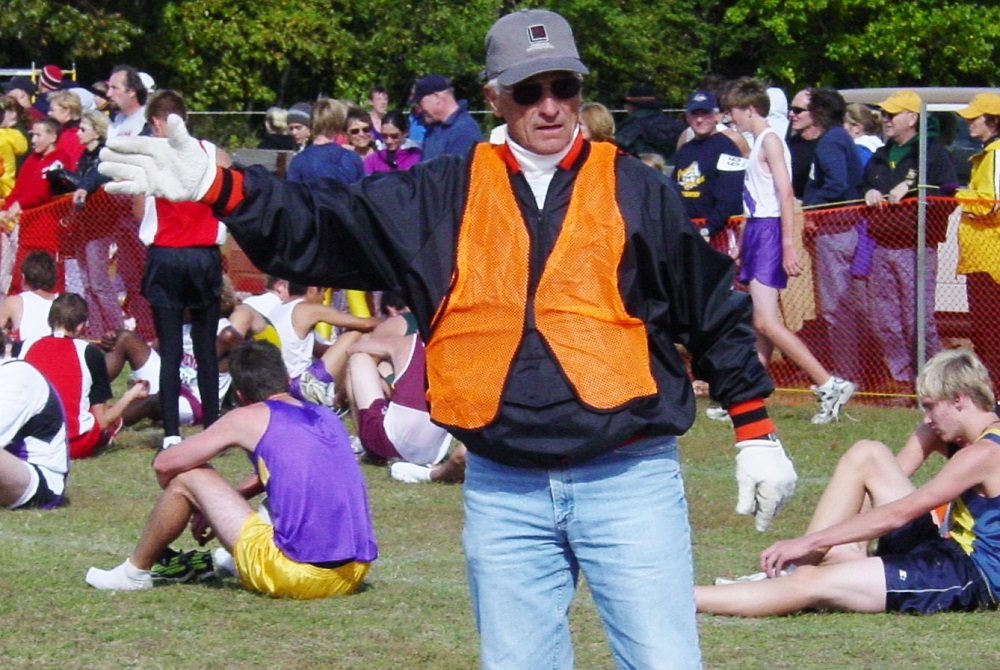
Janke was a track and cross country coach for Jackson who was recognized statewide for his commitment to high school athletics, student athletes and the two sports he loved the most. Although he retired from coaching nearly two decades ago, he remained very involved in high school sports. He was a leader in both sports across the state, a giant in the high school running community.
A Detroit native who went to Central Michigan University to play football, Janke had short stints at Southfield and Milford schools before moving to Jackson where he taught history and physical education. Although he got his start as a football coach, at Jackson he took over the track and cross country programs in 1966. He pulled double duty for years before stepping down as track coach in 1990, but he continued with cross country through 2003 while helping coach the distance runners in track for several more years.
If it involved track & field or cross country in Michigan, Janke was probably involved. He was an early pioneer in the Michigan Interscholastic Track Coaches Association, the first statewide sports-specific association for coaches in the state. He founded several events, including the first countywide cross country meet in Jackson. He hosted, organized and gave presentations at coaching clinics for years and in the early 1970s helped organize indoor track & field meets through MITCA by contacting colleges across the state to see if they were interested in hosting events. He also was the first to publish a MITCA newsletter.
In cross country, he was among those who played a role in bringing all four classes together for a Lower Peninsula championship meet at Michigan International Speedway in Brooklyn. He helped with the event long after coaching. He also served as head field events judge at Big Ten Indoor Championships and became a high school official after retiring as head coach.
His passion for the sport was evident.
“He had a genuine love for the sport,” Pryor said. “He always had his way of doing things. He was a special kind of guy.”
When Pryor was a high school sprinter at Jackson, Janke was an assistant coach who mainly worked with long distance runners.
“He coached hard,” Pryor said, adding that he never fully appreciated Coach Janke until later in life and especially after he became track coach. Pryor found pages and pages of handwritten notes with dates, times and athletes’ names.
“He even wrote down the weather,” Pryor said.
He and Janke had a lot of discussions, often over breakfast, about track events.
“He would be at almost all of the meets,” Pryor said. “He learned every kid by name. He told them he wanted to see them at the state meet. I welcomed him with open arms. When I began to see just what he meant to our state, I realized this guy was a diamond.
“I was blessed to see him behind the curtain. I saw he was the type of guy who really cared about people and wanted to see them succeed. He was more than a coach.”
Vandercook Lake cross country coach Dan Roggenbaum is one of several from the Jackson area who would seek out Janke for advice and mentorship. He said Janke approached officiating with the same rigor and commitment he did coaching.
“Charlie was always willing to help me out with any questions I ever had,” he said. “He was larger than life to me and most other coaches in our county. He was always willing to help and give advice to any of us who were a lot newer to the cross country and track & field scene.”
Two things Janke was most proud of was Withington Stadium in Jackson and the cross country course at Ella Sharp Park named after him.
“I always admired his love and passion for cross country, track & field,” said Ben Pack, now a coach and administrator at Manchester, but once a shot and discus thrower for Janke. “On days of track meets he would have the track set up before the school day started, with the blocks at the starting line, the hurdles stacked along the track to be placed for the first hurdle race, and the throws event areas lined. Every detail for the practices and meets were paid attention to.
“He didn’t do this because he had to do it; he did it because he loved doing it. He always wanted everything to be first class.”
Janke was admittedly a tough coach.
In winning the Al Cotton Award for his dedication to Jackson athletics, the Jackson Citizen-Patriot wrote this about Janke in 2003: “One does not need to talk to many of Janke's athletes or listen very long to get a clear picture of the type of coach he was. He was intense. He was in charge. He demanded respect and he expected the best, and he received a huge measure of both from those who followed his regimen.”
Janke was inducted into both the Michigan High School Coaches Association Hall of Fame and the MITCA Hall of Fame.
Pack said, “During high school we had a sign that read, ‘The mind controls the body.’ In PE strength class we often did exercises that helped us understand how much more we could push ourselves if we fought off the pain of the exercise. Without question, this built mental toughness. He taught kids how to set goals, and the step-by-step process to get to the goal.”
All told, Janke spent more than 60 years involved in track and cross country. His impact will roll on in both sports. A number of former athletes have gone on to become teachers and coaches themselves, like Pack, who not only was an athlete for Janke but coached alongside him. Pack served as Jackson’s varsity football coach from 1987-2002 and again in 2012.
“As peers we often would guide kids to each other’s sports,” Pack said. “Kids that I felt would be better at running cross country, I sent to him. Kids that he felt would be good football players he sent to me. Working together was an honor.”
Jim Martin ran for Janke at Jackson in the 1970s. He’s now in his 36th year coaching track and cross country, the last 26 at Sault Ste. Marie High School. He said he’s a coach today because of the impact Janke had on him.
“At a time in my life that I needed structure and guidance, he was the rock,” Martin said. “He was always there. There's no way I'm in this (coaching) 35 years without him. He was my role model. He cannot be replaced.”
Last fall, Martin took his Sault Ste. Marie team to Jackson for the Charles Janke Invitational. His Blue Devils team won. Going into the meet, he didn’t think that was possible.
“For the life of me I couldn’t figure out how we won that,” Martin said. “We were good, but not Jackson good. … That was the last time Coach Janke saw my team. Now I know why.”
A Celebration of Life service will be held at 2 p.m. on June 12, 2022, at, appropriately, Withington Stadium.
 Doug Donnelly has served as a sports and news reporter and city editor over 25 years, writing for the Daily Chief-Union in Upper Sandusky, Ohio from 1992-1995, the Monroe Evening News from 1995-2012 and the Adrian Daily Telegram since 2013. He's also written a book on high school basketball in Monroe County and compiles record books for various schools in southeast Michigan. E-mail him at [email protected] with story ideas for Jackson, Washtenaw, Hillsdale, Lenawee and Monroe counties.
PHOTO: Charles Janke coaches his Jackson team during a cross country meet in 2003. (Photo by John Johnson.)