


New Math: Division & Multiplication Problems
July 25, 2017
By Jack Roberts
MHSAA Executive Director
This is the second part in a series on MHSAA tournament classification, past and present, that will be published over the next two weeks. This series originally ran in this spring's edition of MHSAA benchmarks.
High school tournament classifications went viral before there was social media and most of us knew what “viral” meant.
Much as a virus infects computers today or has created epidemics of disease around the world for centuries, high school tournament classification – once introduced – tends to spread uncontrollably. Once started, it tends to keep expanding and rarely contracts.
While we are still some distance from providing every team a trophy as a result of expanding high school tournament classification across the country, there is criticism nevertheless that we are headed in that direction – a philosophy which is supposed to exist only in local youth sports for our youngest children.
Michigan could be blamed for all this. Michigan is generally accepted as the first state to provide different classifications for season-ending tournaments for different sized schools. It started a century ago. Today, every state has various classifications for its tournaments in most if not all sports. And it is a bit ironic that Michigan – creator of the classification chaos – more than most other states has kept the number of tournament classes or divisions under control.
Yes, there is evidence that tournament classifications have expanded over the years in Michigan, especially with the relatively recent introduction of tournaments in football and the late 1990s’ move from classes to divisions in most MHSAA tournaments. But the MHSAA Representative Council has held true to its word when it expanded the playoffs for football from four classes to eight divisions: this is needed because of unique factors of football, factors that exist in no other sport; and all other sports should be capped at a maximum of four classes or divisions.
Kentucky is the preeminent defender of single-class basketball. All of its 276 high schools compete for the single state championship for each gender. In Indiana, there are still open wounds from its move in 1998 from one to four classes for its 400 schools in basketball.
Multi-class tournaments have tended to increase the number of non-public school champions, which some states are trying to lower through enrollment “multipliers,” and also tend to increase the number of repeat champions, which some states are trying to affect with “success factors” which lift smaller schools into classifications for larger schools if they take home too many trophies.
While there is considerable evidence that state tournaments do as much bad as good for educational athletics, state associations persist in providing postseason tournaments because, on balance, the experiences are supposed to be good for student-athletes. And once we reach that conclusion it is just a small leap to believe that if the tournaments are good for a few, they must be better for more – which leads to creating more and more tournament classifications. One becomes two classes, then three, then four and so forth.
While the argument is that more classifications or divisions provides more students with opportunities to compete and win, it is undeniable that the experience changes as the number of tournament classifications expands. It is not possible for state associations to provide the same level of support when tournament classifications expand to multiple venues playing simultaneously. For example, there is less audio and video broadcast potential at each venue, and less media coverage to each venue. Focus is diluted and fans diminished at each championship.
No one can argue reasonably that today's two-day MHSAA Football Finals of eight championship games has the same pizazz as the one-day, four-games event conducted prior to 1990.
In some states the number of divisions has grown so much that it is difficult to see much difference between the many season-ending state championship games and a regular-season event in the same sport.
It is a balancing act. And Michigan has been studying that balance longer than any other state, and charting a steadier course than most.
Addition by Division
The shift to Divisions for MHSAA Tournament play in numerous sports has added up to a greater number of champions for teams and individuals across the state. Following are the sports currently employing a divisional format, and the procedures for determining enrollment and classification.
In 23 statewide or Lower Peninsula tournaments, schools which sponsor the sport are currently divided into nearly equal divisions. They are:
- Baseball - 4 Divisions
- Boys Bowling - 4 Divisions
- Girls Bowling - 4 Divisions
- Girls Competitive Cheer - 4 Divisions
- LP Boys Cross Country - 4 Divisions
- LP Girls Cross Country - 4 Divisions
- LP Boys Golf - 4 Divisions
- LP Girls Golf - 4 Divisions
- Ice Hockey - 3 Divisions
- Boys Lacrosse - 2 Divisions
- Girls Lacrosse - 2 Divisions
- Boys Skiing - 2 Divisions
- Girls Skiing - 2 Divisions
- LP Boys Soccer - 4 Divisions LP
- Girls Soccer - 4 Divisions
- Girls Softball - 4 Divisions
- LP Boys Swimming & Diving - 3 Divisions
- LP Girls Swimming & Diving - 3 Divisions
- LP Boys Tennis - 4 Divisions
- LP Girls Tennis - 4 Divisions
- LP Boys Track & Field - 4 Divisions
- LP Girls Track & Field - 4 Divisions
- Wrestling - 4 Divisions
Lists of schools for each division of these 23 tournaments are posted on MHSAA.com approximately April 1. Listings of schools in Upper Peninsula tournaments for their sports are also posted on MHSAA.com. The lists are based on school memberships and sports sponsorships in effect or anticipated for the following school year, as known to the MHSAA office as of a date in early March.
In football, the 256 schools which qualify for MHSAA 11-player playoffs are placed in eight equal divisions annually on Selection Sunday. Beginning in 2017, the 8-player divisions will be determined in a like manner on Selection Sunday as well, with 32 qualifying schools placed in two divisions.
Schools have the option to play in any higher division in one or more sports for a minimum of two years.
The deadlines for "opt-ups" are as follows:
- Applications for fall sports must be submitted by April 15
- Applications for winter sports must be submitted by Aug. 15
- Applications for spring sports must be submitted by Oct. 15
Subsequent to the date of these postings for these tournaments, no school will have its division raised or lowered by schools opening or closing, schools adding or dropping sports, schools exercising the option to play in a higher division, or approval or dissolution of cooperative programs.
When the same sport is conducted for boys and girls in the same season (e.g., track & field and cross country), the gender that has the most sponsoring schools controls the division breaks for both genders.
Reeb, Officiating Crew Dedicated to Helping Make Island Games Go
By
Tom Spencer
Special for MHSAA.com
January 8, 2022
High school sports officials are quite familiar with the phrase, “They can’t play the game without you.”
 Athletic Directors are even more familiar with it. They live it. They believe it. Covering the multitude of interscholastic contests is quite daunting for mainland Michigan ADs.
School officials on Mackinac Island and Beaver Island have an even bigger task.
That’s where Dave Reeb comes in. He’s been officiating volleyball and basketball for as long as folks can remember.
Without Reeb, 73 years young, and his partners, the island athletes simply wouldn’t be able to play the game.
“For many years Dave has organized getting refs over to the Island for our volleyball and basketball programs,” said Kerry Smith, Beaver Island AD. “He always makes sure we have someone here.
“Especially at a time when refs are hard to find, he always comes through for us.”
Reeb would have been at Mackinac Island this weekend with Glen McIntyre to officiate a boys basketball Northern Lights Conference game between the Lakers and Munising Baptist. COVID-19 challenges caused the visitors to cancel the Friday evening and Saturday morning contests.
McIntyre is currently registered for basketball, volleyball and softball with MHSAA. He began officiating in 1979. He got into volleyball a few years ago He’s scheduled to go with Reeb to Mackinac Island again Feb. 11 and to Beaver Island Feb. 18.
In the meantime, Reeb will take advantage of the weekend off and travel to Perry with his wife, Linda, to watch one of his grandsons play middle school basketball. It should be easy traveling as compared with journeying to Mackinac and Beaver.
 Boat, airline and sometimes snowmobiles are offered by the schools to get Reeb and his partners over from the mainland and to the school. Reeb lives in the Inland Lakes area, as do many of his partners.
During his early days of going to the islands, Reeb flew out of Petoskey with his former referee partner Randy Sagante in a private plane actually piloted by Sagante. The two of them were dubbed “The Flying Referees” by a local reporter.
Chartered flights have been the most common mode Reeb and other referees have used to get to both islands.
“With Mackinac, you never know,” said Reeb, a 30-year volleyball and 20-year basketball veteran. “When you go over there on the ice crusher … it’s been fun too.”
Reeb’s next island game is at Beaver Island on Jan. 14. Steve Hines, formerly the longtime girls basketball coach at East Jordan, will be taking his first trip to officiate the Islanders with Reeb. They are scheduled to fly out of the Charlevoix Airport.
Hines has officiated volleyball with Reeb and has been to Mackinac Island once for volleyball. They’ve done basketball games together previously on the mainland.
“When I exited coaching, I decided to give officiating a shot,” Hines said. “I am looking forward to going with Dave.”
Hines is a shiny example of what school administrators love about Reeb. He always comes through with a partner so kids can play the game
“Every time, yep,” Hines said of Reeb.
Amy Peterson, who is now in her second year as superintendent, principal and athletic director for Mackinac Island, is glad she met Reeb shortly after starting on the Lake Huron island. She had been involved in athletics in her previous job at Houghton Lake but only as a parent of school athletes.
Reeb had been coming to Mackinac Island long before she arrived.
“I got to know Dave last year right when I got here,” Peterson said. “One thing about Dave is he is either here himself to help or he knows a whole lot of people who can.
“Being new to this area and the athletic part, he was really helpful.”
Another example of getting officials to the islands is Reeb’s grandson, Jacob. He went to Beaver Island in 2018 and 2019 to referee both volleyball and basketball with his grandfather.
 “After we’d get done, he’d stick around and shoot baskets with the teams,” Reeb said. “They got to know him.
“It was fun for him. It was a connection for him too.”
It isn’t just his just his abilities to get officials nor his officiating skills that stand out for Reeb on the Lake Michigan island though.
“Dave is not only a ref but a friend to our community,” Smith said. “He genuinely cares about the kids and community here.
“He is an amazing asset to our school and the other schools he serves all over Northern Michigan,” Smith continued. “Dave is one of a kind, and we truly appreciate his commitment and dedication to BICS.”
Smith noted Reeb has had a significant impact on student-athletes over the years.
“The kids and parents know him well,” she said. “He goes out of his way to help kids improve skills as well as help new coaches.
“He always has a smile and a kind of easy-going demeanor,” she continued. “Everyone knows Dave, and we will keep him coming back to the island for as long as he wants to ref.”
Reeb has enjoyed the relationships, too, just as he did during his career as an educator with the Inland Lake schools.
“It is great to see the students progress year to year,” he said. “Now I am seeing some of their kids coming through, just like I did at Inland Lakes.
“Some of the fans have been enjoyable … you see them again and again,” he added. “I have really, really enjoyed it, and it helps the schools.”
Retired Beaver Island volleyball coach Connie Boyle indicated Reed was much more than a referee. She was impressed with Reeb’s commitment and saw him as a mentor, coach and a friend to many of the visiting coaches, as well as visiting and island athletes.
“When you ref on the island, it is a huge time commitment because you need to be at Island Airways in Charlevoix for your flight by 4:30 and you will ref basketball and volleyball games that night, as well as first thing in the morning, which means you won't leave the island until 1 o’clock the next day,” she said. “You can always count on Dave to do an impeccable job during the game.”
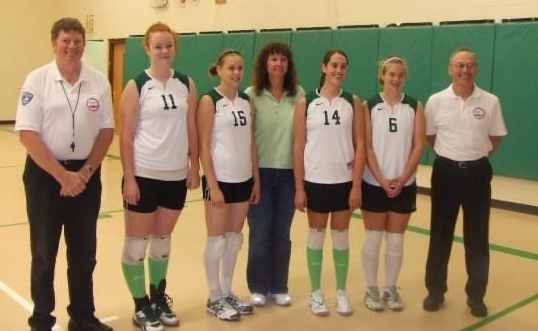 Boyle is one of many who noted the specialness and frequency of which Reeb and his wife Linda made quilts and presented them as gifts.
“Occasionally he gifts a senior one of his very special quilts, which are truly amazing and cherished by the girls,” Boyle said. “Because if Dave Reeb thinks you're a special player and person, you stand even a little taller.”
Boyle’ s daughter Caitlin, who died last year after battling a brain tumor, received a quilt from the Reebs. She was part of the Islanders Class of 2009.
Tom Frick, now retired, was a teacher at Mackinac Island and Inland Lake schools. He refereed volleyball and basketball for nine years. He was yet another example of Reeb finding referees to help.
“One day we were talking and he said, ‘Get your stuff, and we’ll do it’ - so I did,” Frick recalled. “We went over there four or five years.
“He was very committed to the those people on the islands,” Frick continued. “They really enjoyed him.”
Weather often interferes with getting on and off the islands. Reeb has never taken the two-hour ferry ride from Charlevoix to Beaver, counting on the plane ride. He has been on the much shorter ferry ride to Mackinac.
For the most part, the flights to the islands have been fine, the officials noted. Only once on each Island did Reeb get “stranded” while refereeing the Lakers and Islanders. He and his partner had to spend another night waiting for the weather to clear for a flight back to the mainland.
 Tom Spencer is a longtime MHSAA-registered basketball and soccer official, and former softball and baseball official, and he also has coached in the northern Lower Peninsula area. He previously has written for the Saginaw News, Bay County Sports Page and Midland Daily News. He can be reached at [email protected] with story ideas for Manistee, Wexford, Missaukee, Roscommon, Ogemaw, Iosco, Alcona, Oscoda, Crawford, Kalkaska, Grand Traverse, Benzie, Leelanau, Antrim, Otsego, Montmorency, Alpena, Presque Isle, Cheboygan, Charlevoix and Emmet counties.
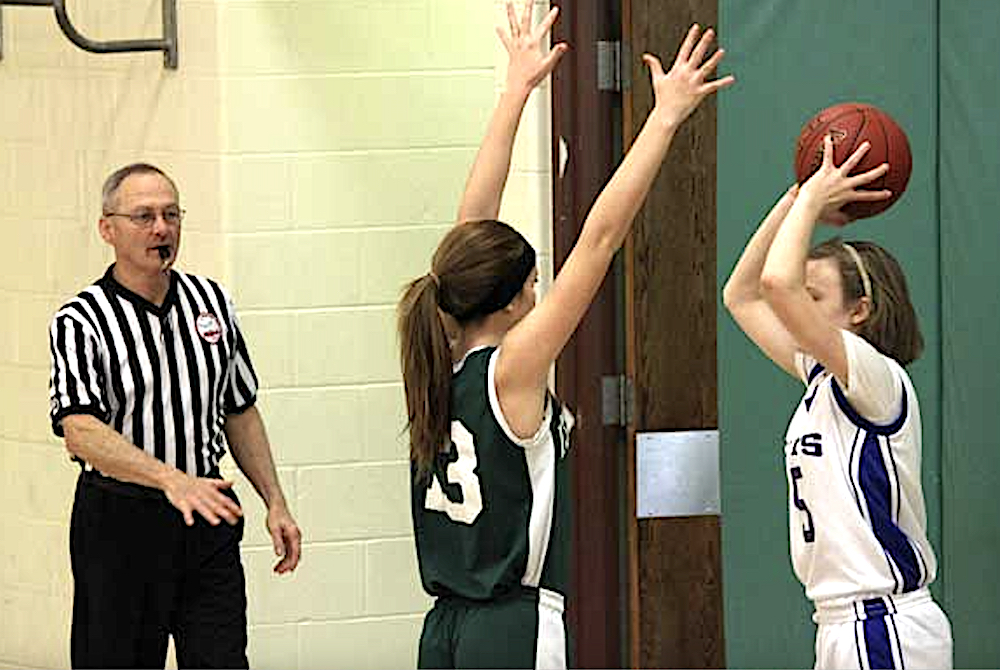
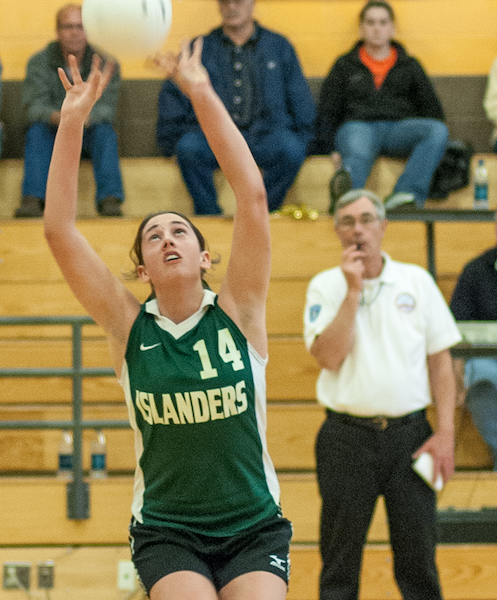
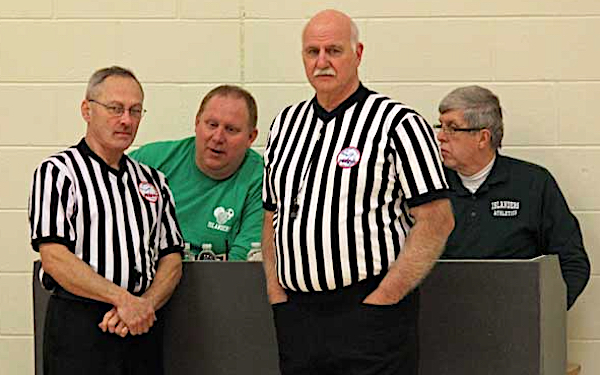
PHOTOS (Top) Official Dave Reeb counts off an inbound during a basketball game at Beaver Island. (2) Former longtime official Morris Porter monitors the action as Caitlin Boyle sets during a 2008 match. (3) From left, Reeb, Gerald LaFreniere, referee Jerry Cook and Rick Speck talk things over at the scorer’s table. (4). From left, former official Randy Sagante with Beaver Island athletes Heather McDonough (11), Deven Cook (15), former volleyball coach Connie Boyle, Caitlin Boyle (14), Maeve Green (6) and Reeb. The four athletes were seniors in 2008-09. (Basketball photos courtesy of Beaver Island News on the ‘Net; volleyball photos courtesy of Frank Solle.)