


New Math: Division & Multiplication Problems
July 25, 2017
By Jack Roberts
MHSAA Executive Director
This is the second part in a series on MHSAA tournament classification, past and present, that will be published over the next two weeks. This series originally ran in this spring's edition of MHSAA benchmarks.
High school tournament classifications went viral before there was social media and most of us knew what “viral” meant.
Much as a virus infects computers today or has created epidemics of disease around the world for centuries, high school tournament classification – once introduced – tends to spread uncontrollably. Once started, it tends to keep expanding and rarely contracts.
While we are still some distance from providing every team a trophy as a result of expanding high school tournament classification across the country, there is criticism nevertheless that we are headed in that direction – a philosophy which is supposed to exist only in local youth sports for our youngest children.
Michigan could be blamed for all this. Michigan is generally accepted as the first state to provide different classifications for season-ending tournaments for different sized schools. It started a century ago. Today, every state has various classifications for its tournaments in most if not all sports. And it is a bit ironic that Michigan – creator of the classification chaos – more than most other states has kept the number of tournament classes or divisions under control.
Yes, there is evidence that tournament classifications have expanded over the years in Michigan, especially with the relatively recent introduction of tournaments in football and the late 1990s’ move from classes to divisions in most MHSAA tournaments. But the MHSAA Representative Council has held true to its word when it expanded the playoffs for football from four classes to eight divisions: this is needed because of unique factors of football, factors that exist in no other sport; and all other sports should be capped at a maximum of four classes or divisions.
Kentucky is the preeminent defender of single-class basketball. All of its 276 high schools compete for the single state championship for each gender. In Indiana, there are still open wounds from its move in 1998 from one to four classes for its 400 schools in basketball.
Multi-class tournaments have tended to increase the number of non-public school champions, which some states are trying to lower through enrollment “multipliers,” and also tend to increase the number of repeat champions, which some states are trying to affect with “success factors” which lift smaller schools into classifications for larger schools if they take home too many trophies.
While there is considerable evidence that state tournaments do as much bad as good for educational athletics, state associations persist in providing postseason tournaments because, on balance, the experiences are supposed to be good for student-athletes. And once we reach that conclusion it is just a small leap to believe that if the tournaments are good for a few, they must be better for more – which leads to creating more and more tournament classifications. One becomes two classes, then three, then four and so forth.
While the argument is that more classifications or divisions provides more students with opportunities to compete and win, it is undeniable that the experience changes as the number of tournament classifications expands. It is not possible for state associations to provide the same level of support when tournament classifications expand to multiple venues playing simultaneously. For example, there is less audio and video broadcast potential at each venue, and less media coverage to each venue. Focus is diluted and fans diminished at each championship.
No one can argue reasonably that today's two-day MHSAA Football Finals of eight championship games has the same pizazz as the one-day, four-games event conducted prior to 1990.
In some states the number of divisions has grown so much that it is difficult to see much difference between the many season-ending state championship games and a regular-season event in the same sport.
It is a balancing act. And Michigan has been studying that balance longer than any other state, and charting a steadier course than most.
Addition by Division
The shift to Divisions for MHSAA Tournament play in numerous sports has added up to a greater number of champions for teams and individuals across the state. Following are the sports currently employing a divisional format, and the procedures for determining enrollment and classification.
In 23 statewide or Lower Peninsula tournaments, schools which sponsor the sport are currently divided into nearly equal divisions. They are:
- Baseball - 4 Divisions
- Boys Bowling - 4 Divisions
- Girls Bowling - 4 Divisions
- Girls Competitive Cheer - 4 Divisions
- LP Boys Cross Country - 4 Divisions
- LP Girls Cross Country - 4 Divisions
- LP Boys Golf - 4 Divisions
- LP Girls Golf - 4 Divisions
- Ice Hockey - 3 Divisions
- Boys Lacrosse - 2 Divisions
- Girls Lacrosse - 2 Divisions
- Boys Skiing - 2 Divisions
- Girls Skiing - 2 Divisions
- LP Boys Soccer - 4 Divisions LP
- Girls Soccer - 4 Divisions
- Girls Softball - 4 Divisions
- LP Boys Swimming & Diving - 3 Divisions
- LP Girls Swimming & Diving - 3 Divisions
- LP Boys Tennis - 4 Divisions
- LP Girls Tennis - 4 Divisions
- LP Boys Track & Field - 4 Divisions
- LP Girls Track & Field - 4 Divisions
- Wrestling - 4 Divisions
Lists of schools for each division of these 23 tournaments are posted on MHSAA.com approximately April 1. Listings of schools in Upper Peninsula tournaments for their sports are also posted on MHSAA.com. The lists are based on school memberships and sports sponsorships in effect or anticipated for the following school year, as known to the MHSAA office as of a date in early March.
In football, the 256 schools which qualify for MHSAA 11-player playoffs are placed in eight equal divisions annually on Selection Sunday. Beginning in 2017, the 8-player divisions will be determined in a like manner on Selection Sunday as well, with 32 qualifying schools placed in two divisions.
Schools have the option to play in any higher division in one or more sports for a minimum of two years.
The deadlines for "opt-ups" are as follows:
- Applications for fall sports must be submitted by April 15
- Applications for winter sports must be submitted by Aug. 15
- Applications for spring sports must be submitted by Oct. 15
Subsequent to the date of these postings for these tournaments, no school will have its division raised or lowered by schools opening or closing, schools adding or dropping sports, schools exercising the option to play in a higher division, or approval or dissolution of cooperative programs.
When the same sport is conducted for boys and girls in the same season (e.g., track & field and cross country), the gender that has the most sponsoring schools controls the division breaks for both genders.
Breslin Bound: 2021-22 Boys Report Week 1
By
Geoff Kimmerly
MHSAA.com senior editor
December 13, 2021
Showcase matchups began quenching fans’ thirst for the new season last week, with more on the way, and league play already is ramping up as we embark on a four-month journey – much different than last season’s two-month sprint.

Boys basketball season began the way it’s meant to begin, and no one will be taking that for granted.
Every Monday with “Breslin Bound” we’ll take glances at five scores that especially jumped out from the previous week, provide snapshots of two teams in each division to watch as the winter progresses, and then give a glimpse of five intriguing matchups on the schedule during the week to come.
“Breslin Bound” is powered by MI Student Aid and based on results and schedules posted for each school at MHSAA.com. Send corrections or missing scores to [email protected].
Week in Review
The countdown of last week’s five most intriguing results:
1. Detroit U-D Jesuit 51, Detroit Martin Luther King 42 These two are both expected to be in the Division 1 championship mix again, as usual, making this a game that might be recalled when March rolls around.
2. Bloomfield Hills Brother Rice 86, Grand Blanc 68 The Warriors opened with an impressive win over the reigning Division 1 champion, putting up what would’ve been a season-high points total last winter.
3. Freeland 80, Bridgeport 51 Although these Tri-Valley Conference foes did split last season, Bridgeport is coming off a run to the Division 2 Semifinals.
4. Grand Rapids Catholic Central 50, Grand Rapids Christian 45 The reigning Division 2 champion didn’t lose a game last season but got an immediate test from the Eagles in this opener.
5. Harrison 40, Beaverton 38 Harrison finished seventh and Beaverton was undefeated in winning the Jack Pine Conference last season; this avenged 29 and 39-point losses by the Hornets.
Watch List
With an eye toward March, here are two teams in each division making sparks:
Division 1
Bay City Central (2-0) The Wolves are making an early push for one of the most interesting potential turnarounds this winter. The finished 2-12 last season, and they’ve already equaled that success. And it came with plenty of excitement – Central opened with a 63-61 win over Midland Dow and followed with another close finish, 51-49 over Tawas.
Okemos (2-0) After a rare down season – finishing 3-7 with a pair of overtime losses and two more defeats by five or fewer points – Okemos is off to a fast start reestablishing itself as a contender in the Capital Area Activities Conference Blue. The first step was a 63-51 opening-night win over a Howell team coming off a District title, and the next was a 53-37 victory over DeWitt.
Division 2
Onsted (3-0) The Wildcats are coming off two straight 14-win seasons, and they couldn’t have gotten off to a better start last week. All three wins were by double digits – 69-56 over Michigan Center, 68-38 over Hanover-Horton and 69-26 over Jonesville – and Hanover-Horton made the Division 3 Semifinals last winter, after defeating Michigan Center in Regional play.
Richmond (3-0) The Blue Devils joined Onsted among 12 teams statewide to start 3-0 last week, a great bounce-back after going 4-6 last season with six games canceled. This start is more reminiscent of when the team went 18-4 in 2019-20 – except last week Richmond also got a win over Fraser, 51-49, to go with victories over Marine City and Cardinal Mooney.
Warren Michigan Collegiate (2-0) After missing last season’s Quarterfinals by a one-point loss to Detroit Loyola, Michigan Collegiate opened in a big way last week. The Cougars downed Detroit Mumford by 30 and then defeated Ecorse 72-45 at the Horatio Williams Tip-Off Classic. A Motor City Roundball Classic matchup Dec. 27 with Detroit Renaissance could be telling before Charter School Conference play begins. (UPDATED Jan. 31, 2022; this originally appeared under Division 3, but Michigan Collegiate is in Division 2.)
Division 3
Holton (2-0) Even with last season shortened, Holton has upped its win total each of the last four from six to 10 to 13 to finishing 15-6 last winter. The Red Devils got started on attempting to repeat as champions of the Central State Activities Association Silver with a 46-28 win over Morley Stanwood on Friday, after opening with a 16-point win over Howard City Tri County.
Division 4
Lake Linden-Hubbell (2-0) The Lakes play in a strong Copper Country division of the Copper Mountain Conference which features primarily Dollar Bay and Painesdale Jeffers as well. But Lake Linden-Hubbell will try to work its way into the race and got a solid jump on bettering last season’s 7-9 overall finish with a 39-34 win over Hancock and more sizable victory over Baraga.
New Buffalo (2-0) The Bison are coming off a District title and off to a fast start. They held on for a 77-73 win over Division 1 Sturgis to open, and then won big against Covert to kick off the Berrien-Cass-St. Joseph Conference White schedule. New Buffalo was runner-up in the league and 13-4 overall last season.
Can't-Miss Contests
Be on the lookout for results of these games coming up:
Tuesday – Traverse City St. Francis (0-0) at Charlevoix (1-0) – The Lake Michigan Conference race gets going right away, with the reigning champion Rayders taking on one of last season’s co-runners-up.
Thursday – Orchard Lake St. Mary’s (2-0) at Clarkston (2-0) – This is a rematch of a Division 1 Regional Semifinal, won by the Eaglets 38-37 on the way to reaching last season’s Quarterfinals.
Friday – Hudsonville Unity Christian (2-0) at Grand Rapids South Christian (1-1) – Two of the Grand Rapids area’s best were a combined 33-6 last season.
Friday – Detroit U-D Jesuit (3-0) at Ferndale (0-1) – Jesuit lost only one game last season, a Division 1 Regional Final, and Ferndale is coming off a run to the Division 2 Semifinals.
Saturday – Benton Harbor (2-0) vs. Flint Carman-Ainsworth (1-0) at Grand Rapids Union – This Showcase Classic game matches teams that were a combined 29-6 last season.
Second Half’s weekly “Breslin Bound” previews and reviews are powered by MI Student Aid, a part of the Office of Postsecondary Financial Planning located within the Michigan Department of Treasury. MI Student Aid encourages students to pursue postsecondary education by providing access to student financial resources and information. MI Student Aid administers the state’s 529 college savings programs (MET/MESP), as well as scholarship and grant programs that help make college Accessible, Affordable and Attainable for you. Connect with MI Student Aid at www.michigan.gov/mistudentaid and find more information on Facebook and Twitter @mistudentaid.
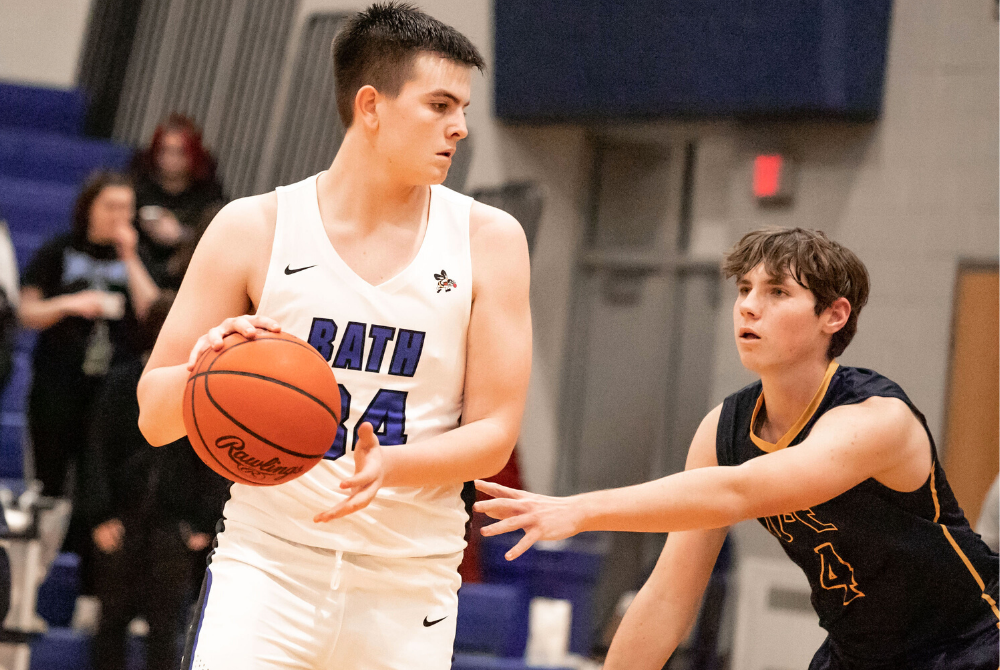
PHOTO Ovid-Elsie, defending, opened with a 56-52 win over Bath last week. (Photo by Christine McCallister.)