


New Math: Division & Multiplication Problems
July 25, 2017
By Jack Roberts
MHSAA Executive Director
This is the second part in a series on MHSAA tournament classification, past and present, that will be published over the next two weeks. This series originally ran in this spring's edition of MHSAA benchmarks.
High school tournament classifications went viral before there was social media and most of us knew what “viral” meant.
Much as a virus infects computers today or has created epidemics of disease around the world for centuries, high school tournament classification – once introduced – tends to spread uncontrollably. Once started, it tends to keep expanding and rarely contracts.
While we are still some distance from providing every team a trophy as a result of expanding high school tournament classification across the country, there is criticism nevertheless that we are headed in that direction – a philosophy which is supposed to exist only in local youth sports for our youngest children.
Michigan could be blamed for all this. Michigan is generally accepted as the first state to provide different classifications for season-ending tournaments for different sized schools. It started a century ago. Today, every state has various classifications for its tournaments in most if not all sports. And it is a bit ironic that Michigan – creator of the classification chaos – more than most other states has kept the number of tournament classes or divisions under control.
Yes, there is evidence that tournament classifications have expanded over the years in Michigan, especially with the relatively recent introduction of tournaments in football and the late 1990s’ move from classes to divisions in most MHSAA tournaments. But the MHSAA Representative Council has held true to its word when it expanded the playoffs for football from four classes to eight divisions: this is needed because of unique factors of football, factors that exist in no other sport; and all other sports should be capped at a maximum of four classes or divisions.
Kentucky is the preeminent defender of single-class basketball. All of its 276 high schools compete for the single state championship for each gender. In Indiana, there are still open wounds from its move in 1998 from one to four classes for its 400 schools in basketball.
Multi-class tournaments have tended to increase the number of non-public school champions, which some states are trying to lower through enrollment “multipliers,” and also tend to increase the number of repeat champions, which some states are trying to affect with “success factors” which lift smaller schools into classifications for larger schools if they take home too many trophies.
While there is considerable evidence that state tournaments do as much bad as good for educational athletics, state associations persist in providing postseason tournaments because, on balance, the experiences are supposed to be good for student-athletes. And once we reach that conclusion it is just a small leap to believe that if the tournaments are good for a few, they must be better for more – which leads to creating more and more tournament classifications. One becomes two classes, then three, then four and so forth.
While the argument is that more classifications or divisions provides more students with opportunities to compete and win, it is undeniable that the experience changes as the number of tournament classifications expands. It is not possible for state associations to provide the same level of support when tournament classifications expand to multiple venues playing simultaneously. For example, there is less audio and video broadcast potential at each venue, and less media coverage to each venue. Focus is diluted and fans diminished at each championship.
No one can argue reasonably that today's two-day MHSAA Football Finals of eight championship games has the same pizazz as the one-day, four-games event conducted prior to 1990.
In some states the number of divisions has grown so much that it is difficult to see much difference between the many season-ending state championship games and a regular-season event in the same sport.
It is a balancing act. And Michigan has been studying that balance longer than any other state, and charting a steadier course than most.
Addition by Division
The shift to Divisions for MHSAA Tournament play in numerous sports has added up to a greater number of champions for teams and individuals across the state. Following are the sports currently employing a divisional format, and the procedures for determining enrollment and classification.
In 23 statewide or Lower Peninsula tournaments, schools which sponsor the sport are currently divided into nearly equal divisions. They are:
- Baseball - 4 Divisions
- Boys Bowling - 4 Divisions
- Girls Bowling - 4 Divisions
- Girls Competitive Cheer - 4 Divisions
- LP Boys Cross Country - 4 Divisions
- LP Girls Cross Country - 4 Divisions
- LP Boys Golf - 4 Divisions
- LP Girls Golf - 4 Divisions
- Ice Hockey - 3 Divisions
- Boys Lacrosse - 2 Divisions
- Girls Lacrosse - 2 Divisions
- Boys Skiing - 2 Divisions
- Girls Skiing - 2 Divisions
- LP Boys Soccer - 4 Divisions LP
- Girls Soccer - 4 Divisions
- Girls Softball - 4 Divisions
- LP Boys Swimming & Diving - 3 Divisions
- LP Girls Swimming & Diving - 3 Divisions
- LP Boys Tennis - 4 Divisions
- LP Girls Tennis - 4 Divisions
- LP Boys Track & Field - 4 Divisions
- LP Girls Track & Field - 4 Divisions
- Wrestling - 4 Divisions
Lists of schools for each division of these 23 tournaments are posted on MHSAA.com approximately April 1. Listings of schools in Upper Peninsula tournaments for their sports are also posted on MHSAA.com. The lists are based on school memberships and sports sponsorships in effect or anticipated for the following school year, as known to the MHSAA office as of a date in early March.
In football, the 256 schools which qualify for MHSAA 11-player playoffs are placed in eight equal divisions annually on Selection Sunday. Beginning in 2017, the 8-player divisions will be determined in a like manner on Selection Sunday as well, with 32 qualifying schools placed in two divisions.
Schools have the option to play in any higher division in one or more sports for a minimum of two years.
The deadlines for "opt-ups" are as follows:
- Applications for fall sports must be submitted by April 15
- Applications for winter sports must be submitted by Aug. 15
- Applications for spring sports must be submitted by Oct. 15
Subsequent to the date of these postings for these tournaments, no school will have its division raised or lowered by schools opening or closing, schools adding or dropping sports, schools exercising the option to play in a higher division, or approval or dissolution of cooperative programs.
When the same sport is conducted for boys and girls in the same season (e.g., track & field and cross country), the gender that has the most sponsoring schools controls the division breaks for both genders.
1st & Goal: 2021 Finals Review
By
Geoff Kimmerly
MHSAA.com senior editor
November 30, 2021
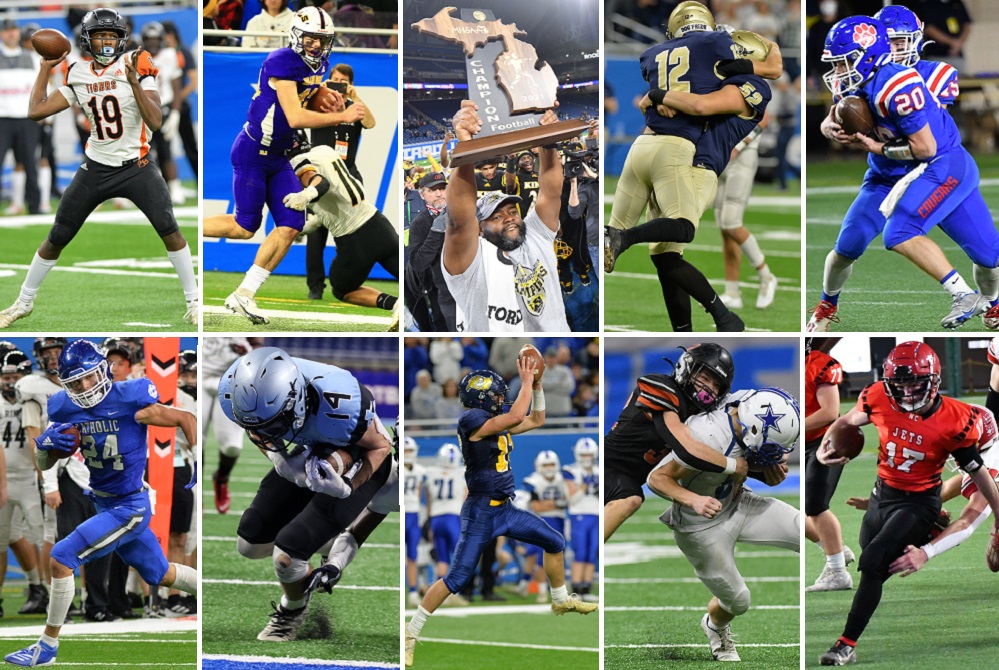
Two of the longest MHSAA Finals days at Ford Field – capped by two of the most exciting championship games in recent memory – concluded the 2021 football season this weekend.
 Fans were able to savor every moment until nearly midnight both nights, and more than 38,000 made the trip to Detroit over the two-day 11-player event. That was in addition to those who journeyed from near and far the weekend before for the 8-Player Finals at Northern Michigan University’s Superior Dome, where a pair of repeat champions reigned again.
Second Half covered all 10 championship games, with quick recaps and links (click on the game scores) to those stories below followed by notations of performances entered into the MHSAA Finals record book and a report on some of the biggest and best stories to emerge from the championship weekends.
Finals in Review
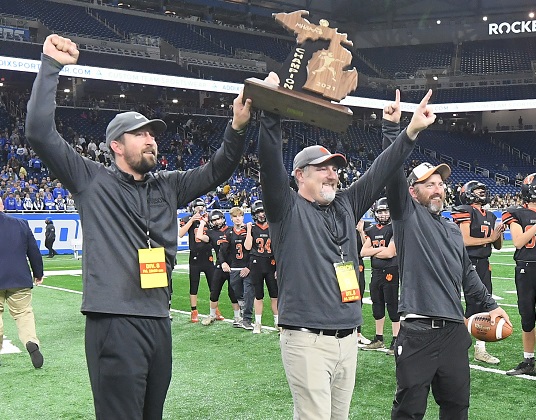
11-Player Division 1: Belleville 55, Rochester Adams 33
After falling a win short of reaching the Final the last three seasons, Belleville advanced this fall and completed its first championship run. Freshman quarterback Bryce Underwood showed on a statewide stage why he’s received lots of attention during his high school debut, and he was surrounded by seniors including receiver Jeremiah Caldwell who helped carry the Tigers to the win.
11-Player Division 2: Warren De La Salle Collegiate 41, Traverse City Central 14
After falling in last season’s championship game, De La Salle took the next step in winning its fourth Finals title – and with expectations we could see the Pilots back at Ford Field again in 2022. Junior quarterback Brady Drogosh has been a big part of both trips, and this time he had a hand in 316 total yards and four touchdowns either running or passing.
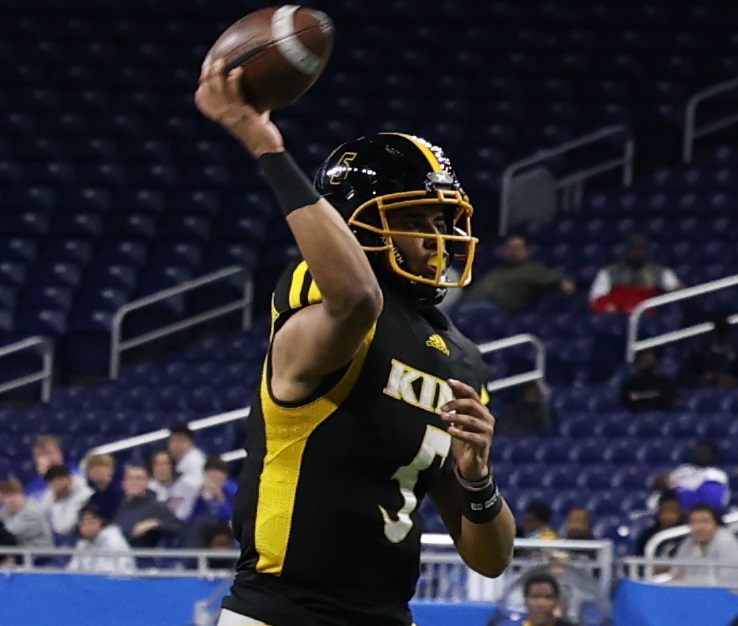
11-Player Division 3: Detroit Martin Luther King 25, DeWitt 21
Two of the state’s premier quarterbacks were on display, junior Dante Moore for King and senior Ty Holtz for reigning champ DeWitt. But the deciding play was a defensive stand – specifically, the Crusaders stopping a 4th-and-goal from their 1-yard line with 2:34 to play. Both teams brought interceptions back for touchdowns, Holtz making the grab and score for DeWitt.
11-Player Division 4: Chelsea 55, Hudsonville Unity Christian 52
This is the game from this weekend many will be referring to years from now. Take your pick why – the 11-Player Finals record 107 combined points, Chelsea’s also-record 28-point comeback over the final 23 minutes, the fact Unity Christian had set the season record for points scored during the game. Maybe the walk-off field goal by Hunter Shaw saved in part by the deft handling of a short snap by quarterback/holder Lucas Dunn.
11-Player Division 5: Grand Rapids Catholic Central 31, Marine City 7
The Cougars won their second-straight championship in Division 5 and fifth over the last six seasons to go with Division 4 titles in 2016, 2017 and 2019. They did so with what has to be one of the finest back-up quarterbacking performances ever – senior John Passinault stepped in for injured past Finals star Joey Silveri and threw for 2,307 yards and 37 touchdowns this fall.
11-Player Division 6: Lansing Catholic 16, Warren Michigan Collegiate 6
The Cougars have been known for their offensive production over the last decade or more, but the defense led the way to their second championship in three seasons – they had won Division 5 in 2019. Lansing Catholic gave up only 40 points – or eight per game – during this playoff run, and in this game took advantage of four interceptions and a fumble recovery.
11-Player Division 7: Pewamo-Westphalia 14, Lawton 10
The Pirates added their fourth championship in six seasons, capping a run which saw them win their league and defeat eight more league champions along the way – one of them Lansing Catholic, the eventual Division 6 title winner. P-W had accomplished most of it with key players out with injuries, but multiple returned to lead the Pirates past Lawton, which was making its first Finals appearance.
11-Player Division 8: Hudson 14, Beal City 7
Defense has reigned in Division 8 the last few seasons, with Hudson following recent champions Centreville and Reading in thriving on that side of the ball. The Tigers ended their undefeated season having given up only 99 points (7.1 per game), and this time stopped a Beal City team averaging 35.5 points per contest entering Ford Field.
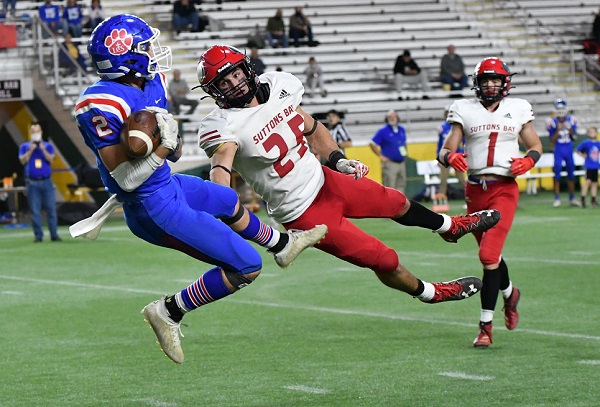
8-Player Division 1: Adrian Lenawee Christian 31, Suttons Bay 20
A rematch of last season’s Division 1 Final was more closely contested, but with the same result as Lenawee Christian finished its second-straight undefeated campaign. Cougars quarterback Ashur Bryja is a name to remember – he opened the scoring 51 seconds in with an interception return touchdown, ran for two more scores and threw for 229 yards.
8-Player Division 2: Powers North Central 63, Colon 0
The Jets won their second-straight Division 2 title and fourth 8-player championship total, and put up a combined 133 points over those last two Finals wins. North Central had 520 yards of total offense this time. Wyatt Raab, Luke Gorzinski and Alex Naser all scored two touchdowns, and Gorzinski also was the team’s leading tackler.
Records Report
11-Player
Chelsea and Hudsonville blew past the previous record of 94 combined points in an 11-Player Finals game with their combined 107. Chelsea’s 55 tied for third-most, with Unity Christian now sitting at sixth on that list after Belleville also scored 55 in Division 1.
As expected from a 55-52 game, Chelsea ended up with the fourth-most total yardage in 11-Player Finals history, with 533, and the teams’ combined total of 1,024 ranks second. Chelsea’s 28 first downs are tied for third-most.
Chelsea’s Lucas Hanifan tied 11-player championship game records with 30 points and five touchdowns, and set the receiving touchdowns record by two with that total. His quarterback Lucas Dunn set the 11-Player Finals record with six touchdown passes while also making the yardage list with 308, pass attempts list with 36 and completions list with 25. Hanifan’s nine receptions also rank among the most in that category.
Belleville freshman quarterback Bryce Underwood may have even exceeded high expectations with his Finals debut, making the total offense list with a combined 346 rushing and passing yards (with 284 passing) and tying for second with four others with five touchdown passes. Senior receiver Jeremiah Caldwell played a big part, tying for second with 204 receiving yards (on only four receptions) and also tying for second with three touchdown catches.
Warren De La Salle Collegiate became the 22nd team to keep an opponent from completing a pass, shutting out Traverse City Central on its nine attempts. Detroit Martin Luther King became the 29th team to not punt in an 11-Player Final.
De La Salle quarterback Brady Drogosh also made the total yardage list with 316 (including 174 rushing). King’s Dante Moore made the completions list with 18 on 24 attempts.
Chelsea’s Hunter Shaw and Belleville’s Brayden Lane tied the 11-Player Finals record held by three others with seven extra points, while in Division 2, De La Salle’s Brady Lowe made the extra point list with five. Shaw and Adams’ Colin Timko became the 11th and 12th, respectively, to make two or more field goals, Timko hitting from 27 and 35 yards in the Division 1 game and Shaw from 26 and 33.
Hudson’s march to victory included 282 rushing yards on 64 carries, which tied for the eighth-most runs by one team in an 11-Player Final.
8-Player
Powers North Central’s big win was accompanied by multiple scoring record book entries, including for 29 points in a quarter (third most), 49 in the first half (first) and 63 for one game (also ranking third). The Jets also made the team rushing yardage list with 328 and the team first downs list with 20. North Central also became the first in the category for fewest rushing yards allowed, holding Colon to -14.
Adrian Lenawee Christian set the team first downs record with 24 against Suttons Bay.
Lenawee Christian quarterback Ashur Bryja earned the sixth-most total yards in 8-Player Finals history, with 372 including 229 passing.
North Central’s Jaden Walters set the standard for 8-player championship game kickers, making all seven of his extra point attempts.
Suttons Bay’s August Schaub set a record that will be tough to match, returning an interception 99 yards for a touchdown against Lenawee Christian.
Teammate Hugh Periard was added with the second-longest rushing play in 8-Player Finals history, 90 yards against Lenawee Christian.
Stories Behind the Scores
Winning streaks grow: A few of this season’s winners not only repeated as champions, but extended overall winning streaks that will be followed closely next season. Grand Rapids Catholic Central has won 36 straight games, tied for the sixth-longest undefeated run. Lenawee Christian has won all 24 8-player games it’s played over the last two seasons, and North Central also is 24-0 over the last two.
What’s new is new: Belleville and Chelsea were first-time champions after some just-misses over the last decade. As noted above, the Tigers made the Semifinals this season for the fourth straight year before reaching Ford Field for the first time, and Chelsea has made the Semifinals five of the last seven seasons and had lost in Finals in 2015 and 2018.
QB Power: Michigan is graduating another fine class of high school quarterbacks – DeWitt’s Ty Holtz, in particular, provided two seasons of memories leading the Panthers on back-to-back trips to Ford Field. But we should expect to see some of the other 2021 championship signal-callers a lot next season. King’s Dante Moore will close one of the most highly-followed careers in some time, and De La Salle’s Brady Drogosh will be watched just as much next fall. Belleville’s Bryce Underwood will generate plenty of statewide interest over the next three seasons. As noted, Lenawee Christian’s Ashur Bryja is one of the next stars among the small schools, and North Central’s Luke Gorzinski has led two championship runs and still is just a junior. Two more to remember: Marine City junior Jeffery Heaslip was a standout run/pass threat in leading his team to the Division 5 Final, and Rochester Adams junior Parker Picot became known at least in-state as much for football leading his team in Division 1 as he’s known as a top-level baseball prospect.
No taking ‘normal’ for granted: Those who experienced the start-stop-start 2020 season will never forget it, nor should any of us who had the opportunity to enjoy a more “normal” 2021. With COVID-19 ever present, Michigan high schools did their parts again to play safely this fall. And proper perspective remains a great teacher of just how much that’s worth.
Second Half’s weekly “1st & Goal” previews and reviews are powered by MI Student Aid, a part of the Office of Postsecondary Financial Planning located within the Michigan Department of Treasury. MI Student Aid encourages students to pursue postsecondary education by providing access to student financial resources and information. MI Student Aid administers the state’s 529 college savings programs (MET/MESP), as well as scholarship and grant programs that help make college Accessible, Affordable and Attainable for you. Connect with MI Student Aid at www.michigan.gov/mistudentaid and find more information on Facebook and Twitter @mistudentaid.