


New Math: Division & Multiplication Problems
July 25, 2017
By Jack Roberts
MHSAA Executive Director
This is the second part in a series on MHSAA tournament classification, past and present, that will be published over the next two weeks. This series originally ran in this spring's edition of MHSAA benchmarks.
High school tournament classifications went viral before there was social media and most of us knew what “viral” meant.
Much as a virus infects computers today or has created epidemics of disease around the world for centuries, high school tournament classification – once introduced – tends to spread uncontrollably. Once started, it tends to keep expanding and rarely contracts.
While we are still some distance from providing every team a trophy as a result of expanding high school tournament classification across the country, there is criticism nevertheless that we are headed in that direction – a philosophy which is supposed to exist only in local youth sports for our youngest children.
Michigan could be blamed for all this. Michigan is generally accepted as the first state to provide different classifications for season-ending tournaments for different sized schools. It started a century ago. Today, every state has various classifications for its tournaments in most if not all sports. And it is a bit ironic that Michigan – creator of the classification chaos – more than most other states has kept the number of tournament classes or divisions under control.
Yes, there is evidence that tournament classifications have expanded over the years in Michigan, especially with the relatively recent introduction of tournaments in football and the late 1990s’ move from classes to divisions in most MHSAA tournaments. But the MHSAA Representative Council has held true to its word when it expanded the playoffs for football from four classes to eight divisions: this is needed because of unique factors of football, factors that exist in no other sport; and all other sports should be capped at a maximum of four classes or divisions.
Kentucky is the preeminent defender of single-class basketball. All of its 276 high schools compete for the single state championship for each gender. In Indiana, there are still open wounds from its move in 1998 from one to four classes for its 400 schools in basketball.
Multi-class tournaments have tended to increase the number of non-public school champions, which some states are trying to lower through enrollment “multipliers,” and also tend to increase the number of repeat champions, which some states are trying to affect with “success factors” which lift smaller schools into classifications for larger schools if they take home too many trophies.
While there is considerable evidence that state tournaments do as much bad as good for educational athletics, state associations persist in providing postseason tournaments because, on balance, the experiences are supposed to be good for student-athletes. And once we reach that conclusion it is just a small leap to believe that if the tournaments are good for a few, they must be better for more – which leads to creating more and more tournament classifications. One becomes two classes, then three, then four and so forth.
While the argument is that more classifications or divisions provides more students with opportunities to compete and win, it is undeniable that the experience changes as the number of tournament classifications expands. It is not possible for state associations to provide the same level of support when tournament classifications expand to multiple venues playing simultaneously. For example, there is less audio and video broadcast potential at each venue, and less media coverage to each venue. Focus is diluted and fans diminished at each championship.
No one can argue reasonably that today's two-day MHSAA Football Finals of eight championship games has the same pizazz as the one-day, four-games event conducted prior to 1990.
In some states the number of divisions has grown so much that it is difficult to see much difference between the many season-ending state championship games and a regular-season event in the same sport.
It is a balancing act. And Michigan has been studying that balance longer than any other state, and charting a steadier course than most.
Addition by Division
The shift to Divisions for MHSAA Tournament play in numerous sports has added up to a greater number of champions for teams and individuals across the state. Following are the sports currently employing a divisional format, and the procedures for determining enrollment and classification.
In 23 statewide or Lower Peninsula tournaments, schools which sponsor the sport are currently divided into nearly equal divisions. They are:
- Baseball - 4 Divisions
- Boys Bowling - 4 Divisions
- Girls Bowling - 4 Divisions
- Girls Competitive Cheer - 4 Divisions
- LP Boys Cross Country - 4 Divisions
- LP Girls Cross Country - 4 Divisions
- LP Boys Golf - 4 Divisions
- LP Girls Golf - 4 Divisions
- Ice Hockey - 3 Divisions
- Boys Lacrosse - 2 Divisions
- Girls Lacrosse - 2 Divisions
- Boys Skiing - 2 Divisions
- Girls Skiing - 2 Divisions
- LP Boys Soccer - 4 Divisions LP
- Girls Soccer - 4 Divisions
- Girls Softball - 4 Divisions
- LP Boys Swimming & Diving - 3 Divisions
- LP Girls Swimming & Diving - 3 Divisions
- LP Boys Tennis - 4 Divisions
- LP Girls Tennis - 4 Divisions
- LP Boys Track & Field - 4 Divisions
- LP Girls Track & Field - 4 Divisions
- Wrestling - 4 Divisions
Lists of schools for each division of these 23 tournaments are posted on MHSAA.com approximately April 1. Listings of schools in Upper Peninsula tournaments for their sports are also posted on MHSAA.com. The lists are based on school memberships and sports sponsorships in effect or anticipated for the following school year, as known to the MHSAA office as of a date in early March.
In football, the 256 schools which qualify for MHSAA 11-player playoffs are placed in eight equal divisions annually on Selection Sunday. Beginning in 2017, the 8-player divisions will be determined in a like manner on Selection Sunday as well, with 32 qualifying schools placed in two divisions.
Schools have the option to play in any higher division in one or more sports for a minimum of two years.
The deadlines for "opt-ups" are as follows:
- Applications for fall sports must be submitted by April 15
- Applications for winter sports must be submitted by Aug. 15
- Applications for spring sports must be submitted by Oct. 15
Subsequent to the date of these postings for these tournaments, no school will have its division raised or lowered by schools opening or closing, schools adding or dropping sports, schools exercising the option to play in a higher division, or approval or dissolution of cooperative programs.
When the same sport is conducted for boys and girls in the same season (e.g., track & field and cross country), the gender that has the most sponsoring schools controls the division breaks for both genders.
Preview: Powers May Reign, But Many Have Chances to Shine
By
Geoff Kimmerly
MHSAA.com senior editor
November 18, 2021
Powerhouse programs appear set to rule again at this weekend’s Lower Peninsula Girls Swimming & Diving Finals.
Ann Arbor Pioneer in Division 1, Birmingham Seaholm in Division 2 and East Grand Rapids in Division 3 will enter Friday’s preliminaries with large groups of contenders seeded among the top 16 in their respective events.
But one of the best parts of this weekend’s meets is the opportunity that provides – placers up to 16th score points, and hundreds will have that opportunity. Among returning event champions and this weekend’s top-seeded individuals alone, 28 schools are represented – with many more likely to celebrate one or more placers climbing the podium.
Competition begins at noon for Friday’s preliminaries and Saturday’s championships. Friday’s action will begin with swimming, with divers taking the pool approximately 3 p.m. at all three sites.
Spectator limits – two tickets per Finals qualifier – will be in place in Divisions 1 and 3, but all three Finals will be streamed live on MHSAA.tv both days with an announcer calling Saturday’s action. Click for lineups and seed times for all three meets.
Lower Peninsula Division 1 at Holland Aquatic Center
Reigning champion: Ann Arbor Pioneer
2020 runner-up: Farmington Hills Mercy
2021 top-ranked: 1. Ann Arbor Pioneer, 2. Northville, 3. Brighton.
Pioneer won last season’s championship, its first since 2008, with exactly double the points (368) of the next closest placer. This could be quite an encore, as 21 entries and all three relays are seeded to score, all three relays are among four top seeds, and a scoring diver also is returning. Northville was third last season and is seeking its first team championship with all three relays and nine individuals seeded to score. Brighton was fourth a year ago and has some possibilities as all three relays and 11 individuals enter in scoring positions.
Stella Chapman, Ann Arbor Pioneer junior: The reigning champion in the 100-yard backstroke also took fourth in the 200 individual medley last season and swam on the winning 400 freestyle relay. She seeded second in the backstroke (55.84), fourth in the IM (2:07.64) and likely will swim on two top-seeded relays.
Lily Cramer, Ann Arbor Pioneer senior: She could be in line for at least one individual championship after swimming on two winning relays both last season and in 2019, and coming in fifth in the IM and eighth in the 100 breaststroke as a junior. She seeded first in the 200 freestyle (1:48.50) and second in the breaststroke (1:02.16) and is likely to swim on two top-seeded relays as well.
Sophie Curtis, Grand Blanc senior: She’s seeking to join her two-time title-winning older sister Emma with her first trip to the top of the podium, seeded first this weekend in the 100 freestyle (51.15) and fourth in the backstroke (57.13). She finished third in the 100 and sixth in the backstroke last season.
Brady Kendall, Plymouth senior: The reigning champion in the 50 freestyle and 100 butterfly is seeded first in both races with times of 23 seconds and 54.02, respectively.
Abby Marcukaitis, Middleville Thornapple Kellogg senior: After finishing fourth in the backstroke and ninth in the 50 last season, Marcukaitis also enters her final high school races with a chance at a first title. She’s seeded first in the backstroke (55.63) and 14th in the 50.
Emily Roden, Northville junior: She won the butterfly as a freshman and then finished fourth in that race and third in the 200 freestyle last season. She returns as the top seed in the IM (2:04.43) and second in the butterfly (55.11).
Victoria Schreiber, Brighton junior: After finishing runner-up in both the 200 and 500 freestyles last season, she’s the top seed in the 500 (4:58.43) just ahead of teammate Annika Geyer (4:58.52) and third-seeded in the 200 free (1:52.19).
McKenzie Siroky, Livonia Stevenson junior: The reigning champion in the breaststroke is the top seed in that race (1:00.86) and second-seeded in the 50 (23.04), just four hundredths of a second outside the top spot in the latter race.
Vivian VanRenterghem, Ann Arbor Pioneer senior: An individual champion in the 200 free and winner as part of the 400 free relay the last two seasons, VanRenterghem is likely to swim on two top-seeded relays and is seeded fifth in the 200 free (1:53.22) and sixth in the 100 (51.96). She also was 10th in the backstroke as a junior.
Ann Arbor Pioneer 200 medley relay: All three Pioneer relays have posted seed times that would place them among the fastest in LPD1 history in those respective races. But a medley relay likely made up of Chapman, seniors Amelia Weyhing and Holly Pringle and junior Sophia Guo might have the best chance at chasing a record. Their seed time of 1:43.57 would fall in fifth all-time in LPD1, with the record 1:42.40.
Megan Jolly, Rockford sophomore: Jolly scored a 454.05 at her Regional at Hudsonville to win by just under 118 points. Her score also was the best from any of the Division 1 Regionals by 11 points.
Lower Peninsula Division 2 at Oakland University
Reigning champion: Birmingham Seaholm
2020 runner-up: Rochester Adams
2021 top-ranked: 1. Birmingham Seaholm, 2. Grand Rapids Northview, 3. Rochester Adams.
Seaholm has won the last two Division 2 team titles and three of the last five with a 2018 runner-up finish in that mix as well, and prevailed last season with two relay winners but without an individual event champion. The Maples have all three relays and 14 individual entries seeded to score, plus a diver, and likely is the team to chase again. Northview finished third last season and is hoping to make a jump with all three relays and 10 individual entries seeded to score. Adams finished 46 points off the lead a year ago and is the most recent not-Seaholm champ, having edged the Maples in 2018. The Highlanders have two relays and nine individual entries in scoring position to start the event. Skyline is an interesting contender as well with three relays and nine individual entries seeded to score including three top seeds, plus two divers.
Grace Albrecht, Jenison sophomore: She made her Finals debut with a win in the 50 and sixth place in the 100 freestyle, and will return seeded second in both races in 23.76 and 52.50 seconds, respectively.
Karen Austin, Birmingham Groves senior: Last season’s runner-up in the 500 (and fifth-place finisher in the IM) will be looking to take the last step up the podium as the top seed in the 500 (4:59.29) and fifth in the IM (2:09.17).
Angelina Baker, Portland Northern senior: The reigning champion in the 500 is second-seeded this time but only 61 hundredths of a second off the top at 4:59.90. She’s also seeded seventh in the butterfly (57.67) after finishing fourth in that race last season.
Lily Cleason, Ann Arbor Skyline junior: She was runner-up in the backstroke and seventh in the 200 free as a sophomore, but is seeded first in both this weekend in 55.22 and 1:51.75, respectively.
Samantha Clifford, Birmingham Seaholm junior: She piled plenty of points toward the team title last season swimming on two winning relays and finishing second in the 100 free and third in the 200. She’s been part of three relay champs total over her first two seasons and could add an individual title seeded first in 100 (52.25) and second in the 200 (1:52.51).
Addy Forbes, Grand Rapids Northview sophomore: Another freshman champion last season, she won the backstroke and finished fourth in the IM. She’s seeded third in the backstroke (58.04) and seventh in the IM (2:10.06) this time.
Tess Heavner, Fenton freshman: She could be the next freshman Finals champ, entering seeded first in the breaststroke (1:03.91), second in the IM (2:05.85) and slated to swim on the top-seeded 200 medley relay.
Claire Kozma, Ann Arbor Skyline senior: A past placer at the LPD1 Finals, she enters her final meet for Skyline as the top seed in the 50 (23.64) and sixth in the butterfly (57.47).
Gracie Olsen, Fenton senior: She will be looking to finish her Fenton career with a few more championships to go with the four she’s earned over the last three seasons. Olsen has won the butterfly the last two Finals and is seeded first at 55.25. She’s also seeded first in the IM (2:02.85) after winning that race as a freshman. She won the 200 free her sophomore season before finishing runner-up in that race as a junior.
Hannah Williams, Portage Northern junior: A multi-event champion as a sophomore could add to her titles in the 200 free and breaststroke. She’s seeded second in the breaststroke (1:04.32) and 12th in the 200 this time.
Caroline Li, Okemos junior: She finished diving runner-up last season and as a freshman, and enters this weekend having posted the second-highest Division 2 Regional score of 463.05.
Lily Witte, Dexter junior: The two-time champion in Division 2 posted the highest Regional score last week of 472.25 and also will be swimming the 50 and potentially on the 200 free relay.
Lower Peninsula Division 3 at Calvin University
Reigning champion: Bloomfield Hills Cranbrook Kingswood
2020 runner-up: Hamilton
2021 top-ranked: 1. East Grand Rapids, 2. Bloomfield Hills Marian, 3. Holland Christian.
After not competing at last season’s Finals, East Grand Rapids could add to its record 23 championships – and most recently won four straight in either Division 3 or 2 from 2016-19. The Pioneers have all three relays and 21 individual entries seeded to score, plus three strong divers competing. Marian was third last season and won its most recent Finals title in 2014 in Division 2. With three relays and 11 individual entries seeded to score, plus a diver, the Mustangs should have an opportunity to move up. Holland Christian finished fourth last season and could climb with strong relays leading the way.
Gwen Eisenbeis, Williamston senior: The reigning champion in the 50 and runner-up in the backstroke is seeded second in both the 50 (23.79) and 100 free (51.71).
Scarlet Maison, Standish-Sterling freshman: She’ll make her Finals debut in the IM and breaststroke and is top-seeded in the former (2:09.07) and third-seeded in the latter (1:07.02).
Ginger McMahon, Grosse Pointe Woods University Liggett senior: The breaststroke champion as both a freshman and junior, and runner-up in the IM last season as well, she enters this weekend top-seeded in the breaststroke (1:04.21) and seventh in the butterfly (1:00.27).
Lauren McNamara, Flat Rock sophomore: She finished third in the butterfly and 12th in the IM last season and is expected to make a jump in both as the top seed in the butterfly (56.98) and seventh in the IM (2:13.21).
Riley Nugent, Plainwell senior: She will swim for a rare fourth championship in the same race after winning the 500 freestyle her first three seasons. She’s seeded second in that race (5:11.35) and eighth in the 200 free (1:58.56) after finishing third in the latter last season.
Erika Pietras, Grosse Ile senior: She’s another strong distance swimmer, coming off a runner-up finish in the 500 and fourth place in the 200 last season. She’s seeded first this time in the 500 (5:08.36) and fifth in the 200 (1:56.14).
Sarah Rott, Grand Rapids Catholic Central sophomore: The top seed in the 200 free (1:56.14) and sixth in the 100 (53.72), she was fifth and tied for ninth, respectively, in those races last season.
Alina Stanczak, Pontiac Notre Dame Prep senior: She finished fourth in the backstroke and seventh in the 100 free last season and could finish with her first title, entering the weekend top-seeded in the backstroke (58.96) and 10th in the 100.
Julia Waechter, Bloomfield Hills Marian senior: After climbing the podium with her 200 medley teammates as a freshman, she will have multiple opportunities to finish with individual titles. Waechter is seeded first in the 50 (23.64) and 100 (51.40) and will swim on the top-seeded 200 free relay and second-seeded 400 free relay. She was third in the 50 and fourth in the 100 last season.
Ava Jendritz, East Grand Rapids sophomore: Three East Grand Rapids divers finished among the top five at the Hamilton Regional, and Jendritz led the way for all of Division 3 with a score of 442.50.
Abigail Sullivan, Otsego senior: She was third at the Hamilton Regional with a 408.65, but won last season’s Finals championship by nearly 110 points with a 455.50.
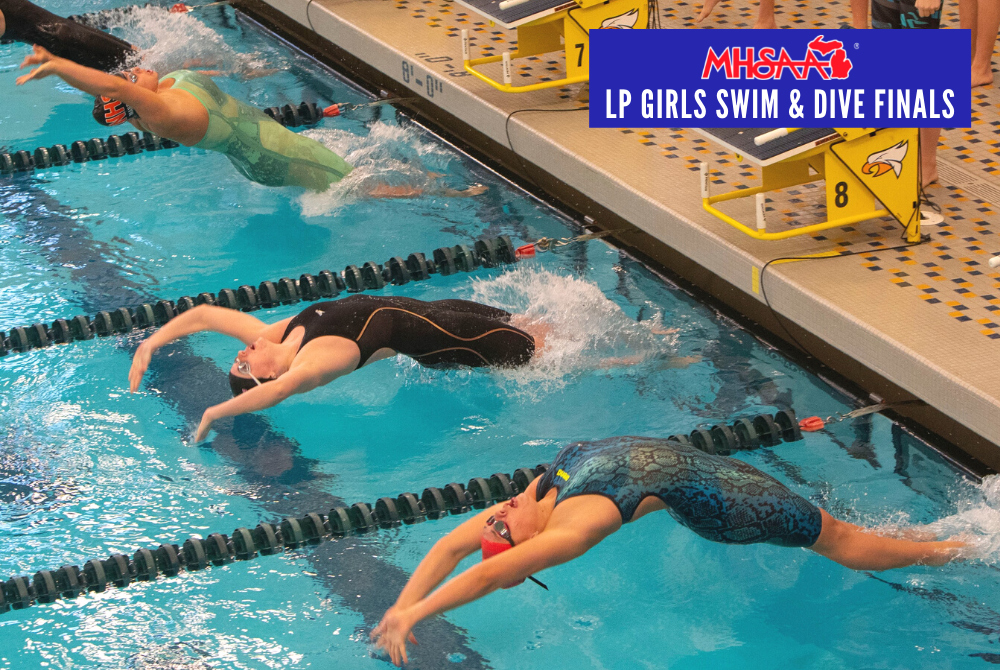
PHOTO: Contenders launch during last season's Lower Peninsula Division 1 Finals. (Click for more from High School Sports Scene.)