


New Math: Division & Multiplication Problems
July 25, 2017
By Jack Roberts
MHSAA Executive Director
This is the second part in a series on MHSAA tournament classification, past and present, that will be published over the next two weeks. This series originally ran in this spring's edition of MHSAA benchmarks.
High school tournament classifications went viral before there was social media and most of us knew what “viral” meant.
Much as a virus infects computers today or has created epidemics of disease around the world for centuries, high school tournament classification – once introduced – tends to spread uncontrollably. Once started, it tends to keep expanding and rarely contracts.
While we are still some distance from providing every team a trophy as a result of expanding high school tournament classification across the country, there is criticism nevertheless that we are headed in that direction – a philosophy which is supposed to exist only in local youth sports for our youngest children.
Michigan could be blamed for all this. Michigan is generally accepted as the first state to provide different classifications for season-ending tournaments for different sized schools. It started a century ago. Today, every state has various classifications for its tournaments in most if not all sports. And it is a bit ironic that Michigan – creator of the classification chaos – more than most other states has kept the number of tournament classes or divisions under control.
Yes, there is evidence that tournament classifications have expanded over the years in Michigan, especially with the relatively recent introduction of tournaments in football and the late 1990s’ move from classes to divisions in most MHSAA tournaments. But the MHSAA Representative Council has held true to its word when it expanded the playoffs for football from four classes to eight divisions: this is needed because of unique factors of football, factors that exist in no other sport; and all other sports should be capped at a maximum of four classes or divisions.
Kentucky is the preeminent defender of single-class basketball. All of its 276 high schools compete for the single state championship for each gender. In Indiana, there are still open wounds from its move in 1998 from one to four classes for its 400 schools in basketball.
Multi-class tournaments have tended to increase the number of non-public school champions, which some states are trying to lower through enrollment “multipliers,” and also tend to increase the number of repeat champions, which some states are trying to affect with “success factors” which lift smaller schools into classifications for larger schools if they take home too many trophies.
While there is considerable evidence that state tournaments do as much bad as good for educational athletics, state associations persist in providing postseason tournaments because, on balance, the experiences are supposed to be good for student-athletes. And once we reach that conclusion it is just a small leap to believe that if the tournaments are good for a few, they must be better for more – which leads to creating more and more tournament classifications. One becomes two classes, then three, then four and so forth.
While the argument is that more classifications or divisions provides more students with opportunities to compete and win, it is undeniable that the experience changes as the number of tournament classifications expands. It is not possible for state associations to provide the same level of support when tournament classifications expand to multiple venues playing simultaneously. For example, there is less audio and video broadcast potential at each venue, and less media coverage to each venue. Focus is diluted and fans diminished at each championship.
No one can argue reasonably that today's two-day MHSAA Football Finals of eight championship games has the same pizazz as the one-day, four-games event conducted prior to 1990.
In some states the number of divisions has grown so much that it is difficult to see much difference between the many season-ending state championship games and a regular-season event in the same sport.
It is a balancing act. And Michigan has been studying that balance longer than any other state, and charting a steadier course than most.
Addition by Division
The shift to Divisions for MHSAA Tournament play in numerous sports has added up to a greater number of champions for teams and individuals across the state. Following are the sports currently employing a divisional format, and the procedures for determining enrollment and classification.
In 23 statewide or Lower Peninsula tournaments, schools which sponsor the sport are currently divided into nearly equal divisions. They are:
- Baseball - 4 Divisions
- Boys Bowling - 4 Divisions
- Girls Bowling - 4 Divisions
- Girls Competitive Cheer - 4 Divisions
- LP Boys Cross Country - 4 Divisions
- LP Girls Cross Country - 4 Divisions
- LP Boys Golf - 4 Divisions
- LP Girls Golf - 4 Divisions
- Ice Hockey - 3 Divisions
- Boys Lacrosse - 2 Divisions
- Girls Lacrosse - 2 Divisions
- Boys Skiing - 2 Divisions
- Girls Skiing - 2 Divisions
- LP Boys Soccer - 4 Divisions LP
- Girls Soccer - 4 Divisions
- Girls Softball - 4 Divisions
- LP Boys Swimming & Diving - 3 Divisions
- LP Girls Swimming & Diving - 3 Divisions
- LP Boys Tennis - 4 Divisions
- LP Girls Tennis - 4 Divisions
- LP Boys Track & Field - 4 Divisions
- LP Girls Track & Field - 4 Divisions
- Wrestling - 4 Divisions
Lists of schools for each division of these 23 tournaments are posted on MHSAA.com approximately April 1. Listings of schools in Upper Peninsula tournaments for their sports are also posted on MHSAA.com. The lists are based on school memberships and sports sponsorships in effect or anticipated for the following school year, as known to the MHSAA office as of a date in early March.
In football, the 256 schools which qualify for MHSAA 11-player playoffs are placed in eight equal divisions annually on Selection Sunday. Beginning in 2017, the 8-player divisions will be determined in a like manner on Selection Sunday as well, with 32 qualifying schools placed in two divisions.
Schools have the option to play in any higher division in one or more sports for a minimum of two years.
The deadlines for "opt-ups" are as follows:
- Applications for fall sports must be submitted by April 15
- Applications for winter sports must be submitted by Aug. 15
- Applications for spring sports must be submitted by Oct. 15
Subsequent to the date of these postings for these tournaments, no school will have its division raised or lowered by schools opening or closing, schools adding or dropping sports, schools exercising the option to play in a higher division, or approval or dissolution of cooperative programs.
When the same sport is conducted for boys and girls in the same season (e.g., track & field and cross country), the gender that has the most sponsoring schools controls the division breaks for both genders.
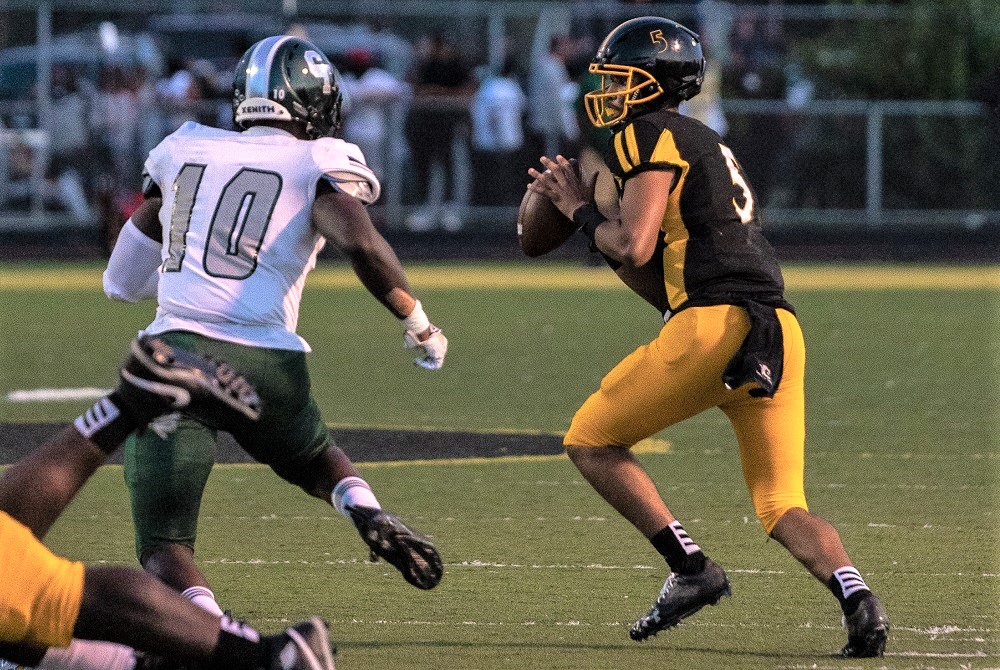
Moore Making Case as Best of Martin Luther King's QB Greats
By
Tom Markowski
Special for Second Half
October 7, 2021
It might come as no surprise to many, but we could be watching the best quarterback that's ever been a part of the rich football history at Detroit Martin Luther King.
 Let's begin with Darnell Dickerson, an `86 King graduate. Dickerson was the Detroit News' No. 1 Blue Chip prospect and went on to play at Pittsburgh. More recently there's Dequan Finn, who led King to the 2016 Division 2 title. Finn is currently the back-up quarterback at Toledo.
Now there's Dante Moore. Moore (6-foot-3, 200 pounds) is still a junior, so there's still much for him to accomplish, and for us to witness, at King.
As a freshman, Moore led the Crusaders to the Division 2 title game before they lost to Muskegon Mona Shores, 35-26. Last season, King lost to River Rouge, 33-30, in a Division 3 Regional Final. This season, King is 5-1 and one of the favorites to win the Division 3 title. Its only loss was Carmel High, 42-40. Carmel (6-1) is one of the top teams in Indiana.
Tyrone Spencer is in his sixth season as King's head coach and he realizes, with Moore, he has a special player.
“He's very poised, mature for his age,” Spencer said. “He's a class act on and off the field. He's got a great arm and great accuracy.”
Moore, 16, attended a number of camps throughout the country this past summer including many in the South including at Auburn, Clemson, Florida State and Georgia. At the Elite 11 camp in California, Moore was able to gauge how he measures up to a number of the top quarterbacks in the country, many of whom are a year older, and he more than held his own.
In only four games on the field (two wins came by forfeit), Moore has completed 67 of 95 pass attempts, for 1,280 yards and 17 touchdowns. He's received 27 scholarship offers including from Michigan and Michigan State.
Despite all of the hype Moore has received, he remains grounded. He's a quiet leader, but a leader nonetheless. As a sophomore he was elected captain, a rarity for any program but especially one as successful as King.
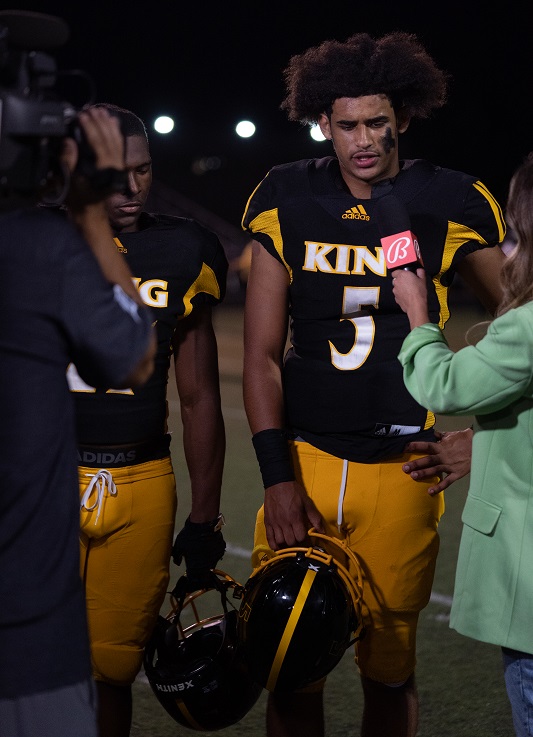 “I remember my first snap (as a freshman) against Detroit Catholic Central at Wayne State,” he said. “It was crazy. Now I'm a junior, and I'm just thankful being with my teammates at a school like King.”
Moore was King's starter from day one, and he remembers well that first game against DCC – a 24-22 defeat against the Shamrocks, who went on to share the Detroit Catholic League Central title.
“It was crazy, taking my first snap,” Moore said. “Now I'm a junior. It goes so fast.”
Life has its twists and turns, and Moore has had his share. Born in East Cleveland, Ohio, Moore and his family moved to Detroit when he was 5. His father grew up in the Detroit area and went to Southfield High, where he competed in basketball, football and track, and job opportunities brought Otha Moore and his family back to Detroit.
But before all that took place, Moore and his family had moved to Lorain, located just west of Cleveland, then they went to live with his grandmother on a farm in Lancaster, located just southeast of Columbus. Too young to be responsible for chores such as milking cows and such, Moore did get a taste of farm life and the early-to-bed, early-to-rise lifestyle.
In addition to football, Moore began playing soccer at an early age. From second grade through eighth Moore was on the pitch either as a goalkeeper or a striker. He credits that sport for improving his footwork. When asked if he'd play soccer if King sponsored the sport, Moore quickly replied yes and admits he misses the game. He does get a few opportunities to show those foot skills; Moore is King's punter and has handled the place-kicking duties at times.
There was a transitionary period, country life to the big city, but Moore said because he's the out-going type, it didn't take him long to make new friends. It was this type of personality that years later would lead to a relationship that would not only grow into a strong friendship, but one that would have a lasting effect on his development as a quarterback.
While working out at a Southfield health club, Moore recognized Devin Gardner – the former Inkster star and Michigan quarterback/receiver – going through his workout. Moore wasn't going miss out on this chance meeting. He introduced himself, and they almost instantly became friends. For the past three years or so, Gardner has worked with Moore, mostly during the offseason. But rarely does a week go by when the two don’t talk about football, school, you name it.
“We talk about anything,” Moore said. “We tell each other jokes. We go to fairs together. He gives me advice on how to be a better man in my life. He's making an impact. He gets me mentally prepared.”
Moore first acknowledges his father as the one who's had the greatest impact in his life – athletically, emotionally and socially. After that, it's his other family – the King coaching staff – who has played such an important part in his development.
First there's Spencer, then there's quarterback coach Jerrell Noland – a former King quarterback (2007 graduate) who played at Kentucky State – and Terel Patrick, King's offensive coordinator. Both Spencer and Patrick coached under one of the icons in Detroit's coaching history, James Reynolds, and Patrick like Noland also played for Reynolds.
“I lean on (Patrick's) shoulder,” Moore said. “He helps me break down film and be prepared. It's not all about football at King. It's family.”
As for college, Moore has placed those decisions on hold until after the season.
“I'm just thankful I have the opportunity to play at a school like King,” he said. “I'm concentrating on the season and winning a state title. At the end of the season, I'll narrow down my choices.”
 Tom Markowski primarily covered high school sports for the The Detroit News from 1984-2014, focusing on the Detroit area and contributing to statewide coverage of football and basketball. He also is a former correspondent and web content director for State Champs! Sports Network. Contact him at [email protected] with story ideas for Oakland, Macomb and Wayne counties.
PHOTOS (Top) King quarterback Dante Moore (5) avoids the pressure during a 41-34 Week 3 win over Detroit Cass Tech. (Middle) Moore interviews after the game with Bally Sports Detroit. (Photos by Quintin Love Jr.)