


New Math: Division & Multiplication Problems
July 25, 2017
By Jack Roberts
MHSAA Executive Director
This is the second part in a series on MHSAA tournament classification, past and present, that will be published over the next two weeks. This series originally ran in this spring's edition of MHSAA benchmarks.
High school tournament classifications went viral before there was social media and most of us knew what “viral” meant.
Much as a virus infects computers today or has created epidemics of disease around the world for centuries, high school tournament classification – once introduced – tends to spread uncontrollably. Once started, it tends to keep expanding and rarely contracts.
While we are still some distance from providing every team a trophy as a result of expanding high school tournament classification across the country, there is criticism nevertheless that we are headed in that direction – a philosophy which is supposed to exist only in local youth sports for our youngest children.
Michigan could be blamed for all this. Michigan is generally accepted as the first state to provide different classifications for season-ending tournaments for different sized schools. It started a century ago. Today, every state has various classifications for its tournaments in most if not all sports. And it is a bit ironic that Michigan – creator of the classification chaos – more than most other states has kept the number of tournament classes or divisions under control.
Yes, there is evidence that tournament classifications have expanded over the years in Michigan, especially with the relatively recent introduction of tournaments in football and the late 1990s’ move from classes to divisions in most MHSAA tournaments. But the MHSAA Representative Council has held true to its word when it expanded the playoffs for football from four classes to eight divisions: this is needed because of unique factors of football, factors that exist in no other sport; and all other sports should be capped at a maximum of four classes or divisions.
Kentucky is the preeminent defender of single-class basketball. All of its 276 high schools compete for the single state championship for each gender. In Indiana, there are still open wounds from its move in 1998 from one to four classes for its 400 schools in basketball.
Multi-class tournaments have tended to increase the number of non-public school champions, which some states are trying to lower through enrollment “multipliers,” and also tend to increase the number of repeat champions, which some states are trying to affect with “success factors” which lift smaller schools into classifications for larger schools if they take home too many trophies.
While there is considerable evidence that state tournaments do as much bad as good for educational athletics, state associations persist in providing postseason tournaments because, on balance, the experiences are supposed to be good for student-athletes. And once we reach that conclusion it is just a small leap to believe that if the tournaments are good for a few, they must be better for more – which leads to creating more and more tournament classifications. One becomes two classes, then three, then four and so forth.
While the argument is that more classifications or divisions provides more students with opportunities to compete and win, it is undeniable that the experience changes as the number of tournament classifications expands. It is not possible for state associations to provide the same level of support when tournament classifications expand to multiple venues playing simultaneously. For example, there is less audio and video broadcast potential at each venue, and less media coverage to each venue. Focus is diluted and fans diminished at each championship.
No one can argue reasonably that today's two-day MHSAA Football Finals of eight championship games has the same pizazz as the one-day, four-games event conducted prior to 1990.
In some states the number of divisions has grown so much that it is difficult to see much difference between the many season-ending state championship games and a regular-season event in the same sport.
It is a balancing act. And Michigan has been studying that balance longer than any other state, and charting a steadier course than most.
Addition by Division
The shift to Divisions for MHSAA Tournament play in numerous sports has added up to a greater number of champions for teams and individuals across the state. Following are the sports currently employing a divisional format, and the procedures for determining enrollment and classification.
In 23 statewide or Lower Peninsula tournaments, schools which sponsor the sport are currently divided into nearly equal divisions. They are:
- Baseball - 4 Divisions
- Boys Bowling - 4 Divisions
- Girls Bowling - 4 Divisions
- Girls Competitive Cheer - 4 Divisions
- LP Boys Cross Country - 4 Divisions
- LP Girls Cross Country - 4 Divisions
- LP Boys Golf - 4 Divisions
- LP Girls Golf - 4 Divisions
- Ice Hockey - 3 Divisions
- Boys Lacrosse - 2 Divisions
- Girls Lacrosse - 2 Divisions
- Boys Skiing - 2 Divisions
- Girls Skiing - 2 Divisions
- LP Boys Soccer - 4 Divisions LP
- Girls Soccer - 4 Divisions
- Girls Softball - 4 Divisions
- LP Boys Swimming & Diving - 3 Divisions
- LP Girls Swimming & Diving - 3 Divisions
- LP Boys Tennis - 4 Divisions
- LP Girls Tennis - 4 Divisions
- LP Boys Track & Field - 4 Divisions
- LP Girls Track & Field - 4 Divisions
- Wrestling - 4 Divisions
Lists of schools for each division of these 23 tournaments are posted on MHSAA.com approximately April 1. Listings of schools in Upper Peninsula tournaments for their sports are also posted on MHSAA.com. The lists are based on school memberships and sports sponsorships in effect or anticipated for the following school year, as known to the MHSAA office as of a date in early March.
In football, the 256 schools which qualify for MHSAA 11-player playoffs are placed in eight equal divisions annually on Selection Sunday. Beginning in 2017, the 8-player divisions will be determined in a like manner on Selection Sunday as well, with 32 qualifying schools placed in two divisions.
Schools have the option to play in any higher division in one or more sports for a minimum of two years.
The deadlines for "opt-ups" are as follows:
- Applications for fall sports must be submitted by April 15
- Applications for winter sports must be submitted by Aug. 15
- Applications for spring sports must be submitted by Oct. 15
Subsequent to the date of these postings for these tournaments, no school will have its division raised or lowered by schools opening or closing, schools adding or dropping sports, schools exercising the option to play in a higher division, or approval or dissolution of cooperative programs.
When the same sport is conducted for boys and girls in the same season (e.g., track & field and cross country), the gender that has the most sponsoring schools controls the division breaks for both genders.
After Slight Delay, Veteran Spring Lake Impresses in Long-Awaited Launch
By
Tom Kendra
Special for MHSAA.com
September 9, 2021
Spring Lake returned 17 starters and, understandably, couldn’t wait to get this season started.
 But just as the Lakers were revving up their engine for takeoff, they were idled for another week.
Spring Lake picked up a forfeit victory in Week 1 after Muskegon Orchard View decided to not field a varsity team this fall, so the Lakers put in another week of practice and then unleashed all of their pent-up energy on Zeeland East last Thursday.
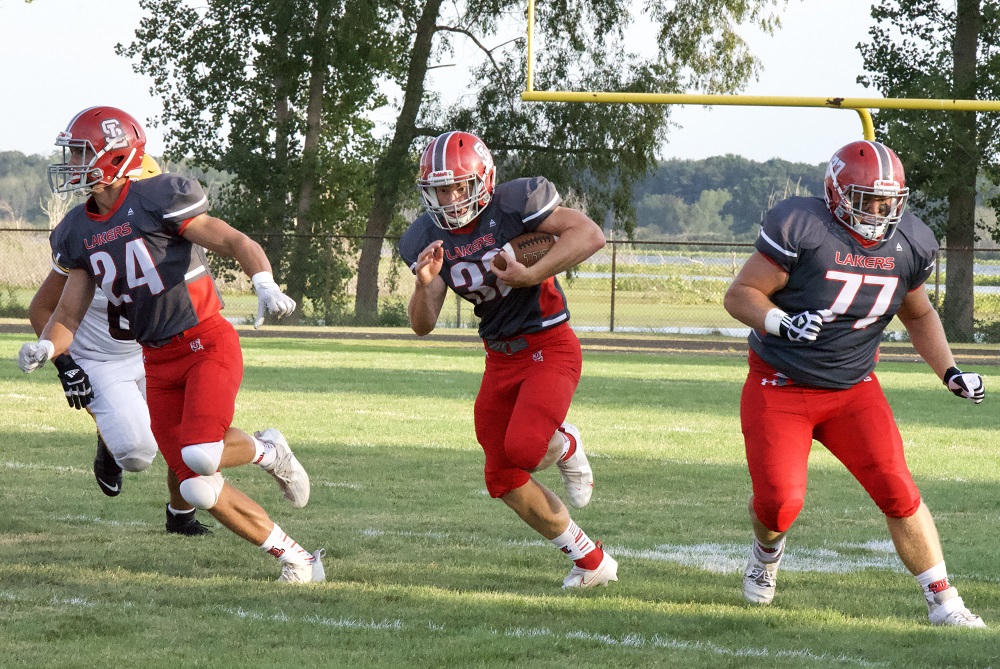
Christian Folkert rushed 11 times for 211 yards and four touchdowns as Spring Lake sprinted to a 42-0 halftime lead and then cruised to a convincing 56-21 nonleague victory.
“We were so excited and pumped,” said Folkert, a 5-foot-11, 195-pound senior. “We wanted to go out there and send a message and show everyone what we have this year.”
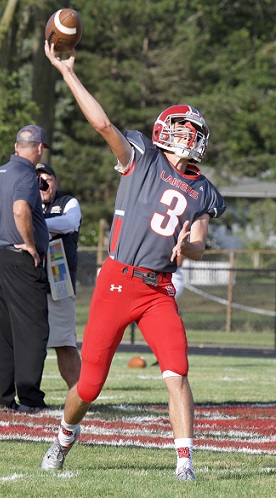
After the Lakers’ front line and Folkert established itself in the first quarter, senior quarterback Jackson Core (6-1, 170) did his thing in the second quarter, connecting on touchdown passes to senior Joe Westhoff and junior Derrick Paggeot.
Core finished 6-of-7 passing for 90 yards, and Paggeot had four catches for 71 yards. SL piled up 401 total rushing yards, with eight ball carriers.
The final score was a surprise to many throughout West Michigan, considering Zeeland East plays in the larger Ottawa-Kent Conference Green and has qualified for the playoffs 10 straight seasons. About the only people not surprised were Spring Lake’s 19 seniors, who are used to winning – and winning big.
 The Lakers’ senior class went undefeated in seventh grade, lost one game in eighth grade (to Hudsonville Unity Christian), then went unbeaten as freshmen and sophomores – despite having five of the best players from the class playing on the varsity as sophomores. Those five who were called up in 2019 were Folkert, twin brothers and linemen Travis and Hunter Throop, RJ Lisman (C/LB) and Ty French (H-back/DE).
“Our senior class is used to winning, and that gives us confidence,” explained Core, whose father, Bill, is Spring Lake’s longtime basketball and softball coach. “It’s not just a couple of us seniors, we have a lot guys who can play and push each other. I guess that’s why we’re so excited for this season.”
Spring Lake broke through last season and beat Fremont (48-0) in a Division 4 District opener, snapping a 12-game playoff losing streak dating back to 2001, before falling to Ada Forest Hills Eastern (28-21) in the District Semifinal.
The bulk of that 5-3 team is back, led by Folkert, who combines size and speed – and now another intangible, according to sixth-year Lakers coach Dan Start.
“In the past, Christian was more of a battering ram who ran people over,” explained Start, a former player at Grandville, who coached football in Florida before taking the Spring Lake job in 2016. “He can still do that, for sure, but he’s learned how to make them miss, too. His change of direction and vision is much-improved.”
Folkert is also a leader of the Lakers’ 4-2-5 defensive look from his defensive end position. With Folkert and French setting the edge at the two defensive end spots and the Throop brothers plugging up the middle, Zeeland East was unable to run the ball.
Spring Lake begins league play in the rugged O-K Blue this week at Holland Christian. The real test comes over the final four weeks of the conference season at home against Hudsonville Unity Christian and Coopersville, at Grand Rapids West Catholic and at home against Allendale – all of whom are 2-0 thus far.
“We’ve only won one game, so we obviously have a long way to go,” said Folkert, who also gave a shout out to his school’s student section, which was loud and raucous for the Zeeland East game, clad in matching black shirts. “You never know what is going to happen. We have a lot of good players, but we have to go out there and ball and get it done. I mean, everyone said we were going to lose to Zeeland East and that didn’t happen.”
 Spring Lake has had two undefeated teams during the playoff era, in 1980 and 1982, but neither qualified for the playoffs – which at that time included just 32 teams in the entire state, broken into four classes. The 1982 team was a particularly hard-luck story, posting eight shutouts in nine games and outscoring its opponents by a combined score of 266-6.
The Lakers’ best playoff run came in 2000, when they made it all the way to the Division 5 championship game at the Pontiac Silverdome, losing to Jackson Lumen Christi, 42-15.
Spring Lake reached the second round the following year, but before last fall, the Lakers went “one and done” in the playoffs 11 straight times.
After snapping that skid, this year’s senior-laden Lakers squad is focused on making a long playoff run.
Spring Lake is the largest school in Division 4 with 825 students, which means many of its conference opponents could become early-round playoff foes as well.
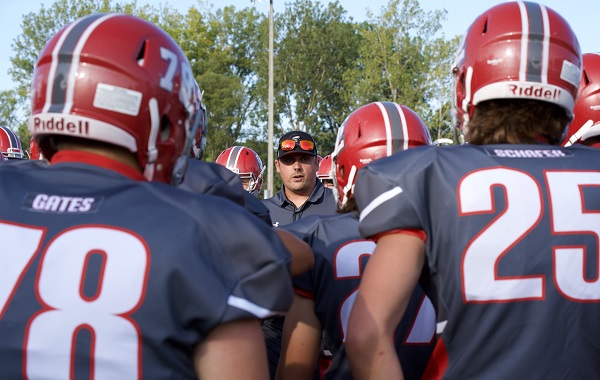
“First off, we do play in a very difficult conference,” said Start, whose assistants include offensive coordinator Kyle Jewett and defensive coordinator Aaron West. “So we feel like if we can do well in our conference, then we can do well in the playoffs.
“But honestly, that is so far away. Our goal right now is to get one percent better every day. If we actually do that, the results will take care of themselves.”
 Tom Kendra worked 23 years at The Muskegon Chronicle, including five as assistant sports editor and the final six as sports editor through 2011. E-mail him at [email protected] with story ideas for Muskegon, Oceana, Mason, Lake, Oceola, Mecosta and Newaygo counties.
PHOTOS: (Top) Spring Lake senior running back Christian Folkert breaks through a huge hole on a 57-yard touchdown run in the first quarter of the Lakers' 56-21 win over visiting Zeeland East on Sept. 3. Joe Westhoff (24) and Hunter Throop (77) provide additional blocking for Folkert, who finished with 11 carries for 211 yards and four touchdowns. (Middle) Spring Lake senior quarterback Jackson Core launches a pass during his team's win over Zeeland East. He completed 6-of-7 passes for 90 yards and two touchdowns. (Below) Spring Lake coach Dan Start, now in his sixth season, addresses his team before the start of last Thursday’s game. (Photos by Kelly Gates.)