

New Math: Division & Multiplication Problems
July 25, 2017
By Jack Roberts
MHSAA Executive Director
This is the second part in a series on MHSAA tournament classification, past and present, that will be published over the next two weeks. This series originally ran in this spring's edition of MHSAA benchmarks.
High school tournament classifications went viral before there was social media and most of us knew what “viral” meant.
Much as a virus infects computers today or has created epidemics of disease around the world for centuries, high school tournament classification – once introduced – tends to spread uncontrollably. Once started, it tends to keep expanding and rarely contracts.
While we are still some distance from providing every team a trophy as a result of expanding high school tournament classification across the country, there is criticism nevertheless that we are headed in that direction – a philosophy which is supposed to exist only in local youth sports for our youngest children.
Michigan could be blamed for all this. Michigan is generally accepted as the first state to provide different classifications for season-ending tournaments for different sized schools. It started a century ago. Today, every state has various classifications for its tournaments in most if not all sports. And it is a bit ironic that Michigan – creator of the classification chaos – more than most other states has kept the number of tournament classes or divisions under control.
Yes, there is evidence that tournament classifications have expanded over the years in Michigan, especially with the relatively recent introduction of tournaments in football and the late 1990s’ move from classes to divisions in most MHSAA tournaments. But the MHSAA Representative Council has held true to its word when it expanded the playoffs for football from four classes to eight divisions: this is needed because of unique factors of football, factors that exist in no other sport; and all other sports should be capped at a maximum of four classes or divisions.
Kentucky is the preeminent defender of single-class basketball. All of its 276 high schools compete for the single state championship for each gender. In Indiana, there are still open wounds from its move in 1998 from one to four classes for its 400 schools in basketball.
Multi-class tournaments have tended to increase the number of non-public school champions, which some states are trying to lower through enrollment “multipliers,” and also tend to increase the number of repeat champions, which some states are trying to affect with “success factors” which lift smaller schools into classifications for larger schools if they take home too many trophies.
While there is considerable evidence that state tournaments do as much bad as good for educational athletics, state associations persist in providing postseason tournaments because, on balance, the experiences are supposed to be good for student-athletes. And once we reach that conclusion it is just a small leap to believe that if the tournaments are good for a few, they must be better for more – which leads to creating more and more tournament classifications. One becomes two classes, then three, then four and so forth.
While the argument is that more classifications or divisions provides more students with opportunities to compete and win, it is undeniable that the experience changes as the number of tournament classifications expands. It is not possible for state associations to provide the same level of support when tournament classifications expand to multiple venues playing simultaneously. For example, there is less audio and video broadcast potential at each venue, and less media coverage to each venue. Focus is diluted and fans diminished at each championship.
No one can argue reasonably that today's two-day MHSAA Football Finals of eight championship games has the same pizazz as the one-day, four-games event conducted prior to 1990.
In some states the number of divisions has grown so much that it is difficult to see much difference between the many season-ending state championship games and a regular-season event in the same sport.
It is a balancing act. And Michigan has been studying that balance longer than any other state, and charting a steadier course than most.
Addition by Division
The shift to Divisions for MHSAA Tournament play in numerous sports has added up to a greater number of champions for teams and individuals across the state. Following are the sports currently employing a divisional format, and the procedures for determining enrollment and classification.
In 23 statewide or Lower Peninsula tournaments, schools which sponsor the sport are currently divided into nearly equal divisions. They are:
- Baseball - 4 Divisions
- Boys Bowling - 4 Divisions
- Girls Bowling - 4 Divisions
- Girls Competitive Cheer - 4 Divisions
- LP Boys Cross Country - 4 Divisions
- LP Girls Cross Country - 4 Divisions
- LP Boys Golf - 4 Divisions
- LP Girls Golf - 4 Divisions
- Ice Hockey - 3 Divisions
- Boys Lacrosse - 2 Divisions
- Girls Lacrosse - 2 Divisions
- Boys Skiing - 2 Divisions
- Girls Skiing - 2 Divisions
- LP Boys Soccer - 4 Divisions LP
- Girls Soccer - 4 Divisions
- Girls Softball - 4 Divisions
- LP Boys Swimming & Diving - 3 Divisions
- LP Girls Swimming & Diving - 3 Divisions
- LP Boys Tennis - 4 Divisions
- LP Girls Tennis - 4 Divisions
- LP Boys Track & Field - 4 Divisions
- LP Girls Track & Field - 4 Divisions
- Wrestling - 4 Divisions
Lists of schools for each division of these 23 tournaments are posted on MHSAA.com approximately April 1. Listings of schools in Upper Peninsula tournaments for their sports are also posted on MHSAA.com. The lists are based on school memberships and sports sponsorships in effect or anticipated for the following school year, as known to the MHSAA office as of a date in early March.
In football, the 256 schools which qualify for MHSAA 11-player playoffs are placed in eight equal divisions annually on Selection Sunday. Beginning in 2017, the 8-player divisions will be determined in a like manner on Selection Sunday as well, with 32 qualifying schools placed in two divisions.
Schools have the option to play in any higher division in one or more sports for a minimum of two years.
The deadlines for "opt-ups" are as follows:
- Applications for fall sports must be submitted by April 15
- Applications for winter sports must be submitted by Aug. 15
- Applications for spring sports must be submitted by Oct. 15
Subsequent to the date of these postings for these tournaments, no school will have its division raised or lowered by schools opening or closing, schools adding or dropping sports, schools exercising the option to play in a higher division, or approval or dissolution of cooperative programs.
When the same sport is conducted for boys and girls in the same season (e.g., track & field and cross country), the gender that has the most sponsoring schools controls the division breaks for both genders.
St. Phil's Winning Ways Lead to Summer Celebration, Fall Anticipation
By
Pam Shebest
Special for MHSAA.com
August 24, 2021
BATTLE CREEK — Last season’s Division 4 championship gave Battle Creek St. Philip 11 over coach Vicky Groat’s 22 seasons leading the program.
 But those stats are a bit off. They do not include the three Class D titles she won as a player at St. Phil, giving her 14 overall.
“We won three state titles with Mom in ’83, ’84, ’85 and were in the final four in ’82,” Groat said.
“Mom” is Sheila Guerra, who led the Tigers to nine Finals championships while guiding the program from 1982-1997. Together, the mother-daughter duo has accounted for 20 of the school’s MHSAA-record 21 state volleyball titles. (The first was under coach Becky Emrich in 1979.) Those 21 championships, in fact, are more than twice as many as any other volleyball program in the state, and the Tigers’ 30 MHSAA Finals appearances are 17 more than the next best achiever.
That incredible success was recognized in July when Groat was named the National High School Athletic Coaches Association’s Volleyball Coach of the Year.
Guerra died in May 2006. But Mom was very much on Groat’s mind as she received her award. While accolades, awards and championships continue to pile up, Groat said her mother is the foundation for it all.
“Mom always encouraged me, and there are still things I do today that she did,” Groat said. “It may be old school, but it still works.”
And the Tigers will have another strong chance this fall to show how.
Plenty to celebrate
Groat did not tell her players that she was a finalist for the award but they found out anyway, said senior standout Brooke Dzwik, an all-state first-team outside hitter last season.
“(The players) went on this camping trip up to Leland and stayed in Coach (Laurie) Glass’ backyard,” Dzwik said. “We were also with Notre Dame Prep and Bronson. Four winning coaches.”
 Dzwik said Bronson coach Jean LaClair spilled the beans, telling the players the news.
“(The other coaches) were teasing (Groat) about having a speech prepared and she was like ‘No way,’” Dzwik said.
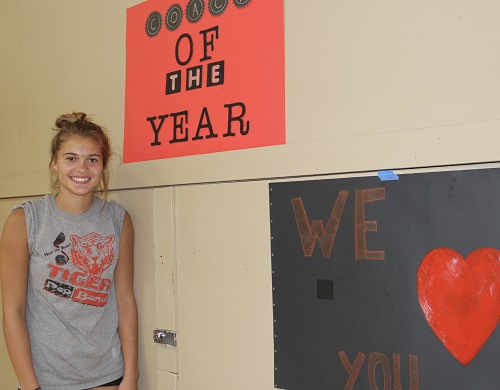
Groat texted her players a picture of herself with the trophy, and during the first day of tryouts in August, the girls welcomed the coach with a few signs, a balloon, a card and Mountain Dew, “her favorite,” Dzwik said.
“We were just overjoyed because no one deserves it more than her.
“She walked in (to the gym) and I think she was pretty happy, but she doesn’t like the attention on her so she will never admit it.”
After her mom retired after the 1996-97 season, Groat took over, stepped away for 1999-2000 but then returned to direct the Tigers again for the last two decades.
No one, including Groat, expected her team to win the Division 4 title after starting last season with a 23-13 record, just nine athletes on the team and no junior varsity to draw from in case of injury.
“I begged (current senior) Alex Kersten to come out — she’s a cross country runner — and she did,” Groat said.
After a two-month delay because of the pandemic a year ago, practice was held outside at Battle Creek’s Bailey Park.
“We started off in the sand, and we were grateful that we were even allowed to get together and see everyone’s faces for the first time,” Dzwik said.
“It was awful at first, but (playing in sand) definitely made our legs stronger by the end of the season, and we were thankful for it.”
This year, expectations are much higher.
The Tigers lost just one player, Harleen Deol, to graduation and return five seniors also including Rachel Myers, Alexis Snyder and Bailey Fancher. Fancher made the all-state third team last season at libero.
“I feel more pressure now,” Dzwik said. “We didn’t have an amazing record last year and then pulled out a win.
“This year, we do have a (championship) win, so we placed a target on our backs.”
This season already includes a “first” for St. Phil.
“For the first time in St. Phil history, we have an eighth grader, Charli Greger (on varsity),” Groat said. “We were under 100 students last year, so we could have eighth graders play this year.
“Right now, we’re at 100 (students) so next year we won’t be able to have eighth graders.”
Other players are juniors Maddie Hoelscher and Kate Doyle and sophomores Rylee Altman and Makenzee Grimm.
Groat also has a junior varsity team for the first time in two years – a really good thing, she said.
“Take out the five seniors next year and I’m left with four players if I don’t have a JV team,” she said. “We brought eighth graders up to the JV team with four freshmen.
“Never thought we’d have to do that, but we want a program. I couldn’t imagine not having a St. Phil volleyball team. That would be a sad day.”
Family tradition
While a student at St. Phil, Groat was coached by her mother in volleyball and track. In addition, Groat’s father Lou coached basketball at the school.
Her parents as her coaches was not always an easy combination for a young teen.
“It’s always the coach’s kid who gets the brunt of it.” Groat said. “I still remember one of my friends and I were fighting during volleyball and my mom was blaming me. I was like, what about her?
“In track if she had no one to run something, ‘Vicky, you’re going to do it.’ But it was fun.”
 Groat, who is also principal and athletic director at the school, credits her parents for not only her coaching success, but her life skills.
“I learned from the best.” she said. “I try to carry both their philosophies in the way they treated people.
“My mom was tough on kids, but if anybody needed anything, she was the first one there. She pushed hard and had high expectations, but she really was a softie inside. People still don’t believe me on that.”
Groat relies on one other person who is like family: assistant coach Angela Williams Frost.
“We call her Willi,” Groat said. “She’s been a great assistant for 18 years. She was a head coach at Springport and could be a head coach anywhere in the state.
“She’s very talented and smart. It makes my job easier knowing that Willi is there. I’ll be in practice and someone will come to the door for me and Willi is there to take over.”
July’s recognition was a total surprise, Groat said, deflecting any accolades. But it also can be regarded as deserved praise for her work teaching an abundance of lessons she learned herself as part of the volleyball program and the Guerra coaching tree.
“It’s just so much about my kids, the kids who have been here and who have played in our system,” she said. “It’s not a big school; we have our traditions, and they buy into it. It’s been great.
“Hopefully over the years we, as coaches, have taught them the important things in life, the life lessons that they will carry on. Sports are an important part of it, but there are other things involved.”
 Pam Shebest served as a sportswriter at the Kalamazoo Gazette from 1985-2009 after 11 years part-time with the Gazette while teaching French and English at White Pigeon High School. She can be reached at [email protected] with story ideas for Calhoun, Kalamazoo and Van Buren counties.
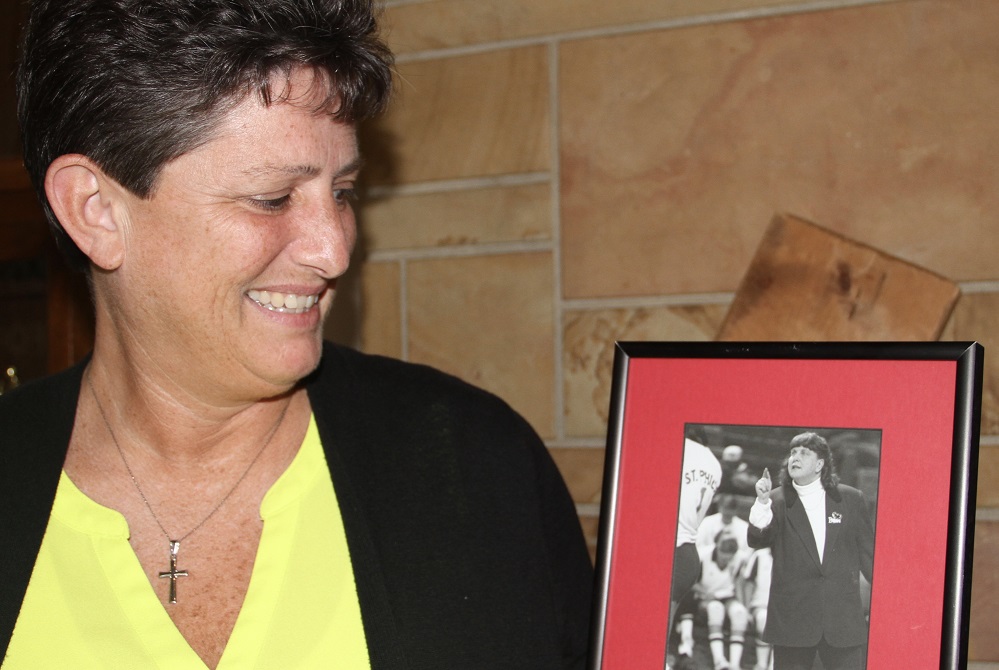
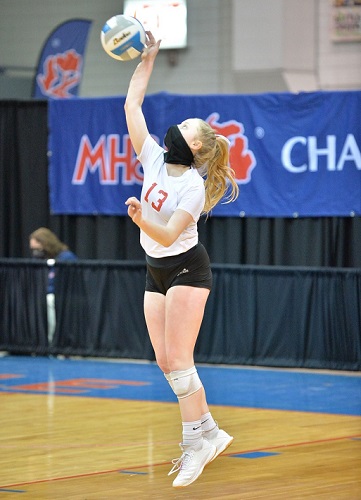
PHOTOS: (Top) Battle Creek St. Philip coach Vicky Groat holds up a picture of her mother, Sheila Guerra, with whom she’s combined to lead the Tigers to 20 of their 21 MHSAA Finals volleyball championships. (Middle) Senior Brooke Dzwik shows some of the signs she and teammates made to celebrate Groat’s national Coach of the Year recognition. (Below) Then-junior Bailey Fancher serves during last season’s Division 4 title match. (Top and middle photos by Pam Shebest.)