

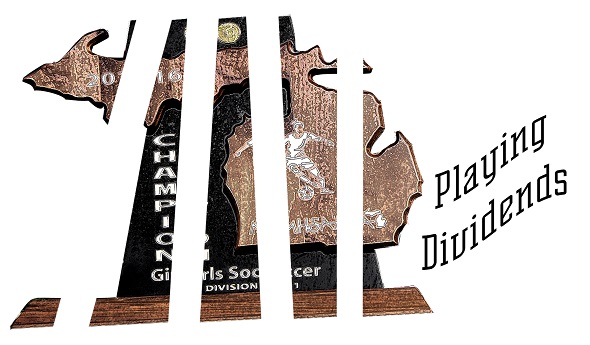
New Math: Division & Multiplication Problems
July 25, 2017
By Jack Roberts
MHSAA Executive Director
This is the second part in a series on MHSAA tournament classification, past and present, that will be published over the next two weeks. This series originally ran in this spring's edition of MHSAA benchmarks.
High school tournament classifications went viral before there was social media and most of us knew what “viral” meant.
Much as a virus infects computers today or has created epidemics of disease around the world for centuries, high school tournament classification – once introduced – tends to spread uncontrollably. Once started, it tends to keep expanding and rarely contracts.
While we are still some distance from providing every team a trophy as a result of expanding high school tournament classification across the country, there is criticism nevertheless that we are headed in that direction – a philosophy which is supposed to exist only in local youth sports for our youngest children.
Michigan could be blamed for all this. Michigan is generally accepted as the first state to provide different classifications for season-ending tournaments for different sized schools. It started a century ago. Today, every state has various classifications for its tournaments in most if not all sports. And it is a bit ironic that Michigan – creator of the classification chaos – more than most other states has kept the number of tournament classes or divisions under control.
Yes, there is evidence that tournament classifications have expanded over the years in Michigan, especially with the relatively recent introduction of tournaments in football and the late 1990s’ move from classes to divisions in most MHSAA tournaments. But the MHSAA Representative Council has held true to its word when it expanded the playoffs for football from four classes to eight divisions: this is needed because of unique factors of football, factors that exist in no other sport; and all other sports should be capped at a maximum of four classes or divisions.
Kentucky is the preeminent defender of single-class basketball. All of its 276 high schools compete for the single state championship for each gender. In Indiana, there are still open wounds from its move in 1998 from one to four classes for its 400 schools in basketball.
Multi-class tournaments have tended to increase the number of non-public school champions, which some states are trying to lower through enrollment “multipliers,” and also tend to increase the number of repeat champions, which some states are trying to affect with “success factors” which lift smaller schools into classifications for larger schools if they take home too many trophies.
While there is considerable evidence that state tournaments do as much bad as good for educational athletics, state associations persist in providing postseason tournaments because, on balance, the experiences are supposed to be good for student-athletes. And once we reach that conclusion it is just a small leap to believe that if the tournaments are good for a few, they must be better for more – which leads to creating more and more tournament classifications. One becomes two classes, then three, then four and so forth.
While the argument is that more classifications or divisions provides more students with opportunities to compete and win, it is undeniable that the experience changes as the number of tournament classifications expands. It is not possible for state associations to provide the same level of support when tournament classifications expand to multiple venues playing simultaneously. For example, there is less audio and video broadcast potential at each venue, and less media coverage to each venue. Focus is diluted and fans diminished at each championship.
No one can argue reasonably that today's two-day MHSAA Football Finals of eight championship games has the same pizazz as the one-day, four-games event conducted prior to 1990.
In some states the number of divisions has grown so much that it is difficult to see much difference between the many season-ending state championship games and a regular-season event in the same sport.
It is a balancing act. And Michigan has been studying that balance longer than any other state, and charting a steadier course than most.
Addition by Division
The shift to Divisions for MHSAA Tournament play in numerous sports has added up to a greater number of champions for teams and individuals across the state. Following are the sports currently employing a divisional format, and the procedures for determining enrollment and classification.
In 23 statewide or Lower Peninsula tournaments, schools which sponsor the sport are currently divided into nearly equal divisions. They are:
- Baseball - 4 Divisions
- Boys Bowling - 4 Divisions
- Girls Bowling - 4 Divisions
- Girls Competitive Cheer - 4 Divisions
- LP Boys Cross Country - 4 Divisions
- LP Girls Cross Country - 4 Divisions
- LP Boys Golf - 4 Divisions
- LP Girls Golf - 4 Divisions
- Ice Hockey - 3 Divisions
- Boys Lacrosse - 2 Divisions
- Girls Lacrosse - 2 Divisions
- Boys Skiing - 2 Divisions
- Girls Skiing - 2 Divisions
- LP Boys Soccer - 4 Divisions LP
- Girls Soccer - 4 Divisions
- Girls Softball - 4 Divisions
- LP Boys Swimming & Diving - 3 Divisions
- LP Girls Swimming & Diving - 3 Divisions
- LP Boys Tennis - 4 Divisions
- LP Girls Tennis - 4 Divisions
- LP Boys Track & Field - 4 Divisions
- LP Girls Track & Field - 4 Divisions
- Wrestling - 4 Divisions
Lists of schools for each division of these 23 tournaments are posted on MHSAA.com approximately April 1. Listings of schools in Upper Peninsula tournaments for their sports are also posted on MHSAA.com. The lists are based on school memberships and sports sponsorships in effect or anticipated for the following school year, as known to the MHSAA office as of a date in early March.
In football, the 256 schools which qualify for MHSAA 11-player playoffs are placed in eight equal divisions annually on Selection Sunday. Beginning in 2017, the 8-player divisions will be determined in a like manner on Selection Sunday as well, with 32 qualifying schools placed in two divisions.
Schools have the option to play in any higher division in one or more sports for a minimum of two years.
The deadlines for "opt-ups" are as follows:
- Applications for fall sports must be submitted by April 15
- Applications for winter sports must be submitted by Aug. 15
- Applications for spring sports must be submitted by Oct. 15
Subsequent to the date of these postings for these tournaments, no school will have its division raised or lowered by schools opening or closing, schools adding or dropping sports, schools exercising the option to play in a higher division, or approval or dissolution of cooperative programs.
When the same sport is conducted for boys and girls in the same season (e.g., track & field and cross country), the gender that has the most sponsoring schools controls the division breaks for both genders.

Four-Time Finals Placer Piot Earns Ultimate Amateur Championship
By
Tom Lang
Special for MHSAA.com
August 23, 2021
James Piot was a high school all-state Super Team member all four years he played golf at Detroit Catholic Central.
Piot – who has since moved on to play at Michigan State – was never an MHSAA Finals individual champion. But recently he achieved something much bigger, winning the ultimate individual crown for amateurs – the 121st U.S. Amateur Championship.
His championship run concluded Sunday, Aug. 15 at the iconic Oakmont Country Club with a 2 and 1 match play victory over Austin Greaser of Ohio and the University of North Carolina.
Piot led the Shamrocks to a Lower Peninsula Division 1 runner-up team finish in 2014 as a freshman, followed by three consecutive championships creating arguably the best era of high school golf for any one program in Michigan history.
According to his former assistant coach – Jimmy Dewling, now the boys golf head coach at Brighton – team titles suited Piot just fine.
“I think his team winning meant just as much to him than any individual title,” Dewling said. “Truly he’s one of those types of guys.”
Piot’s senior year in 2017, Catholic Central had three players on the all-state Super Team: Piot, Ben Smith (Georgia Tech) and Sean Niles (MHSAA individual champ), while teammates Dyllan Skinner and Sean Sooch were first team all-state.
Now on the national stage, Piot defeated Greaser of Ohio, 2-and-1, by sinking a 20-foot par putt on the 17th hole of the day’s second round in the scheduled 36-hole national final.
“It's the greatest feeling in the world,” Piot said to the national media on site. “I mean, as an amateur it's the best thing you can do. It was making that putt on 17 was just like, ‘Oh, my God. I might've done it.’”
By winning the elite amateur tournament, Piot is to receive presumably automatic exemptions into three professional majors next year: The Masters, the U.S. Open and the British Open. That alone is a career-defining bucket list for anyone in golf – and he’s still a college student.
Piot was playing in the U.S. Amateur for the second straight year. In 2020 at Bandon Dunes (in Oregon), he was second in stroke play to enter the match play portion the No. 2 seed. He won his first match but then was bumped out in the round of 32.
 This year he finished his unfinished business by cruising through the match play, winning three of his six rounds with identical scores of 4-and-3. In the final, Piot was 1-up after the morning round of 18 holes. But after a lunch break and change of shirts from a dark color to a white one with a green Sparty golfer logo, there was a 4-hole swing where Piot found himself down three after 27 holes.
“I told myself on that tee box (on 10), I said, ‘I'm going to play this (last) nine 4-under.’ That's what I put in my head. Just self-belief.”
The tables turned hard at that point when Piot won four consecutive holes (10-13), and five of six, to go 2-up with three holes remaining, eventually grabbing the win 2-and-1.
Standing at that 10th tee, Piot was down three holes and TV commentator ‘Bones’ MacKay said it would be very difficult for Piot to get back into the match.
“I gave him the nickname when he was 9-years-old of ‘Spunkdog,’ because he’s got so much fight,” said Brian Cairns, his long-time teacher at Fox Hills Learning Center in Plymouth. “He’s in a corner by himself, he’ll come out every time by himself. He’s got spunk. You saw how he walked; you saw how mellow he was. You saw his shoulders go up on the back nine. He made the swings when he needed to make them.”
Dewling provided a similar but different angle on Piot.
“He took pride that he’s a public course guy and put that chip on his shoulder to beat people,” Dewling said about the high school years. “He’d watch other people practice and play and he believed he was doing things different and better than they were.
“I’ve been around high school golfers who practice because they feel like they have to. They think if they’re at the course it means they’re getting better than the next guy. But I think James would go to practice because he really wants to be there, and he really wants to know he’s preparing differently and he’s going to win more.”
Piot has always shown gratitude for the support he’s received over the years from high school buddies to his family and fans of both Catholic Central and MSU – who made up a huge section of the crowd that memorable Sunday afternoon at Oakmont.
“Mom and Dad have always been there, and I’ve been blessed to have the family and the support system I had before I even got to Michigan State,” he said. “I also had my high school coaches there (at Oakmont), Mike Anderson, Rick Williams (Detroit Catholic Central) and Jimmy Dewling, who are great mentors to me in life as well. It’s an extreme blessing to have some of the people in my life and seeing them (at Oakmont). Beyond golf, it was the coolest thing in the world.”
During his Catholic Central career, Piot was not one to dwell on “what could have been” after his MHSAA Finals individual title pursuits. He tied for sixth in Division 1 as a freshman, eighth as a sophomore, fifth as a junior and placed fourth alone as a senior in 2017.
“I think he understood the process better than anyone else – that one or two days of golf wasn’t going to define him. He’s got bigger aspirations than just one tournament," Dewling said. "He truly had an outlook and a perspective that’s so much greater than anything else. He’s so composed in high-pressure situations because he realizes his goals are still in front of him.
“James just plays with a chip on his shoulder, and I don’t think winning the U.S. Amateur is going to change that either. That’s the kind of competitive person he is.”
The people who know Piot well said he won’t change his life much in the short term at least, and will compete with the Spartans this fall and spring while finishing up his degree in finance. His Spartans have unfinished business as well, going after a Big Ten title.
“I just want to enjoy my last ride with the boys,” he said. “My school credit load might shift in the spring … but I’m looking forward to the college season and getting back out there with the Spartans. … We’re going to have a really good team and our goal this year is Big Ten champions, and hopefully we can do that.”
After receiving the U.S. Amateur trophy from the USGA officials, Piot gripped the golden hardware with a graceful respect, and turned it around a few times while looking it over. He was then asked if any past winners’ names stood out to him.
“I was just trying to see if it was real or not. I couldn't believe it. I mean, I honestly was like, did I just win the U.S. Am, in the back of my mind,” Piot answered. “I didn't really sit there and stare at all the names.”
Yet from now on and forever in history, James Piot’s name will be on that special trophy for others to search out and admire.
PHOTOS: (Top) Detroit Catholic Central grad James Piot, now playing at Michigan State, keeps an eye on his shot during a 2020 Golf Association of Michigan event. (Middle) Piot, second from right, stands with his Detroit Catholic Central team after the Shamrocks had clinched their third-straight Finals championship in 2017. (Top photo courtesy of Golf Association of Michigan; middle photo by HighSchoolSportsScene.com.)