


New Math: Division & Multiplication Problems
July 25, 2017
By Jack Roberts
MHSAA Executive Director
This is the second part in a series on MHSAA tournament classification, past and present, that will be published over the next two weeks. This series originally ran in this spring's edition of MHSAA benchmarks.
High school tournament classifications went viral before there was social media and most of us knew what “viral” meant.
Much as a virus infects computers today or has created epidemics of disease around the world for centuries, high school tournament classification – once introduced – tends to spread uncontrollably. Once started, it tends to keep expanding and rarely contracts.
While we are still some distance from providing every team a trophy as a result of expanding high school tournament classification across the country, there is criticism nevertheless that we are headed in that direction – a philosophy which is supposed to exist only in local youth sports for our youngest children.
Michigan could be blamed for all this. Michigan is generally accepted as the first state to provide different classifications for season-ending tournaments for different sized schools. It started a century ago. Today, every state has various classifications for its tournaments in most if not all sports. And it is a bit ironic that Michigan – creator of the classification chaos – more than most other states has kept the number of tournament classes or divisions under control.
Yes, there is evidence that tournament classifications have expanded over the years in Michigan, especially with the relatively recent introduction of tournaments in football and the late 1990s’ move from classes to divisions in most MHSAA tournaments. But the MHSAA Representative Council has held true to its word when it expanded the playoffs for football from four classes to eight divisions: this is needed because of unique factors of football, factors that exist in no other sport; and all other sports should be capped at a maximum of four classes or divisions.
Kentucky is the preeminent defender of single-class basketball. All of its 276 high schools compete for the single state championship for each gender. In Indiana, there are still open wounds from its move in 1998 from one to four classes for its 400 schools in basketball.
Multi-class tournaments have tended to increase the number of non-public school champions, which some states are trying to lower through enrollment “multipliers,” and also tend to increase the number of repeat champions, which some states are trying to affect with “success factors” which lift smaller schools into classifications for larger schools if they take home too many trophies.
While there is considerable evidence that state tournaments do as much bad as good for educational athletics, state associations persist in providing postseason tournaments because, on balance, the experiences are supposed to be good for student-athletes. And once we reach that conclusion it is just a small leap to believe that if the tournaments are good for a few, they must be better for more – which leads to creating more and more tournament classifications. One becomes two classes, then three, then four and so forth.
While the argument is that more classifications or divisions provides more students with opportunities to compete and win, it is undeniable that the experience changes as the number of tournament classifications expands. It is not possible for state associations to provide the same level of support when tournament classifications expand to multiple venues playing simultaneously. For example, there is less audio and video broadcast potential at each venue, and less media coverage to each venue. Focus is diluted and fans diminished at each championship.
No one can argue reasonably that today's two-day MHSAA Football Finals of eight championship games has the same pizazz as the one-day, four-games event conducted prior to 1990.
In some states the number of divisions has grown so much that it is difficult to see much difference between the many season-ending state championship games and a regular-season event in the same sport.
It is a balancing act. And Michigan has been studying that balance longer than any other state, and charting a steadier course than most.
Addition by Division
The shift to Divisions for MHSAA Tournament play in numerous sports has added up to a greater number of champions for teams and individuals across the state. Following are the sports currently employing a divisional format, and the procedures for determining enrollment and classification.
In 23 statewide or Lower Peninsula tournaments, schools which sponsor the sport are currently divided into nearly equal divisions. They are:
- Baseball - 4 Divisions
- Boys Bowling - 4 Divisions
- Girls Bowling - 4 Divisions
- Girls Competitive Cheer - 4 Divisions
- LP Boys Cross Country - 4 Divisions
- LP Girls Cross Country - 4 Divisions
- LP Boys Golf - 4 Divisions
- LP Girls Golf - 4 Divisions
- Ice Hockey - 3 Divisions
- Boys Lacrosse - 2 Divisions
- Girls Lacrosse - 2 Divisions
- Boys Skiing - 2 Divisions
- Girls Skiing - 2 Divisions
- LP Boys Soccer - 4 Divisions LP
- Girls Soccer - 4 Divisions
- Girls Softball - 4 Divisions
- LP Boys Swimming & Diving - 3 Divisions
- LP Girls Swimming & Diving - 3 Divisions
- LP Boys Tennis - 4 Divisions
- LP Girls Tennis - 4 Divisions
- LP Boys Track & Field - 4 Divisions
- LP Girls Track & Field - 4 Divisions
- Wrestling - 4 Divisions
Lists of schools for each division of these 23 tournaments are posted on MHSAA.com approximately April 1. Listings of schools in Upper Peninsula tournaments for their sports are also posted on MHSAA.com. The lists are based on school memberships and sports sponsorships in effect or anticipated for the following school year, as known to the MHSAA office as of a date in early March.
In football, the 256 schools which qualify for MHSAA 11-player playoffs are placed in eight equal divisions annually on Selection Sunday. Beginning in 2017, the 8-player divisions will be determined in a like manner on Selection Sunday as well, with 32 qualifying schools placed in two divisions.
Schools have the option to play in any higher division in one or more sports for a minimum of two years.
The deadlines for "opt-ups" are as follows:
- Applications for fall sports must be submitted by April 15
- Applications for winter sports must be submitted by Aug. 15
- Applications for spring sports must be submitted by Oct. 15
Subsequent to the date of these postings for these tournaments, no school will have its division raised or lowered by schools opening or closing, schools adding or dropping sports, schools exercising the option to play in a higher division, or approval or dissolution of cooperative programs.
When the same sport is conducted for boys and girls in the same season (e.g., track & field and cross country), the gender that has the most sponsoring schools controls the division breaks for both genders.
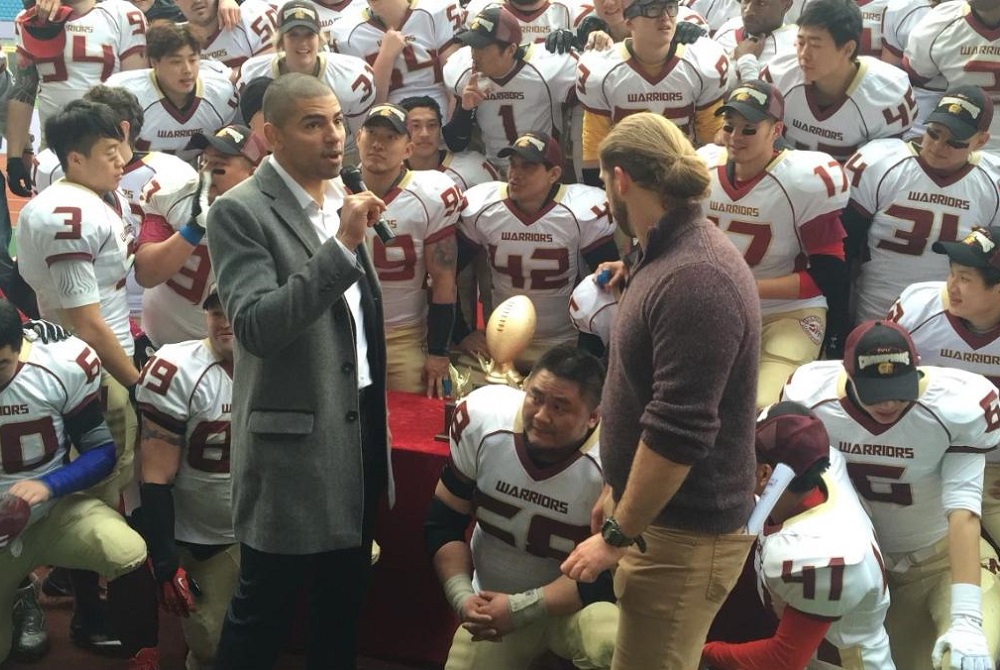
St. Mary's Standout McLaurin Becomes Chinese Football Pioneer
By
Tom Markowski
Special for Second Half
August 19, 2021
The eight years Chris McLaurin spent in China not only changed his life, but they changed the perception of American football in China and elsewhere – and just may have opened the door to a whole new market.
 We're talking “American football,” not soccer. Most of us are familiar with NFL Europe, but NFL China? Not so much. When McLaurin went to China in 2011, the thought of teaching the locals American football never occurred to him. He went there to work for a private company, and circumstances just seemed to fall in place.
Some might say McLaurin was in the right place at the right time, but it can also be said he was the right person at the right time to lead this undertaking. McLaurin had the background, both athletically and organizationally, to take on such an endeavor.
“I met a lot of people who were interested in football,” McLaurin said. “I thought, football? I had a limited understanding of what they knew. I was very surprised they would reach out to me. I quickly found out they were hungry to learn.”
A 2005 graduate of Orchard Lake St. Mary's, McLaurin started at tight end and linebacker, and helped the Eaglets reach the MHSAA Division 2 Final in 2004 (where they lost to Muskegon). McLaurin went on to play four seasons at Michigan and graduated in 2009 with a degree in history and minor in urban and community studies. He had thoughts of entering law school when other opportunities interceded.
During his time in Ann Arbor, McLaurin worked with an organization that focused on disadvantaged youth in the area and helped open doors for them. They were allowed to attend lectures at the university as well as sporting events.
Upon graduation, the seeds that would blossom in Asia began being sown in other parts of the world.
McLaurin received a Fulbright Scholarship and went to Johannesburg, South Africa, to work with underprivileged youth as part of a program called Tomorrow Trust. During this time he worked with the United Nations Development Programme and Harvard Law School in their pursuit of promoting economic rights for the poor.
Following his work in South Africa, McLaurin began his post-graduate work at the London School of Economics. He earned his degree after working in the House of Commons and as a research assistant for the Runnymede Trust. Then came a six-month internship within the Obama Administration as part of the White House Domestic Policy Council.
And after that, he was off to Chongqing in western China to work for a private equity company as a project manager. Two years later, he started his own company in addition to a non-profit organization. Much of his work centered on the automobile industry and global technology.
During this time he learned to speak Mandarin and, in doing so, was introduced to more of the local customs – including American football.
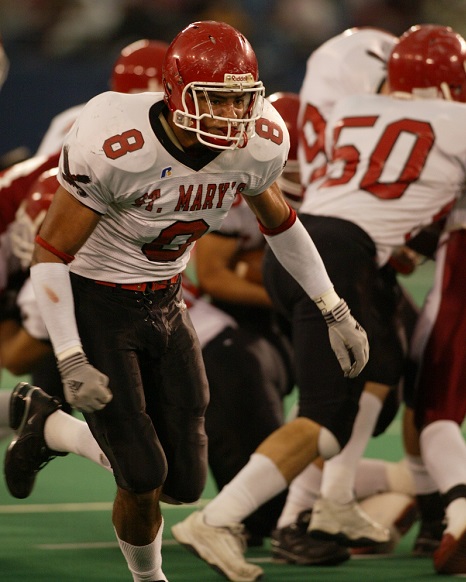 What McLaurin found was a rudimental brand of football, what we would term a recreational type of competition. McLaurin began his involvement gradually, on weekends.
“After that first year (2012), I took it up a notch,” McLaurin said. “We started recruiting players and bought new equipment. They watched football on TV, but it's not an easy game to understand. You have to play football to learn it. You don't get that from watching TV.”
A year of training, recruiting and, yes, some frustration, led McLaurin to start a league, the American Football League of China (now known as the China National Football League). The rules are similar to those at the U.S. college level. There are 11 players a side, and when a ball carrier's knee touches the ground the play is over.
In the beginning “it was successful,” he said. “There were no leagues when I got there. There was no one to organize it. We went from (fewer than) 10 teams to, 3-to-4 years later, there are 80-90.”
McLaurin quickly learned he needed help if this adventure was to succeed. USA Football had a footprint in Shanghai, and McLaurin reached out to the organization. McLaurin contacted a handful of former teammates including Prescott Burgess and Morgan Trent for advice. Former NFL player Bruce Plummer and NFL coach and scout Jerry Hardaway worked some of the camps and clinics with McLaurin and added much-needed experience and expertise.
After playing at Southern Illinois, Hardaway’s first coaching position was at Memphis State as an assistant, and then he went to Grambling State to coach under the legendary Eddie Robison for six seasons. He also coached at the University of California under Joe Kapp prior to working in the NFL and then heading to China.
“I was told, through another guy, that (McLaurin) needed some help,” Hardaway said. “It was all about getting back to basics. That's what made it fun. They had no clue when you'd say to them, control the ground at impact when you're making a block. They had no idea of the terms that you'd use. To see the young kids, to see on their faces, they were absorbing everything.
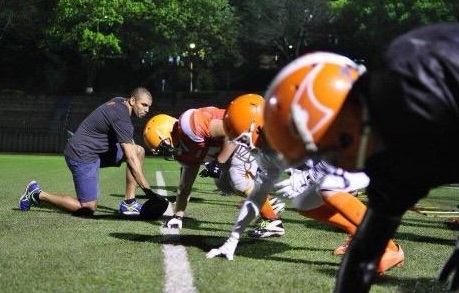 “Yes, yes, yes, it was worthwhile. First of all, people had no clue about what it takes to do something like this. They were learning. Some of the parents thought it was a violent sport. That's what they heard. Then they switched. They saw me, us, teach the basics and they saw what we were doing. For me, it gave me a sense, like hey, you have to teach and you have to enjoy it.”
Soon after that first season, the NFL got involved as did the National Committee on United States - China Relations. McLaurin credits the NFL for advising him on the business end of starting a new league and structuring. After 18 months, McLaurin got out of coaching and became the commissioner.
“(The NFL) wanted to expand,” he said. “They saw how their brand was quite low (in China). China is a natural.”
Progress was slow, but it was still progress. The 2015 championship game was played in Shanghai, and McLaurin estimates it drew 3,500 spectators.
He continued to work with the AFLC through 2019 but then decided to make a career move. He returned to the U.S. and, this fall, is pursuing a dream he's held since leaving U-M. At age 34, McLaurin entered Harvard Law School.
“When I started, the last thing we wanted was a U.S. version of football,” he said. “We wanted it to be Chinese football. There were limitations on how many foreigners would compete. At first it was five (per team), then three. We wanted it to be a Chinese experience."
2020-21 Made in Michigan
August 5: Herremans' Focus on 'Dadding,' Giving Kids Similar Small-Town Childhood - Read
July 29: Loy Norrix Career Prepped Crocker for U-M Success, Law Degree Pursuit - Read
July 19: Top PGA Pro Finish Latest Greatest Highlight as Cook Continues Climb - Read
July 16: TC West Standout Renews Ties to Titans, Cheers Past Teammates' Gold Pursuit - Read
July 8: Caro Champs Find Common Ground Again as Mental Health Providers - Read
June 28: Michigan's Minor Leaguers Making Up for Lost Season - Read
PHOTOS: (Top) Former Orchard Lake St. Mary's standout Chris McLaurin started an American football league in China and remained part of its leadership through 2019. (Middle) McLaurin was a two-way starter for St. Mary's 2004 Division 2 runner-up team. (Below) McLaurin runs drills for one of the Chinese teams. (Top and below photos courtesy of Chris McLaurin; middle photo from MHSAA archives.)