

New Math: Division & Multiplication Problems
July 25, 2017
By Jack Roberts
MHSAA Executive Director
This is the second part in a series on MHSAA tournament classification, past and present, that will be published over the next two weeks. This series originally ran in this spring's edition of MHSAA benchmarks.
High school tournament classifications went viral before there was social media and most of us knew what “viral” meant.
Much as a virus infects computers today or has created epidemics of disease around the world for centuries, high school tournament classification – once introduced – tends to spread uncontrollably. Once started, it tends to keep expanding and rarely contracts.
While we are still some distance from providing every team a trophy as a result of expanding high school tournament classification across the country, there is criticism nevertheless that we are headed in that direction – a philosophy which is supposed to exist only in local youth sports for our youngest children.
Michigan could be blamed for all this. Michigan is generally accepted as the first state to provide different classifications for season-ending tournaments for different sized schools. It started a century ago. Today, every state has various classifications for its tournaments in most if not all sports. And it is a bit ironic that Michigan – creator of the classification chaos – more than most other states has kept the number of tournament classes or divisions under control.
Yes, there is evidence that tournament classifications have expanded over the years in Michigan, especially with the relatively recent introduction of tournaments in football and the late 1990s’ move from classes to divisions in most MHSAA tournaments. But the MHSAA Representative Council has held true to its word when it expanded the playoffs for football from four classes to eight divisions: this is needed because of unique factors of football, factors that exist in no other sport; and all other sports should be capped at a maximum of four classes or divisions.
Kentucky is the preeminent defender of single-class basketball. All of its 276 high schools compete for the single state championship for each gender. In Indiana, there are still open wounds from its move in 1998 from one to four classes for its 400 schools in basketball.
Multi-class tournaments have tended to increase the number of non-public school champions, which some states are trying to lower through enrollment “multipliers,” and also tend to increase the number of repeat champions, which some states are trying to affect with “success factors” which lift smaller schools into classifications for larger schools if they take home too many trophies.
While there is considerable evidence that state tournaments do as much bad as good for educational athletics, state associations persist in providing postseason tournaments because, on balance, the experiences are supposed to be good for student-athletes. And once we reach that conclusion it is just a small leap to believe that if the tournaments are good for a few, they must be better for more – which leads to creating more and more tournament classifications. One becomes two classes, then three, then four and so forth.
While the argument is that more classifications or divisions provides more students with opportunities to compete and win, it is undeniable that the experience changes as the number of tournament classifications expands. It is not possible for state associations to provide the same level of support when tournament classifications expand to multiple venues playing simultaneously. For example, there is less audio and video broadcast potential at each venue, and less media coverage to each venue. Focus is diluted and fans diminished at each championship.
No one can argue reasonably that today's two-day MHSAA Football Finals of eight championship games has the same pizazz as the one-day, four-games event conducted prior to 1990.
In some states the number of divisions has grown so much that it is difficult to see much difference between the many season-ending state championship games and a regular-season event in the same sport.
It is a balancing act. And Michigan has been studying that balance longer than any other state, and charting a steadier course than most.
Addition by Division
The shift to Divisions for MHSAA Tournament play in numerous sports has added up to a greater number of champions for teams and individuals across the state. Following are the sports currently employing a divisional format, and the procedures for determining enrollment and classification.
In 23 statewide or Lower Peninsula tournaments, schools which sponsor the sport are currently divided into nearly equal divisions. They are:
- Baseball - 4 Divisions
- Boys Bowling - 4 Divisions
- Girls Bowling - 4 Divisions
- Girls Competitive Cheer - 4 Divisions
- LP Boys Cross Country - 4 Divisions
- LP Girls Cross Country - 4 Divisions
- LP Boys Golf - 4 Divisions
- LP Girls Golf - 4 Divisions
- Ice Hockey - 3 Divisions
- Boys Lacrosse - 2 Divisions
- Girls Lacrosse - 2 Divisions
- Boys Skiing - 2 Divisions
- Girls Skiing - 2 Divisions
- LP Boys Soccer - 4 Divisions LP
- Girls Soccer - 4 Divisions
- Girls Softball - 4 Divisions
- LP Boys Swimming & Diving - 3 Divisions
- LP Girls Swimming & Diving - 3 Divisions
- LP Boys Tennis - 4 Divisions
- LP Girls Tennis - 4 Divisions
- LP Boys Track & Field - 4 Divisions
- LP Girls Track & Field - 4 Divisions
- Wrestling - 4 Divisions
Lists of schools for each division of these 23 tournaments are posted on MHSAA.com approximately April 1. Listings of schools in Upper Peninsula tournaments for their sports are also posted on MHSAA.com. The lists are based on school memberships and sports sponsorships in effect or anticipated for the following school year, as known to the MHSAA office as of a date in early March.
In football, the 256 schools which qualify for MHSAA 11-player playoffs are placed in eight equal divisions annually on Selection Sunday. Beginning in 2017, the 8-player divisions will be determined in a like manner on Selection Sunday as well, with 32 qualifying schools placed in two divisions.
Schools have the option to play in any higher division in one or more sports for a minimum of two years.
The deadlines for "opt-ups" are as follows:
- Applications for fall sports must be submitted by April 15
- Applications for winter sports must be submitted by Aug. 15
- Applications for spring sports must be submitted by Oct. 15
Subsequent to the date of these postings for these tournaments, no school will have its division raised or lowered by schools opening or closing, schools adding or dropping sports, schools exercising the option to play in a higher division, or approval or dissolution of cooperative programs.
When the same sport is conducted for boys and girls in the same season (e.g., track & field and cross country), the gender that has the most sponsoring schools controls the division breaks for both genders.
TC West Standout Renews Ties to Titans, Cheers Past Teammates' Gold Pursuit
By
Tom Spencer
Special for MHSAA.com
July 16, 2021
Savanna Wojtanowski was made here. She played here. She stayed here — except for stints in Washington, D.C., where international soccer players joined her.
 Now she’s back as a high school soccer coach.
While lots of faces familiar to United States and Canadian television viewers and soccer fans are expected at the Olympic Games in Tokyo, some of those players will be personally familiar to Wojtanowski.
Wojtanowski played alongside a handful of current and recent players on the U.S. and Canadian women’s teams after serving as four-year starting goalie for Traverse City West and during a college career that began with two seasons at Ferris State and concluded with her final two at Michigan State in 2016 and 2017. During her time with the Spartans, Wojtanowski spent two offseasons with the reserve team for the Washington Spirit, one of the original eight teams when the National Women’s Soccer League (NWSL) was formed in 2012.
At West, Wojtanowski was named second team all-conference as a junior and senior, as well as first team all-district, first team all-region and all-state honorable mention her senior season in 2013. West winning the Big North Conference title that spring remains her favorite memory from high school soccer – and she quickly has matched that achievement as a coach, leading West to the BNC championship this past spring in her first season after taking over the program.
Wojtanowski is looking for the U.S. national team to come out with a vengeance after the disappointment of the 2016 Olympic Games in Brazil. There the U.S. fell to Sweden in a semifinal shootout, which meant failing to reach the gold medal match for the first time since women’s soccer was introduced to the Olympics in 1996 in Atlanta.
Sweden is the U.S.’s opening-game opponent July 21 in Tokyo.
“I believe there is a lot of revenge being chased after the Rio Olympics,” the 25-year-old former keeper said. “I was with the Spirit during Rio, and when the team returned from the Olympics, the sense of disappointment was felt for a long time.
 “I believe going into this year's Olympics, we will see a different type of fire displayed from the USWNT.”
Wojtanowski won’t see former Washington Spirit teammate Diana Matheson of Canadian fame and Estelle Johnson of Cameroon playing in Tokyo. Matheson recently announced her retirement after 18 years representing Canada’s national team. Johnson and her teammates lost a playoff with Chile for the last of 16 slots in the Olympics.
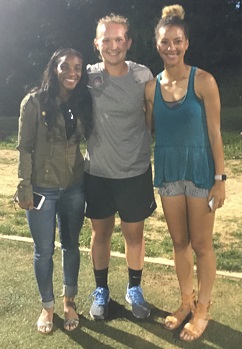 Wojtanowski feels fortunate that she had the chance to compete with and against the women trying to claim gold at Tokyo.
“During college I was able to play two years on the Washington Spirit reserves, which opened the door to the pro side of the game,” she said. “I was fortunate enough to be one of two college players training full-time with the pro squad for those two summers.
“Having the opportunity to play alongside some USWNT women and the Canada women was such a great experience.”
Wojtanowski played with current U.S. roster players Crystal Dunn and Kristie Mewis. The current Canadians she played with are Stephanie Labbe and Shelina Zadorsky. Labbe was Canada’s starting goalkeeper in Rio.
Dunn, though, stands out most to Wojtanowski. Dunn was with the Spirit but now plays for Portland. She has 24 goals and 19 assists in 116 appearances for the USWNT as primarily a defender.
“(Dunn) was such a treat to play with …. her humor, attitude, and training mentality is something I will forever remember,” Wojtanowski said. “She was constantly dancing, laughing, and having a great time at training, but when it was time to get serious she would get the job done.”
Wojtanowski also had the tough job of trying to stop U.S. standout Rose Lavelle during Lavelle’s time starring for Wisconsin. The past Badgers standout and now-Washington Spirit midfielder has 14 goals and nine assists in 56 appearances for the U.S.
Wojtanowski began her collegiate career with two seasons at Ferris State University. After transferring to MSU, she played two more seasons and as a junior in 2016 tied the MSU single-game record with 14 saves against then-No. 16 Penn State. She earned a bachelor’s degree in business with a focus on administration and management and a master’s certificate in supply chain management and procurement. She returned home to start the next chapters of life, and she works as a supply chain buyer fulltime along with her guidance of the Titans.
She’s thrilled to be back at her high school alma mater, which she guided to an overall 10-4-1 record this spring, with the Titans eventually falling to Midland Dow in a Division 1 District Final.
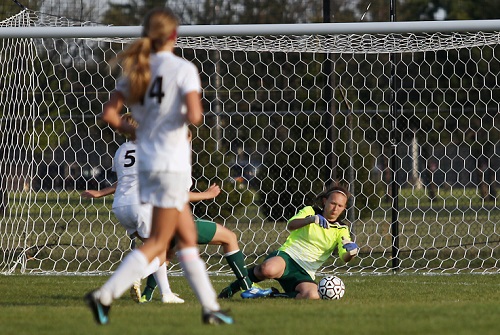 “I wanted to give back to the community,” said Wojtanowski, who previously had coached at the club level in Lansing. “West has always had a very special place in my heart ever since graduation.
“When this opportunity presented itself, I knew I had to take the opportunity to be a Titan again,” she continued. “It has been a special experience to coach the program that I grew up with.”
Wojtanowski wants to instill a family-based culture in the Titans program, something she came to know and love while at Michigan State.
“The biggest thing for me is growing them as individuals both on and off the soccer field,” she said.
Wojtanowski believes girls high school and women’s soccer in this country have changed for the better since she played. And, she’s not the least bit surprised by the consistent success of the USWNT.
“The women's game in the US has grown significantly since I started playing soccer in 2000,” Wojtanowski noted. “Our farm systems here in the U.S. along with club, college, and other programs feed a constantly-elite level of players through the USWNT system.”
2020-21 Made in Michigan
July 8: Caro Champs Find Common Ground Again as Mental Health Providers - Read
June 28: Michigan's Minor Leaguers Making Up for Lost Season - Read
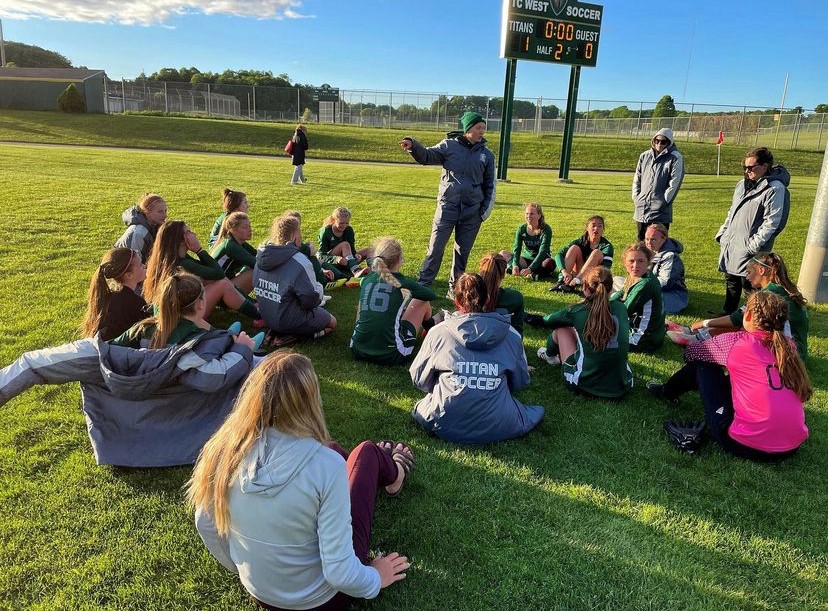
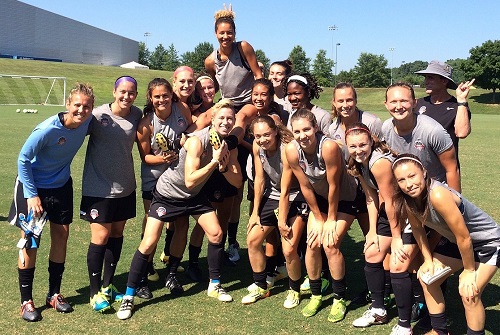
PHOTOS: (Top) Savanna Wojtanowski leads a halftime discussion this spring with her Traverse City West varsity. (Middle) Wojtanowski, second row standing far right in group photo, trained two seasons with the Washington Spirit’s reserves; the Spirit first team included U.S. national teamer Crystal Dunn (left in second photo) and Cameroon national teamer Estelle Johnson (far right). (Below) Wojtanowski makes a save for West against Traverse City Central in 2012. (Top photo by Daisy Kinney, middle courtesy of Savanna Wojtanowski and below courtesy of the Traverse City Record-Eagle.)