

New Math: Division & Multiplication Problems
July 25, 2017
By Jack Roberts
MHSAA Executive Director
This is the second part in a series on MHSAA tournament classification, past and present, that will be published over the next two weeks. This series originally ran in this spring's edition of MHSAA benchmarks.
High school tournament classifications went viral before there was social media and most of us knew what “viral” meant.
Much as a virus infects computers today or has created epidemics of disease around the world for centuries, high school tournament classification – once introduced – tends to spread uncontrollably. Once started, it tends to keep expanding and rarely contracts.
While we are still some distance from providing every team a trophy as a result of expanding high school tournament classification across the country, there is criticism nevertheless that we are headed in that direction – a philosophy which is supposed to exist only in local youth sports for our youngest children.
Michigan could be blamed for all this. Michigan is generally accepted as the first state to provide different classifications for season-ending tournaments for different sized schools. It started a century ago. Today, every state has various classifications for its tournaments in most if not all sports. And it is a bit ironic that Michigan – creator of the classification chaos – more than most other states has kept the number of tournament classes or divisions under control.
Yes, there is evidence that tournament classifications have expanded over the years in Michigan, especially with the relatively recent introduction of tournaments in football and the late 1990s’ move from classes to divisions in most MHSAA tournaments. But the MHSAA Representative Council has held true to its word when it expanded the playoffs for football from four classes to eight divisions: this is needed because of unique factors of football, factors that exist in no other sport; and all other sports should be capped at a maximum of four classes or divisions.
Kentucky is the preeminent defender of single-class basketball. All of its 276 high schools compete for the single state championship for each gender. In Indiana, there are still open wounds from its move in 1998 from one to four classes for its 400 schools in basketball.
Multi-class tournaments have tended to increase the number of non-public school champions, which some states are trying to lower through enrollment “multipliers,” and also tend to increase the number of repeat champions, which some states are trying to affect with “success factors” which lift smaller schools into classifications for larger schools if they take home too many trophies.
While there is considerable evidence that state tournaments do as much bad as good for educational athletics, state associations persist in providing postseason tournaments because, on balance, the experiences are supposed to be good for student-athletes. And once we reach that conclusion it is just a small leap to believe that if the tournaments are good for a few, they must be better for more – which leads to creating more and more tournament classifications. One becomes two classes, then three, then four and so forth.
While the argument is that more classifications or divisions provides more students with opportunities to compete and win, it is undeniable that the experience changes as the number of tournament classifications expands. It is not possible for state associations to provide the same level of support when tournament classifications expand to multiple venues playing simultaneously. For example, there is less audio and video broadcast potential at each venue, and less media coverage to each venue. Focus is diluted and fans diminished at each championship.
No one can argue reasonably that today's two-day MHSAA Football Finals of eight championship games has the same pizazz as the one-day, four-games event conducted prior to 1990.
In some states the number of divisions has grown so much that it is difficult to see much difference between the many season-ending state championship games and a regular-season event in the same sport.
It is a balancing act. And Michigan has been studying that balance longer than any other state, and charting a steadier course than most.
Addition by Division
The shift to Divisions for MHSAA Tournament play in numerous sports has added up to a greater number of champions for teams and individuals across the state. Following are the sports currently employing a divisional format, and the procedures for determining enrollment and classification.
In 23 statewide or Lower Peninsula tournaments, schools which sponsor the sport are currently divided into nearly equal divisions. They are:
- Baseball - 4 Divisions
- Boys Bowling - 4 Divisions
- Girls Bowling - 4 Divisions
- Girls Competitive Cheer - 4 Divisions
- LP Boys Cross Country - 4 Divisions
- LP Girls Cross Country - 4 Divisions
- LP Boys Golf - 4 Divisions
- LP Girls Golf - 4 Divisions
- Ice Hockey - 3 Divisions
- Boys Lacrosse - 2 Divisions
- Girls Lacrosse - 2 Divisions
- Boys Skiing - 2 Divisions
- Girls Skiing - 2 Divisions
- LP Boys Soccer - 4 Divisions LP
- Girls Soccer - 4 Divisions
- Girls Softball - 4 Divisions
- LP Boys Swimming & Diving - 3 Divisions
- LP Girls Swimming & Diving - 3 Divisions
- LP Boys Tennis - 4 Divisions
- LP Girls Tennis - 4 Divisions
- LP Boys Track & Field - 4 Divisions
- LP Girls Track & Field - 4 Divisions
- Wrestling - 4 Divisions
Lists of schools for each division of these 23 tournaments are posted on MHSAA.com approximately April 1. Listings of schools in Upper Peninsula tournaments for their sports are also posted on MHSAA.com. The lists are based on school memberships and sports sponsorships in effect or anticipated for the following school year, as known to the MHSAA office as of a date in early March.
In football, the 256 schools which qualify for MHSAA 11-player playoffs are placed in eight equal divisions annually on Selection Sunday. Beginning in 2017, the 8-player divisions will be determined in a like manner on Selection Sunday as well, with 32 qualifying schools placed in two divisions.
Schools have the option to play in any higher division in one or more sports for a minimum of two years.
The deadlines for "opt-ups" are as follows:
- Applications for fall sports must be submitted by April 15
- Applications for winter sports must be submitted by Aug. 15
- Applications for spring sports must be submitted by Oct. 15
Subsequent to the date of these postings for these tournaments, no school will have its division raised or lowered by schools opening or closing, schools adding or dropping sports, schools exercising the option to play in a higher division, or approval or dissolution of cooperative programs.
When the same sport is conducted for boys and girls in the same season (e.g., track & field and cross country), the gender that has the most sponsoring schools controls the division breaks for both genders.
Flashback 1981: Softball Showcase Makes Ranney Park Home
By
Ron Pesch
MHSAA historian
May 28, 2021
After years of grouping the championship games by classification across various diamonds in the state, talks about creating a new format for both the Michigan High School Athletic Association baseball and softball championships began following the 1980 spring tournaments.
 “Baseball and softball coaches have been complaining about spreading the tournament sites throughout the state,” according to an article in the Lansing State Journal. “They feel if football championships can be held at the Silverdome and basketball at Crisler Arena in Ann Arbor, why not showcase their sports (at a single location).”
“The coaches are certainly in favor of the four-class finals at the same site and were looking into it,” said Vern Norris, executive director of the MHSAA in June 1980. “There are several exceptional sites right now.”
In September, the Association announced that the 1981 Baseball Finals would be held at Central Michigan University’s Alumni Field, and that the Softball Finals would be played at Lansing’s Ranney Park, a sports complex that featured nearly $70,000 in recent renovations. Rain delayed all four championship games, scheduled for Saturday, June 13. Instead, they were played on the following Monday.
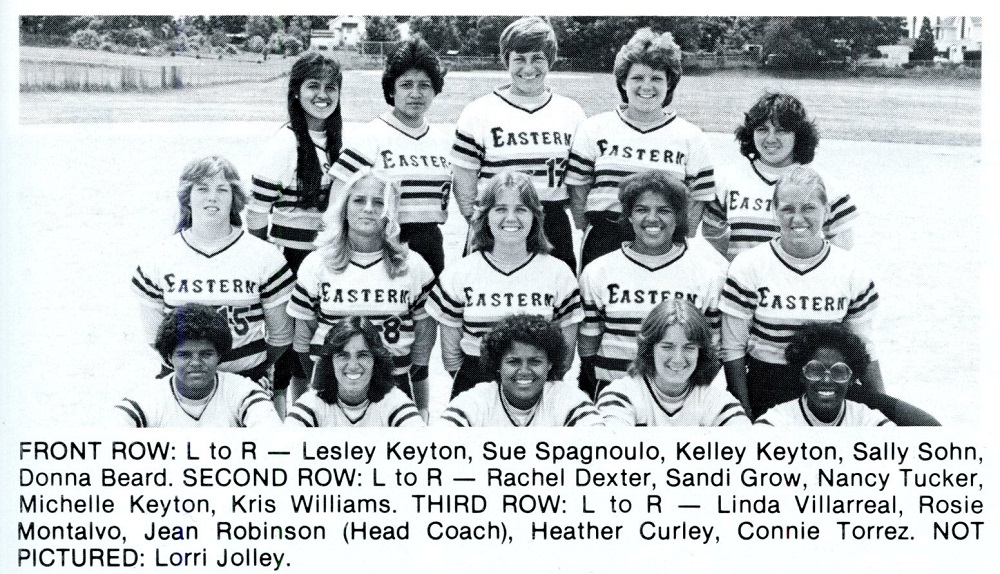
Class A: Lansing Eastern 8, Warren Cousino 0
Lefty Sally Sohn allowed just three hits as Lansing Eastern shut down once-beaten Warren Cousino, 8-0. It was Sohn’s 17th win on the year without a defeat. Diane Gentry, previously unbeaten in 19 games, took the loss.
Eastern pounded out 13 hits, scoring once in the first inning and twice in the second for a quick 3-0 lead. Leftfielder Sue Spagnuolo, who went 4 for 5 at the plate, piled up a double and three singles in the championship game, drove in one of the runs in the second inning, and then followed with two more RBI in the third. Senior Kelley Keyton, who led the team in batting with a .412 average and six home runs, singled in two more runs in the third. Playing first base, she was one of three sisters, including Lesley Keyton (second) and Michelle Keyton (third), who occupied the infield for the Quakers. Sophomore shortstop Rachel Dexter added three hits and was outstanding defensively. The team’s final run came in the fifth.
Dexter, Lesley Keyton and Gentry would all later become teammates at Michigan State, while Sohn would carve out an outstanding career at Ferris State. Spagnuolo would attend Alma College, earning all-MIAA honors and setting multiple Scots records on the basketball court.
In eight postseason contests, Eastern outscored its opponents 79-9, with the Cousino win marking the only tournament shutout. In 1995, the Quakers’ team was honored with induction into the Greater Lansing Sports Hall of Fame.
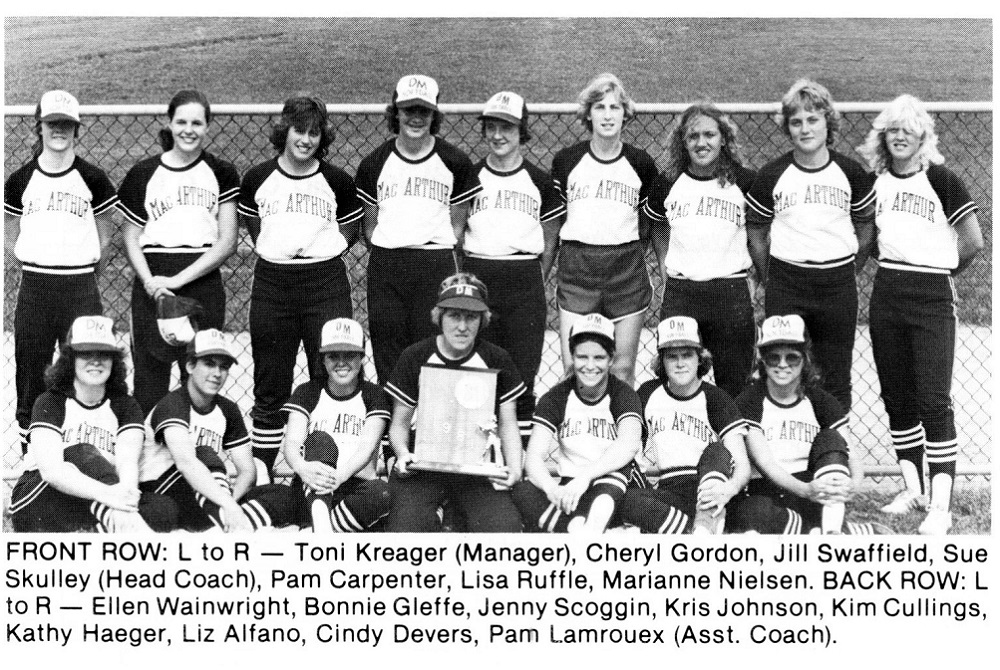
Class B: Saginaw MacArthur 8, Eaton Rapids 4
Saginaw MacArthur’s Liz Alfano held Eaton Rapids to four hits, all coming in the fifth inning, to lead her team to an 8-4 win over the Greyhounds. MacArthur, which lost its 1980 Regional Final to eventual Class B champion Fenton, finished the season with a 20-5 record.
The Generals opened up a 6-0 advantage early in the contest.
After walking in her first at bat, Pam Carpenter scored the game’s opening run on a Greyhounds throwing error in the bottom of the first inning, and then doubled in two runs in the second. A bloop single by Alfano in the third pushed across another run. That was followed by a single by Jenny Scoggin that scored two more runs, giving MacArthur its lead.
Alfano hadn’t allowed a hit through the first four innings before a bad hop on a grounder in the top of the fifth allowed Eaton Rapids to score a run. Trailing 6-1, the Greyhounds filled the bases with nobody out. MacArthur’s second baseman Cindy Devers came up big defensively, turning a double play on a grounder by tagging the runner headed from first to second before making the easy toss to first. While the runner at third scored, it appeared that “MacArthur might escape without further damage, “ according to Mike Thompson of the Saginaw News.
“However, an infield error allowed a third run to score. Another error, followed by a base hit, produced another run and cut MacArthur’s lead to 6-4.
With “the tying runs in scoring position … Generals Coach Sue Skulley made a trip to the pitching rubber.” Skulley knew Eaton Rapids had a reputation as a strong comeback team, and hoped a little break might help Alfano on this hot, muggy day.
‘“It was nearly 90 degrees out there,’” said Skulley. “’She was tired and she let up a little.’”
Following the mound visit, Alfano got the third out of the inning on a fly to right field.
Devers scored in the fifth and Carpenter scored again after notching a triple in the sixth to seal the victory.
Alfano finished with a 16-3 win-loss mark on the year. Eaton Rapids ended with a 14-9 record as Denise Miller was tagged with the loss.
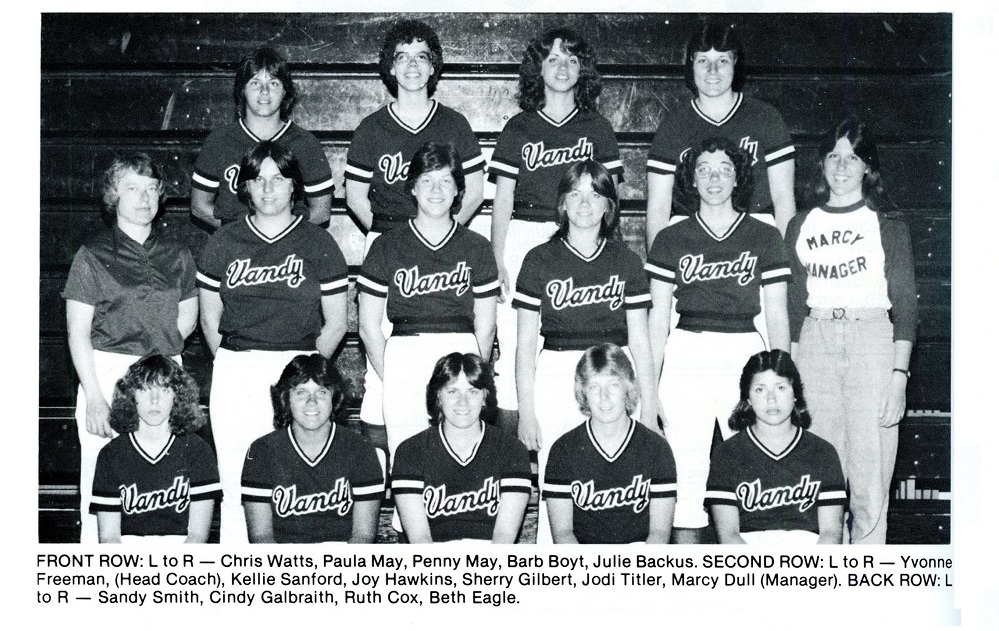
Class C: Vandercook Lake 5, Breckenridge 4
Five walks, two hit batters, and eight errors – including a pair in the ninth inning – helped the Vandercook Lake Jayhawks (14-4) earn a surprise 5-4 win over Breckenridge (18-6).
>Vandercook Lake blew an early 3-1 lead, and with the game tied, 3-3, a lead-off triple by Breckenridge first baseman Brenda Rohn in the top of the seventh appeared to set the stage for a comeback win by the Huskies. “However,” according to Lansing State Journal coverage, “an unsuccessful squeeze play and two pop ups got Jayhawks pitcher Beth Eagle out of the touchy situation.” With Vandercook Lake unable to score in the bottom half, the teams headed for extra innings.
In the top of the ninth, Rohn, who finished 4 for 4 from the plate, notched her third triple of the day, and then scored on a two-out single by Claudia Parfitt to break the tie, 4-3.
But Vandercook Lake scored twice in the bottom of the inning to grab the title.
“Barb Boyt reached first for the Jayhawks on a throwing error then moved to third after a wild pitch and a passed ball,” stated the Jackson Citizen Patriot years later, recalling the drama. “After Breckenridge issued a walk to put the game-winning run on first, Coach Yvonne Freeman put Sherry Gilbert in to pinch run. Boyt scored on another error and Gilbert moved to second. With two outs, Paula May hit a groundball to third base and Gilbert slid under the tag for a 5-4 win.”
Freeman had only four players turn out for varsity tryouts that spring, and junked the JV squad to compile a team.
Breckenridge’s Evelyn O’Boyle, who allowed two hits on the day, was unbeaten entering the match-up and took the loss.
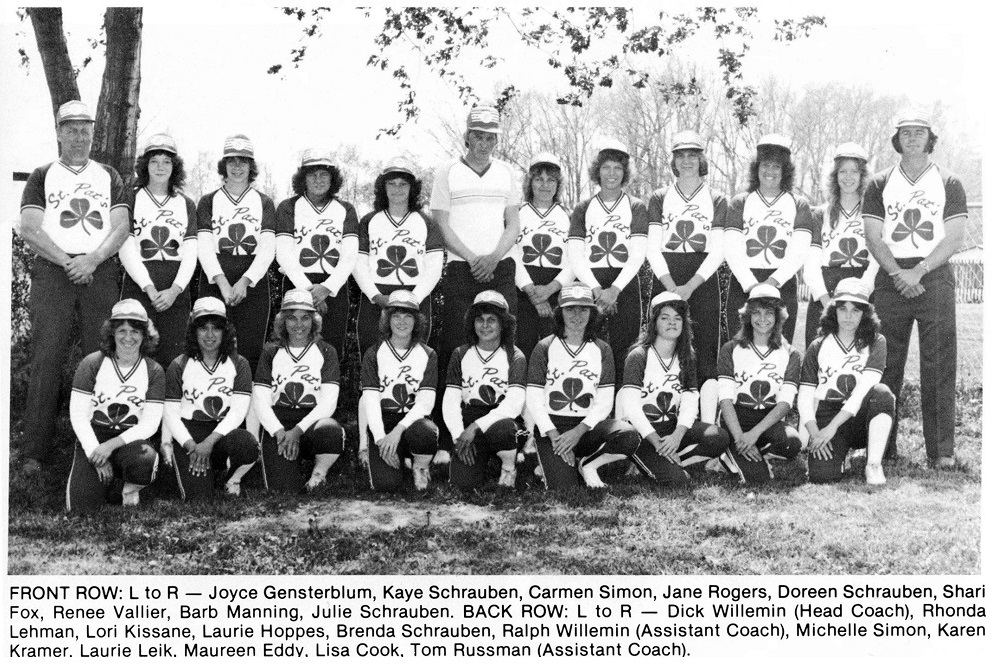
Class D: Portland St. Patrick 3, Wyoming Lee 2
Portland St. Patrick opened up an early 3-0 lead, then held on for a 3-2 win over Wyoming Lee before a crowd of 500. It was the Shamrocks’ 26th win on the year against two losses.
“We’ve played well all year,” St. Patrick coach Dick Willemin told the Journal correspondent Steven Waite following the game. “We got super play out of our infield today. But I’ve said all along we’d go as far as (pitcher) Jane (Rogers) took us.”
Sophomore Karen Kramer opened the St. Patrick scoring in the bottom of the first inning. In the second, Carmen Simon “walked, moved to second on a wild pitch and scored on Laurie Hoppes’ single to center,” according to the Journal’s account of the game. “(Freshman Laurie) Leik was safe on a fielder’s choice, stole second, and took third on a passed ball. She scored on catcher Doreen Schrauben’s ground out.”
Lee (21-8) rallied back in the fourth, as Tammi Melinn doubled, moved to third on a Cassie McCann single, then scored on a single by Cheryl DeLaat. McCann, who had advanced to third on DeLaat’s hit, scored “on an ensuing ‘pickle play’” as DeLaat was thrown out attempting to steal second. “Rogers got St. Patrick out of further trouble by forcing the next two batters to pop out.”
Rogers’ strong pitching combined with solid defense sealed the victory. Just a junior, Rogers allowed four hits and fanned five to end the year with a 21-2 mark. She struck out more than 100 during the season and established Shamrocks records for strikeouts in a game, season, and career, as well as wins in a season with 21 against two defeats.
A special thanks to Saginaw’s Jeffrey Cottrell at the Castle Museum and Stacy McNally at the Hoyt Library for their assistance in gathering reference materials.
 Ron Pesch has taken an active role in researching the history of MHSAA events since 1985 and began writing for MHSAA Finals programs in 1986, adding additional features and "flashbacks" in 1992. He inherited the title of MHSAA historian from the late Dick Kishpaugh following the 1993-94 school year, and resides in Muskegon. Contact him at [email protected] with ideas for historical articles.
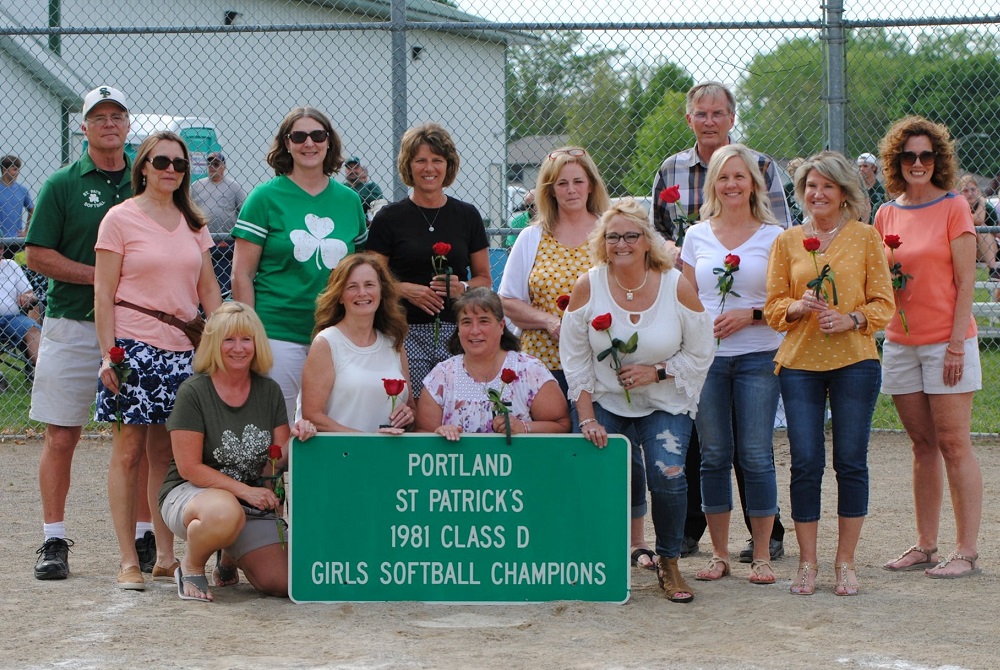
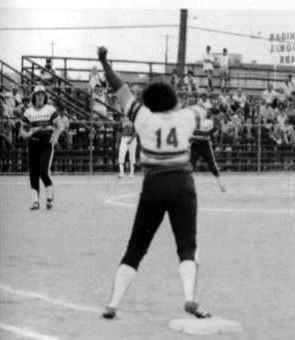
PHOTOS: The 1981 Portland St. Patrick softball team celebrates 40 years since its championship season during a May 20 reunion. Back row: Coach Tom Russman, Michelle (Simon) Nakfoor, Laurie (Leik) Kinne, Karen (Kramer) Trierweiler, Julie (Schrauben) May, Coach Ralph Willemin, Carmen (Simon) Stiffler, Jane (Rogers) Wheaton, Rhonda (Lehman) Goodrich. Front row: Joyce (Gensterblum) Werner, Sherri (Fox) Gensterblum, Kaye (Schrauben) Sandborn, Brenda (Schrauben) Smith. Missing: Maureen (Eddy) Devota, Renee (Vallier) Haneghan, Lisa (Cook) Barrone, Barb (Manning) Renterghem, Lori (Kissane) Rademacher, Doreen (Schrauben) Spohn, Head Coach Dick Willemin (deceased). (2) Lansing Eastern's Kelley Keyton celebrates following the final out of the Class A championship game in 1981. (3-6) Team photos from the 1981 champions. (Photos collected by Ron Pesch.)