

New Math: Division & Multiplication Problems
July 25, 2017
By Jack Roberts
MHSAA Executive Director
This is the second part in a series on MHSAA tournament classification, past and present, that will be published over the next two weeks. This series originally ran in this spring's edition of MHSAA benchmarks.
High school tournament classifications went viral before there was social media and most of us knew what “viral” meant.
Much as a virus infects computers today or has created epidemics of disease around the world for centuries, high school tournament classification – once introduced – tends to spread uncontrollably. Once started, it tends to keep expanding and rarely contracts.
While we are still some distance from providing every team a trophy as a result of expanding high school tournament classification across the country, there is criticism nevertheless that we are headed in that direction – a philosophy which is supposed to exist only in local youth sports for our youngest children.
Michigan could be blamed for all this. Michigan is generally accepted as the first state to provide different classifications for season-ending tournaments for different sized schools. It started a century ago. Today, every state has various classifications for its tournaments in most if not all sports. And it is a bit ironic that Michigan – creator of the classification chaos – more than most other states has kept the number of tournament classes or divisions under control.
Yes, there is evidence that tournament classifications have expanded over the years in Michigan, especially with the relatively recent introduction of tournaments in football and the late 1990s’ move from classes to divisions in most MHSAA tournaments. But the MHSAA Representative Council has held true to its word when it expanded the playoffs for football from four classes to eight divisions: this is needed because of unique factors of football, factors that exist in no other sport; and all other sports should be capped at a maximum of four classes or divisions.
Kentucky is the preeminent defender of single-class basketball. All of its 276 high schools compete for the single state championship for each gender. In Indiana, there are still open wounds from its move in 1998 from one to four classes for its 400 schools in basketball.
Multi-class tournaments have tended to increase the number of non-public school champions, which some states are trying to lower through enrollment “multipliers,” and also tend to increase the number of repeat champions, which some states are trying to affect with “success factors” which lift smaller schools into classifications for larger schools if they take home too many trophies.
While there is considerable evidence that state tournaments do as much bad as good for educational athletics, state associations persist in providing postseason tournaments because, on balance, the experiences are supposed to be good for student-athletes. And once we reach that conclusion it is just a small leap to believe that if the tournaments are good for a few, they must be better for more – which leads to creating more and more tournament classifications. One becomes two classes, then three, then four and so forth.
While the argument is that more classifications or divisions provides more students with opportunities to compete and win, it is undeniable that the experience changes as the number of tournament classifications expands. It is not possible for state associations to provide the same level of support when tournament classifications expand to multiple venues playing simultaneously. For example, there is less audio and video broadcast potential at each venue, and less media coverage to each venue. Focus is diluted and fans diminished at each championship.
No one can argue reasonably that today's two-day MHSAA Football Finals of eight championship games has the same pizazz as the one-day, four-games event conducted prior to 1990.
In some states the number of divisions has grown so much that it is difficult to see much difference between the many season-ending state championship games and a regular-season event in the same sport.
It is a balancing act. And Michigan has been studying that balance longer than any other state, and charting a steadier course than most.
Addition by Division
The shift to Divisions for MHSAA Tournament play in numerous sports has added up to a greater number of champions for teams and individuals across the state. Following are the sports currently employing a divisional format, and the procedures for determining enrollment and classification.
In 23 statewide or Lower Peninsula tournaments, schools which sponsor the sport are currently divided into nearly equal divisions. They are:
- Baseball - 4 Divisions
- Boys Bowling - 4 Divisions
- Girls Bowling - 4 Divisions
- Girls Competitive Cheer - 4 Divisions
- LP Boys Cross Country - 4 Divisions
- LP Girls Cross Country - 4 Divisions
- LP Boys Golf - 4 Divisions
- LP Girls Golf - 4 Divisions
- Ice Hockey - 3 Divisions
- Boys Lacrosse - 2 Divisions
- Girls Lacrosse - 2 Divisions
- Boys Skiing - 2 Divisions
- Girls Skiing - 2 Divisions
- LP Boys Soccer - 4 Divisions LP
- Girls Soccer - 4 Divisions
- Girls Softball - 4 Divisions
- LP Boys Swimming & Diving - 3 Divisions
- LP Girls Swimming & Diving - 3 Divisions
- LP Boys Tennis - 4 Divisions
- LP Girls Tennis - 4 Divisions
- LP Boys Track & Field - 4 Divisions
- LP Girls Track & Field - 4 Divisions
- Wrestling - 4 Divisions
Lists of schools for each division of these 23 tournaments are posted on MHSAA.com approximately April 1. Listings of schools in Upper Peninsula tournaments for their sports are also posted on MHSAA.com. The lists are based on school memberships and sports sponsorships in effect or anticipated for the following school year, as known to the MHSAA office as of a date in early March.
In football, the 256 schools which qualify for MHSAA 11-player playoffs are placed in eight equal divisions annually on Selection Sunday. Beginning in 2017, the 8-player divisions will be determined in a like manner on Selection Sunday as well, with 32 qualifying schools placed in two divisions.
Schools have the option to play in any higher division in one or more sports for a minimum of two years.
The deadlines for "opt-ups" are as follows:
- Applications for fall sports must be submitted by April 15
- Applications for winter sports must be submitted by Aug. 15
- Applications for spring sports must be submitted by Oct. 15
Subsequent to the date of these postings for these tournaments, no school will have its division raised or lowered by schools opening or closing, schools adding or dropping sports, schools exercising the option to play in a higher division, or approval or dissolution of cooperative programs.
When the same sport is conducted for boys and girls in the same season (e.g., track & field and cross country), the gender that has the most sponsoring schools controls the division breaks for both genders.

Wisconsin Summer Champ Aiming for 2nd MHSAA Finals Title
By
Tom Lang
Special for MHSAA.com
May 25, 2021
Powers North Central junior Bryson Mercier has missed a large portion of the typically-shorter spring golf season in the Upper Peninsula due to attending his Uncle’s retirement after 22 years serving in the U.S. Army.
 But Mercier still worked on his golf skills along the way, albeit in entirely different surroundings than his native Upper Peninsula.
“Yeah, it was awesome,” he said about testing out the links at Royal Hawaiian Golf Course. “An amazing course and the views were nothing like you’d ever see here, that’s for sure. Probably the coolest golf course I have ever played on.”
Now back home in the western U.P., Mercier is aspiring to add to his Upper Peninsula Division 3 Finals championship won in 2019 as a freshman, and after COVID-19 forced the cancelation of his 2020 high school season.
He won the Big Bay Invitational this season and took runner-up at both of his other invitationals to date, one a 9-hole co-ed event and shooting a 72 in the other.
Mercier first received a little bit of notice at age 14 when he won a Drive, Chip and Putt local qualifier in Green Bay, Wis. Soon after he won the aforementioned U.P. Division 3 championship with a 74; his next two closest competitors tied with 82s. Then he won the Junior Tour championship of the Upper Peninsula Golf Association (UPGA) in 2019 – and he won it again during the summer of 2020 with a 1-under par 71.
Yet what really lifted Mercier’s golfing profile was earning Junior Player of the Year honors in Wisconsin last summer.
Wisconsin?
That’s the best place for Mercier to compete in multiple junior events within reasonable driving distance. Powers is due south of Marquette and west of Escanaba. He’s played in only one Michigan event ‘below the bridge’ – the GAM Junior Invitational. Most American Junior Golf Association (AJGA) events, where college coaches tend to swarm, are 7-10 hours’ drive away and simply not feasible.
Becoming Wisconsin Junior Player of the Year was not a specific goal – but it’s put him on the radar of college coaches, as it should. Earning any state’s top spot in summer-long accumulated points is no easy feat.
“That’s not what I was looking to do,” Mercier said about Wisconsin Player of the Year, yet he would like to repeat it soon, after his junior year in high school concludes next week. “I set short-term goals for each tournament. I’m not a person that likes to look too much into the future, because if you focus too much on the future, you’re going to miss something that’s happening right now.
“But that was the highlight of my summer.”
Mercier played about a dozen 2020 Wisconsin events and placed in the top 10 every time – a very consistent accomplishment he said he is proud of most. He won the WPGA Players Tour event at Blackwolf Run in a playoff, then posted consecutive victories on the Irish Course at Whistling Straights – the College Showcase with a 74 and then another WPGA Junior Tour event. The very next day he grabbed a fourth win with a personal-best 67 in a WPGA Junior Tour event in Green Bay. He added three runner-up finishes on the Wisconsin tour, which typically features the better high school players in that state.
In Wisconsin he averaged 72.5 strokes over 14 tournament rounds. His second consecutive UPGA win gave him five tournament victories during the summer of 2020.
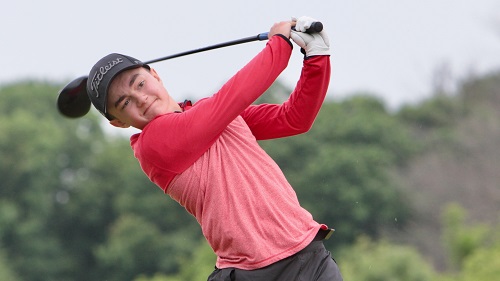 Mercier grew up a Tiger Woods fan just like his dad, who introduced him to the game with toy clubs as a toddler.
“He never forced golf on me, I just picked up on it myself,” Mercier said.
Mercier has been self-taught ever since. He doesn’t see the need for a swing coach, and who can argue? He said he can feel when something is wrong and typically corrects it fairly quickly. He’s driving the ball further with more regimented workouts, currently averaging 280-85 yards off the tee and climbing (the PGA Tour average at The Players Championship in March was 296 yards).
In more recent years, Mercier relates to different player on the PGA Tour.
“Rory McIlroy is my favorite pro right now,” Mercier said. “His body is a lot more like mine – a shorter, smaller individual.”
Mercier has college scholarship offers from University of Detroit Mercy and Wisconsin-Green Bay. With his high school junior season soon to conclude, he has more opportunities to impress scouts.
He wants to study business. Math is his favorite subject. He said that college golf won’t necessarily lead to a pro stint on Tour, but that it will help in expanding personal and business connections for a successful career.
“Bryson is relentless as a player … he has taken his natural talent to the next level through hard work and a tremendous desire to excel,” said North Central coach Gerald Whitens. “He displays a great attitude in the classroom (3.89 GPA, president of National Honor Society) and along with fellow students and teaching staff. The same work ethic that has made him such a good golfer has made him a strong student.
“His accuracy both off the tee and with mid-irons allow him to play precision golf, while his length has improved with fitness training and confidence. He takes pride in his short game and rarely three-putts or fails to get up and down after a missed green.”
Mercier said his goals are: “Just keep getting better, learn from high school, learn from college. Just take in everything.”
North Central has never been a golf school. Basketball is the main attraction to the youth in that region, where Mercier’s father, Adam, coached the Jets boys varsity to three straight Class D titles from 2015-17 while amassing Michigan’s state record in the sport of 83 consecutive victories.
Bryson was in late elementary and middle school at that time, as a starting point guard, but has dedicated his high school career to golf, where it appears that winning runs in the family.
“I feel like I can help make a difference to maybe get younger people my age to try golf,” he said. “It’s such a good sport for young people to get into because it’s such a life-skills sport. You can learn so much more outside of golf by playing golf, all the life lessons. You can develop great personality traits.
“I think every young person should play golf. You don’t have to be good at golf to play golf and have fun. If you choose basketball, you’re going to have to be really good at it. You don’t have to be amazing at golf to still have fun at the same time.”
That said, Mercier is one amazing golfer – who is also having fun.
PHOTOS: (Top) North Central’s Bryson Mercier keeps his eyes on an approach shot during last summer’s WPGA Junior Championship. (Middle) Mercier follows through on a drive during a round last summer. (Photos by Rob Hernandez/Wisconsin.Golf).