


New Math: Division & Multiplication Problems
July 25, 2017
By Jack Roberts
MHSAA Executive Director
This is the second part in a series on MHSAA tournament classification, past and present, that will be published over the next two weeks. This series originally ran in this spring's edition of MHSAA benchmarks.
High school tournament classifications went viral before there was social media and most of us knew what “viral” meant.
Much as a virus infects computers today or has created epidemics of disease around the world for centuries, high school tournament classification – once introduced – tends to spread uncontrollably. Once started, it tends to keep expanding and rarely contracts.
While we are still some distance from providing every team a trophy as a result of expanding high school tournament classification across the country, there is criticism nevertheless that we are headed in that direction – a philosophy which is supposed to exist only in local youth sports for our youngest children.
Michigan could be blamed for all this. Michigan is generally accepted as the first state to provide different classifications for season-ending tournaments for different sized schools. It started a century ago. Today, every state has various classifications for its tournaments in most if not all sports. And it is a bit ironic that Michigan – creator of the classification chaos – more than most other states has kept the number of tournament classes or divisions under control.
Yes, there is evidence that tournament classifications have expanded over the years in Michigan, especially with the relatively recent introduction of tournaments in football and the late 1990s’ move from classes to divisions in most MHSAA tournaments. But the MHSAA Representative Council has held true to its word when it expanded the playoffs for football from four classes to eight divisions: this is needed because of unique factors of football, factors that exist in no other sport; and all other sports should be capped at a maximum of four classes or divisions.
Kentucky is the preeminent defender of single-class basketball. All of its 276 high schools compete for the single state championship for each gender. In Indiana, there are still open wounds from its move in 1998 from one to four classes for its 400 schools in basketball.
Multi-class tournaments have tended to increase the number of non-public school champions, which some states are trying to lower through enrollment “multipliers,” and also tend to increase the number of repeat champions, which some states are trying to affect with “success factors” which lift smaller schools into classifications for larger schools if they take home too many trophies.
While there is considerable evidence that state tournaments do as much bad as good for educational athletics, state associations persist in providing postseason tournaments because, on balance, the experiences are supposed to be good for student-athletes. And once we reach that conclusion it is just a small leap to believe that if the tournaments are good for a few, they must be better for more – which leads to creating more and more tournament classifications. One becomes two classes, then three, then four and so forth.
While the argument is that more classifications or divisions provides more students with opportunities to compete and win, it is undeniable that the experience changes as the number of tournament classifications expands. It is not possible for state associations to provide the same level of support when tournament classifications expand to multiple venues playing simultaneously. For example, there is less audio and video broadcast potential at each venue, and less media coverage to each venue. Focus is diluted and fans diminished at each championship.
No one can argue reasonably that today's two-day MHSAA Football Finals of eight championship games has the same pizazz as the one-day, four-games event conducted prior to 1990.
In some states the number of divisions has grown so much that it is difficult to see much difference between the many season-ending state championship games and a regular-season event in the same sport.
It is a balancing act. And Michigan has been studying that balance longer than any other state, and charting a steadier course than most.
Addition by Division
The shift to Divisions for MHSAA Tournament play in numerous sports has added up to a greater number of champions for teams and individuals across the state. Following are the sports currently employing a divisional format, and the procedures for determining enrollment and classification.
In 23 statewide or Lower Peninsula tournaments, schools which sponsor the sport are currently divided into nearly equal divisions. They are:
- Baseball - 4 Divisions
- Boys Bowling - 4 Divisions
- Girls Bowling - 4 Divisions
- Girls Competitive Cheer - 4 Divisions
- LP Boys Cross Country - 4 Divisions
- LP Girls Cross Country - 4 Divisions
- LP Boys Golf - 4 Divisions
- LP Girls Golf - 4 Divisions
- Ice Hockey - 3 Divisions
- Boys Lacrosse - 2 Divisions
- Girls Lacrosse - 2 Divisions
- Boys Skiing - 2 Divisions
- Girls Skiing - 2 Divisions
- LP Boys Soccer - 4 Divisions LP
- Girls Soccer - 4 Divisions
- Girls Softball - 4 Divisions
- LP Boys Swimming & Diving - 3 Divisions
- LP Girls Swimming & Diving - 3 Divisions
- LP Boys Tennis - 4 Divisions
- LP Girls Tennis - 4 Divisions
- LP Boys Track & Field - 4 Divisions
- LP Girls Track & Field - 4 Divisions
- Wrestling - 4 Divisions
Lists of schools for each division of these 23 tournaments are posted on MHSAA.com approximately April 1. Listings of schools in Upper Peninsula tournaments for their sports are also posted on MHSAA.com. The lists are based on school memberships and sports sponsorships in effect or anticipated for the following school year, as known to the MHSAA office as of a date in early March.
In football, the 256 schools which qualify for MHSAA 11-player playoffs are placed in eight equal divisions annually on Selection Sunday. Beginning in 2017, the 8-player divisions will be determined in a like manner on Selection Sunday as well, with 32 qualifying schools placed in two divisions.
Schools have the option to play in any higher division in one or more sports for a minimum of two years.
The deadlines for "opt-ups" are as follows:
- Applications for fall sports must be submitted by April 15
- Applications for winter sports must be submitted by Aug. 15
- Applications for spring sports must be submitted by Oct. 15
Subsequent to the date of these postings for these tournaments, no school will have its division raised or lowered by schools opening or closing, schools adding or dropping sports, schools exercising the option to play in a higher division, or approval or dissolution of cooperative programs.
When the same sport is conducted for boys and girls in the same season (e.g., track & field and cross country), the gender that has the most sponsoring schools controls the division breaks for both genders.
Diabetes, Missed COVID Season Can't Slow Renaissance Record Setter
By
Tom Markowski
Special for Second Half
May 13, 2021
Kaila Jackson knew something was wrong.
 Less than two months had passed since she competed, as an eighth grader, in the 2018 Michigan High School Indoor State Track Championships in Saginaw, where she set a meet and age group (indoor) record in the 60-yard dash of 7.56 seconds. And her body was sending her confusing signals.
“My times were getting slower,” she said. “I was out of breath.”
Her parents, Anthony and Kimberlee Jackson, weren’t taking any chances with the youngest of their two children. They took Kaila to their family pediatrician and, after receiving the shocking results, she was immediately taken to Beaumont Hospital.
At age 13, Jackson was diagnosed with Type 1 diabetes.
The self-pity, depression or additional physical and/or emotional difficulties Kaila experienced upon receiving the news didn’t last long. That August she won the AAU 100-meter national championship at North Carolina A&T before entering her freshman year at Detroit Renaissance.
“It did take time to get (physically) better,” she said. “After a few days, me and my dad, we said let’s get on the track and see what happens. And I did pretty good. I was surprised.”
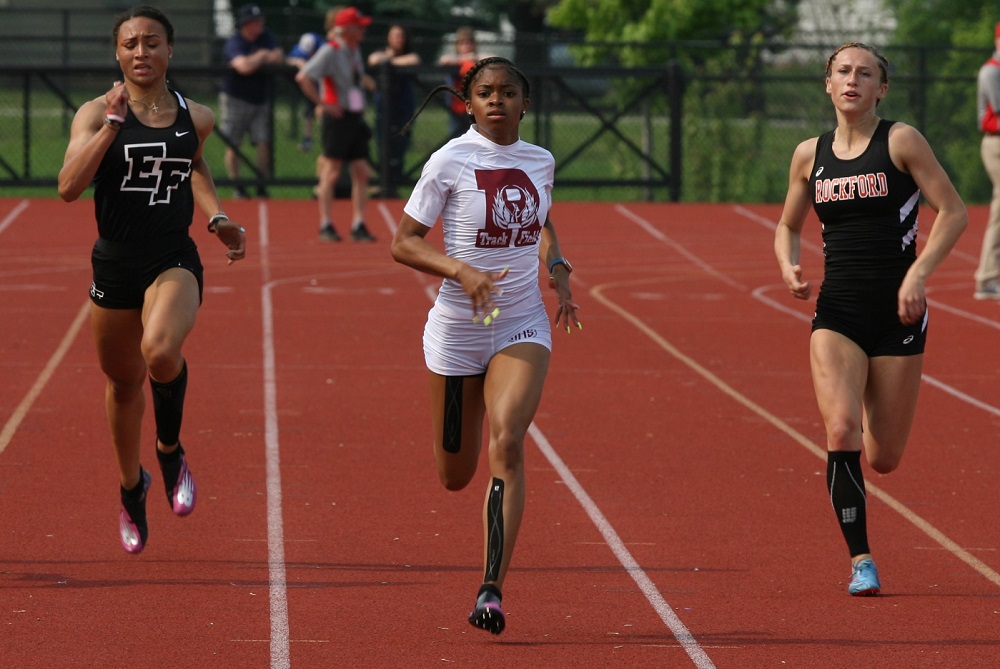
The more Jackson runs, the more she wins and the more the records fall. That first season at Renaissance, at the MHSAA Lower Peninsula Division 1 Track & Field Championships, Jackson won the 200-meter dash, placed second in the 100, and her sprint relay teams won both the 400 and 800.
The pandemic cut short the 2020 track season, but it didn’t stop Jackson. She continued to train with her three coaches – her father, Renaissance girls track coach Calvin Johnson, and Olympic gold medalist Darnell Hall, who serves as the Renaissance boys track coach. Unofficially, all three coach both squads. With their help, Jackson continues to improve her standing in the world of track & field.
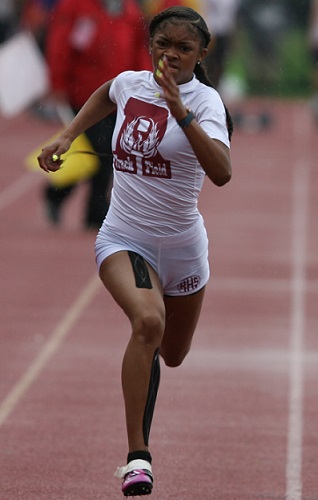 At the Ypsilanti Lincoln Spring Indoor Classic on April 10, Jackson won the 100 and 200-meter dashes with the times of 11.82 and 24.04, respectively. The time in the 100 set a national high school indoor record.
It’s been a quick rise to the top for Jackson, and her ability as a track athlete came out of the blue. Her older sister, Tailar, is an accomplished volleyball player who will graduate from Winston-Salem State (NC) on May 21 after competing in that sport for four years.
Her parents were also fine athletes. Kimberlee played volleyball at Detroit Pershing, and Anthony played basketball and was the starting quarterback on the 1988 Detroit dePoress Class C championship team. Anthony Jackson went to Cincinnati and started as a receiver, but was forced to leave school after his sophomore season due to a family illness.
Kaila Jackson’s entry into track began with a phone call from a gym teacher at her school, Bates Academy in Detroit.
“He calls me up and says, she’s (running faster than) all the boys,” Anthony Jackson said. “So I gave Darnell, who I’ve known for years, a call and he said to bring my daughter to him. After he sees her run he says to me, ‘I think we got something here.’
“My wife and I were surprised. Track is not something we talked about. But one thing I will say: Kaila is a competitor. ”
And that continues, whether it’s competing against the sprinters next to her or battling the diabetes she lives with every day. That passion to compete, to excel, began early on.
In her second season competing on a national level, Jackson placed seventh in the 100-meter at the U-9 championships. As a 10-year-old, she placed second in the 100 and the 200.
Most recently, Renaissance took first place at Friday’s New Balance Invitational that featured 16 teams from Michigan hosted by Farmington High. Jackson was named MVP as she took first in the 100 (12.06) and 200 (24.95), and her sprint relay teams both placed first.
Her teammate and fellow junior, Olivia Jenkins, was second in the 100 (12.65). Another Renaissance junior, Leeah Burr, placed first in the 400 (57.26).
“As a freshman, (Jackson) was immature,” Johnson said. “Her maturation process has improved tenfold. She’s at that point … she’s extremely talented but extremely coachable. She doesn’t carry herself like she knows everything.
“Through the maturation process she’s working toward what I want her to do, and that’s the 400. It will extend her range. She really likes the 200, and (competing in the) 400 will give her more strength.”
Johnson is in his seventh season at Renaissance. His first head coaching stint was at Berkley (1988-98) before he moved on to Southfield High. A hurdles champion in high school in Georgia and at South Carolina State, Johnson said he and Hall are fortunate to be blessed with the top-level athletes under their wings. Johnson’s expertise is working with the hurdlers and the athletes who compete in the high and long jumps, but he’s involved with all facets of the program and team management of the deep and experienced lineup.
Renaissance as a team finished runner-up to Oak Park at the 2019 Division 1 Final, and Jackson surely will make the Phoenix a favorite again next month as it pursues its first championship since 2007.
Like all the athletes whose 2020 seasons were cut short by COVID-19, Jackson was disappointed she was unable to compete in school-sponsored meets. That said, Johnson said that left a bitter taste – with the result being Jackson is even more determined to excel.
Finishing first is but one goal. Others include being a leader and a role model. In the end it’s about being the best person she can be, as an athlete, a student (Jackson has a 3.8 GPA) and teammate. She achieves while also giving herself three insulin shots daily.
“We don’t want her to get too big-headed,” Anthony Jackson said. “She’s a humble kid who has an extreme love for the sport. She’s has great leadership skills and is a student (of the sport). She’s just 16. She’s special.”
It would be easy for Jackson to get ahead of herself, to look beyond this time of her life and imagine competing in college or internationally. As important as it is to have goals, it’s just as important to remain in the moment and work to improve on a day-to-day basis. Jackson knows she’s in a spotlight, and there’s a responsibility that goes along with being at the top.
“It’s about staying humble,” she said. “I don’t get a big head when I talk about (my accomplishments). I stay humble.
“My coaches tell me to run with a purpose. I realize people with diabetes will look up to me as a role model. When I could see I could get over it, maybe they can look and say, ‘I can get over it, too.'”
 Tom Markowski is a correspondent for the State Champs! Sports Network and previously directed its web coverage. He also covered primarily high school sports for the The Detroit News from 1984-2014, focusing on the Detroit area and contributing to statewide coverage of football and basketball. Contact him at [email protected] with story ideas for Oakland, Macomb and Wayne counties.
PHOTOS: (Top) Detroit Renaissance's Kaila Jackson, middle, paces the field on the way to winning the 200 meters at the 2019 MHSAA Lower Peninsula Division 1 Finals. (Middle) Jackson races through the final few steps of the 100 that day in finishing runner-up in that event. (Click for more from RunMichigan.com.)