

New Math: Division & Multiplication Problems
July 25, 2017
By Jack Roberts
MHSAA Executive Director
This is the second part in a series on MHSAA tournament classification, past and present, that will be published over the next two weeks. This series originally ran in this spring's edition of MHSAA benchmarks.
High school tournament classifications went viral before there was social media and most of us knew what “viral” meant.
Much as a virus infects computers today or has created epidemics of disease around the world for centuries, high school tournament classification – once introduced – tends to spread uncontrollably. Once started, it tends to keep expanding and rarely contracts.
While we are still some distance from providing every team a trophy as a result of expanding high school tournament classification across the country, there is criticism nevertheless that we are headed in that direction – a philosophy which is supposed to exist only in local youth sports for our youngest children.
Michigan could be blamed for all this. Michigan is generally accepted as the first state to provide different classifications for season-ending tournaments for different sized schools. It started a century ago. Today, every state has various classifications for its tournaments in most if not all sports. And it is a bit ironic that Michigan – creator of the classification chaos – more than most other states has kept the number of tournament classes or divisions under control.
Yes, there is evidence that tournament classifications have expanded over the years in Michigan, especially with the relatively recent introduction of tournaments in football and the late 1990s’ move from classes to divisions in most MHSAA tournaments. But the MHSAA Representative Council has held true to its word when it expanded the playoffs for football from four classes to eight divisions: this is needed because of unique factors of football, factors that exist in no other sport; and all other sports should be capped at a maximum of four classes or divisions.
Kentucky is the preeminent defender of single-class basketball. All of its 276 high schools compete for the single state championship for each gender. In Indiana, there are still open wounds from its move in 1998 from one to four classes for its 400 schools in basketball.
Multi-class tournaments have tended to increase the number of non-public school champions, which some states are trying to lower through enrollment “multipliers,” and also tend to increase the number of repeat champions, which some states are trying to affect with “success factors” which lift smaller schools into classifications for larger schools if they take home too many trophies.
While there is considerable evidence that state tournaments do as much bad as good for educational athletics, state associations persist in providing postseason tournaments because, on balance, the experiences are supposed to be good for student-athletes. And once we reach that conclusion it is just a small leap to believe that if the tournaments are good for a few, they must be better for more – which leads to creating more and more tournament classifications. One becomes two classes, then three, then four and so forth.
While the argument is that more classifications or divisions provides more students with opportunities to compete and win, it is undeniable that the experience changes as the number of tournament classifications expands. It is not possible for state associations to provide the same level of support when tournament classifications expand to multiple venues playing simultaneously. For example, there is less audio and video broadcast potential at each venue, and less media coverage to each venue. Focus is diluted and fans diminished at each championship.
No one can argue reasonably that today's two-day MHSAA Football Finals of eight championship games has the same pizazz as the one-day, four-games event conducted prior to 1990.
In some states the number of divisions has grown so much that it is difficult to see much difference between the many season-ending state championship games and a regular-season event in the same sport.
It is a balancing act. And Michigan has been studying that balance longer than any other state, and charting a steadier course than most.
Addition by Division
The shift to Divisions for MHSAA Tournament play in numerous sports has added up to a greater number of champions for teams and individuals across the state. Following are the sports currently employing a divisional format, and the procedures for determining enrollment and classification.
In 23 statewide or Lower Peninsula tournaments, schools which sponsor the sport are currently divided into nearly equal divisions. They are:
- Baseball - 4 Divisions
- Boys Bowling - 4 Divisions
- Girls Bowling - 4 Divisions
- Girls Competitive Cheer - 4 Divisions
- LP Boys Cross Country - 4 Divisions
- LP Girls Cross Country - 4 Divisions
- LP Boys Golf - 4 Divisions
- LP Girls Golf - 4 Divisions
- Ice Hockey - 3 Divisions
- Boys Lacrosse - 2 Divisions
- Girls Lacrosse - 2 Divisions
- Boys Skiing - 2 Divisions
- Girls Skiing - 2 Divisions
- LP Boys Soccer - 4 Divisions LP
- Girls Soccer - 4 Divisions
- Girls Softball - 4 Divisions
- LP Boys Swimming & Diving - 3 Divisions
- LP Girls Swimming & Diving - 3 Divisions
- LP Boys Tennis - 4 Divisions
- LP Girls Tennis - 4 Divisions
- LP Boys Track & Field - 4 Divisions
- LP Girls Track & Field - 4 Divisions
- Wrestling - 4 Divisions
Lists of schools for each division of these 23 tournaments are posted on MHSAA.com approximately April 1. Listings of schools in Upper Peninsula tournaments for their sports are also posted on MHSAA.com. The lists are based on school memberships and sports sponsorships in effect or anticipated for the following school year, as known to the MHSAA office as of a date in early March.
In football, the 256 schools which qualify for MHSAA 11-player playoffs are placed in eight equal divisions annually on Selection Sunday. Beginning in 2017, the 8-player divisions will be determined in a like manner on Selection Sunday as well, with 32 qualifying schools placed in two divisions.
Schools have the option to play in any higher division in one or more sports for a minimum of two years.
The deadlines for "opt-ups" are as follows:
- Applications for fall sports must be submitted by April 15
- Applications for winter sports must be submitted by Aug. 15
- Applications for spring sports must be submitted by Oct. 15
Subsequent to the date of these postings for these tournaments, no school will have its division raised or lowered by schools opening or closing, schools adding or dropping sports, schools exercising the option to play in a higher division, or approval or dissolution of cooperative programs.
When the same sport is conducted for boys and girls in the same season (e.g., track & field and cross country), the gender that has the most sponsoring schools controls the division breaks for both genders.
Preview: Dundee Again Paces Powerful D3 Contenders
By
Geoff Kimmerly
MHSAA.com senior editor
March 29, 2021
Forget for a minute that Dundee on Tuesday will attempt to win a fourth-straight MHSAA Finals championship for the second time in the program’s illustrious history.
Consider first the relative strength of the Division 3 field as this season comes to a close.
Four of seven competing teams are undefeated or have lost only once during this abbreviated season. Combined those seven have 67 qualifiers for the Individual Finals – or nearly 10 per team.
Back to Dundee. The Vikings will travel to Kalamazoo looking to match the 1995-98 teams’ string of four Finals titles, the first of that of that run coming in Class C-D followed by three in Division 4.
Division 3 Quarterfinals – matchups below – begin at 12:30 p.m. at Wings Event Center’s Valley, with Semifinals at 3 p.m. and the championship match at 6.
Division 3 - 12:30 pm - The Valley
#1 Dundee - BYE - Mat 3
#4 Richmond vs. #5 Montrose - Mat 4
#3 Alma vs. #6 Freeland - Mat 1
#2 Whitehall vs. #7 Hart - Mat 2
(Constantine opted out.)
Spectator limits remain in effect, but all matches will be broadcast live and viewable with subscription on MHSAA.tv. Below is a look at all eight teams competing in Division 3, listed by seed.
#1 DUNDEE
Record/rank: 17-1, No. 1
League finish: First in Lenawee County Athletic Association
Coach: Tim Roberts, 22nd season (555-76-1)
Championship history: Twelve MHSAA championships (most recent 2020), seven runner-up finishes.
Individual Finals qualifiers: 103 Kade Kluce (12-2) fr., 112 Braeden Davis (21-0) soph., 119 Kaden Chinavare (18-0) soph., 119 Kyle Smith (12-2) jr., 125 Logan Sander (13-1) jr., 130 Trey Parker (14-3) fr., 135 Aiden Davis (21-1) soph., 140 Austin Fietz (20-2) sr., 145 Casey Swiderski (22-0) jr., 160 Tyler Swiderski (21-1) sr., 171 Nic Bellaire (7-4) sr., 171 Dominick Lomazzo (17-3) sr., 189 Stoney Buell (21-0) sr.
Outlook: Dundee is favored to extend its Division 3 championship streak to four, and returns with nine starters from last season’s lineup leading the way. Buell this weekend will attempt to become the 29th four-time Individual Finals champion in MHSAA history after winning at 160 a year ago. He’s one of six returning individual champions, along with Braeden Davis (103), Fietz (130), Casey Swiderski (135), Tyler Swiderski (145) and Lomazzo (152), while Chinavare (112) earned a third place and Aiden Davis (125) was a runner-up. Among Dundee’s dual wins this season were bouts over Division 4 top seed Clinton and Division 2 top seed Lowell.
#2 WHITEHALL
Record/rank: 25-1, No. 3
League finish: First in West Michigan Conference
Co-coaches: Justin Zeerip, third season; Collin Zeerip, third season (72-6)
Championship history: Class C runner-up 1984.
Individual Finals qualifiers: 112 Ty Whalen (20-3) sr., 119 Matthew Goodrich (23-6) sr., 140 Max Brown (29-1) jr., 145 Marco Moore (28-3) sr., 152 Nicholas Blanchard (25-5) jr., 152 Alec Pruett (11-4) jr., 160 Jacob Haynes (25-4) sr., 171 Connor Young (25-5) sr., 189 Kris Dowdell (190-8) sr., 215 Ira Jenkins (31-0) jr., 285 Shane Cook (27-2) soph.
Outlook: After missing the Quarterfinals last season in Division 2, Whitehall is back in Division 3 and headed to the Quarterfinals for the fifth time in six years and seeking at least a fourth Semifinal berth during this run. The Vikings will bring an experienced lineup, with 12 of 14 expected starters upperclassmen. Brown finished third in Division 2 at 130 last season, and Jenkins was fifth at 171.
#3 ALMA
Record/rank: 21-3, No. 2
League finish: First in Tri-Valley Conference
Coach: Randy Miniard, 10th season (233-98)
Championship history: Has never appeared in an MHSAA Final
Individual Finals qualifiers: 119 Dominic Anguiano (24-3) sr., 125 Gianni Tripp (24-6) soph., 140 Solomon Rosales (23-5) sr., Dametrius Castillo (24-4) sr., 160 Jacob Munger (22-4) jr., 171 Cole O’Boyle (22-4) fr.
Outlook: The Panthers earned the third seed of the second-straight season, and eliminated No. 7 Portland in the Regional Final to advance. Alma is graduating only three after this season and could another valuable building block with a nice run Tuesday. Castillo, the Division 3 champion at 119 as a freshman, also was runner-up last season at 135, while Rosales was fourth at 130 in 2020.
#4 RICHMOND
Record/rank: 9-0, No. 4
League finish: First in Blue Water Area Conference
Co-coaches: Brandon Day, 17th season (487-99), Preston Treend, fifth season (105-15)
Championship history: Eight MHSAA championships (most recent 2017), eight runner-up finishes
Individual Finals qualifiers: 103 Emmet Kettel (10-1) sr., 112 Noah Harris (11-1) soph., 119 Hunter Keller (10-1) sr., 140 Austin Bergeon (7-3) jr., 160 Gavin Resk (5-1) sr., 171 Kevin McKiernan (8-1) jr., 189 Regan Rewalt (5-2) sr., 189 Wesley Peters (11-1) jr., 215 Eddie Olson (22-2) soph., 285 Dan McKiernan (10-0) sr.
Outlook: Richmond has wrestled in 10 of the last 11 Division 3 Finals and finished runner-up the last three seasons. The Blue Devils have more freshman (five) than seniors (four) in Tuesday’s expected starting lineup, but have continued to roll including downing No. 8 Algonac during this postseason run. Keller is a two-time individual runner-up, including at 112 last season. Also placing last season were Harris (eighth at 103), Peters (third at 171) and McKiernan (fifth at 285).
#5 MONTROSE
Record/rank: 12-1, No. 5
League finish: No league title awarded this season.
Coach: Jason Perrin, fourth season (62-35)
Championship history: Nine MHSAA championships (most recent 2005), five runner-up finishes.
Individual Finals qualifiers: 103 Thor Robbins (11-3) jr., 112 Hunter Coxon (14-4) soph., 119 Seth Coffin (13-3) jr., 125 Aidan Bernard (14-1) jr., 130 Jake Elasivich (15-1) sr., 145 Blake Greenman (14-4) jr., 152 Ty Emmendorfer (15-4) jr., 189 Cody Smith (14-3) jr., 285 Levi Harber (15-1) jr., 285 Aden Viar (7-2) jr.
Outlook: After what had been more than a decade away from the Quarterfinals, Montrose these days is making a third-straight trip and reached the Semifinals a year ago. A young lineup last season now boasts 11 upperclassmen among the expected 14 starters. Harber was third at 215 last season, while Bernard was third at 125 and senior Bobby Skinner (135, 14-2) was seventh at 152.
#6 FREELAND
Record/rank: 19-3, unranked
League finish: Second in Tri-Valley Conference
Coach: Ryan Fournier, first season (19-3)
Championship history: Has never appeared in an MHSAA Final.
Individual Finals qualifiers: 103 Noah Graham (19-2) fr., 112 Gibby Shepard (16-6) fr., 130 Tyler Tomasek (21-4) sr., 135 Wilson Longnecker (15-5) jr., 135 Cayden Remainder (15-6) soph., 140 Cole Fourier (21-3) jr., 160 Nolan VanLoo (22-4) sr.
Outlook: Freeland is making its second appearance at the Quarterfinals – the first was in 2004 – and possibly setting itself up for a quicker return next time with seven freshmen and only two seniors among Tuesday’s projected starters. Another noticeable stride for the program will be noticed more this weekend; VanLoo was Freeland’s only Individual Finals qualifier in 2020 but will be joined by six teammates this time. The Falcons downed No. 10 Remus Chippewa Hills in the Regional Final.
#7 HART
Record/rank: 26-4, No. 6
League finish: Second in West Michigan Conference
Coach: Brad Altland, ninth season (247-90)
Championship history: Has never appeared in an MHSAA Final.
Individual Finals qualifiers: 103 Bryce Jorissen (22-12) soph., 112 Trenton Swihart (29-7) soph., 119 Trayce Tate (23-4) soph., 125 Austin Martinez (18-11) fr., 130 Spencer Vanderzwaaag (29-3) sr., 135 Chance Alvesteffer (30-4) jr., 145 Mason Cantu (30-2) jr., 160 Thomas Tanner (29-5) sr., 189 Leo Guadarrama (32-2) jr., 285 Braeden Carskadon (26-10) sr.
Outlook: After making the Quarterfinals last season for just the second time, in Division 4, Hart has equaled the feat despite facing larger opponents in Division 3. The Pirates defeated No. 9 Kingsley in the Regional Semifinal to highlight this trip. Cantu finished individual runner-up at 135 in Division 4 last season, while Tate was fourth at 112, Alvesteffer was fifth at 130 and Tanner was eighth at 152.
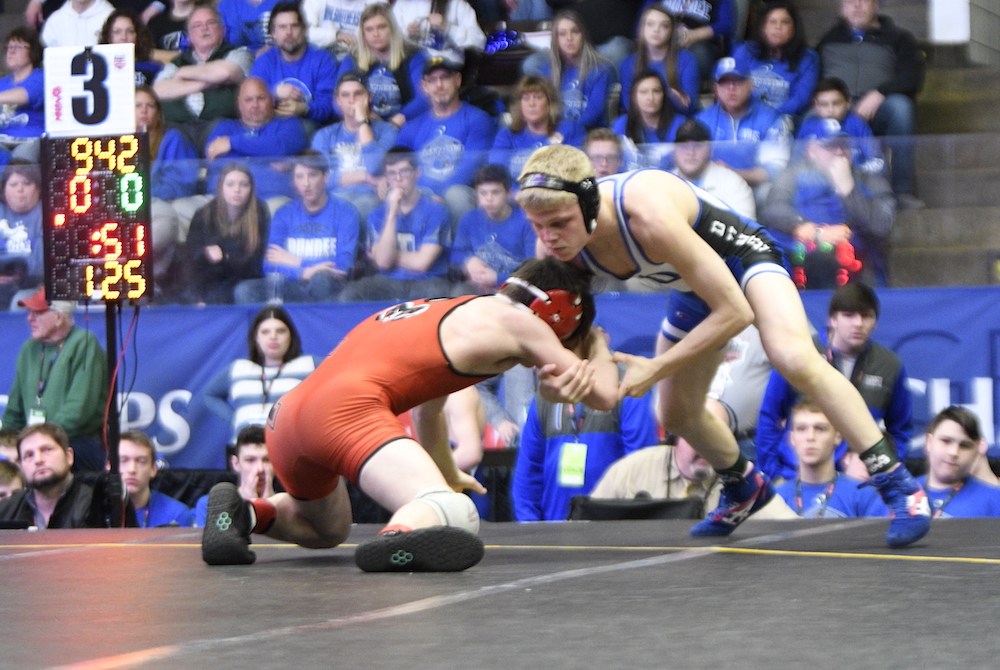
PHOTO: Dundee’s Aiden Davis (right) and Montrose’s Aidan Bernard face off during last season’s Division 3 Semifinals. (Click for more from HighSchoolSportsScene.com.)