

New Math: Division & Multiplication Problems
July 25, 2017
By Jack Roberts
MHSAA Executive Director
This is the second part in a series on MHSAA tournament classification, past and present, that will be published over the next two weeks. This series originally ran in this spring's edition of MHSAA benchmarks.
High school tournament classifications went viral before there was social media and most of us knew what “viral” meant.
Much as a virus infects computers today or has created epidemics of disease around the world for centuries, high school tournament classification – once introduced – tends to spread uncontrollably. Once started, it tends to keep expanding and rarely contracts.
While we are still some distance from providing every team a trophy as a result of expanding high school tournament classification across the country, there is criticism nevertheless that we are headed in that direction – a philosophy which is supposed to exist only in local youth sports for our youngest children.
Michigan could be blamed for all this. Michigan is generally accepted as the first state to provide different classifications for season-ending tournaments for different sized schools. It started a century ago. Today, every state has various classifications for its tournaments in most if not all sports. And it is a bit ironic that Michigan – creator of the classification chaos – more than most other states has kept the number of tournament classes or divisions under control.
Yes, there is evidence that tournament classifications have expanded over the years in Michigan, especially with the relatively recent introduction of tournaments in football and the late 1990s’ move from classes to divisions in most MHSAA tournaments. But the MHSAA Representative Council has held true to its word when it expanded the playoffs for football from four classes to eight divisions: this is needed because of unique factors of football, factors that exist in no other sport; and all other sports should be capped at a maximum of four classes or divisions.
Kentucky is the preeminent defender of single-class basketball. All of its 276 high schools compete for the single state championship for each gender. In Indiana, there are still open wounds from its move in 1998 from one to four classes for its 400 schools in basketball.
Multi-class tournaments have tended to increase the number of non-public school champions, which some states are trying to lower through enrollment “multipliers,” and also tend to increase the number of repeat champions, which some states are trying to affect with “success factors” which lift smaller schools into classifications for larger schools if they take home too many trophies.
While there is considerable evidence that state tournaments do as much bad as good for educational athletics, state associations persist in providing postseason tournaments because, on balance, the experiences are supposed to be good for student-athletes. And once we reach that conclusion it is just a small leap to believe that if the tournaments are good for a few, they must be better for more – which leads to creating more and more tournament classifications. One becomes two classes, then three, then four and so forth.
While the argument is that more classifications or divisions provides more students with opportunities to compete and win, it is undeniable that the experience changes as the number of tournament classifications expands. It is not possible for state associations to provide the same level of support when tournament classifications expand to multiple venues playing simultaneously. For example, there is less audio and video broadcast potential at each venue, and less media coverage to each venue. Focus is diluted and fans diminished at each championship.
No one can argue reasonably that today's two-day MHSAA Football Finals of eight championship games has the same pizazz as the one-day, four-games event conducted prior to 1990.
In some states the number of divisions has grown so much that it is difficult to see much difference between the many season-ending state championship games and a regular-season event in the same sport.
It is a balancing act. And Michigan has been studying that balance longer than any other state, and charting a steadier course than most.
Addition by Division
The shift to Divisions for MHSAA Tournament play in numerous sports has added up to a greater number of champions for teams and individuals across the state. Following are the sports currently employing a divisional format, and the procedures for determining enrollment and classification.
In 23 statewide or Lower Peninsula tournaments, schools which sponsor the sport are currently divided into nearly equal divisions. They are:
- Baseball - 4 Divisions
- Boys Bowling - 4 Divisions
- Girls Bowling - 4 Divisions
- Girls Competitive Cheer - 4 Divisions
- LP Boys Cross Country - 4 Divisions
- LP Girls Cross Country - 4 Divisions
- LP Boys Golf - 4 Divisions
- LP Girls Golf - 4 Divisions
- Ice Hockey - 3 Divisions
- Boys Lacrosse - 2 Divisions
- Girls Lacrosse - 2 Divisions
- Boys Skiing - 2 Divisions
- Girls Skiing - 2 Divisions
- LP Boys Soccer - 4 Divisions LP
- Girls Soccer - 4 Divisions
- Girls Softball - 4 Divisions
- LP Boys Swimming & Diving - 3 Divisions
- LP Girls Swimming & Diving - 3 Divisions
- LP Boys Tennis - 4 Divisions
- LP Girls Tennis - 4 Divisions
- LP Boys Track & Field - 4 Divisions
- LP Girls Track & Field - 4 Divisions
- Wrestling - 4 Divisions
Lists of schools for each division of these 23 tournaments are posted on MHSAA.com approximately April 1. Listings of schools in Upper Peninsula tournaments for their sports are also posted on MHSAA.com. The lists are based on school memberships and sports sponsorships in effect or anticipated for the following school year, as known to the MHSAA office as of a date in early March.
In football, the 256 schools which qualify for MHSAA 11-player playoffs are placed in eight equal divisions annually on Selection Sunday. Beginning in 2017, the 8-player divisions will be determined in a like manner on Selection Sunday as well, with 32 qualifying schools placed in two divisions.
Schools have the option to play in any higher division in one or more sports for a minimum of two years.
The deadlines for "opt-ups" are as follows:
- Applications for fall sports must be submitted by April 15
- Applications for winter sports must be submitted by Aug. 15
- Applications for spring sports must be submitted by Oct. 15
Subsequent to the date of these postings for these tournaments, no school will have its division raised or lowered by schools opening or closing, schools adding or dropping sports, schools exercising the option to play in a higher division, or approval or dissolution of cooperative programs.
When the same sport is conducted for boys and girls in the same season (e.g., track & field and cross country), the gender that has the most sponsoring schools controls the division breaks for both genders.
Preview: Could Friday Finals See New Challengers?
By
Geoff Kimmerly
MHSAA.com senior editor
March 25, 2021
Friday's MHSAA Division 1 and 3 Competitive Cheer Finals at Michigan State University's Breslin Center will include the reigning champions from both divisions and a handful of other contenders we're used to seeing compete during the season's final weekend.
But could this also be another opportunity for a new contender to break through? Rochester Adams won its first championship last season in Division 1, but Plymouth also finished among the top two for the first time. Richmond and Pontiac Notre Dame Prep seem to trade off being the best in Division 3, but Paw Paw is undefeated this season and Croswell-Lexington is another program on the rise.
Spectators will be limited at Friday's Finals, but both will be viewable with subscription on MHSAA.tv. Division 3 begins competition at 10 a.m., with Division 1 at 3 p.m.
Here's a glance at all eight teams competing in each of those divisions (with Division 2 and 4 previews to be published later Friday):
Division 1
BRIGHTON
League finish: First in Kensington Lakes Activities Association West.
Coach: Christina Wilson, seventh season
Championship history: Class A runner-up 1999.
Top score: 788.38.
Team composition: 22 total (five seniors, 10 juniors, two sophomores, five freshmen).
Outlook: Brighton, which also won the overall KLAA title, will be making its fourth Finals appearance in five seasons and is looking to improve on last year’s sixth-place finish at a very tightly-contested Division 1 meet. Brighton’s last three overall scores this season have been 781 or higher to go with wins at the KLAA, District and Regional meets. Seniors Sage Spangler, Gabrielle Ditto and Riley Harvill earned all-region recognition last season.
BROWNSTOWN WOODHAVEN
League finish: Did not compete in a league this season.
Coach: Tara Hazey, 10th season
Championship history: Seeking first top-two Finals finish.
Top score: 783.9.
Team composition: 24 total (four seniors, three juniors, two sophomores, 15 freshmen).
Outlook: Woodhaven is returning to the Finals for the first time since 1995, the latest in a string of accomplishments the last few seasons that also included the program’s first District title in 2019. The Warriors have scored at least 770 points three of their last four competitions. Seniors Marla Matatall, Marisela Vazquez and Brooke Sadlowski and junior Kennedy Stewart earned all-district honors last season.
GRAND BLANC
League finish: Did not compete in a league this season.
Coach: Christina Swansey, 10th season
Championship history: Seeking first top-two Finals finish.
Top score: 782.8.
Team composition: 21 total (four seniors, seven juniors, seven sophomores, three freshmen).
Outlook: Grand Blanc competed only four times this season, but the Bobcats made them count scoring at least 770 at all four and winning their District. They just missed its first top-two Finals finish a year ago, coming in third but less than two points off the lead. Senior Isabella Andre made the all-state second team last season, and junior Jackie Kloph earned an honorable mention.
GRANDVILLE
League finish: First in Ottawa-Kent Conference Red.
Coach: Julie Smith-Boyd, 40th season
Championship history: Six MHSAA titles (most recent 2015), nine runner-up finishes.
Top score: 784.44.
Team composition: 23 total (three seniors, eight juniors, three sophomores, 10 freshmen).
Outlook: Despite missing last season’s Finals, Grandville is among a group of near-yearly qualifiers and finished top-two as recently as 2016. The Bulldogs have scored 780 points four times this winter including to win their District and finish second at their Regional. Seniors Charli Sanchez, Chloe Beatty, Ellie Irwin and juniors Elyse Friberg and Ashley Lam earned all-district recognition last season.
LAKE ORION
League finish: Third in Oakland Activities Association Red.
Coach: Niki Hills, seventh season
Championship history: Seeking first top-two Finals finish.
Top score: 784.02.
Team composition: 27 total (seven seniors, eight juniors, six sophomores, six freshmen).
Outlook: Lake Orion is another Finals regular and finished seventh last season. The Dragons have scored 772 or higher their last six competitions, and finished second at their District less than two points off the lead. Senior Tara Koncelik made the all-state first team last season.
PLYMOUTH
League finish: First in KLAA East.
Coach: Samantha Kerr, sixth season
Championship history: Division 1 runner-up 2020.
Top score: 788.66 at District.
Team composition: 32 total (five seniors, 13 juniors, 10 sophomores, four freshmen)
Outlook: Plymouth posted its top Finals finish ever just a year ago and could be building toward another grand finale with scores of 780 or better its last four competitions. The Wildcats won their District and finished second at both the KLAA overall conference meet and their Regional. Juniors Allison Cassar, Avery Maruszewski and Natalia Muzquiz made the all-state first team last season.
ROCHESTER ADAMS
League finish: First in OAA Red.
Coach: Brooke Miller, seventh season
Championship history: Division 1 champion 2020, three runner-up finishes.
Top score: 791.96.
Team composition: 28 total (seven seniors, 10 juniors, nine sophomores, two freshmen).
Outlook: After finishing Division 1 runner-up two straight seasons, Adams claimed its first title in 2020 and might be the team to chase again this weekend. The Highlanders have scored at least 790 points in four meets and won every competition but one where they finished second. Seniors Claire Crutchfield and Olivia Ris made the all-state first team last winter, senior Ava Bondra and juniors Julia Schultz and Christina Truszkowski made the second team and seniors Carly Schultz and Melina Catenacci and junior Sabrina Lee earned honorable mentions.
ROCHESTER HILLS STONEY CREEK
League finish: Second in OAA Red.
Coach: Tricia Williams, 18th season
Championship history: Division 1 champion 2019 and 2010.
Top score: 788.48.
Team composition: 19 total (three seniors, 11 juniors, one sophomore, four freshmen).
Outlook: Stoney Creek is another frequent Finals participant back after missing the trip a year ago. The Cougars have scored at least 783 points at three competitions including in finishing third at their Regional. Senior Avery McNamara and junior Ella DeGraw earned all-region recognition in 2020.
Division 3
ALMA
League finish: Second in Tri-Valley Conference.
Coach: Kelly Gibson, second season
Championship history: Seeking first top-two finish.
Top score: 714.78 at Regional.
Team composition: 15 total (six seniors, three juniors, three sophomores, three freshmen).
Outlook: Alma was a solid second in the TVC, taking second at all four league competitions and scoring at least 675 at all four. Gibson is only four years removed from cheering for the Panthers and led them to a league title in her first season a year ago. Seniors Christa Fornusek and Victoria Gotaas earned all-region honors last season.
BATTLE CREEK PENNFIELD
League finish: Second in Interstate 8 Athletic Conference.
Coach: Kristen Tucker, sixth season
Championship history: Seeking first top-two Finals finish.
Top score: 720.86 at Regional.
Team composition: 19 total (nine seniors, four juniors, six sophomores).
Outlook: After making Regionals for the fourth straight season, Pennfield took the next step with third place to make it to this weekend’s meet. The Panthers also won three invitationals during the regular season. Seniors Makayla Woolman, Jaidyn Pike and Cathrine Govier and juniors Madison Bommersbach and Delainee Etheridge earned all-district recognition last winter.
COMSTOCK PARK
League finish: First in O-K Silver.
Coach: Hayley Strickland, third season
Championship history: Two MHSAA titles (most recent 2011), four runner-up finishes.
Top score: 757.66.
Team composition: 22 total (six seniors, five juniors, seven sophomores, four freshmen)
Outlook: The Panthers finished fifth at last season’s Finals and followed up by placing first or second at all but one competition this season. They’ve scored less than 700 points only once and at least 730 in four straight meets. Senior Madison Kucharczyk is a returning all-state first teamer, seniors Shanthony Taylor and Niyah Gill made the second team last season and sophomore Delaney Geraghty earned honorable mention.
CROSWELL-LEXINGTON
League finish: Second in Blue Water Area Conference.
Coach: Katie Tomlinson, sixth season
Championship history: Seeking first top-two Finals finish.
Top score: 767.76 at District.
Team composition: 17 total (three seniors, five juniors, five sophomores, four freshmen).
Outlook: Last season’s fourth-place finisher was within five points of coming in runner-up. The Pioneers have gone over 755 points four times this winter and 764 or higher in both of their last two meets. Juniors Taylor Johnson and Ashley Peyerk made the all-state second team last season, and junior Sage Kellerman earned an honorable mention.
FLAT ROCK
League finish: First in Huron League.
Coach: Katelynne Zipfel, second season
Championship history: Class C-D champion 1998, two runner-up finishes.
Top score: Not submitted.
Team composition: 17 total (six seniors, six juniors, three sophomores, two freshmen).
Outlook: Flat Rock scored 742 at its District and 762 at its Regional on the way back to the Finals. The Rams finished third at both but also within three points of winning both – and the Regional included annual powers Pontiac Notre Dame Prep, Croswell-Lexington and Richmond. Seniors Kassandra Corrujedo and Kylee Marrow earned all-region in 2020.
PAW PAW
League finish: First in Wolverine Conference.
Coach: Stefanie Miller, 12th season
Championship history: Seeking first top-two Finals finish.
Top score: 779.44.
Team composition: 22 total (four seniors, eight juniors, four sophomores, six freshmen).
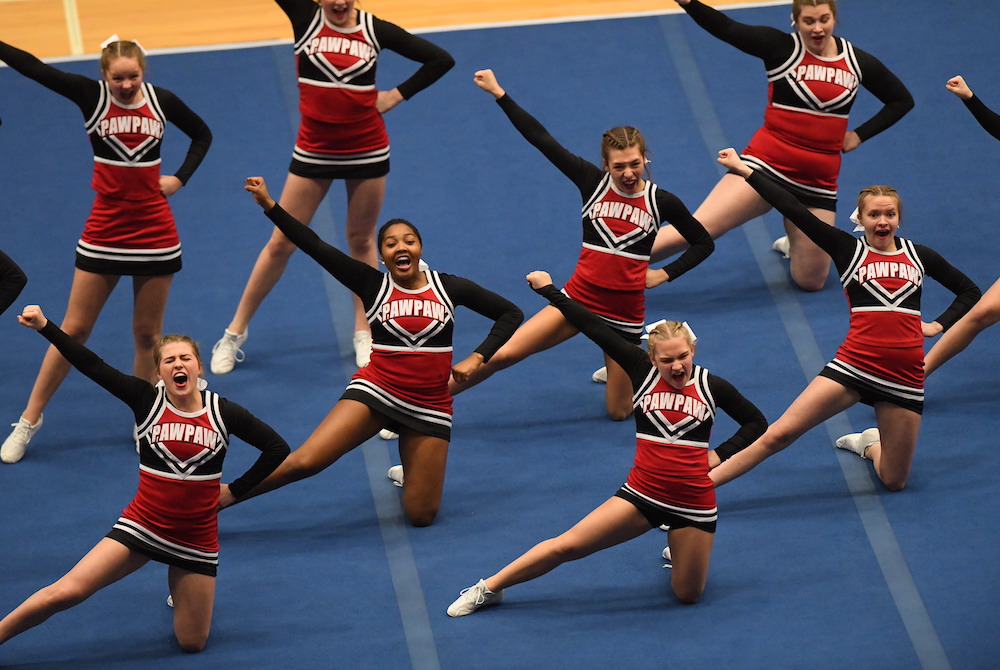
Outlook: Paw Paw finished third last season, only two points out of second, and has won every competition it has competed in this season. Paw Paw has scored at least 770 points four times and 776 or more the last three. Senior Mackenzie Miller and junior Paige Miller made the all-state first team last season, juniors Rylee Goldberg and Alexis Sunlin made the second and junior Gabby Oh earned an honorable mention.
PONTIAC NOTRE DAME PREP
League finish: Does not compete in a league.
Coach: Beth Lockhart, eighth season
Championship history: Five MHSAA titles (most recent 2018), three runner-up finishes.
Top score: 772.34 at District.
Team composition: 24 total (five seniors, six juniors, five sophomores, eight freshmen).
Outlook: Last season’s runner-up finish was Notre Dame Prep’s second straight and eighth-consecutive top-two finish in Division 3. The Fighting Irish bounced back from finishing second to Richmond at the District to winning their Regional. Senior Olivia Duoba is a returning all-state first teamer, juniors Grace Byrne and Riley Lumm and sophomore Raylynn Quasarano made the second and senior Sydney Hoeppner earned an honorable mention.
RICHMOND
League finish: First in Blue Water Area Conference.
Coach: Kelli Matthes, 13th season
Championship history: Four MHSAA titles (most recent 2020), five runner-up finishes.
Top score: 781.87 at District.
Team composition: 23 total (one senior, eight juniors, eight sophomores, six freshmen).
Outlook: Richmond has won the last two Division 3 titles and finished first or second nine of the last 10 seasons. The Blue Devils’ low score is 744.44 and they won all of their competitions before finishing fourth at the Regional – but still, only 4.1 points out of first that day. Juniors Makenna Parker and Gracie Ellis made the all-state first team last season, and junior Ava Moskwa made the second team.
PHOTO: Paw Paw competes in Round 1 of last season's Division 3 Competitive Cheer Finals.