


New Math: Division & Multiplication Problems
July 25, 2017
By Jack Roberts
MHSAA Executive Director
This is the second part in a series on MHSAA tournament classification, past and present, that will be published over the next two weeks. This series originally ran in this spring's edition of MHSAA benchmarks.
High school tournament classifications went viral before there was social media and most of us knew what “viral” meant.
Much as a virus infects computers today or has created epidemics of disease around the world for centuries, high school tournament classification – once introduced – tends to spread uncontrollably. Once started, it tends to keep expanding and rarely contracts.
While we are still some distance from providing every team a trophy as a result of expanding high school tournament classification across the country, there is criticism nevertheless that we are headed in that direction – a philosophy which is supposed to exist only in local youth sports for our youngest children.
Michigan could be blamed for all this. Michigan is generally accepted as the first state to provide different classifications for season-ending tournaments for different sized schools. It started a century ago. Today, every state has various classifications for its tournaments in most if not all sports. And it is a bit ironic that Michigan – creator of the classification chaos – more than most other states has kept the number of tournament classes or divisions under control.
Yes, there is evidence that tournament classifications have expanded over the years in Michigan, especially with the relatively recent introduction of tournaments in football and the late 1990s’ move from classes to divisions in most MHSAA tournaments. But the MHSAA Representative Council has held true to its word when it expanded the playoffs for football from four classes to eight divisions: this is needed because of unique factors of football, factors that exist in no other sport; and all other sports should be capped at a maximum of four classes or divisions.
Kentucky is the preeminent defender of single-class basketball. All of its 276 high schools compete for the single state championship for each gender. In Indiana, there are still open wounds from its move in 1998 from one to four classes for its 400 schools in basketball.
Multi-class tournaments have tended to increase the number of non-public school champions, which some states are trying to lower through enrollment “multipliers,” and also tend to increase the number of repeat champions, which some states are trying to affect with “success factors” which lift smaller schools into classifications for larger schools if they take home too many trophies.
While there is considerable evidence that state tournaments do as much bad as good for educational athletics, state associations persist in providing postseason tournaments because, on balance, the experiences are supposed to be good for student-athletes. And once we reach that conclusion it is just a small leap to believe that if the tournaments are good for a few, they must be better for more – which leads to creating more and more tournament classifications. One becomes two classes, then three, then four and so forth.
While the argument is that more classifications or divisions provides more students with opportunities to compete and win, it is undeniable that the experience changes as the number of tournament classifications expands. It is not possible for state associations to provide the same level of support when tournament classifications expand to multiple venues playing simultaneously. For example, there is less audio and video broadcast potential at each venue, and less media coverage to each venue. Focus is diluted and fans diminished at each championship.
No one can argue reasonably that today's two-day MHSAA Football Finals of eight championship games has the same pizazz as the one-day, four-games event conducted prior to 1990.
In some states the number of divisions has grown so much that it is difficult to see much difference between the many season-ending state championship games and a regular-season event in the same sport.
It is a balancing act. And Michigan has been studying that balance longer than any other state, and charting a steadier course than most.
Addition by Division
The shift to Divisions for MHSAA Tournament play in numerous sports has added up to a greater number of champions for teams and individuals across the state. Following are the sports currently employing a divisional format, and the procedures for determining enrollment and classification.
In 23 statewide or Lower Peninsula tournaments, schools which sponsor the sport are currently divided into nearly equal divisions. They are:
- Baseball - 4 Divisions
- Boys Bowling - 4 Divisions
- Girls Bowling - 4 Divisions
- Girls Competitive Cheer - 4 Divisions
- LP Boys Cross Country - 4 Divisions
- LP Girls Cross Country - 4 Divisions
- LP Boys Golf - 4 Divisions
- LP Girls Golf - 4 Divisions
- Ice Hockey - 3 Divisions
- Boys Lacrosse - 2 Divisions
- Girls Lacrosse - 2 Divisions
- Boys Skiing - 2 Divisions
- Girls Skiing - 2 Divisions
- LP Boys Soccer - 4 Divisions LP
- Girls Soccer - 4 Divisions
- Girls Softball - 4 Divisions
- LP Boys Swimming & Diving - 3 Divisions
- LP Girls Swimming & Diving - 3 Divisions
- LP Boys Tennis - 4 Divisions
- LP Girls Tennis - 4 Divisions
- LP Boys Track & Field - 4 Divisions
- LP Girls Track & Field - 4 Divisions
- Wrestling - 4 Divisions
Lists of schools for each division of these 23 tournaments are posted on MHSAA.com approximately April 1. Listings of schools in Upper Peninsula tournaments for their sports are also posted on MHSAA.com. The lists are based on school memberships and sports sponsorships in effect or anticipated for the following school year, as known to the MHSAA office as of a date in early March.
In football, the 256 schools which qualify for MHSAA 11-player playoffs are placed in eight equal divisions annually on Selection Sunday. Beginning in 2017, the 8-player divisions will be determined in a like manner on Selection Sunday as well, with 32 qualifying schools placed in two divisions.
Schools have the option to play in any higher division in one or more sports for a minimum of two years.
The deadlines for "opt-ups" are as follows:
- Applications for fall sports must be submitted by April 15
- Applications for winter sports must be submitted by Aug. 15
- Applications for spring sports must be submitted by Oct. 15
Subsequent to the date of these postings for these tournaments, no school will have its division raised or lowered by schools opening or closing, schools adding or dropping sports, schools exercising the option to play in a higher division, or approval or dissolution of cooperative programs.
When the same sport is conducted for boys and girls in the same season (e.g., track & field and cross country), the gender that has the most sponsoring schools controls the division breaks for both genders.
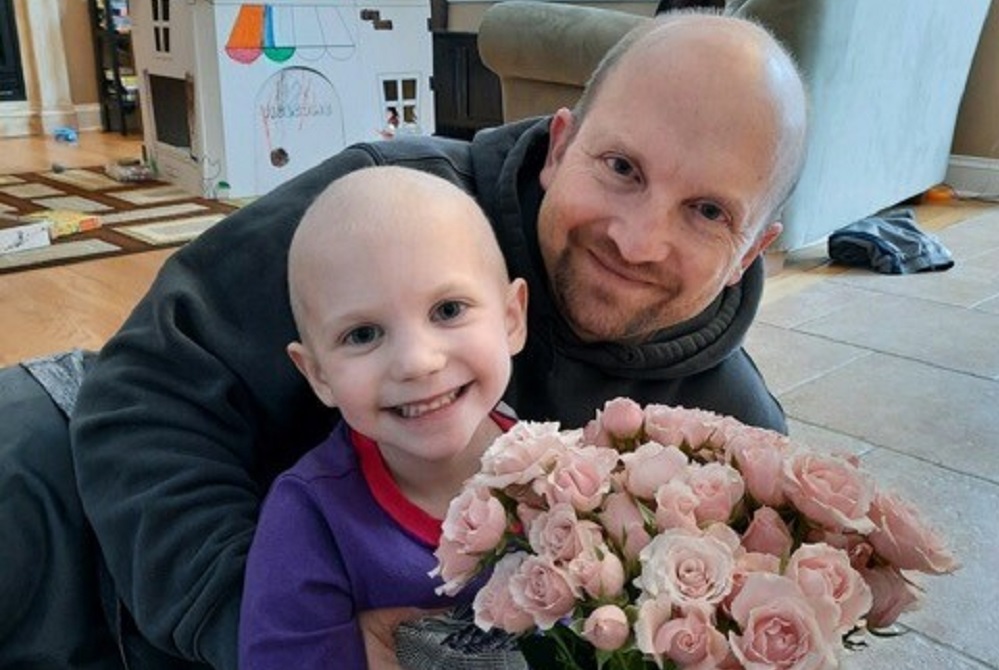
#Charleytough Getting Stronger Amid Outpouring of Support
By
Tim Robinson
Special for MHSAA.com
March 11, 2021
On a recent evening at the home of Corunna boys basketball coach John “Rocky” Buscemi and his wife Chloe, the household is a whirlwind of activity.
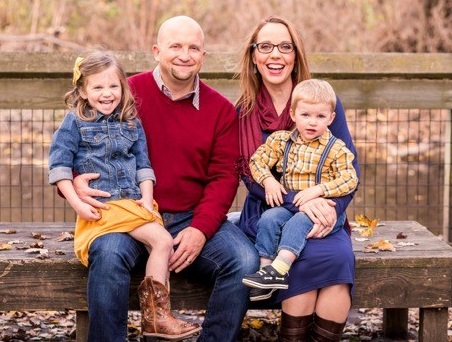
 Their daughter Charley, 5, darts in and out of the Buscemis’ home office to ask questions, mimic riding a horse, or whatever else comes to the mind of a little girl full of energy.
The only thing that would tell you that cancer had interrupted their lives for five months in the fall and winter is the hair that just now is starting to grow on Charley’s scalp.
Shock, then Support
Charley Buscemi is named after her grandfather, Charley Silm, who refereed high school basketball for 22 years in and around mid-Michigan when he wasn’t working on the farm. He often took his daughter, Chloe, to games he worked when she was a youngster.
“I remember packing up my little bag with snacks and watch my dad officiate,” Chloe Silm-Buscemi recalled. “Even though I didn’t play basketball, I grew up in the gym, just like Charley did.”
Her daughter has grown up watching her dad coach. She confidently refers to Corunna players as “her boys” and announces that she wants to coach with him some day.
Last summer, Charley was having trouble sleeping, and sleep apnea was diagnosed. Her doctor advised that removing Charley’s tonsils would likely eliminate the apnea.
 The Buscemis agreed, and her tonsils were removed Sept. 25.
“We knew nothing else,” Chloe said, “but apparently the doctor noticed that one of the tonsils looked abnormal, or a little awkward, so he sent it off for testing.”
Chloe said she was told that any complications might require another operation to stop bleeding in the area, but she was stunned when the doctor’s office called back Oct. 1.
“We didn’t know the testing had been done,” Chloe said. “We got a call that said ‘the findings of the pathology are consistent with a diagnosis of lymphoma.’ And we were like, ‘Wait. What?’ It caught us completely off guard. (Charley) was racing in circles around our kitchen island and our dining room table, and I was like, no, you’ve got the wrong kid here. There’s no way this kid has cancer.”
“Initially, it was, this can’t be right,” Rocky said. “I was trying to read between the lines and find some wording that gave some idea that this is what they think. I tried to hang onto the idea that there’s got to be more tests, and those tests will show us that it’s not (cancer).”
The diagnosis was correct. Charley had diffuse large B-cell lymphoma, the most common type of non-Hodgkin lymphoma. It’s a fast-growing cancer that affects B-lymphocytes, a type of blood cell that helps fight infection.
While it is a fast-growing lymphoma, it’s considered potentially curable.
The cancerous cells found in Charley’s tonsil were sent to the Mayo Clinic and the National Institute of Health, and the diagnosis was confirmed.
Charley began chemotherapy at Sparrow Hospital in Lansing and celebrated her fifth birthday there.
Chloe, meanwhile, was also navigating the second trimester of her pregnancy.
“I spent most of my second trimester sleeping on a cot in the hospital while she got chemo treatments,” Chloe said.
“Her first round of chemo was horrible,” Rocky said. “She didn’t react to it well, and we were there 20 of 25 days.”
 But once word got out, people in the Corunna school system, neighbors, fellow coaches and others reached out in the Buscemis’ time of need.
“The schools were so understanding,” Rocky said. “Once we found out, it was, go be with your family. Put in for your (Family and Medical Leave Act). Everyone was supportive from that end.”
The Corunna basketball players drove out to the Buscemi home and raked up its leaves. Some Corunna alumni got together to string up Christmas lights, the Orchard Lake St. Mary’s team sent her a giant stuffed panda, and many more showed support.
“We’re working on thank-yous now,” Chloe said. “My mom says people would know if you posted a thank-you (online), but I want to be able to send something out. Right now there’s something like 250 thank-yous.”
Strength & Sliver Linings
Charley had two rounds of chemotherapy and has been pronounced cancer-free. She has monthly meetings with her oncologist and quarterly CT scans scheduled for the next year.
“They’re watching her heart, because the chemo can affect that, so we meet with the cardiologist,” Chloe says.
“It’s a lot for a little person,” she adds as Charley flits back and forth between parents, announcing at one point she has cleaned her plate at dinner with no small amount of pride. “But for the most part, she’s just like this. She’s pretty happy, pretty easy-going, and takes it in stride. Sometimes I struggle with it more than she does. You feel totally helpless.”
For Rocky, the whole experience is full of silver linings, however hard-won.
“You’re always trying to find the silver linings,’ he said. “We had no idea she had cancer, but the silver lining was once we found out what it was, and it was confined to the tonsil, the blessing was it was almost a miracle we had her tonsils removed almost at the same time it was starting to develop. It wasn’t found anywhere else, so that’s a silver lining.
“Recently she’s been diagnosed as having celiac disease, and we’ve been given the OK to (shift) to a gluten-free diet. If she hadn’t had cancer, we might not have known until she was a teenager and had permanent damage. We’ve been so fortunate and blessed to find things out when we did.”
The Buscemis talk in tones of awe and appreciation for the caring and other gestures that have come their way.
“It’s incredibly humbling,” Rocky said. “It makes you want to do for someone else. I’m much more aware of people in need, and I hope to pay it forward. There are a lot of people you wouldn’t have anticipated reaching out who have reached out.”
The fear and stress of that time, he said, are often near, even with Charley in the clear.
“I wanted to be strong for Chloe and my family and be that rock that could be leaned on,” he said. “But man, oh man, there are still mornings when I drive to school and tear up. It’s nice to have other guys who understand that or have been through it. I’d be the rock here (at home) and then I’d be emotional with my friends in the coaching fraternity.”
Charley and 3-year-old brother Sam were mainstays at practice last year, playing quietly in a corner of the gym while the team practiced. Charley was at most every game, and Rocky always made a point of looking for her and her mother in the stands.
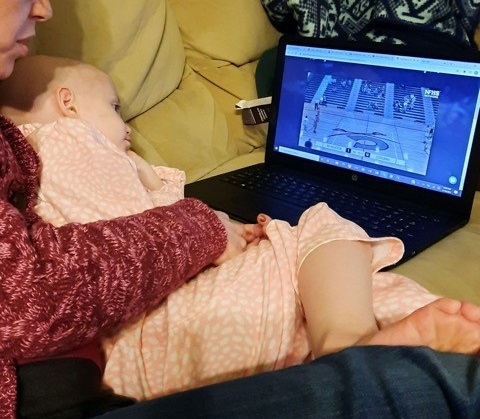
That hasn’t been the case this year, as Charley’s immune system has been weakened by the chemo and has kept her at home this season, watching the Cavaliers play on her mother’s laptop.
There’s been another change, too.
 “I’ve adopted a one-day-at-a-time, appreciate-every-moment approach,” Rocky said. “A year ago in 9-degree weather, I might have been trying to find reasons not to go outside. Now if Charley wants to go sledding, we’re going sledding!”
He laughs as he says that, a man who has a new appreciation of things.
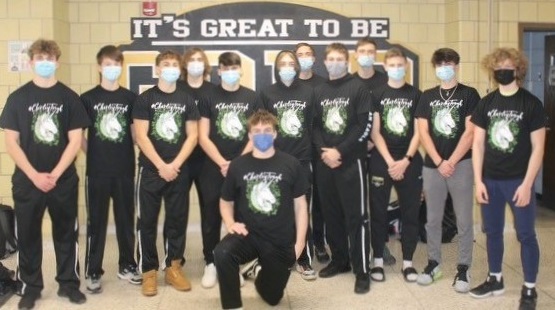
His players have been honoring her, too, wearing black T-shirts at warmups with a large unicorn on the front with the hashtag #Charleytough and the Corunna logo on a basketball.
As for Charley, she will go back to kindergarten next year, but at the moment, she’s anxiously awaiting the birth of her brother or sister March 22.
She already has informed her parents that her new sibling will be a girl, named Maggie, and wants the newborn to sleep in her room.
“She says, ‘Mommy, I’ll feed the baby,’” Chloe said, chuckling. “I told Rocky we don’t have to worry about parenting a third baby. Charley’s got it.”
Besides another new brother or sister, if all goes well, Charley will be back on the sideline with her dad and her basketball team next winter.
Rocky says his family’s experience, among other things, showed him how strong the ties are in the coaching community.
“It was nice to see the game be the bridge that allowed me to reach out and depend on people a little bit,” he said “Without it, you don’t have those relationships. Things like this make you realize how special those things really are. If you don’t experience it, you don’t get to understand people’s true motivations.
“It was humbling,” he added. “It was scary at times, but all in all it was a little bit of everything that helped us to be able to get through this.”
PHOTOS: (Top) Charley Buscemi and her dad Rocky enjoy a fun moment at home. (2) From left: Charley, Rocky, Chloe and Sam Buscemi. (3) Corunna players wear #Charleytough T-shirts as warm-ups for their games. They prominently feature Charley’s favorite animal, a unicorn. (4) Charley’s immune system isn’t robust enough for her to attend games in person, but she never misses a chance to watch “her boys” play on her mom’s laptop. (Photos courtesy of the Buscemi family.)