

New Math: Division & Multiplication Problems
July 25, 2017
By Jack Roberts
MHSAA Executive Director
This is the second part in a series on MHSAA tournament classification, past and present, that will be published over the next two weeks. This series originally ran in this spring's edition of MHSAA benchmarks.
High school tournament classifications went viral before there was social media and most of us knew what “viral” meant.
Much as a virus infects computers today or has created epidemics of disease around the world for centuries, high school tournament classification – once introduced – tends to spread uncontrollably. Once started, it tends to keep expanding and rarely contracts.
While we are still some distance from providing every team a trophy as a result of expanding high school tournament classification across the country, there is criticism nevertheless that we are headed in that direction – a philosophy which is supposed to exist only in local youth sports for our youngest children.
Michigan could be blamed for all this. Michigan is generally accepted as the first state to provide different classifications for season-ending tournaments for different sized schools. It started a century ago. Today, every state has various classifications for its tournaments in most if not all sports. And it is a bit ironic that Michigan – creator of the classification chaos – more than most other states has kept the number of tournament classes or divisions under control.
Yes, there is evidence that tournament classifications have expanded over the years in Michigan, especially with the relatively recent introduction of tournaments in football and the late 1990s’ move from classes to divisions in most MHSAA tournaments. But the MHSAA Representative Council has held true to its word when it expanded the playoffs for football from four classes to eight divisions: this is needed because of unique factors of football, factors that exist in no other sport; and all other sports should be capped at a maximum of four classes or divisions.
Kentucky is the preeminent defender of single-class basketball. All of its 276 high schools compete for the single state championship for each gender. In Indiana, there are still open wounds from its move in 1998 from one to four classes for its 400 schools in basketball.
Multi-class tournaments have tended to increase the number of non-public school champions, which some states are trying to lower through enrollment “multipliers,” and also tend to increase the number of repeat champions, which some states are trying to affect with “success factors” which lift smaller schools into classifications for larger schools if they take home too many trophies.
While there is considerable evidence that state tournaments do as much bad as good for educational athletics, state associations persist in providing postseason tournaments because, on balance, the experiences are supposed to be good for student-athletes. And once we reach that conclusion it is just a small leap to believe that if the tournaments are good for a few, they must be better for more – which leads to creating more and more tournament classifications. One becomes two classes, then three, then four and so forth.
While the argument is that more classifications or divisions provides more students with opportunities to compete and win, it is undeniable that the experience changes as the number of tournament classifications expands. It is not possible for state associations to provide the same level of support when tournament classifications expand to multiple venues playing simultaneously. For example, there is less audio and video broadcast potential at each venue, and less media coverage to each venue. Focus is diluted and fans diminished at each championship.
No one can argue reasonably that today's two-day MHSAA Football Finals of eight championship games has the same pizazz as the one-day, four-games event conducted prior to 1990.
In some states the number of divisions has grown so much that it is difficult to see much difference between the many season-ending state championship games and a regular-season event in the same sport.
It is a balancing act. And Michigan has been studying that balance longer than any other state, and charting a steadier course than most.
Addition by Division
The shift to Divisions for MHSAA Tournament play in numerous sports has added up to a greater number of champions for teams and individuals across the state. Following are the sports currently employing a divisional format, and the procedures for determining enrollment and classification.
In 23 statewide or Lower Peninsula tournaments, schools which sponsor the sport are currently divided into nearly equal divisions. They are:
- Baseball - 4 Divisions
- Boys Bowling - 4 Divisions
- Girls Bowling - 4 Divisions
- Girls Competitive Cheer - 4 Divisions
- LP Boys Cross Country - 4 Divisions
- LP Girls Cross Country - 4 Divisions
- LP Boys Golf - 4 Divisions
- LP Girls Golf - 4 Divisions
- Ice Hockey - 3 Divisions
- Boys Lacrosse - 2 Divisions
- Girls Lacrosse - 2 Divisions
- Boys Skiing - 2 Divisions
- Girls Skiing - 2 Divisions
- LP Boys Soccer - 4 Divisions LP
- Girls Soccer - 4 Divisions
- Girls Softball - 4 Divisions
- LP Boys Swimming & Diving - 3 Divisions
- LP Girls Swimming & Diving - 3 Divisions
- LP Boys Tennis - 4 Divisions
- LP Girls Tennis - 4 Divisions
- LP Boys Track & Field - 4 Divisions
- LP Girls Track & Field - 4 Divisions
- Wrestling - 4 Divisions
Lists of schools for each division of these 23 tournaments are posted on MHSAA.com approximately April 1. Listings of schools in Upper Peninsula tournaments for their sports are also posted on MHSAA.com. The lists are based on school memberships and sports sponsorships in effect or anticipated for the following school year, as known to the MHSAA office as of a date in early March.
In football, the 256 schools which qualify for MHSAA 11-player playoffs are placed in eight equal divisions annually on Selection Sunday. Beginning in 2017, the 8-player divisions will be determined in a like manner on Selection Sunday as well, with 32 qualifying schools placed in two divisions.
Schools have the option to play in any higher division in one or more sports for a minimum of two years.
The deadlines for "opt-ups" are as follows:
- Applications for fall sports must be submitted by April 15
- Applications for winter sports must be submitted by Aug. 15
- Applications for spring sports must be submitted by Oct. 15
Subsequent to the date of these postings for these tournaments, no school will have its division raised or lowered by schools opening or closing, schools adding or dropping sports, schools exercising the option to play in a higher division, or approval or dissolution of cooperative programs.
When the same sport is conducted for boys and girls in the same season (e.g., track & field and cross country), the gender that has the most sponsoring schools controls the division breaks for both genders.
Henry Adds Coaching to K-Zoo Connection
By
Pam Shebest
Special for MHSAA.com
October 7, 2020
KALAMAZOO — When he was 5 years old, Daniel Henry lost his father to brain cancer.
 At age 14, he lost his mother to breast cancer.
Grieving his losses and living with his 23-year-old sister, Henry found solace in friends and high school tennis.
After skipping fourth grade, Henry was a young sophomore at Kalamazoo Central when his mother died.
“It was very difficult,” said Henry, now 21. “She’s the one who structured my day. It was my mom that planned out my activities because on the Northside (area of Kalamazoo), it’s very easy to get very distracted and do the wrong things.
“She definitely made sure that I followed the right type of people, people who were doing the right kinds of things for me. After that, it was, ‘Now what do I do?’”
Tennis indeed played a prominent role, engaging him at Central, pointing him toward the next step after graduation and bringing him back after college to share what he's learned.
Continuing a legacy
Tennis continues to give Henry a connection with his mother, Gina Rickman, who was a tennis pro at the YMCA of Greater Kalamazoo.
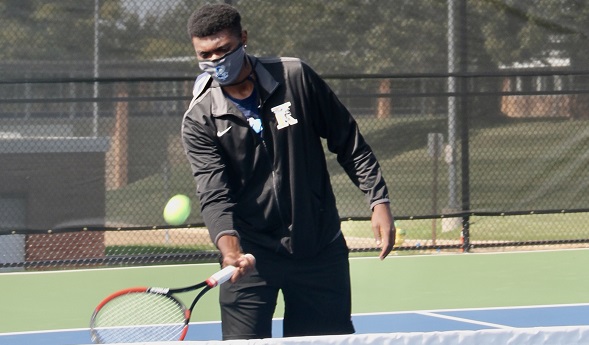
Continuing her legacy, he is a first-year coach of Kalamazoo Loy Norrix’s boys tennis team – quite a leap for a guy who played high school tennis at crosstown rival Kalamazoo Central.
 “I hope no one from Central sees this,” Henry said, laughing. “I actually really do like it.
“Whatever I thought of Norrix my whole time being at the rival school, it’s kind of nice now that I don’t have to have any ill will toward my rival school. My mom went (to Norrix) as well. It’s just kind of poetic.”
Graduating from Kalamazoo College this year with a degree in computer science, Henry is taking a break from his job as a legal intern at Ven Johnson Law to coach.
Portage Central tennis coach Peter Militzer worked with Rickman and has known Henry most of his life.
“Gina had a heart of gold. She did more for the game of tennis with underprivileged youth than anyone I know,” Militzer said. “She instilled that same sense of giving back to your community in both Daniel and (sister) Brittany.”
Brittany Johnson took charge of Henry when their mother died, since his uncle lived in Chicago and his beloved grandmother, June Cotton, was in a nursing home.
“Looking back, I expected her to take on the role of my mother and was disappointed at times when I feel like she didn’t quite live up to that,” Henry said of his sister.
“But now that I’m nearing 22, I couldn’t imagine having the responsibility of taking care of anyone.”
Without his mother’s guidance, “It was very hard for me to find something to do constructively other than tennis.
 ”I’m just really happy I didn’t fall into some bad habits. It could have made it much harder to get here, if not impossible.”
Henry started playing tennis at age 7, but when a coach tried to change his grip by taping his hand to the racket, he said he gave it up.
“When I got to high school, I was like, ‘OK. I played this before. I’m not really good at it right now, but I can meet some friends and play a sport in high school,’” Henry said, “because I wasn’t sure if I was going to make the basketball team.”
Militzer said that at K-Central, Daniel was almost a coach to his teammates.
“He had few players on his team who could even rally with him, but it never seemed to get him down,” he said.
“In watching his team interact, you could see how important he was to the group.”
Keeping a Kalamazoo Promise
The Kalamazoo Promise was instrumental in Henry’s college choice.
The Promise is a fund provided by anonymous donors that will pay tuition to any Michigan college for students who graduate from Kalamazoo Public Schools.
“In kindergarten, they pound (the Promise) into our heads,” Henry said. “I didn’t really know what it meant at the time.”
By his sophomore year at Central, he understood and realized he had to keep his grades up if he wanted to attend college.
“I had a 4.0 before my mom passed away,” he said. “For me to just try to hold on and keep my grades, up I didn’t really need to study very much. But it started to show my senior year when I took AP classes.
“Part of it was I’m going to college because my grandma said so, and (I need to) keep my grades up so I can go to the best college I can go to.”
 Henry said then-KPS superintendent Michael Rice – who became Michigan state superintendent of public instruction in 2019 – talked to Kalamazoo College men’s tennis coach Mark Riley about him.
“I’d been ignoring (Riley’s) emails because it was a Division III school,” Henry said. “Then I learned (Hornets tennis) was top 20 in the nation. I didn’t know much about college athletics.”
He chose Kalamazoo College, but said he was feeling burned out on school.
“Then Coach Riley said ‘No, you’re here to become a student. You’re here to learn.
“‘You’re here to get your degree and move on because tennis will only last four years, but the connections you make and things you learn will last the rest of your life.”
Norrix athletic director Andrew Laboe noted how the tennis team got a boost after football was postponed due to COVID-19 precautions earlier this year. At many schools, football players picked up other fall sports including tennis. “The telling part of that is three out of the four football players have stayed for the remainder of the season,” he said.
“Daniel is a big reason why they stayed. He has made tennis a fun experience for everyone.”
Laboe said Henry’s youth is a plus.
“He relates to the athletes well as he understands them at their level as he is young himself,” Laboe said. “They respect that he has played well at Kalamazoo College and that he is a product of Kalamazoo Public Schools and has been in our community his entire life.”
Riley said Henry is a “good listener, empathetic, caring, respectful and wants his (players) to love the sport like he does.
“He’s a proactive leader and has the ability to lead by example on the court. Daniel will thrive in life and any endeavor that he chooses.”
While Henry has his eye on attending law school in the near future, he is committed to teaching his Norrix players those same values.
“This is so fun, especially being in a team environment,” he said. “Looking at the relationship that I have with Coach Riley, he’s just hilarious and knows exactly what he’s talking about.
“If the player listens, he’s going to start winning. That’s just how it works. That’s how it worked throughout my career. The times I lost was because I wasn’t listening.”
 Pam Shebest served as a sportswriter at the Kalamazoo Gazette from 1985-2009 after 11 years part-time with the Gazette while teaching French and English at White Pigeon High School. She can be reached at [email protected] with story ideas for Calhoun, Kalamazoo and Van Buren counties.
PHOTOS: (Top) Kalamazoo Loy Norrix boys tennis coach Daniel Henry sends back a volley during a practice this fall. (2) Daniel Henry. (3) Daniel Henry and his mother Gina Rickman. (4) From left: Loy Norrix athletic director Andrew Laboe, Portage Central coach Peter Militzer, Kalamazoo College coach Mark Riley. (Action and top Henry photos by Pam Shebest. Henry and Rickman photo courtesy of Daniel Henry. Riley photo courtesy of Kalamazoo College.)