


New Math: Division & Multiplication Problems
July 25, 2017
By Jack Roberts
MHSAA Executive Director
This is the second part in a series on MHSAA tournament classification, past and present, that will be published over the next two weeks. This series originally ran in this spring's edition of MHSAA benchmarks.
High school tournament classifications went viral before there was social media and most of us knew what “viral” meant.
Much as a virus infects computers today or has created epidemics of disease around the world for centuries, high school tournament classification – once introduced – tends to spread uncontrollably. Once started, it tends to keep expanding and rarely contracts.
While we are still some distance from providing every team a trophy as a result of expanding high school tournament classification across the country, there is criticism nevertheless that we are headed in that direction – a philosophy which is supposed to exist only in local youth sports for our youngest children.
Michigan could be blamed for all this. Michigan is generally accepted as the first state to provide different classifications for season-ending tournaments for different sized schools. It started a century ago. Today, every state has various classifications for its tournaments in most if not all sports. And it is a bit ironic that Michigan – creator of the classification chaos – more than most other states has kept the number of tournament classes or divisions under control.
Yes, there is evidence that tournament classifications have expanded over the years in Michigan, especially with the relatively recent introduction of tournaments in football and the late 1990s’ move from classes to divisions in most MHSAA tournaments. But the MHSAA Representative Council has held true to its word when it expanded the playoffs for football from four classes to eight divisions: this is needed because of unique factors of football, factors that exist in no other sport; and all other sports should be capped at a maximum of four classes or divisions.
Kentucky is the preeminent defender of single-class basketball. All of its 276 high schools compete for the single state championship for each gender. In Indiana, there are still open wounds from its move in 1998 from one to four classes for its 400 schools in basketball.
Multi-class tournaments have tended to increase the number of non-public school champions, which some states are trying to lower through enrollment “multipliers,” and also tend to increase the number of repeat champions, which some states are trying to affect with “success factors” which lift smaller schools into classifications for larger schools if they take home too many trophies.
While there is considerable evidence that state tournaments do as much bad as good for educational athletics, state associations persist in providing postseason tournaments because, on balance, the experiences are supposed to be good for student-athletes. And once we reach that conclusion it is just a small leap to believe that if the tournaments are good for a few, they must be better for more – which leads to creating more and more tournament classifications. One becomes two classes, then three, then four and so forth.
While the argument is that more classifications or divisions provides more students with opportunities to compete and win, it is undeniable that the experience changes as the number of tournament classifications expands. It is not possible for state associations to provide the same level of support when tournament classifications expand to multiple venues playing simultaneously. For example, there is less audio and video broadcast potential at each venue, and less media coverage to each venue. Focus is diluted and fans diminished at each championship.
No one can argue reasonably that today's two-day MHSAA Football Finals of eight championship games has the same pizazz as the one-day, four-games event conducted prior to 1990.
In some states the number of divisions has grown so much that it is difficult to see much difference between the many season-ending state championship games and a regular-season event in the same sport.
It is a balancing act. And Michigan has been studying that balance longer than any other state, and charting a steadier course than most.
Addition by Division
The shift to Divisions for MHSAA Tournament play in numerous sports has added up to a greater number of champions for teams and individuals across the state. Following are the sports currently employing a divisional format, and the procedures for determining enrollment and classification.
In 23 statewide or Lower Peninsula tournaments, schools which sponsor the sport are currently divided into nearly equal divisions. They are:
- Baseball - 4 Divisions
- Boys Bowling - 4 Divisions
- Girls Bowling - 4 Divisions
- Girls Competitive Cheer - 4 Divisions
- LP Boys Cross Country - 4 Divisions
- LP Girls Cross Country - 4 Divisions
- LP Boys Golf - 4 Divisions
- LP Girls Golf - 4 Divisions
- Ice Hockey - 3 Divisions
- Boys Lacrosse - 2 Divisions
- Girls Lacrosse - 2 Divisions
- Boys Skiing - 2 Divisions
- Girls Skiing - 2 Divisions
- LP Boys Soccer - 4 Divisions LP
- Girls Soccer - 4 Divisions
- Girls Softball - 4 Divisions
- LP Boys Swimming & Diving - 3 Divisions
- LP Girls Swimming & Diving - 3 Divisions
- LP Boys Tennis - 4 Divisions
- LP Girls Tennis - 4 Divisions
- LP Boys Track & Field - 4 Divisions
- LP Girls Track & Field - 4 Divisions
- Wrestling - 4 Divisions
Lists of schools for each division of these 23 tournaments are posted on MHSAA.com approximately April 1. Listings of schools in Upper Peninsula tournaments for their sports are also posted on MHSAA.com. The lists are based on school memberships and sports sponsorships in effect or anticipated for the following school year, as known to the MHSAA office as of a date in early March.
In football, the 256 schools which qualify for MHSAA 11-player playoffs are placed in eight equal divisions annually on Selection Sunday. Beginning in 2017, the 8-player divisions will be determined in a like manner on Selection Sunday as well, with 32 qualifying schools placed in two divisions.
Schools have the option to play in any higher division in one or more sports for a minimum of two years.
The deadlines for "opt-ups" are as follows:
- Applications for fall sports must be submitted by April 15
- Applications for winter sports must be submitted by Aug. 15
- Applications for spring sports must be submitted by Oct. 15
Subsequent to the date of these postings for these tournaments, no school will have its division raised or lowered by schools opening or closing, schools adding or dropping sports, schools exercising the option to play in a higher division, or approval or dissolution of cooperative programs.
When the same sport is conducted for boys and girls in the same season (e.g., track & field and cross country), the gender that has the most sponsoring schools controls the division breaks for both genders.
Familiar Name Home Again for Mona Shores
September 23, 2020
By Tom Kendra
Special for Second Half
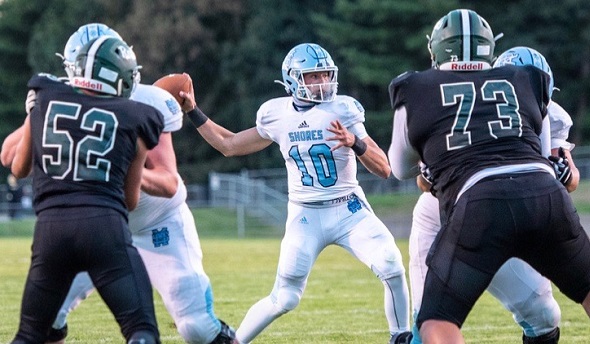
One of the biggest names in Muskegon Mona Shores football history is back at quarterback – after a 40-year hiatus.
 Mark Konecny, who went on to Alma College and then became the first Michigan Intercollegiate Athletic Association player to make it to the NFL, moved back home from Colorado in 2017. Now it’s his son (same name) who is connecting with receivers for the reigning Division 2 champion Sailors.
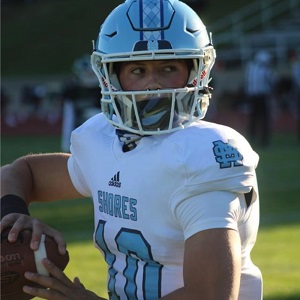
“It’s kind of cool to be here playing on the same field and practicing on the same field as him,” said Konecny, a 6-foot, 190-pound junior who wears No. 10, while his dad wore No. 11 at Shores. “I came here for a veer camp in the summer before my 8th-grade year and I liked Coach Koziak and the kids and thought it would be a good fit for me, and it has been.”
Konecny is the backup to senior Brady Rose (5-7, 172), a state Player of the Year candidate who powered the Sailors to a 35-26 upset of Detroit Martin Luther King in last year’s MHSAA Division 2 Final. But that doesn’t mean Konecny won’t play a key role in Friday’s showdown at crosstown rival Muskegon High.
Konecny threw a pair of first-half touchdown passes Friday as Shores picked up right where it left off with a 55-0 pounding of Muskegon Reeths-Puffer in an Ottawa-Kent Conference Green game.
While the explosive Rose is a magician running the veer offense, Koziak said having a backup like Konecny with a rocket arm adds another dimension to the attack.
“We want to get our best players on the field, but there can only be one quarterback, so it’s kind of a problem,” said Koziak, who led Mona Shores to its first-ever playoff berth in 2013 and then to the Finals three times in the past six years. “Brady is an amazing leader and high school football player, while Mark is more of a prototypical QB who can really spin it. So we’ll try to find unique ways to get them on the field at the same time.”
One of those unique ways came in the first quarter Friday, when Konecny lined up as a slot receiver and received a backwards toss from Rose. Konecny then fired his first-ever varsity pass, which a wide-open Elijah Farnum took 59 yards for a touchdown.
On the next possession, Konecny took over at quarterback and Rose moved to the slot, the position he played last year before stepping in for injured starting quarterback Caden Broersma early in the Semifinal against Walled Lake Western. With the Puffer defense focused on Rose, Konecny gunned a four-yard scoring pass to a sliding Keondre Pierce on a seam route.
 The two-quarterback attack might be required Friday at Muskegon, as Shores managed just 15 rushing yards and three first downs in last year’s humbling 53-0 loss to the Big Reds.
Muskegon holds a 32-7 all-time edge over Mona Shores, and had won 14 in a row before the Sailors broke through with back-to-back regular-season wins in 2014 and 2015. The Big Reds have since won five straight in the series, including a playoff victory in 2015.
Friday’s game will be the first on the new synthetic field turf at renovated Hackley Stadium, where the Big Reds have been playing since 1927.
Muskegon coach Shane Fairfield hinted before Monday’s practice that the Big Reds could also use multiple quarterbacks in Friday’s game. Projected starter Amari Crowley did not play in Muskegon’s 59-14 opening win at Holland, but is expected to be back Friday. Junior Myles Walton stepped in last week and rushed for 133 yards and completed 4-of-5 passes for 52 yards.
Konecny’s dad remembers classic battles against Muskegon back during his era, and leading the Sailors to a 20-7 win over Muskegon his senior year in 1980 before suffering a season-ending broken collarbone the following week at Traverse City.
He was converted to running back at Alma College, where he became the first in school history to rush for more than 1,000 yards in a season with 1,059 in 1984 in earning all-MIAA honors. He played two years in the Canadian Football League, before realizing his dream of playing in the NFL in 1987 with the Miami Dolphins.
Konecny’s best NFL season came with the Philadelphia Eagles in 1988, when he returned 17 kickoffs for 276 yards and 32 punts for 226 yards.
After football, he worked as a fireman in Littleton, Colo., for 25 years, but fate led him back home to Mona Shores when Koziak invited him to speak at a team fundraiser in 2017. Later that year, the younger Konecny took part in the school’s veer camp and the family decided to come home for good.
Things have fallen into place ever since. Konecny got a job with the Norton Shores Fire Department; his wife, Lauri, landed a kindergarten teaching job at Campbell Elementary in the Mona Shores district; and their only child, Mark, quarterbacked the Sailors freshmen to a 7-1-1 record two years ago and the junior varsity to an 8-1 record last fall.
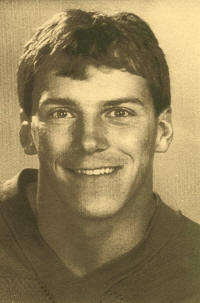 The elder Konecny coached the Shores special teams the past two years, but stepped aside during the offseason to give his son some space and just be another dad in the stands.
“I want these next two years to be all about him and the work that he has put in,” said Konecny, who was inducted into the Muskegon Area Sports Hall of Fame in 2007. “I just want to be an advocate for him and do whatever I can, lend whatever knowledge or experience I can, to help him achieve his goals.”
The younger Konecny is always trying to learn – soaking in lessons from Koziak and offensive coordinator Aaron James about the nuances of the veer offense and working with his father and former MSU quarterback Ryan Van Dyke on the mechanics of quarterback play. But perhaps the best lessons of all come from Rose.
“We compete with each other, but we also encourage each other,” explained Konecny, who has played hockey in the past but plans to powerlift and play baseball this school year. “What Brady does on the field just logistically doesn’t make sense for someone his size. But you see him in the weight room and around our teammates, and he’s such a leader. He’s a great influence on me.”
Koziak said he has no doubt Konecny will be a college quarterback in a couple of years.
“One of the things I really like about Mark is that he has a very inquisitive football mind,” said Koziak. “He wants to know why we do certain things we do in terms of motion or blocking on a particular play – not just what he has to do, but why.”
Konecny also has an incredible work ethic, never missing a chance to throw with his teammates or to hit the weight room. He recently became a rare junior skill athlete to join the Mona Shores 1,000-pound club – meaning his combined best lift in the bench, squat and dead lift tops that weight.
And when he’s not doing one of those things, he can often be spotted at his dad’s old favorite workout spot: the giant Lake Michigan sand dunes at Lake Harbor Park.
“Every so often, we’ll be sitting around the house and he’ll be restless and go run the dunes,” the elder Konecny said with a smile. “Those are the same dunes that I used to run when I played at Shores, so that’s kind of neat. Like father, like son, I guess.”
 Tom Kendra worked 23 years at The Muskegon Chronicle, including five as assistant sports editor and the final six as sports editor through 2011. E-mail him at [email protected] with story ideas for Muskegon, Oceana, Mason, Lake, Oceola, Mecosta and Newaygo counties.
PHOTOS: (Top) Mona Shores junior quarterback Mark Konecny drops back to pass during Friday's game at Muskegon Reeths-Puffer. (Middle) Konecny warms up Friday. (Below) The elder Mark Konecny. (Mona Shores photos by Eric Sturr and Mike Meekhof, respectively. Head shot courtesy of the Muskegon Area Sports Hall of Fame.)