

New Math: Division & Multiplication Problems
July 25, 2017
By Jack Roberts
MHSAA Executive Director
This is the second part in a series on MHSAA tournament classification, past and present, that will be published over the next two weeks. This series originally ran in this spring's edition of MHSAA benchmarks.
High school tournament classifications went viral before there was social media and most of us knew what “viral” meant.
Much as a virus infects computers today or has created epidemics of disease around the world for centuries, high school tournament classification – once introduced – tends to spread uncontrollably. Once started, it tends to keep expanding and rarely contracts.
While we are still some distance from providing every team a trophy as a result of expanding high school tournament classification across the country, there is criticism nevertheless that we are headed in that direction – a philosophy which is supposed to exist only in local youth sports for our youngest children.
Michigan could be blamed for all this. Michigan is generally accepted as the first state to provide different classifications for season-ending tournaments for different sized schools. It started a century ago. Today, every state has various classifications for its tournaments in most if not all sports. And it is a bit ironic that Michigan – creator of the classification chaos – more than most other states has kept the number of tournament classes or divisions under control.
Yes, there is evidence that tournament classifications have expanded over the years in Michigan, especially with the relatively recent introduction of tournaments in football and the late 1990s’ move from classes to divisions in most MHSAA tournaments. But the MHSAA Representative Council has held true to its word when it expanded the playoffs for football from four classes to eight divisions: this is needed because of unique factors of football, factors that exist in no other sport; and all other sports should be capped at a maximum of four classes or divisions.
Kentucky is the preeminent defender of single-class basketball. All of its 276 high schools compete for the single state championship for each gender. In Indiana, there are still open wounds from its move in 1998 from one to four classes for its 400 schools in basketball.
Multi-class tournaments have tended to increase the number of non-public school champions, which some states are trying to lower through enrollment “multipliers,” and also tend to increase the number of repeat champions, which some states are trying to affect with “success factors” which lift smaller schools into classifications for larger schools if they take home too many trophies.
While there is considerable evidence that state tournaments do as much bad as good for educational athletics, state associations persist in providing postseason tournaments because, on balance, the experiences are supposed to be good for student-athletes. And once we reach that conclusion it is just a small leap to believe that if the tournaments are good for a few, they must be better for more – which leads to creating more and more tournament classifications. One becomes two classes, then three, then four and so forth.
While the argument is that more classifications or divisions provides more students with opportunities to compete and win, it is undeniable that the experience changes as the number of tournament classifications expands. It is not possible for state associations to provide the same level of support when tournament classifications expand to multiple venues playing simultaneously. For example, there is less audio and video broadcast potential at each venue, and less media coverage to each venue. Focus is diluted and fans diminished at each championship.
No one can argue reasonably that today's two-day MHSAA Football Finals of eight championship games has the same pizazz as the one-day, four-games event conducted prior to 1990.
In some states the number of divisions has grown so much that it is difficult to see much difference between the many season-ending state championship games and a regular-season event in the same sport.
It is a balancing act. And Michigan has been studying that balance longer than any other state, and charting a steadier course than most.
Addition by Division
The shift to Divisions for MHSAA Tournament play in numerous sports has added up to a greater number of champions for teams and individuals across the state. Following are the sports currently employing a divisional format, and the procedures for determining enrollment and classification.
In 23 statewide or Lower Peninsula tournaments, schools which sponsor the sport are currently divided into nearly equal divisions. They are:
- Baseball - 4 Divisions
- Boys Bowling - 4 Divisions
- Girls Bowling - 4 Divisions
- Girls Competitive Cheer - 4 Divisions
- LP Boys Cross Country - 4 Divisions
- LP Girls Cross Country - 4 Divisions
- LP Boys Golf - 4 Divisions
- LP Girls Golf - 4 Divisions
- Ice Hockey - 3 Divisions
- Boys Lacrosse - 2 Divisions
- Girls Lacrosse - 2 Divisions
- Boys Skiing - 2 Divisions
- Girls Skiing - 2 Divisions
- LP Boys Soccer - 4 Divisions LP
- Girls Soccer - 4 Divisions
- Girls Softball - 4 Divisions
- LP Boys Swimming & Diving - 3 Divisions
- LP Girls Swimming & Diving - 3 Divisions
- LP Boys Tennis - 4 Divisions
- LP Girls Tennis - 4 Divisions
- LP Boys Track & Field - 4 Divisions
- LP Girls Track & Field - 4 Divisions
- Wrestling - 4 Divisions
Lists of schools for each division of these 23 tournaments are posted on MHSAA.com approximately April 1. Listings of schools in Upper Peninsula tournaments for their sports are also posted on MHSAA.com. The lists are based on school memberships and sports sponsorships in effect or anticipated for the following school year, as known to the MHSAA office as of a date in early March.
In football, the 256 schools which qualify for MHSAA 11-player playoffs are placed in eight equal divisions annually on Selection Sunday. Beginning in 2017, the 8-player divisions will be determined in a like manner on Selection Sunday as well, with 32 qualifying schools placed in two divisions.
Schools have the option to play in any higher division in one or more sports for a minimum of two years.
The deadlines for "opt-ups" are as follows:
- Applications for fall sports must be submitted by April 15
- Applications for winter sports must be submitted by Aug. 15
- Applications for spring sports must be submitted by Oct. 15
Subsequent to the date of these postings for these tournaments, no school will have its division raised or lowered by schools opening or closing, schools adding or dropping sports, schools exercising the option to play in a higher division, or approval or dissolution of cooperative programs.
When the same sport is conducted for boys and girls in the same season (e.g., track & field and cross country), the gender that has the most sponsoring schools controls the division breaks for both genders.
The Official View: We Are Family
By
Brent Rice
MHSAA Assistant Director
September 8, 2020
Camaraderie – and a feeling of being part of a bigger sports family – is among draws for nearly 10,000 officials who register with the MHSAA each school year.
As “The Official View” returns today for the 2020-21 school year, we feature a trio of sisters who have embraced the avocation and also announce a social media opportunity to further draw Michigan’s officiating community together as we play again for the first time in nearly half a year.

It’s Official!
Officials Awards and Alumni Banquet: Unfortunately, we weren’t able to get together this spring as a group for the annual Officials Awards and Alumni Banquet. Because of the importance of recognizing officials for their service, dedication and contributions to the MHSAA, John Johnson and Faye Verellen-Brown in our office created an excellent virtual stand-in for the traditional banquet. Check out the short video montage HERE.
For those receiving 20-, 30-, 40-, 45- and 50-year service awards, they have been received in the MHSAA office after a delay in production by our supplier due to COVID-19, and they are being sent to you via USPS.
Mark your calendars for May 8, 2021. This is the scheduled date for next year’s Officials Awards and Alumni Banquet. Plan on joining us in person to honor and recognize accomplishments by MHSAA officials across the state.
Officials Deadlines: The registration deadline for officials has been extended until Sept. 14. Consideration for further extensions will be made as necessary.
Other officials deadlines (i.e., MIGS, schedule submission, rules meetings and exams as applicable) for all fall sports remain in place for Sept. 17. The MHSAA has provided Local Approved Associations with flexibility for the 50 percent minimum-attendance requirement. Officials in those sports should submit the schedule they were assigned to start the season. While this may change as the season progresses, it will suffice for the purpose of providing the MHSAA with the assignments each official receives.
MHSAA Officials Facebook Page: To better engage and communicate with officials, the MHSAA has created a Facebook page specifically for all things officiating. Here, you’ll be able to get updates, connect with other officials and discuss rules, mechanics and plays for the high school sports you officiate. Please take some time to connect with us and others by visiting this new resource HERE.
Know Your Rules
FOOTBALL In high school football, in what ways can a team score using a kick?
Ruling: There are two categories of kicks – free kicks and scrimmage kicks. Free kicks include kickoffs (place kick or drop kick), safety kicks (place kick, drop kick or punt) and fair-catch kicks (place kick or drop kick). Of these, only fair-catch kicks can score (because the receiving team may attempt a field goal from the spot of the catch).
Scrimmage kicks include field goals (place kick or drop kick), tries (place kick or drop kick) and punts (punt). Of these, only field goals and tries can score.
NOTE: In high school an attempted field goal that does not score has the same effect as a punt.
It’s Your Call
SOCCER This newest IYC involves a trick play by the team in red. On this corner kick, players of the red team begin running out of play and around the back of the net. Then, one of those players reenters the field just as the corner kick is made, heading the ball into the net. Does the goal count? What’s the call?
The Official View: We are Family
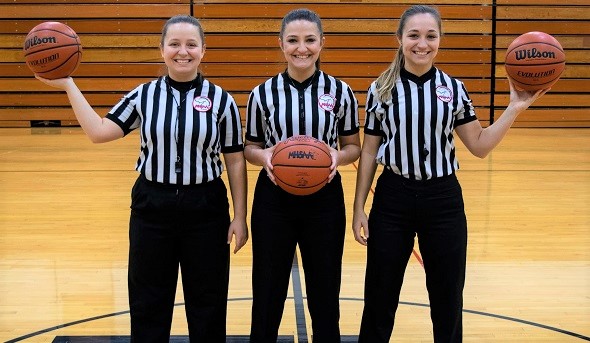
If you were to ask any of the Bedrosian sisters a way that young women can stay physically active, learn skills that can be applied to their daily lives and make some money doing it, they undoubtedly would tell you “officiating.”
Each of the women (Sara Bauman, Leslie Bedrosian and Alex Bedrosian), who all graduated from New Lothrop, spend much of their winters on the hardcourt doing just that – officiating MHSAA basketball games. And last season, before COVID-19 caused a premature end to the basketball season, the sisters were able to work a three-person crew together for the first time.
Sara, 23, said she started officiating after meeting veteran official Mike Clark, and as a way to stay connected to the game she loved. “At that point in my life I had already coached, but I wanted something closer to what it felt like to play,” said Bauman, now a third-year law student at the MSU College of Law.
Leslie and Alex, both current college students themselves, said they each started officiating after following in their older sister footsteps and for similar reasons. Leslie said, “I love being a part of the game. In addition, refereeing has been my income while I attend college. I’m thankful for all of the friendships and connections I’ve made and the people I’ve met who are appreciative of the work that goes into officiating.”
The impact officiating has had on their lives is not lost on the sisters. Alex, 19, looks at officiating as a challenge.
“Being a female official can be tough, but I feel like it only makes me more confident and has given me a desire to show people what I am capable of doing,” says the youngest Bedrosian sister.
Similarly, 20-year-old Leslie says that officiating has “helped me become more assertive, ready to talk to people and handle difficult situations head on.”
Sara said she hopes displaying those same traits will inspire women to also take up officiating: “It is truly the best feeling to have a female player come up to you in awe because they have yet to have a female officiate (her) game.”
This trio of officiating sisters gives credit for their quick starts to the camps they attended and all of the veteran mentor officials who have helped them along the way, namely Clark and Sharon Sawyers. Bauman and the Bedrosians are committed to continued improvement, working their way up the high school ranks and maybe even working at the college level. It’s clear they enjoy everything officiating has to offer, and we expect long and successful careers from all of them.
If you have an interesting story or an official you’d like to see featured, send details and pictures to [email protected].
PHOTO: Sisters Leslie Bedrosian (left), Sara Bauman (middle) and Alex Bedrosian are MHSAA-registered basketball officials and last year worked together as a crew for the first time. (Photo by Ashley Breiler.)