


New Math: Division & Multiplication Problems
July 25, 2017
By Jack Roberts
MHSAA Executive Director
This is the second part in a series on MHSAA tournament classification, past and present, that will be published over the next two weeks. This series originally ran in this spring's edition of MHSAA benchmarks.
High school tournament classifications went viral before there was social media and most of us knew what “viral” meant.
Much as a virus infects computers today or has created epidemics of disease around the world for centuries, high school tournament classification – once introduced – tends to spread uncontrollably. Once started, it tends to keep expanding and rarely contracts.
While we are still some distance from providing every team a trophy as a result of expanding high school tournament classification across the country, there is criticism nevertheless that we are headed in that direction – a philosophy which is supposed to exist only in local youth sports for our youngest children.
Michigan could be blamed for all this. Michigan is generally accepted as the first state to provide different classifications for season-ending tournaments for different sized schools. It started a century ago. Today, every state has various classifications for its tournaments in most if not all sports. And it is a bit ironic that Michigan – creator of the classification chaos – more than most other states has kept the number of tournament classes or divisions under control.
Yes, there is evidence that tournament classifications have expanded over the years in Michigan, especially with the relatively recent introduction of tournaments in football and the late 1990s’ move from classes to divisions in most MHSAA tournaments. But the MHSAA Representative Council has held true to its word when it expanded the playoffs for football from four classes to eight divisions: this is needed because of unique factors of football, factors that exist in no other sport; and all other sports should be capped at a maximum of four classes or divisions.
Kentucky is the preeminent defender of single-class basketball. All of its 276 high schools compete for the single state championship for each gender. In Indiana, there are still open wounds from its move in 1998 from one to four classes for its 400 schools in basketball.
Multi-class tournaments have tended to increase the number of non-public school champions, which some states are trying to lower through enrollment “multipliers,” and also tend to increase the number of repeat champions, which some states are trying to affect with “success factors” which lift smaller schools into classifications for larger schools if they take home too many trophies.
While there is considerable evidence that state tournaments do as much bad as good for educational athletics, state associations persist in providing postseason tournaments because, on balance, the experiences are supposed to be good for student-athletes. And once we reach that conclusion it is just a small leap to believe that if the tournaments are good for a few, they must be better for more – which leads to creating more and more tournament classifications. One becomes two classes, then three, then four and so forth.
While the argument is that more classifications or divisions provides more students with opportunities to compete and win, it is undeniable that the experience changes as the number of tournament classifications expands. It is not possible for state associations to provide the same level of support when tournament classifications expand to multiple venues playing simultaneously. For example, there is less audio and video broadcast potential at each venue, and less media coverage to each venue. Focus is diluted and fans diminished at each championship.
No one can argue reasonably that today's two-day MHSAA Football Finals of eight championship games has the same pizazz as the one-day, four-games event conducted prior to 1990.
In some states the number of divisions has grown so much that it is difficult to see much difference between the many season-ending state championship games and a regular-season event in the same sport.
It is a balancing act. And Michigan has been studying that balance longer than any other state, and charting a steadier course than most.
Addition by Division
The shift to Divisions for MHSAA Tournament play in numerous sports has added up to a greater number of champions for teams and individuals across the state. Following are the sports currently employing a divisional format, and the procedures for determining enrollment and classification.
In 23 statewide or Lower Peninsula tournaments, schools which sponsor the sport are currently divided into nearly equal divisions. They are:
- Baseball - 4 Divisions
- Boys Bowling - 4 Divisions
- Girls Bowling - 4 Divisions
- Girls Competitive Cheer - 4 Divisions
- LP Boys Cross Country - 4 Divisions
- LP Girls Cross Country - 4 Divisions
- LP Boys Golf - 4 Divisions
- LP Girls Golf - 4 Divisions
- Ice Hockey - 3 Divisions
- Boys Lacrosse - 2 Divisions
- Girls Lacrosse - 2 Divisions
- Boys Skiing - 2 Divisions
- Girls Skiing - 2 Divisions
- LP Boys Soccer - 4 Divisions LP
- Girls Soccer - 4 Divisions
- Girls Softball - 4 Divisions
- LP Boys Swimming & Diving - 3 Divisions
- LP Girls Swimming & Diving - 3 Divisions
- LP Boys Tennis - 4 Divisions
- LP Girls Tennis - 4 Divisions
- LP Boys Track & Field - 4 Divisions
- LP Girls Track & Field - 4 Divisions
- Wrestling - 4 Divisions
Lists of schools for each division of these 23 tournaments are posted on MHSAA.com approximately April 1. Listings of schools in Upper Peninsula tournaments for their sports are also posted on MHSAA.com. The lists are based on school memberships and sports sponsorships in effect or anticipated for the following school year, as known to the MHSAA office as of a date in early March.
In football, the 256 schools which qualify for MHSAA 11-player playoffs are placed in eight equal divisions annually on Selection Sunday. Beginning in 2017, the 8-player divisions will be determined in a like manner on Selection Sunday as well, with 32 qualifying schools placed in two divisions.
Schools have the option to play in any higher division in one or more sports for a minimum of two years.
The deadlines for "opt-ups" are as follows:
- Applications for fall sports must be submitted by April 15
- Applications for winter sports must be submitted by Aug. 15
- Applications for spring sports must be submitted by Oct. 15
Subsequent to the date of these postings for these tournaments, no school will have its division raised or lowered by schools opening or closing, schools adding or dropping sports, schools exercising the option to play in a higher division, or approval or dissolution of cooperative programs.
When the same sport is conducted for boys and girls in the same season (e.g., track & field and cross country), the gender that has the most sponsoring schools controls the division breaks for both genders.
Work Molds Lohr Into WSU Wins Leader
By
Paul Costanzo
Special for MHSAA.com
August 5, 2020
When Carrie Lohr was spending weekends in her youth chopping wood with her father or helping clear stones from her the fields of her grandfather’s farm, she wasn’t thinking of how it would help her become a standout athlete or coach. She did think about how she’d rather be swimming in a pool like her friends and classmates.
 But when the Wayne State women’s basketball coach looks back now on her time in Sandusky, it’s those moments that stick out as shaping her.
“I learned the value of hard work,” Lohr, formerly Hickson, said. “I learned the value of earning an allowance. I look back and I was expected to work, and I didn’t know it any other way. Twenty years ago, when I started coaching, I always understood the value of hard work. I was fortunate I have people who have shown me that. That kind of comes back to me more than a particular sport or a particular game or competition. I find myself looking back on how I learned those things with the things that I did.”
Lohr’s hard work helped her become a standout three-sport athlete at Sandusky, an all-conference college basketball player, and now Wayne State’s all-time winningest women’s basketball coach.
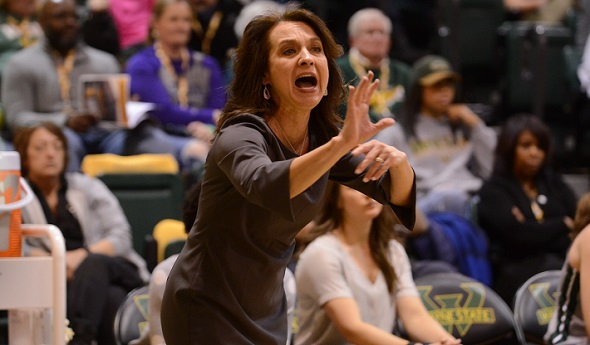
The 1989 Sandusky graduate is entering her 10th season with the Warriors with a career record of 148-111. She led Wayne State to NCAA regional finals in 2013 and 2014, and the regional semifinal in 2015. The 2012-13 season featured Wayne State’s first NCAA Tournament victory and its first regional final appearance.
“She definitely had those good leadership qualities and the love of the game,” said Sandusky girls basketball coach Al DeMott, who coached Lohr in the late 1980s. “And she was a hard worker – nobody is going to out-work her. From Day 1, she wasn’t going to let anyone outwork her or get ahead of her. She’s just a great person, and I couldn’t be prouder.”
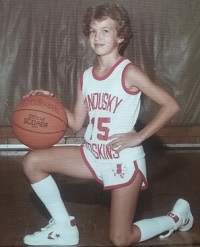
Lohr starred as a point guard for DeMott for two seasons, helping Sandusky reach the Class C Quarterfinals in 1987, where it lost to eventual champion Detroit St. Martin dePorres.
“She used to knock in the 3s, too,” DeMott said. “She hit some big 3s for us in some big games. She was a gamer. She had a smart basketball IQ.”
Lohr played collegiately at St. Clair County Community College (SC4) and the University of Michigan-Dearborn. She was named first-team all-conference, all-region and all-state at SC4, and, unsurprisingly, was a captain at both schools.
 Coaching wasn’t something Lohr considered during her playing days, though.
“I always thought, ‘I could never do this – I could never be a coach. How would I know what to say?’” she said. “But when the buzzer sounds in your last collegiate game and you’re sitting there in the gym and the locker room and reality hit you that it’s over, that was life-changing. It meant so much more to me than I even realized.”
Lohr started her coaching career in 1994 as the freshman girls basketball coach at Richmond, and she quickly fell in love with the profession. Her journey included stints as the freshman girls coach at Port Huron Northern and assistant jobs at SC4 and Oakland University.
While Lohr had found her passion, she still needed to pay the bills.
“I was living my dream (coaching) and following my dream, but reality was hitting me that I may not be able to continue on this path,” Lohr said. “A friend of mine was in medical sales, so I found myself in medical sales for five years. That afforded me to go back into coaching at SC4 as an assistant again, then I got into head coaching.”
She took over the Skippers program in 2002, and had a 166-106 record in nine seasons at her alma mater. It was her first time running a program, and she also became a mother two weeks before her first game with the birth of her daughter Sarah. Carrie was pregnant with her son Eli throughout her entire third season as coach. Lohr said her husband Eric was incredibly supportive, which was crucial to making it work.
She also had an A-list of former coaches to lean on when she needed advice. DeMott is second in MHSAA history with 753 career wins. Lohr’s former travel coach Fred Shaw is a member of the Michigan High School Coaches Association Hall of Fame. And Dave Mann, who has won four MHSAA championships, coached her at U-M Dearborn.
“I really attribute me being in coaching to all of my coaches,” she said. “I always maintained a connection with those individuals. I feel like all three have been a great resource for me. Those times when you’re unsure about something – whether it’s an on-court situation or an off-court situation, I always felt I had three people I could call and seek advice from. I think that’s important to be able to have someone to call and say, ‘I don’t know what to do in this situation.’”
Having played for multiple Hall of Fame-caliber coaches – including the late Paul Jackson, who coached her at SC4 – is also a good way to build a coaching style.
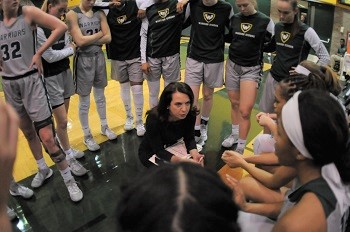 “You learn from other coaches, but you just step out and create your own path,” Lohr said. “I learned a little bit of something different from all of them. The common denominator is they’re all very positive people, but they’re all competitive. They coach very differently.”
In the spring of 2011, Lohr was hired at Wayne State, and she has turned the Warriors into perennial GLIAC contenders.
“I was just lucky, I think, knowing what I know now about how many people apply for these jobs,” she said. “I feel really fortunate that the athletic director here at Wayne State saw something in me and believed in me. I’m very grateful.”
Her kids have grown into athletes themselves at St. Clair High School. Sarah, a senior, plays volleyball and basketball. She could add tennis in the spring, as well, but wasn’t able to this past year because of the cancellation of seasons due to the coronavirus. Eli, a junior, plays tennis, basketball and baseball.
“When I’m watching my kids, it’s enjoyable to just sit back and watch,” Lohr said. “The things I see in my kids is that I think they’re good teammates, and I think they work hard, and those things are important to me. To watch them compete is fun, but to see those things that maybe don’t show up in a tweet or make a headline, those things are really important.”
They’re also getting to enjoy the experience of playing multiple sports in high school, something Lohr thinks back on fondly from her days in Sandusky.
“I still remember my volleyball coaches, and I still remember my softball coach,” Lohr said. “I had a great experience in being a three-sport athlete. It was demanding, but it’s really unfortunate that a lot of young people aren’t able to experience that. I think there’s a lot of pressure on young people to specialize. I felt like there was a strong culture in Sandusky with all of their sports. To look back on it, it was really a special time for me.”
Made in Michigan 2020
July 31: Neitzel Finds Way Back to High School Hoops - Read
July 28: Nichols Lends Winning Past to West's Present - Read
July 17: Miss Tennis Serving Now as 'Hero Coach' - Read
July 9: Joplin Always Has Known Value of Home - Read
June 24: Fracassa's Remarkable Records Still Rule - Read
June 16: Muskegon Grad Casts "Magic" in HBO Series - Read
 Paul Costanzo served as a sportswriter at The Port Huron Times Herald from 2006-15, including three years as lead sportswriter, and prior to that as sports editor at the Hillsdale Daily News from 2005-06. He can be reached at [email protected] with story ideas for Genesee, Lapeer, St. Clair, Sanilac, Huron, Tuscola, Saginaw, Bay, Arenac, Midland and Gladwin counties.
PHOTOS: (Top) Carrie Lohr this winter will enter her 10th season coaching the Wayne State University women’s basketball program. (Middle) Lohr was a standout at Sandusky High during the 1987 and 1988 seasons. (Below) Lohr huddles with her Wayne State players. (Top and below photos courtesy of WSU sports information; Sandusky photo courtesy of Carrie Lohr.)