


New Math: Division & Multiplication Problems
July 25, 2017
By Jack Roberts
MHSAA Executive Director
This is the second part in a series on MHSAA tournament classification, past and present, that will be published over the next two weeks. This series originally ran in this spring's edition of MHSAA benchmarks.
High school tournament classifications went viral before there was social media and most of us knew what “viral” meant.
Much as a virus infects computers today or has created epidemics of disease around the world for centuries, high school tournament classification – once introduced – tends to spread uncontrollably. Once started, it tends to keep expanding and rarely contracts.
While we are still some distance from providing every team a trophy as a result of expanding high school tournament classification across the country, there is criticism nevertheless that we are headed in that direction – a philosophy which is supposed to exist only in local youth sports for our youngest children.
Michigan could be blamed for all this. Michigan is generally accepted as the first state to provide different classifications for season-ending tournaments for different sized schools. It started a century ago. Today, every state has various classifications for its tournaments in most if not all sports. And it is a bit ironic that Michigan – creator of the classification chaos – more than most other states has kept the number of tournament classes or divisions under control.
Yes, there is evidence that tournament classifications have expanded over the years in Michigan, especially with the relatively recent introduction of tournaments in football and the late 1990s’ move from classes to divisions in most MHSAA tournaments. But the MHSAA Representative Council has held true to its word when it expanded the playoffs for football from four classes to eight divisions: this is needed because of unique factors of football, factors that exist in no other sport; and all other sports should be capped at a maximum of four classes or divisions.
Kentucky is the preeminent defender of single-class basketball. All of its 276 high schools compete for the single state championship for each gender. In Indiana, there are still open wounds from its move in 1998 from one to four classes for its 400 schools in basketball.
Multi-class tournaments have tended to increase the number of non-public school champions, which some states are trying to lower through enrollment “multipliers,” and also tend to increase the number of repeat champions, which some states are trying to affect with “success factors” which lift smaller schools into classifications for larger schools if they take home too many trophies.
While there is considerable evidence that state tournaments do as much bad as good for educational athletics, state associations persist in providing postseason tournaments because, on balance, the experiences are supposed to be good for student-athletes. And once we reach that conclusion it is just a small leap to believe that if the tournaments are good for a few, they must be better for more – which leads to creating more and more tournament classifications. One becomes two classes, then three, then four and so forth.
While the argument is that more classifications or divisions provides more students with opportunities to compete and win, it is undeniable that the experience changes as the number of tournament classifications expands. It is not possible for state associations to provide the same level of support when tournament classifications expand to multiple venues playing simultaneously. For example, there is less audio and video broadcast potential at each venue, and less media coverage to each venue. Focus is diluted and fans diminished at each championship.
No one can argue reasonably that today's two-day MHSAA Football Finals of eight championship games has the same pizazz as the one-day, four-games event conducted prior to 1990.
In some states the number of divisions has grown so much that it is difficult to see much difference between the many season-ending state championship games and a regular-season event in the same sport.
It is a balancing act. And Michigan has been studying that balance longer than any other state, and charting a steadier course than most.
Addition by Division
The shift to Divisions for MHSAA Tournament play in numerous sports has added up to a greater number of champions for teams and individuals across the state. Following are the sports currently employing a divisional format, and the procedures for determining enrollment and classification.
In 23 statewide or Lower Peninsula tournaments, schools which sponsor the sport are currently divided into nearly equal divisions. They are:
- Baseball - 4 Divisions
- Boys Bowling - 4 Divisions
- Girls Bowling - 4 Divisions
- Girls Competitive Cheer - 4 Divisions
- LP Boys Cross Country - 4 Divisions
- LP Girls Cross Country - 4 Divisions
- LP Boys Golf - 4 Divisions
- LP Girls Golf - 4 Divisions
- Ice Hockey - 3 Divisions
- Boys Lacrosse - 2 Divisions
- Girls Lacrosse - 2 Divisions
- Boys Skiing - 2 Divisions
- Girls Skiing - 2 Divisions
- LP Boys Soccer - 4 Divisions LP
- Girls Soccer - 4 Divisions
- Girls Softball - 4 Divisions
- LP Boys Swimming & Diving - 3 Divisions
- LP Girls Swimming & Diving - 3 Divisions
- LP Boys Tennis - 4 Divisions
- LP Girls Tennis - 4 Divisions
- LP Boys Track & Field - 4 Divisions
- LP Girls Track & Field - 4 Divisions
- Wrestling - 4 Divisions
Lists of schools for each division of these 23 tournaments are posted on MHSAA.com approximately April 1. Listings of schools in Upper Peninsula tournaments for their sports are also posted on MHSAA.com. The lists are based on school memberships and sports sponsorships in effect or anticipated for the following school year, as known to the MHSAA office as of a date in early March.
In football, the 256 schools which qualify for MHSAA 11-player playoffs are placed in eight equal divisions annually on Selection Sunday. Beginning in 2017, the 8-player divisions will be determined in a like manner on Selection Sunday as well, with 32 qualifying schools placed in two divisions.
Schools have the option to play in any higher division in one or more sports for a minimum of two years.
The deadlines for "opt-ups" are as follows:
- Applications for fall sports must be submitted by April 15
- Applications for winter sports must be submitted by Aug. 15
- Applications for spring sports must be submitted by Oct. 15
Subsequent to the date of these postings for these tournaments, no school will have its division raised or lowered by schools opening or closing, schools adding or dropping sports, schools exercising the option to play in a higher division, or approval or dissolution of cooperative programs.
When the same sport is conducted for boys and girls in the same season (e.g., track & field and cross country), the gender that has the most sponsoring schools controls the division breaks for both genders.
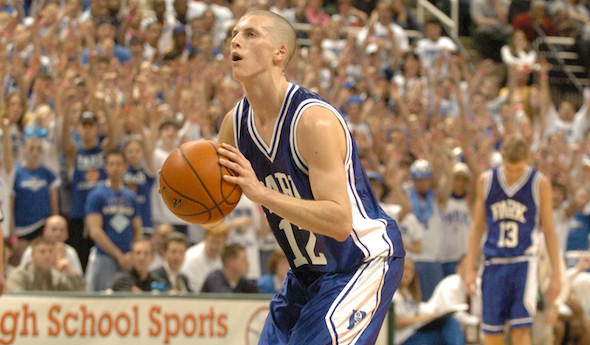
Neitzel Finds Way Back to High School Hoops
By
Dean Holzwarth
Special for MHSAA.com
July 31, 2020
GRAND RAPIDS – Drew Neitzel is a self-proclaimed basketball junkie.
 So when the opportunity arose to reconnect with the high school basketball scene, the former Mr. Basketball and Michigan State standout didn’t think twice.
Neitzel, 35, has spent the past five years as a high school basketball radio analyst alongside longtime broadcaster Bret Bakita.
“It was a natural fit for me coming back to Grand Rapids, and I’ve known Bret since he was broadcasting my games at Wyoming Park,” Neitzel said. “He was looking for a partner and reached out to me.
“I didn’t have the time or desire to maybe get involved with coaching locally, so the high school broadcasting was the perfect fit to keep me around the game and feed my appetite for the game. Friday night hoops is one of the best atmospheres with the student sections and great crowds, and there’s a great following in West Michigan. It’s great to be a part of that high school action again.”
Bakita has been a staple in the West Michigan sports scene and has been a mentor to Neitzel.
“Bret is a true professional and a great guy to work with and learn from,” Neitzel said. “It’s been a great fit and a great team, and hopefully we have a season this winter.”
Neitzel and Bakita were broadcasting a boys District Semifinal in Holland the night before the Covid-19 pandemic started affecting the landscape of sports.
NCAA conference tournaments were canceled, and soon after March Madness and the remainder of the high school winter and spring seasons as well.
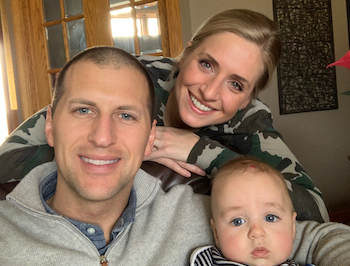
Netizel currently lives in Grand Rapids with wife, Kristi, and their son, Drake, who turns 1 in August.
The recent pandemic has changed the lives of many around the world, but Neitzel has tried to take everything in stride.
“It’s certainly been different, and my wife and I are both working from home, which has been good since we have a 1-year-old,” said Neitzel, who works as a financial advisor in Grand Rapids.
“We try to see the positives with everything going on and the craziness in the world, and working from home allows us to spend extra time with our little guy.
“It presents its own challenges, but overall we’re doing well and we’re trying to be smart and responsible by social distancing and staying outside. Not putting ourselves in harm’s way if we don’t have to.”
The pandemic and enforced precautions has put a damper on summer activities, which included Neitzel’s annual basketball camp.
 The popular Drew Neitzel Basketball Camp has been running for more than a decade, but likely will be halted due to the pandemic.
“This would’ve been our 12th year, and it has been very successful and continued to grow,” Neitzel said. “It’s the one week in the year that I get to get back in the gym with the kids and my dad and 15 of my good buddies who help coach.
“It’s disappointing that we haven’t had the chance to run the camp, and we haven’t officially canceled it, but it looks more like that’s going to be the outcome with everything going on and the gyms not being allowed to open.”
His stellar high school career at Wyoming Park included becoming the school’s all-time leader in points and assists, while winning the Mr. Basketball Award and taking his team to the Class B Semifinals as a senior in 2004. In one of the most memorable games in MHSAA Tournament history – and before a capacity crowd at the Breslin Center – Neitzel scored 36 points but saw his team fall 79-63 to a Detroit Renaissance eventual champion that included major Division I college prospects Malik Hairston, Joseph Crawford and Tajuan Porter.
Quickly, Neitzel made an impact in East Lansing as well. He was a starting point guard for a majority of his time as a Spartan, and helped Michigan State reach the Final Four as a freshman.
“I couldn’t have written a better college career,” Neitzel said. “You wish you would’ve won more games and went to more Final Fours, but when I look back, to step in and start halfway through my freshman year for Coach Izzo and for him to give me the reins with a senior-heavy team was a great experience.
“That 12 months of my life was absolutely crazy. My senior year of high school going to the Breslin Center, winning Mr. Basketball and then earning a starting spot and going to the Final Four was a wild ride. It was an awesome year for me, personally.”
After not being selected in the 2008 NBA Draft, Neitzel played professionally in Germany and France for five years while also being invited to NBA summer leagues and training camps with Minnesota, Portland and Dallas.
His last taste of the NBA came in 2011 during training camp with the Mavericks. He was eventually cut, and finished the season in the G League.
“That was a great experience,” Neitzel said. “They were a first-class organization and Mark Cuban and Rick Carlise were great. It was the year after they beat Miami in the NBA Finals so they were still on cloud nine from the championship.
“The guys in that locker room were Jason Kidd, Jason Terry, Dirk Nowitzki, Vince Carter, Delonte West, Shawn Marion and Lamar Odom. I was a fly on the wall, and to be around those NBA greats and veterans was definitely one of the highlights of my career.”
Made in Michigan 2020
July 28: Nichols Lends Winning Past to West's Present - Read
July 17: Miss Tennis Serving Now as 'Hero Coach' - Read
July 9: Joplin Always Has Known Value of Home - Read
June 24: Fracassa's Remarkable Records Still Rule - Read
June 16: Muskegon Grad Casts "Magic" in HBO Series - Read
 Dean Holzwarth has covered primarily high school sports for Grand Rapids-based WOOD-TV for four years after serving at the Grand Rapids Press and MLive for 16 years along with shorter stints at the Ionia Sentinel and WZZM. Contact him at [email protected] with story ideas for Allegan, Kent and Ottawa counties.
PHOTOS: (Top) Drew Neitzel attempts a free throw before a packed Breslin Center during the 2004 Class B Semifinals. (Middle) Neitzel, with wife Kristi and son Drake. (Top photo by Gary Shook; middle courtesy of Drew Neitzel.)