


New Math: Division & Multiplication Problems
July 25, 2017
By Jack Roberts
MHSAA Executive Director
This is the second part in a series on MHSAA tournament classification, past and present, that will be published over the next two weeks. This series originally ran in this spring's edition of MHSAA benchmarks.
High school tournament classifications went viral before there was social media and most of us knew what “viral” meant.
Much as a virus infects computers today or has created epidemics of disease around the world for centuries, high school tournament classification – once introduced – tends to spread uncontrollably. Once started, it tends to keep expanding and rarely contracts.
While we are still some distance from providing every team a trophy as a result of expanding high school tournament classification across the country, there is criticism nevertheless that we are headed in that direction – a philosophy which is supposed to exist only in local youth sports for our youngest children.
Michigan could be blamed for all this. Michigan is generally accepted as the first state to provide different classifications for season-ending tournaments for different sized schools. It started a century ago. Today, every state has various classifications for its tournaments in most if not all sports. And it is a bit ironic that Michigan – creator of the classification chaos – more than most other states has kept the number of tournament classes or divisions under control.
Yes, there is evidence that tournament classifications have expanded over the years in Michigan, especially with the relatively recent introduction of tournaments in football and the late 1990s’ move from classes to divisions in most MHSAA tournaments. But the MHSAA Representative Council has held true to its word when it expanded the playoffs for football from four classes to eight divisions: this is needed because of unique factors of football, factors that exist in no other sport; and all other sports should be capped at a maximum of four classes or divisions.
Kentucky is the preeminent defender of single-class basketball. All of its 276 high schools compete for the single state championship for each gender. In Indiana, there are still open wounds from its move in 1998 from one to four classes for its 400 schools in basketball.
Multi-class tournaments have tended to increase the number of non-public school champions, which some states are trying to lower through enrollment “multipliers,” and also tend to increase the number of repeat champions, which some states are trying to affect with “success factors” which lift smaller schools into classifications for larger schools if they take home too many trophies.
While there is considerable evidence that state tournaments do as much bad as good for educational athletics, state associations persist in providing postseason tournaments because, on balance, the experiences are supposed to be good for student-athletes. And once we reach that conclusion it is just a small leap to believe that if the tournaments are good for a few, they must be better for more – which leads to creating more and more tournament classifications. One becomes two classes, then three, then four and so forth.
While the argument is that more classifications or divisions provides more students with opportunities to compete and win, it is undeniable that the experience changes as the number of tournament classifications expands. It is not possible for state associations to provide the same level of support when tournament classifications expand to multiple venues playing simultaneously. For example, there is less audio and video broadcast potential at each venue, and less media coverage to each venue. Focus is diluted and fans diminished at each championship.
No one can argue reasonably that today's two-day MHSAA Football Finals of eight championship games has the same pizazz as the one-day, four-games event conducted prior to 1990.
In some states the number of divisions has grown so much that it is difficult to see much difference between the many season-ending state championship games and a regular-season event in the same sport.
It is a balancing act. And Michigan has been studying that balance longer than any other state, and charting a steadier course than most.
Addition by Division
The shift to Divisions for MHSAA Tournament play in numerous sports has added up to a greater number of champions for teams and individuals across the state. Following are the sports currently employing a divisional format, and the procedures for determining enrollment and classification.
In 23 statewide or Lower Peninsula tournaments, schools which sponsor the sport are currently divided into nearly equal divisions. They are:
- Baseball - 4 Divisions
- Boys Bowling - 4 Divisions
- Girls Bowling - 4 Divisions
- Girls Competitive Cheer - 4 Divisions
- LP Boys Cross Country - 4 Divisions
- LP Girls Cross Country - 4 Divisions
- LP Boys Golf - 4 Divisions
- LP Girls Golf - 4 Divisions
- Ice Hockey - 3 Divisions
- Boys Lacrosse - 2 Divisions
- Girls Lacrosse - 2 Divisions
- Boys Skiing - 2 Divisions
- Girls Skiing - 2 Divisions
- LP Boys Soccer - 4 Divisions LP
- Girls Soccer - 4 Divisions
- Girls Softball - 4 Divisions
- LP Boys Swimming & Diving - 3 Divisions
- LP Girls Swimming & Diving - 3 Divisions
- LP Boys Tennis - 4 Divisions
- LP Girls Tennis - 4 Divisions
- LP Boys Track & Field - 4 Divisions
- LP Girls Track & Field - 4 Divisions
- Wrestling - 4 Divisions
Lists of schools for each division of these 23 tournaments are posted on MHSAA.com approximately April 1. Listings of schools in Upper Peninsula tournaments for their sports are also posted on MHSAA.com. The lists are based on school memberships and sports sponsorships in effect or anticipated for the following school year, as known to the MHSAA office as of a date in early March.
In football, the 256 schools which qualify for MHSAA 11-player playoffs are placed in eight equal divisions annually on Selection Sunday. Beginning in 2017, the 8-player divisions will be determined in a like manner on Selection Sunday as well, with 32 qualifying schools placed in two divisions.
Schools have the option to play in any higher division in one or more sports for a minimum of two years.
The deadlines for "opt-ups" are as follows:
- Applications for fall sports must be submitted by April 15
- Applications for winter sports must be submitted by Aug. 15
- Applications for spring sports must be submitted by Oct. 15
Subsequent to the date of these postings for these tournaments, no school will have its division raised or lowered by schools opening or closing, schools adding or dropping sports, schools exercising the option to play in a higher division, or approval or dissolution of cooperative programs.
When the same sport is conducted for boys and girls in the same season (e.g., track & field and cross country), the gender that has the most sponsoring schools controls the division breaks for both genders.
Joplin Always Has Known Value of Home
By
Doug Donnelly
Special for MHSAA.com
July 9, 2020
It is no accident that Stan Joplin has never ventured too far from his hometown of Milan on the border of Monroe and Washtenaw Counties in extreme southeast Michigan.
 In fact, that has been by design.
“Mr. (Phil) Barnes once told me that you never want to get too far from home,” Joplin said recently, recalling one of his high school administrators. “If you are close by your home, people will remember you.”
It has been more than 40 years since Joplin played basketball at Milan, and no one is forgetting him anytime soon.
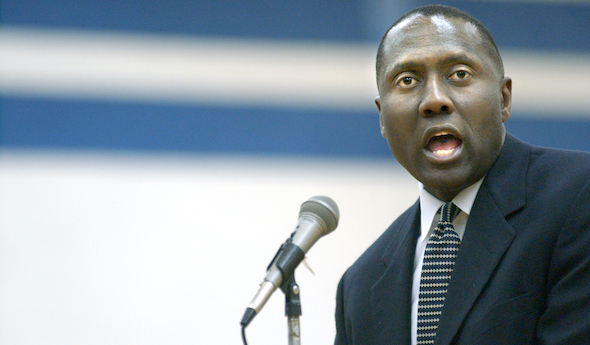
A coach at the high school and Division I collegiate levels and then high school again over nearly 40 years, the 63-year-old Joplin is two seasons removed from his last tenure leading the program at Sylvania Southview. But those decades of wisdom continue to be passed on to Southview students as Joplin serves as an assistant principal at the high school.
“The farthest I ever lived from Milan was when I was coaching at Kent State,” he said. “I’ve remained in southeast Michigan or northwest Ohio all of these years. I have been very fortunate to have the opportunity to stay close to home and receive a good education. You can’t put a price on education. Sooner or later, basketball was going to come to an end.”
It gave him a running start at the beginning.
One of the first four-year starters in Monroe County Region history, Joplin grew up around the game. People like Barnes, coach Ron Dingman and Ann Arbor’s Sandy Sanders all played key roles in Joplin’s early success.
Barnes was a mentor, offering advice and some key life lessons. Dingman was the coach who inserted Joplin into the starting lineup as soon as he could and kept him there as he led the Big Reds in scoring and was named team MVP four consecutive seasons. Sanders was a local basketball guru with connections from Ann Arbor to Detroit.
“Mr. Sanders was umpiring a baseball game and saw me shooting over at the elementary school,” Joplin said. “He invited me to come up to Ann Arbor to play.”
Sanders saw the basketball talent in Joplin and put him on the court in Ann Arbor with other prep talent and some University of Michigan players.
“That’s where I met guys like Campy Russell and Joe Johnson,” Joplin said.
Sanders took area players – including Joplin – to Detroit to play at the famed St. Cecilia Gym. St. Cecilia is well-known in basketball circles for hosting standouts like George Gervin, Magic Johnson and, more recently, Jalen Rose.
“You can imagine what kind of eye-opening experience that was,” Joplin said. “It showed me how hard I had to work. That was huge for me. That really exposed me to basketball.”
Growing up, his neighbor played basketball at Milan, and Joplin would get to go to all the games to watch him. Joplin read about Milan and other local basketball players in the Ypsilanti Press, Ann Arbor News and Monroe News, soaking up everything he could about the game.
“I just wanted to be an athlete,” he said.
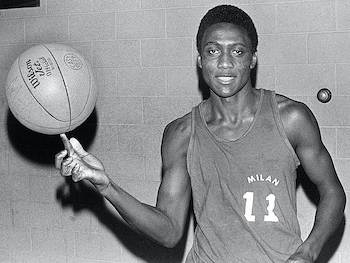
He was more than just an athlete. An all-stater, he scored more than 1,500 career points – still a Milan record – and was recruited to play at the University of Toledo for Bobby Nichols.
 “It was the perfect situation,” Joplin said of growing up where he did. “Milan was a small town. A lot of the students I went to elementary school with I spent my whole time in school with. I knew everyone in the city.”
At Toledo, Joplin blossomed into an all-around player with a knack for elevating his game during key moments. He was named second team all-Mid-American Conference in 1977-78 and 1978-79. The 1979 Rockets won the MAC championship and made the NCAA Tournament. It was there that Joplin had the biggest moment of his career when he knocked down a 20-foot jumper to beat Iowa, 74-72, in the first round. The Rockets would lose a close game in the second round to a Notre Dame team that included four future NBA players. During Joplin’s four years at Toledo, the Rockets went 82-27.
While making national headlines, Joplin also was earning his education, something that Barnes encouraged along the way.
“I followed in his footsteps, went to college, got my degree and went into administration,” Joplin said.
After graduating from UT’s College of Education in 1979, Joplin began coaching at the high school level and was soon head coach at Toledo Start High School. He went on to become an assistant at Kent State University then joined the Rockets’ coaching staff during which time he earned a Master of Administration degree. He would later join the Michigan State University staff with Jud Heathcote and Tom Izzo.
In 1996, Joplin was named head coach at his alma mater, where he remained for 12 years, going 203-155 overall and making the NIT field four times. After he was let go following the 2007-08 campaign, Joplin reached into his education background to become an administrator in the Toledo area. He probably could have landed an assistant coaching job somewhere because of his connections in the sport, but chose not to go that route. He remained close to home.
He coached for a few seasons at Holland (Ohio) Springfield and one year at Sylvania Southview but is enjoying being a basketball fan these days.
“Basketball is the one thing I’ve done my whole life. I miss coaching, but I don’t need it,” he said.
Joplin goes to most of the Southview games and will go on the road occasionally to watch games in which some of his former players are coaching. He gets back to Michigan State University every now and then to watch the Spartans practice and relishes friendships he’s made in the game with people like former University of Michigan head coach Tommy Amaker and former Boston College head coach Al Skinner.
“I’ve got a lot of close friends that I stay in touch with,” he said.
He is not ruling out a return to the sidelines, but is not planning on it, either.
“I watch a lot of basketball. The game has changed,” he said. “The 3-point shot has taken the center out of the game. But, the game itself, is fine.”
Joplin is in the hallways more than the gym these days at Southview. His students know more about Mr. Joplin the school administrator than Stan Joplin the legendary basketball player from Milan – and he is fine with that.
“Every once in a while, someone will say something or bring me a video and say, ‘Hey, Mr. Joplin, I didn’t know you played.’ I just tell them that’s not me, that is just some guy with a lot more hair. It’s become kind of a running joke.”
Made in Michigan 2020
June 24: Fracassa's Remarkable Records Still Rule - Read
June 16: Muskegon Grad Casts "Magic" in HBO Series - Read
 Doug Donnelly has served as a sports and news reporter and city editor over 25 years, writing for the Daily Chief-Union in Upper Sandusky, Ohio from 1992-1995, the Monroe Evening News from 1995-2012 and the Adrian Daily Telegram since 2013. He's also written a book on high school basketball in Monroe County and compiles record books for various schools in southeast Michigan. E-mail him at [email protected] with story ideas for Jackson, Washtenaw, Hillsdale, Lenawee and Monroe counties.
PHOTOS: (Top) Milan basketball legend Stan Joplin serves as an assistant principal at Sylvania Southview High School. (Middle) Joplin still owns the career scoring record at Milan.