

New Math: Division & Multiplication Problems
July 25, 2017
By Jack Roberts
MHSAA Executive Director
This is the second part in a series on MHSAA tournament classification, past and present, that will be published over the next two weeks. This series originally ran in this spring's edition of MHSAA benchmarks.
High school tournament classifications went viral before there was social media and most of us knew what “viral” meant.
Much as a virus infects computers today or has created epidemics of disease around the world for centuries, high school tournament classification – once introduced – tends to spread uncontrollably. Once started, it tends to keep expanding and rarely contracts.
While we are still some distance from providing every team a trophy as a result of expanding high school tournament classification across the country, there is criticism nevertheless that we are headed in that direction – a philosophy which is supposed to exist only in local youth sports for our youngest children.
Michigan could be blamed for all this. Michigan is generally accepted as the first state to provide different classifications for season-ending tournaments for different sized schools. It started a century ago. Today, every state has various classifications for its tournaments in most if not all sports. And it is a bit ironic that Michigan – creator of the classification chaos – more than most other states has kept the number of tournament classes or divisions under control.
Yes, there is evidence that tournament classifications have expanded over the years in Michigan, especially with the relatively recent introduction of tournaments in football and the late 1990s’ move from classes to divisions in most MHSAA tournaments. But the MHSAA Representative Council has held true to its word when it expanded the playoffs for football from four classes to eight divisions: this is needed because of unique factors of football, factors that exist in no other sport; and all other sports should be capped at a maximum of four classes or divisions.
Kentucky is the preeminent defender of single-class basketball. All of its 276 high schools compete for the single state championship for each gender. In Indiana, there are still open wounds from its move in 1998 from one to four classes for its 400 schools in basketball.
Multi-class tournaments have tended to increase the number of non-public school champions, which some states are trying to lower through enrollment “multipliers,” and also tend to increase the number of repeat champions, which some states are trying to affect with “success factors” which lift smaller schools into classifications for larger schools if they take home too many trophies.
While there is considerable evidence that state tournaments do as much bad as good for educational athletics, state associations persist in providing postseason tournaments because, on balance, the experiences are supposed to be good for student-athletes. And once we reach that conclusion it is just a small leap to believe that if the tournaments are good for a few, they must be better for more – which leads to creating more and more tournament classifications. One becomes two classes, then three, then four and so forth.
While the argument is that more classifications or divisions provides more students with opportunities to compete and win, it is undeniable that the experience changes as the number of tournament classifications expands. It is not possible for state associations to provide the same level of support when tournament classifications expand to multiple venues playing simultaneously. For example, there is less audio and video broadcast potential at each venue, and less media coverage to each venue. Focus is diluted and fans diminished at each championship.
No one can argue reasonably that today's two-day MHSAA Football Finals of eight championship games has the same pizazz as the one-day, four-games event conducted prior to 1990.
In some states the number of divisions has grown so much that it is difficult to see much difference between the many season-ending state championship games and a regular-season event in the same sport.
It is a balancing act. And Michigan has been studying that balance longer than any other state, and charting a steadier course than most.
Addition by Division
The shift to Divisions for MHSAA Tournament play in numerous sports has added up to a greater number of champions for teams and individuals across the state. Following are the sports currently employing a divisional format, and the procedures for determining enrollment and classification.
In 23 statewide or Lower Peninsula tournaments, schools which sponsor the sport are currently divided into nearly equal divisions. They are:
- Baseball - 4 Divisions
- Boys Bowling - 4 Divisions
- Girls Bowling - 4 Divisions
- Girls Competitive Cheer - 4 Divisions
- LP Boys Cross Country - 4 Divisions
- LP Girls Cross Country - 4 Divisions
- LP Boys Golf - 4 Divisions
- LP Girls Golf - 4 Divisions
- Ice Hockey - 3 Divisions
- Boys Lacrosse - 2 Divisions
- Girls Lacrosse - 2 Divisions
- Boys Skiing - 2 Divisions
- Girls Skiing - 2 Divisions
- LP Boys Soccer - 4 Divisions LP
- Girls Soccer - 4 Divisions
- Girls Softball - 4 Divisions
- LP Boys Swimming & Diving - 3 Divisions
- LP Girls Swimming & Diving - 3 Divisions
- LP Boys Tennis - 4 Divisions
- LP Girls Tennis - 4 Divisions
- LP Boys Track & Field - 4 Divisions
- LP Girls Track & Field - 4 Divisions
- Wrestling - 4 Divisions
Lists of schools for each division of these 23 tournaments are posted on MHSAA.com approximately April 1. Listings of schools in Upper Peninsula tournaments for their sports are also posted on MHSAA.com. The lists are based on school memberships and sports sponsorships in effect or anticipated for the following school year, as known to the MHSAA office as of a date in early March.
In football, the 256 schools which qualify for MHSAA 11-player playoffs are placed in eight equal divisions annually on Selection Sunday. Beginning in 2017, the 8-player divisions will be determined in a like manner on Selection Sunday as well, with 32 qualifying schools placed in two divisions.
Schools have the option to play in any higher division in one or more sports for a minimum of two years.
The deadlines for "opt-ups" are as follows:
- Applications for fall sports must be submitted by April 15
- Applications for winter sports must be submitted by Aug. 15
- Applications for spring sports must be submitted by Oct. 15
Subsequent to the date of these postings for these tournaments, no school will have its division raised or lowered by schools opening or closing, schools adding or dropping sports, schools exercising the option to play in a higher division, or approval or dissolution of cooperative programs.
When the same sport is conducted for boys and girls in the same season (e.g., track & field and cross country), the gender that has the most sponsoring schools controls the division breaks for both genders.
Vance Bounces Back to Finish as Champ
By
Paul Costanzo
Special for MHSAA.com
March 10, 2020
It took a day for Tristan Vance to fully appreciate what he had accomplished.
 The Clio senior won the Division 2 189-pound championship Saturday at the MHSAA Individual Wrestling Finals. Quite often, it takes some time before the gravity of the moment sets in. For Vance, that was partially true. But mostly, he was too sore to celebrate in a big way.
“That night, I was happy about it and celebrating about it, but I was so sore,” Vance said. “My back started spasming up right after the match. I was just so sore. I wanted to get home, and I wanted to rest. The next day, I was ecstatic.”
The spasms were nothing new to Vance, but rather a painful reminder of what he had to endure to get to this point. He missed more than half of the season because of them and didn’t return to the mat until the postseason.
While Vance himself wasn’t showing the elation and emotion that comes with overcoming what he did, his coach and father, Tony, certainly was understanding of the achievement.
“All I wanted to do is find my wife in the stands and give her a hug and kiss,” Tony Vance said. “It was the best feeling I think I’ve had since my kids were born. I got excited, and I kind of walked to the middle of the mat looking for her. I didn’t know where she was at, then I saw her waving to me. I climbed the wall and gave her a hug. It was such a struggle for him, and so much for us, too.”
The pain started late in the summer for Tristan, but it stemmed from a surgery he had as a 12-year-old. Back then, he was having back pain that effected the way he was walking. After consulting with multiple doctors, a benign tumor was found on his spine.
“I thought I had cancer, and I thought I was going to die – for like 10 minutes,” he said. “Until my mom was like, ‘That’s not what it is.’ After that, I’ve always been kind of chill, not too worried about things.”
The surgery to remove the tumor was successful, but that wasn’t the end of Tristan’s problems. He said he suffered from nerve damage and sciatica. His muscles were still tight, and he had to undergo rehabilitation for his left hamstring.
Eventually, he improved and blossomed into a star athlete at Clio, playing quarterback and linebacker on the football team and earning all-state honors (eighth place) on the wrestling mat as a junior.
That’s what made things even harder when the back pain returned.
“In middle school, none of that mattered to me,” Tristan said. “This year, it really kind of hit a soft spot. I was really depressed about it. I was kind of sure that I wasn’t going to be able to do anything.”
Tristan thought he had another tumor, but that was quickly ruled out. He was told that the smaller muscles around the hole where the tumor used to be were weakened and never fully recovered. The bigger muscles in his back were overcompensating, causing the spasms.
He decided, however, to play quarterback through the football season, even though he ran the ball a lot in Clio’s read-option offense.
“It got so bad where he couldn’t even run sometimes in games,” Tony Vance said. “He would play until he couldn’t play anymore.”
The motivation for Tristan was to play his final season with his friends on the football team. He did admit, though, that if he felt his wrestling season was truly threatened, he may have stopped.
When wrestling season began, the thought was to take things slow. Tristan returned to the mat in January, but his back acted up again in the New Lothrop tournament, and he was once again forced to sit.
“When I had to stop wrestling, it wasn’t because of the pain. It was because my muscles would contract and spasm, and I wasn’t able to do it physically,” he said. “It hurt my feelings. I was like, I don’t know if I’m going to be able to finish the season. I had four other guys on the team that ended up going to the state tournament with me, and I was seeing them do well and I was happy to see that, but I wanted to be part of that so bad.”
 Tristan helped his teammates in the practice room, though he wasn’t sure if he would be able to compete again. As the postseason drew near, he began working out more and preparing for the possibility. The decision was made to put him into the lineup during the Team District and see how he held up.
“We ended up holding him out as long as we could,” Tony Vance said. “He wrestled (in the Team District) and felt pretty good, so I said, ‘All right, we’ll wrestle you in (Individual) Districts. I was worried, because I didn’t want to have another kid have to sit out, then take him all the way up to Gaylord and enter him into Districts and him not be able to wrestle.”
Tristan entered the District with a 10-2 record. He also entered at 189, despite having wrestled at 171 earlier in the season. He weighed around 180 pounds, and Tony Vance didn’t think adding a large weight cut to the stress already on Tristan’s body was a good idea. The bump didn’t bother Tristan, who was second in the District and first at the Regional.
He entered the Individual Finals as the No. 2 seed. But thanks to having wrestled so few matches, and the presence of undefeated Central Michigan recruit John Shelton of East Grand Rapids on the other half of the bracket, Tristan came in under the radar.
“I had a problem with that last season, where I kind of got in my head a little bit and too full of myself, which really affected me,” he said. “Coming in as an underdog – it wasn’t the most fun way for my last season to be, but it really helped with my mentality coming into the tournament.”
Tristan won handily in his first two matches before running into Fruitport’s Crue Cooper in the semifinals. Cooper was considered by many to be Shelton’s main competition heading into the Finals, but Tristan came away with the 3-1 overtime victory.
“I really wasn’t getting too excited about anything, to be honest,” Tony Vance said of his mindset coming into the tournament. “Me and my wife were just happy that he was able to wrestle again. He won a huge match in the semis. As the match was going, I was like, ‘Man. OK, he’s really looking good.’ After that match was done, I was excited. I thought, whatever happens from here, he’s made a good run. I wasn’t thinking that he was going to win it, I was just thinking that we’d see where it goes (Saturday), and I’ll be able to tell how he’s doing at the end of the first period.”
Tristan was calm as he entered his match against Shelton, even after he was informed right beforehand of Shelton’s credentials.
“I have never wrestled him before, and I have never seen him wrestle before because he’s on the west side of the state,” Tristan said. “My plan was mostly just to get to my tie-ups, get to my offense and do what I do best instead of waiting on what he can do.”
The match was tied at 3 after one period, and Tristan was able to take a 4-3 lead with an escape in the second. In the third period, Shelton chose down, and Tristan built an 8-4 lead thanks to a nearfall and a takedown. An escape and a stalling point put Shelton out of striking distance again, and he threw Tristan in a headlock as the clock was winding down. Tristan was able to get to his stomach, though, preventing the takedown or any back points.
“He has ice in his veins,” Tony Vance said. “He doesn’t have any doubt in himself, but he doesn’t show any emotion. He’s just calm and cool.”
After what could be his final competitive match – Tristan said he’s undecided about his future – he was congratulated by a host of spectators just off the mat, including his teammates and coaches from other schools.
Excited but sore, Tristan calmly walked through it all, not yet fully cognizant of the degree of his remarkable achievement.
“I had a lot of emotions through that time, and I wasn’t really thinking about (going through the injury) too much,” Tristan said. “I was just thinking about what had just happened. Now I’ve realized that I kind of accomplished a lot given my circumstances this year.”
 Paul Costanzo served as a sportswriter at The Port Huron Times Herald from 2006-15, including three years as lead sportswriter, and prior to that as sports editor at the Hillsdale Daily News from 2005-06. He can be reached at [email protected] with story ideas for Genesee, Lapeer, St. Clair, Sanilac, Huron, Tuscola, Saginaw, Bay, Arenac, Midland and Gladwin counties.
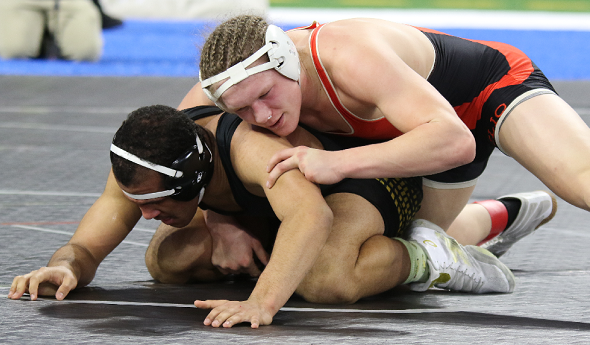
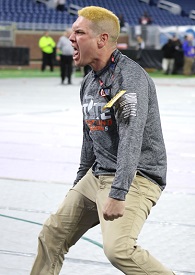
PHOTOS: (Top) Clio’s Tristan Vance works to maintain control in his opening match of the Division 2 Individual Finals against Lansing Waverly’s Demitrius Webb. (Middle) Clio coach – and Tristan’s father – Tony Vance celebrates as Tristan finishes a semifinal win over Fruitport’s Crue Cooper. (Click for more from HighSchoolSportsScene.com.)