

New Math: Division & Multiplication Problems
July 25, 2017
By Jack Roberts
MHSAA Executive Director
This is the second part in a series on MHSAA tournament classification, past and present, that will be published over the next two weeks. This series originally ran in this spring's edition of MHSAA benchmarks.
High school tournament classifications went viral before there was social media and most of us knew what “viral” meant.
Much as a virus infects computers today or has created epidemics of disease around the world for centuries, high school tournament classification – once introduced – tends to spread uncontrollably. Once started, it tends to keep expanding and rarely contracts.
While we are still some distance from providing every team a trophy as a result of expanding high school tournament classification across the country, there is criticism nevertheless that we are headed in that direction – a philosophy which is supposed to exist only in local youth sports for our youngest children.
Michigan could be blamed for all this. Michigan is generally accepted as the first state to provide different classifications for season-ending tournaments for different sized schools. It started a century ago. Today, every state has various classifications for its tournaments in most if not all sports. And it is a bit ironic that Michigan – creator of the classification chaos – more than most other states has kept the number of tournament classes or divisions under control.
Yes, there is evidence that tournament classifications have expanded over the years in Michigan, especially with the relatively recent introduction of tournaments in football and the late 1990s’ move from classes to divisions in most MHSAA tournaments. But the MHSAA Representative Council has held true to its word when it expanded the playoffs for football from four classes to eight divisions: this is needed because of unique factors of football, factors that exist in no other sport; and all other sports should be capped at a maximum of four classes or divisions.
Kentucky is the preeminent defender of single-class basketball. All of its 276 high schools compete for the single state championship for each gender. In Indiana, there are still open wounds from its move in 1998 from one to four classes for its 400 schools in basketball.
Multi-class tournaments have tended to increase the number of non-public school champions, which some states are trying to lower through enrollment “multipliers,” and also tend to increase the number of repeat champions, which some states are trying to affect with “success factors” which lift smaller schools into classifications for larger schools if they take home too many trophies.
While there is considerable evidence that state tournaments do as much bad as good for educational athletics, state associations persist in providing postseason tournaments because, on balance, the experiences are supposed to be good for student-athletes. And once we reach that conclusion it is just a small leap to believe that if the tournaments are good for a few, they must be better for more – which leads to creating more and more tournament classifications. One becomes two classes, then three, then four and so forth.
While the argument is that more classifications or divisions provides more students with opportunities to compete and win, it is undeniable that the experience changes as the number of tournament classifications expands. It is not possible for state associations to provide the same level of support when tournament classifications expand to multiple venues playing simultaneously. For example, there is less audio and video broadcast potential at each venue, and less media coverage to each venue. Focus is diluted and fans diminished at each championship.
No one can argue reasonably that today's two-day MHSAA Football Finals of eight championship games has the same pizazz as the one-day, four-games event conducted prior to 1990.
In some states the number of divisions has grown so much that it is difficult to see much difference between the many season-ending state championship games and a regular-season event in the same sport.
It is a balancing act. And Michigan has been studying that balance longer than any other state, and charting a steadier course than most.
Addition by Division
The shift to Divisions for MHSAA Tournament play in numerous sports has added up to a greater number of champions for teams and individuals across the state. Following are the sports currently employing a divisional format, and the procedures for determining enrollment and classification.
In 23 statewide or Lower Peninsula tournaments, schools which sponsor the sport are currently divided into nearly equal divisions. They are:
- Baseball - 4 Divisions
- Boys Bowling - 4 Divisions
- Girls Bowling - 4 Divisions
- Girls Competitive Cheer - 4 Divisions
- LP Boys Cross Country - 4 Divisions
- LP Girls Cross Country - 4 Divisions
- LP Boys Golf - 4 Divisions
- LP Girls Golf - 4 Divisions
- Ice Hockey - 3 Divisions
- Boys Lacrosse - 2 Divisions
- Girls Lacrosse - 2 Divisions
- Boys Skiing - 2 Divisions
- Girls Skiing - 2 Divisions
- LP Boys Soccer - 4 Divisions LP
- Girls Soccer - 4 Divisions
- Girls Softball - 4 Divisions
- LP Boys Swimming & Diving - 3 Divisions
- LP Girls Swimming & Diving - 3 Divisions
- LP Boys Tennis - 4 Divisions
- LP Girls Tennis - 4 Divisions
- LP Boys Track & Field - 4 Divisions
- LP Girls Track & Field - 4 Divisions
- Wrestling - 4 Divisions
Lists of schools for each division of these 23 tournaments are posted on MHSAA.com approximately April 1. Listings of schools in Upper Peninsula tournaments for their sports are also posted on MHSAA.com. The lists are based on school memberships and sports sponsorships in effect or anticipated for the following school year, as known to the MHSAA office as of a date in early March.
In football, the 256 schools which qualify for MHSAA 11-player playoffs are placed in eight equal divisions annually on Selection Sunday. Beginning in 2017, the 8-player divisions will be determined in a like manner on Selection Sunday as well, with 32 qualifying schools placed in two divisions.
Schools have the option to play in any higher division in one or more sports for a minimum of two years.
The deadlines for "opt-ups" are as follows:
- Applications for fall sports must be submitted by April 15
- Applications for winter sports must be submitted by Aug. 15
- Applications for spring sports must be submitted by Oct. 15
Subsequent to the date of these postings for these tournaments, no school will have its division raised or lowered by schools opening or closing, schools adding or dropping sports, schools exercising the option to play in a higher division, or approval or dissolution of cooperative programs.
When the same sport is conducted for boys and girls in the same season (e.g., track & field and cross country), the gender that has the most sponsoring schools controls the division breaks for both genders.
Ida Champ's Revenge 3 Years in Making
By
Paul Costanzo
Special for MHSAA.com
March 7, 2020
DETROIT – Hunter Assenmacher had waited three years for this.
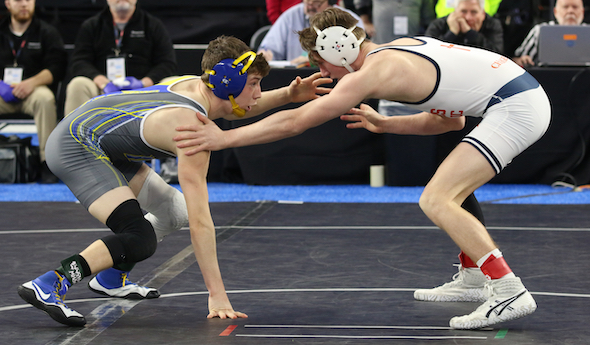
The Ida senior defeated Flint Powers Catholic’s Sean Spidle 7-4 on Saturday in the Division 3 119-pound championship match at the MHSAA Individual Finals at Ford Field. The win avenged Assenmacher’s only Finals loss, which came against Spidle their freshmen year.
“It was definitely weighing on my mind, but I knew I had put in the work the past three years,” Assenmacher said. “I worked so hard, I’ve been waiting for this chance to come back at him. A lot of people thought we might try to bump away from each other, but both of us have been great competitors for each other with great sportsmanship. Wrestling him was truly an honor. It was a great match, and I was really looking forward to it all year.”
The title was the third straight for Assenmacher (48-1), and prevented Spidle (35-1) from claiming his fourth.
Assenmacher was clinging to a one-point lead late in the match, but was able to lock up a front cradle on the edge of the mat to extend his lead to three and wrap up the match and the title.
“I know a lot of people were thinking of him as undefeated the past two years, a four-timer possibly, but you just can’t let that get into your head,” Assenmacher said. “Everybody has to take it one match at a time. Once you get to the state finals, it’s a restart button. You’re both 0-0. It’s just whoever goes out there and wants it more.”
103
Champion: Braeden Davis, Dundee, Fr. (38-4)
Technical fall, 16-1, over Dallas Stanton, Almont, Soph. (39-5)
Before Davis could fully celebrate his Finals title, he had to do some wind sprints on field.
With none of his matches making it to the third period, and his final match ending in the first, he may have needed the extra work.
“I’ve done this before, I’ve been to these big tournaments, and it’s just another tournament to me,” he said. “I just went out there trying to do whatever he gave me, and he gave me a bunch of tilts. I never use a plan; whatever they give me, I use.”
112
Champion: Jordan Rodriguez, Chesaning, Sr. (41-1)
Decision, 7-1, over Hunter Keller, Richmond, Jr. (37-5)
Rodriguez and Keller were both a match away from a Finals title a year ago, but it was Rodriguez who was able to climb to the top of the podium this year.
He used a pair of first-period takedowns to take control of the match and never looked back.
“I wanted to score as many points as I could and not give any opportunities up,” Rodriguez said. “I kind of had a feeling he was going to keep his distance and make me come in close.
“(Last year) made me want to dominate. It sucks losing in the finals, so I just used that to say it’s not going to happen again.”
125
Champion: Ryker Johnecheck, Williamston, Soph. (44-2)
Decision, 3-2 (UTB), over Aiden Davis, Dundee, Fr. (42-5)
With five seconds on the clock in the second ultimate tiebreaker, Johnecheck found himself down one point and with few options.
He went big and it paid off, as his last-second takedown wrapped up his first Finals title.
“This is what I’ve been looking forward to,” he said. “I just thrive off the atmosphere, and this year I looked at it a lot differently. I wasn’t as scared of all the people.
“I really don’t know what happened. He got out and I was like, ‘He’s ahead by a point, I need to get a takedown. I need to get something.’ So I just ran at him and did what I could.”
130
Champion: Austin Fietz, Dundee, Jr. (41-6)
Decision, 5-3, over Brock Holek, Durand, Jr. (45-1)
Fietz started a run of six straight Dundee championships.
With a pair of takedowns in the third period, he was able to overcome a small, early deficit and claim his title.
“This one feels good,” he said. “Going from fourth (place) to fifth to now winning it, this just feels awesome. I knew he had a good dump, just off the scouting report and watching him throughout the tournament. I knew he had a good fireman’s dump, so I knew if I could stay inside and I could get to a move that I like from there, I would be good. That’s how I scored most of my points.”
135
Champion: Casey Swiderski, Dundee, Soph. (39-1)
Major decision, 16-7, over Dametrius Castillo, Alma, Jr. (38-8)
Swiderski came out on top in a matchup of former Finals champions.
He had won at 103 pounds a year ago and had made a big jump throughout the season by wrestling at 125. He jumped up even further for the postseason.
“I was ranked No. 1 at 125 all year, but I’ve got two good teammates that had the possibility to win it at 125 and 130, so I went to 135 weighing 130 maybe,” he said. “We had a state finalist at 125 and a state champ at 130, so I’m just proud of my teammates that they got it done. … My big goal is to get eight (titles) total – four as a team and four individual. That would mean the most to me.”
Castillo had won his individual championship in 2018.
140
Champion: Christian Killion, Dundee, Sr. (46-6)
Decision, 5-3, over William Bradley, Paw Paw, Soph. (49-5)
After finishing second at each of the past two Finals, Killion was able to finish his career on top.
He went up 5-0 in this match, and was able to hold Bradley off down the stretch.
“It’s outstanding – to be a two-time runner-up and finally win one,” he said. “I’m thankful to even be where I am today. When I was coming into high school out of eighth grade, I didn’t know how serious I was going to be in this sport. My buddy Zach Bellaire whipped me into shape and got me to love this sport again. To think I’d even make it this far, to do this good at a tournament is just outstanding to me.”
145
Champion: Tyler Swiderski, Dundee, Jr. (47-3)
Decision, 6-2, over Kael Bunce, Stockbridge, Sr. (33-2)
Like his teammate, Killion, Swiderski finished the past two seasons one step short of the top of the podium.
He used a strong performance on his feet to make sure that wouldn’t happen again, earning a takedown in each period to claim his first Finals title.
“It’s a lot better than sitting on the ground crying – a lot better,” Swiderski said. “I was like, ‘I can’t be a three-time runner-up. That can’t happen.’ So, I was just more free and let my mind take care of things and wrestle.”
152
Champion: Dominic Lomazzo, Dundee, Jr. (24-4)
Decision, 8-5, over Peyton Brooks, Midland Bullock Creek, Soph. (48-6)
A year ago, Lomazzo watched his teammates from the Ford Field stands.
This year, he was able to join in on the fun and claim a Finals title of his own.
“I saw all my friends win last year, and I was so proud of them,” Lomazzo said. “But it just burned that I couldn’t compete. It feels great to win it this year. It feels amazing. It’s dominance – we set that in the beginning of the year, that we’re working for dominance. We have great talent on this team and I’m proud of all these guys, everyone. Even the kids that weren’t in the finals, they did their part this year.”
160
Champion: Stony Buell, Dundee, Jr. (45-3)
Major decision, 12-4, over Randy Pyrzewski, Gladwin, Soph. (47-6)
Buell’s title was the sixth straight for Dundee, and seventh on the night, tying an MHSAA record (set by Detroit Catholic Central in 2019 and St. Johns in 2013).
It also gave Buell his third title in as many tries, putting him on track to become a four-timer next season.
“Ever since I was a child, it’s been one of my biggest goals to be a four-time state champ,” Buell said. “So, really I’m just going to reset the board next year and still be hungry for that next title.”
171
Champion: Dillon Kroening, Gladwin, Sr. (52-1)
Decision, 7-5, over Jaxon Guinn, Dundee, Sr. (36-10)
A year ago, Kroening was a match away from bringing a title back to Gladwin for the first time since 1989. This time, he accomplished the feat.
Kroening came back from an early deficit with a nearfall in the second period, and a reversal and a takedown in the third to wrap up the victory.
“Adversity, I’ve learned to fight through adversity my whole life,” Kroening said. “I started out with my coach from the Pittbulls (club); he’s pushed me hard and never let me quit, and that’s what I showed right there. It just means so much to me. This is for Gladwin.”
189
Champion: Jonathan Clack, Lake Odessa Lakewood, Sr. (52-0)
Decision, 6-4, over Noah Montanari, Richmond, Sr. (35-4)
Clack finished his unbeaten season with his 200th career victory.
He took a 6-1 lead into the third period and held off a late charge from Montanari.
“It feels awesome; I trained my whole life for this,” Clack said. “Every day. I trained harder than anyone in the room, I trained as hard as I could, pushed myself to the limit, did extra practices, extra work and it all paid off. I trained my whole life for this. It’s awesome.”
215
Champion: Luke Davis, Richmond, Sr. (42-2)
Decision, 11-9, over Boe Eckman, Constantine, Jr. (38-4)
Davis spent the year atop the rankings in this weight class, and was dominant on the weekend.
But Eckman put a scare into him, putting him to his back late in the second period. The Richmond senior was able to regroup, however, and grab his first Finals title.
“It’s a big stress relief,” Davis said. “Being a senior and everything, it feels like there’s a giant load off my shoulders. You’re carrying that weight the whole year of being ranked first, to have a close match like that and have some quick scares – I got rolled over to my back there and I was like, ‘No. I could cower up and be a coward and let myself get pinned, make excuses for myself. Or I can fight my way out of it.’ Not to toot my horn, but that’s why I’ve been ranked No. 1 all year. Everyone believes that I can do it, but I believe that I can do it.”
285
Champion: Grant Clarkson, Lake Odessa Lakewood, Sr. (40-0)
Decision, 5-2, over Terrance Watson, Birch Run, Sr. (44-2)
Clarkson was the only heavyweight in the state to finish the season unbeaten, as he capped off his perfect year with a Finals title.
He led 3-2 late in the match, and sealed the victory with a late takedown.
“I’m on cloud nine. I’m ecstatic,” Clarkson said. “I’ve worked at it for four years. After my freshman year watching the state finals, I said I wanted to win a state title. Here we are, four years later. (Going unbeaten) was a goal I set, and I like to achieve my goals. I had to push myself every day to get better, and that’s what I did all year.”
PHOTO: Ida’s Hunter Assenmacher (left) and Flint Powers Catholic’s Sean Spidle face off in the Division 3 119-pound championship match Saturday at Ford Field. (Click for more from HighSchoolSportsScene.com.)