

New Math: Division & Multiplication Problems
July 25, 2017
By Jack Roberts
MHSAA Executive Director
This is the second part in a series on MHSAA tournament classification, past and present, that will be published over the next two weeks. This series originally ran in this spring's edition of MHSAA benchmarks.
High school tournament classifications went viral before there was social media and most of us knew what “viral” meant.
Much as a virus infects computers today or has created epidemics of disease around the world for centuries, high school tournament classification – once introduced – tends to spread uncontrollably. Once started, it tends to keep expanding and rarely contracts.
While we are still some distance from providing every team a trophy as a result of expanding high school tournament classification across the country, there is criticism nevertheless that we are headed in that direction – a philosophy which is supposed to exist only in local youth sports for our youngest children.
Michigan could be blamed for all this. Michigan is generally accepted as the first state to provide different classifications for season-ending tournaments for different sized schools. It started a century ago. Today, every state has various classifications for its tournaments in most if not all sports. And it is a bit ironic that Michigan – creator of the classification chaos – more than most other states has kept the number of tournament classes or divisions under control.
Yes, there is evidence that tournament classifications have expanded over the years in Michigan, especially with the relatively recent introduction of tournaments in football and the late 1990s’ move from classes to divisions in most MHSAA tournaments. But the MHSAA Representative Council has held true to its word when it expanded the playoffs for football from four classes to eight divisions: this is needed because of unique factors of football, factors that exist in no other sport; and all other sports should be capped at a maximum of four classes or divisions.
Kentucky is the preeminent defender of single-class basketball. All of its 276 high schools compete for the single state championship for each gender. In Indiana, there are still open wounds from its move in 1998 from one to four classes for its 400 schools in basketball.
Multi-class tournaments have tended to increase the number of non-public school champions, which some states are trying to lower through enrollment “multipliers,” and also tend to increase the number of repeat champions, which some states are trying to affect with “success factors” which lift smaller schools into classifications for larger schools if they take home too many trophies.
While there is considerable evidence that state tournaments do as much bad as good for educational athletics, state associations persist in providing postseason tournaments because, on balance, the experiences are supposed to be good for student-athletes. And once we reach that conclusion it is just a small leap to believe that if the tournaments are good for a few, they must be better for more – which leads to creating more and more tournament classifications. One becomes two classes, then three, then four and so forth.
While the argument is that more classifications or divisions provides more students with opportunities to compete and win, it is undeniable that the experience changes as the number of tournament classifications expands. It is not possible for state associations to provide the same level of support when tournament classifications expand to multiple venues playing simultaneously. For example, there is less audio and video broadcast potential at each venue, and less media coverage to each venue. Focus is diluted and fans diminished at each championship.
No one can argue reasonably that today's two-day MHSAA Football Finals of eight championship games has the same pizazz as the one-day, four-games event conducted prior to 1990.
In some states the number of divisions has grown so much that it is difficult to see much difference between the many season-ending state championship games and a regular-season event in the same sport.
It is a balancing act. And Michigan has been studying that balance longer than any other state, and charting a steadier course than most.
Addition by Division
The shift to Divisions for MHSAA Tournament play in numerous sports has added up to a greater number of champions for teams and individuals across the state. Following are the sports currently employing a divisional format, and the procedures for determining enrollment and classification.
In 23 statewide or Lower Peninsula tournaments, schools which sponsor the sport are currently divided into nearly equal divisions. They are:
- Baseball - 4 Divisions
- Boys Bowling - 4 Divisions
- Girls Bowling - 4 Divisions
- Girls Competitive Cheer - 4 Divisions
- LP Boys Cross Country - 4 Divisions
- LP Girls Cross Country - 4 Divisions
- LP Boys Golf - 4 Divisions
- LP Girls Golf - 4 Divisions
- Ice Hockey - 3 Divisions
- Boys Lacrosse - 2 Divisions
- Girls Lacrosse - 2 Divisions
- Boys Skiing - 2 Divisions
- Girls Skiing - 2 Divisions
- LP Boys Soccer - 4 Divisions LP
- Girls Soccer - 4 Divisions
- Girls Softball - 4 Divisions
- LP Boys Swimming & Diving - 3 Divisions
- LP Girls Swimming & Diving - 3 Divisions
- LP Boys Tennis - 4 Divisions
- LP Girls Tennis - 4 Divisions
- LP Boys Track & Field - 4 Divisions
- LP Girls Track & Field - 4 Divisions
- Wrestling - 4 Divisions
Lists of schools for each division of these 23 tournaments are posted on MHSAA.com approximately April 1. Listings of schools in Upper Peninsula tournaments for their sports are also posted on MHSAA.com. The lists are based on school memberships and sports sponsorships in effect or anticipated for the following school year, as known to the MHSAA office as of a date in early March.
In football, the 256 schools which qualify for MHSAA 11-player playoffs are placed in eight equal divisions annually on Selection Sunday. Beginning in 2017, the 8-player divisions will be determined in a like manner on Selection Sunday as well, with 32 qualifying schools placed in two divisions.
Schools have the option to play in any higher division in one or more sports for a minimum of two years.
The deadlines for "opt-ups" are as follows:
- Applications for fall sports must be submitted by April 15
- Applications for winter sports must be submitted by Aug. 15
- Applications for spring sports must be submitted by Oct. 15
Subsequent to the date of these postings for these tournaments, no school will have its division raised or lowered by schools opening or closing, schools adding or dropping sports, schools exercising the option to play in a higher division, or approval or dissolution of cooperative programs.
When the same sport is conducted for boys and girls in the same season (e.g., track & field and cross country), the gender that has the most sponsoring schools controls the division breaks for both genders.
Lenawee Christian Different, But Not Down
February 28, 2020
By Doug Donnelly
Special for Second Half
In the first practice without Bree Salenbien, the Lenawee Christian girls basketball team didn’t dwell on the fact the best player in the Division 4 tournament the last couple of seasons won’t be on the court for this season’s playoff run.
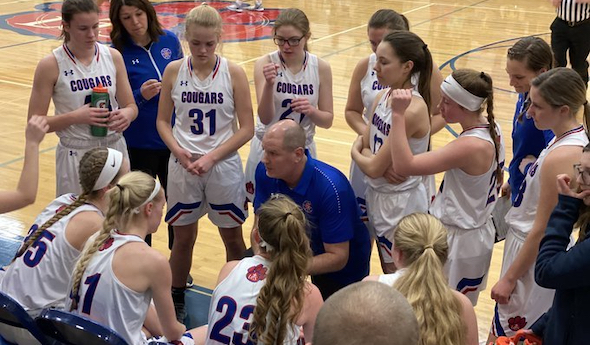
 “Practice was amazing,” third-year Lenawee Christian head coach Jamie Salenbien said. “The girls talked about ways to step up, and they assured each other of their foundation.”
Lenawee Christian has won back-to-back Finals championships, in Class D in 2018 and Division 4 in 2019. During each of those state championship runs, 6-foot-4 Bree Salenbien showcased the incredible talent that has earned her more than 25 scholarship offers from Division I schools across the country – including Michigan and Michigan State.
In a stunning turn of events, however, Salenbien tore her ACL with about 15 seconds remaining in overtime of Lenawee Christian’s final regular-season game earlier this week. That drastically changed the entire MHSAA tournament picture as the 17-3 Cougars – who have played one of the toughest schedules in the state regardless of division – no longer are the overwhelming favorites.
Don’t tell them that, however.
“It definitely is going to be a long hard road,” said Cougars senior Dani Salenbien, Bree’s older sister. “It’s no secret Bree is a huge part of our team, but I have no doubt that our team will adjust and come out strong when we play next.”
The Cougars have gone 15-0 the last two seasons in postseason play, winning the first two girls basketball championships in school history. The Salenbiens have been at the forefront of those title runs. Jamie Salenbien is a Hudson graduate who coached three years at Onsted before stepping down to concentrate on coaching his daughters through their youth teams.
He became head varsity coach at Lenawee Christian when Dani was entering her sophomore year and Bree was about to make her varsity debut. The result was a 26-1 season and Class D Final win over Chassell. Bree was named the Class D Player of the Year and her dad was named Coach of the Year by The Associated Press.
Last season, Dani Salenbien took more of a lead role, especially during the tournament, helping turn the Cougars’ fortunes with an outstanding performance in the championship game win over St. Ignace. Both Salenbiens were all-state choices, and this year it looked like the Cougars were destined to become one of the few three-peat champions in MHSAA history. They have been ranked No. 1 all season. The only team with a higher Michigan Power Rating than LCS is Division 2 Detroit Edison, a team the Cougars lost to as part of a rugged schedule that saw LCS face three teams that have been ranked No. 1 in three separate classes this season.
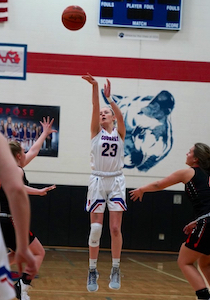
The game against Edison was played in front of a standing-room only crowd at LCS. Dani Salenbien poured in eight 3-pointers and scored a career-high 31 points, which Edison eventually pulled away and won.
 “It definitely was nerve-wracking,” Dani said. “The environment was kind of insane. I had so much fun. It was an opportunity for us to show our love of Christ and play to the best of our ability. Anytime you play a team like that, you have the chance to improve.”
Among the other teams on the LCS schedule this year have been Hartland, who was No. 1 in Division 1 at one point of the season; several state-ranked Division 4 schools such as Fowler and Allen Park Inter-City Baptist; Toledo Christian, ranked No. 2 in Ohio’s Division 4; and Cascades Conference powerhouses Michigan Center and Grass Lake, which was ranked No. 1 in Division 3 for much of the season.
“Playing 20 different teams pushes the girls to prepare and perform each game,” Coach Salenbien said. “By playing some of the best teams in the state, it hopefully prepares the girls for the toughest situations they might face.
“Facing the best requires you to dig deep and play your best.”
The game against Grass Lake on Tuesday was one of those games, two powerhouses battling on every possession. In the waning seconds of the first overtime, the Cougars grabbed a rebound and found Bree on an outlet pass. She took a dribble, then appeared to have tried to dribble the ball behind her back when she went to the floor. By Thursday, the Salenbien family was overwhelmed with text messages, phone calls and e-mails from friends, family and former Cougars players and coaches offering prayers and support for Bree.
On Thursday afternoon the Cougars were back on the practice floor, getting ready for Monday’s Division 4 District game against Ann Arbor Rudolf Steiner.
Coach Salenbien said the girls got in practice, strength training and spent some time reading through some of the messages the team has received over the last couple of days. It’s not business as usual, of course, but don’t expect a letdown once the postseason starts Monday.
“This group is so tough,” Coach Salenbien said. “I just love how fearless they approach challenges.
“One of our themes is ‘Chase the Lion’ which stresses the importance of dreaming big and taking positive risks without fear. The group lives this out.”
Dani, Libby Miller and Caitlin Anderson are four-year starters. Dani – who has signed to play at Hillsdale College next year – has scored more than 1,200 career points, while Miller has made 178 career 3-pointers and Caitlin is nearing 100 career games played. Cara Anderson and Lizzy Scharer both have big game experience as well, having played in an MHSAA Final.
The Cougars plan to approach this Division 4 tournament just as they would with Bree.
“I don’t know if anyone’s roles will change or not,” Dani said. “I’m excited. We’re going to have to play our best, and everyone is going to have to step up. The postseason makes us all that much more serious. We already are serious, but it just intensifies in the postseason.”
The Cougars have played against some of Michigan and Ohio’s best teams this year and are ready for that road to pay off. Lenawee Christian also has something few other teams have – virtually unmatched big game experience.
Like Dani Salenbien said, “It helps when you have been there.”
 Doug Donnelly has served as a sports and news reporter and city editor over 25 years, writing for the Daily Chief-Union in Upper Sandusky, Ohio from 1992-1995, the Monroe Evening News from 1995-2012 and the Adrian Daily Telegram since 2013. He's also written a book on high school basketball in Monroe County and compiles record books for various schools in southeast Michigan. E-mail him at [email protected] with story ideas for Jackson, Washtenaw, Hillsdale, Lenawee and Monroe counties.
PHOTOS: (Top) Adrian Lenawee Christian coach Jamie Salenbien talks things over with his team during a game break this season. (Middle) Dani Salenbien pulls up for a jumper. (Photos courtesy of the Lenawee Christian athletic department.)