


New Math: Division & Multiplication Problems
July 25, 2017
By Jack Roberts
MHSAA Executive Director
This is the second part in a series on MHSAA tournament classification, past and present, that will be published over the next two weeks. This series originally ran in this spring's edition of MHSAA benchmarks.
High school tournament classifications went viral before there was social media and most of us knew what “viral” meant.
Much as a virus infects computers today or has created epidemics of disease around the world for centuries, high school tournament classification – once introduced – tends to spread uncontrollably. Once started, it tends to keep expanding and rarely contracts.
While we are still some distance from providing every team a trophy as a result of expanding high school tournament classification across the country, there is criticism nevertheless that we are headed in that direction – a philosophy which is supposed to exist only in local youth sports for our youngest children.
Michigan could be blamed for all this. Michigan is generally accepted as the first state to provide different classifications for season-ending tournaments for different sized schools. It started a century ago. Today, every state has various classifications for its tournaments in most if not all sports. And it is a bit ironic that Michigan – creator of the classification chaos – more than most other states has kept the number of tournament classes or divisions under control.
Yes, there is evidence that tournament classifications have expanded over the years in Michigan, especially with the relatively recent introduction of tournaments in football and the late 1990s’ move from classes to divisions in most MHSAA tournaments. But the MHSAA Representative Council has held true to its word when it expanded the playoffs for football from four classes to eight divisions: this is needed because of unique factors of football, factors that exist in no other sport; and all other sports should be capped at a maximum of four classes or divisions.
Kentucky is the preeminent defender of single-class basketball. All of its 276 high schools compete for the single state championship for each gender. In Indiana, there are still open wounds from its move in 1998 from one to four classes for its 400 schools in basketball.
Multi-class tournaments have tended to increase the number of non-public school champions, which some states are trying to lower through enrollment “multipliers,” and also tend to increase the number of repeat champions, which some states are trying to affect with “success factors” which lift smaller schools into classifications for larger schools if they take home too many trophies.
While there is considerable evidence that state tournaments do as much bad as good for educational athletics, state associations persist in providing postseason tournaments because, on balance, the experiences are supposed to be good for student-athletes. And once we reach that conclusion it is just a small leap to believe that if the tournaments are good for a few, they must be better for more – which leads to creating more and more tournament classifications. One becomes two classes, then three, then four and so forth.
While the argument is that more classifications or divisions provides more students with opportunities to compete and win, it is undeniable that the experience changes as the number of tournament classifications expands. It is not possible for state associations to provide the same level of support when tournament classifications expand to multiple venues playing simultaneously. For example, there is less audio and video broadcast potential at each venue, and less media coverage to each venue. Focus is diluted and fans diminished at each championship.
No one can argue reasonably that today's two-day MHSAA Football Finals of eight championship games has the same pizazz as the one-day, four-games event conducted prior to 1990.
In some states the number of divisions has grown so much that it is difficult to see much difference between the many season-ending state championship games and a regular-season event in the same sport.
It is a balancing act. And Michigan has been studying that balance longer than any other state, and charting a steadier course than most.
Addition by Division
The shift to Divisions for MHSAA Tournament play in numerous sports has added up to a greater number of champions for teams and individuals across the state. Following are the sports currently employing a divisional format, and the procedures for determining enrollment and classification.
In 23 statewide or Lower Peninsula tournaments, schools which sponsor the sport are currently divided into nearly equal divisions. They are:
- Baseball - 4 Divisions
- Boys Bowling - 4 Divisions
- Girls Bowling - 4 Divisions
- Girls Competitive Cheer - 4 Divisions
- LP Boys Cross Country - 4 Divisions
- LP Girls Cross Country - 4 Divisions
- LP Boys Golf - 4 Divisions
- LP Girls Golf - 4 Divisions
- Ice Hockey - 3 Divisions
- Boys Lacrosse - 2 Divisions
- Girls Lacrosse - 2 Divisions
- Boys Skiing - 2 Divisions
- Girls Skiing - 2 Divisions
- LP Boys Soccer - 4 Divisions LP
- Girls Soccer - 4 Divisions
- Girls Softball - 4 Divisions
- LP Boys Swimming & Diving - 3 Divisions
- LP Girls Swimming & Diving - 3 Divisions
- LP Boys Tennis - 4 Divisions
- LP Girls Tennis - 4 Divisions
- LP Boys Track & Field - 4 Divisions
- LP Girls Track & Field - 4 Divisions
- Wrestling - 4 Divisions
Lists of schools for each division of these 23 tournaments are posted on MHSAA.com approximately April 1. Listings of schools in Upper Peninsula tournaments for their sports are also posted on MHSAA.com. The lists are based on school memberships and sports sponsorships in effect or anticipated for the following school year, as known to the MHSAA office as of a date in early March.
In football, the 256 schools which qualify for MHSAA 11-player playoffs are placed in eight equal divisions annually on Selection Sunday. Beginning in 2017, the 8-player divisions will be determined in a like manner on Selection Sunday as well, with 32 qualifying schools placed in two divisions.
Schools have the option to play in any higher division in one or more sports for a minimum of two years.
The deadlines for "opt-ups" are as follows:
- Applications for fall sports must be submitted by April 15
- Applications for winter sports must be submitted by Aug. 15
- Applications for spring sports must be submitted by Oct. 15
Subsequent to the date of these postings for these tournaments, no school will have its division raised or lowered by schools opening or closing, schools adding or dropping sports, schools exercising the option to play in a higher division, or approval or dissolution of cooperative programs.
When the same sport is conducted for boys and girls in the same season (e.g., track & field and cross country), the gender that has the most sponsoring schools controls the division breaks for both genders.
D2 Preview: Chasing Lowell's Record Reign
February 27, 2020
By Geoff Kimmerly
Second Half editor
Significant change will spark this season’s Division 2 Wrestling Quarterfinals at Wings Event Center, as five teams will be competing in Friday’s round that did not a year ago – including two programs wrestling for the first time at this level of the tournament.
Yet amid the buzz, a constant in Michigan high school wrestling will be standing tall.
Lowell is back and the top seed in Division 2 after winning its record sixth-straight MHSAA Finals championship in Kalamazoo a year ago. In fact, the Red Arrows are the only team among the top five seeds in this division that has won a Finals title.
But extending the streak won’t come easily – especially considering the second and third-seeded teams are led by two of the most successful and longest-serving coaches in MHSAA wrestling history.
The Division 2 Quarterfinals will be wrestled at 6:45 p.m. Friday. Top seed Lowell will wrestle Croswell-Lexington, No. 2 Gaylord will take on New Boston Huron, No. 3 Stevensville Lakeshore will face Mason and No. 4 Warren Woods-Tower will match up with Muskegon Reeths-Puffer. Semifinals are noon Saturday, with the championship match that afternoon at 3:45 p.m. All matches this weekend will be viewable live on a subscription basis on MHSAA.tv. For Friday’s schedule and results throughout, check the MHSAA Wrestling page.
Below is a look at all eight teams competing in Division 2, listed by seed.
#1 Lowell
Record/rank: 12-4, No. 1
League finish: First in Ottawa-Kent Conference White
Coach: R.J. Boudro, sixth season (117-18)
Championship history: Nine MHSAA championships (most recent 2019), six runner-up finishes.
Individual Finals qualifiers: 112 Nick Kohorn (24-11) sr., 112 Ramsy Mutchler (26-17) soph., 125 James Link (27-14) jr., 130 Zeth Strejc (22-12) jr., 135 Dawson Jankowski (26-10) sr., 140 William Link (25-10) jr., 145 Austin Boone (34-0) sr., 152 James Fotis (23-5) sr., 160 Doak Dean (27-8) jr., 171 Jacob Lee (30-9) jr., 215 Jacob Hough (27-9) sr., 215 Keegan Nugent (32-6) jr., 285 Tyler Deloof (18-5) sr., 285 Grant Pratt (26-11) sr.
Outlook: Add to the Red Arrows’ record run that they qualified a full 14 for next week’s Individual Finals, and that alone tells a pretty good story of the team’s continued dominance this winter. Some lineup maneuvering allows Lowell to get 13 of its 14 individual qualifiers into a team match, with freshman Landon Miller (103/19-8) joining the star-loaded group. Boone will wrestle for his fourth individual championship next weekend, and Korhorn was a Finals runner-up in 2018. Deloof, Mutschler, Fotis, Dean and Lee were individual placers last season.
#2 Gaylord
Record/rank: 30-0, No. 2
League finish: First in Big North Conference
Coach: Jerry LaJoie, 26th season (729-135-2)
Championship history: Division 2 runner-up 2018.
Individual Finals qualifiers: 103 Brendan Smith (34-9) fr., 112 Gabe Thompson (30-8) soph., 125 John Sosa (35-2) sr., 125 Will Sides (38-5) sr., 130 Rico Brown (30-1) sr., 145 Chayse LaJoie (33-0) sr., 160 Jacob McKnight (38-2) sr.
Outlook: Gaylord fell by only 10 to Lowell in last season’s Semifinal match and hasn’t lost since, reaching this weekend with a 33-30 Regional Final win over No. 3 DeWitt. Chayse LaJoie just missed on a third individual title in 2019, falling in a 3-2 decision in the 125 championship match, and he too hasn’t lost again. Sosa and McKnight also were Finals placers last season, and junior Quinn Schultz (189/40-8) was a qualifier a year ago although he did not make the final weekend this season. Two freshmen also have broken 40 wins – Gus James (119/40-7) and Brayden Gautreau (152/43-6).
#3 Stevensville Lakeshore
Record/rank: 19-1, No. 6
League finish: First in Southwestern Michigan Athletic Conference
Coach: Bruce Bittenbender, 50th season (939-264-2)
Championship history: Class B runner-up in 1986 and 1994.
Individual Finals qualifiers: 112 Cameron Litaker (26-6) soph., 119 Aaron Lucio (34-5) fr., 130 Micah Hanau (36-3) soph., 135 Shane Williams (38-2) sr., 160 Case Rohl (18-6) sr., 215 Zeke Rohl (34-5) sr.
Outlook: Bittenbender – the state’s winningest coach by more than 100 matches – will lead Lakeshore to the Quarterfinals for the 11th time in the 32-year history of the team format and after the Lancers missed a year ago. They advanced this time with Regional wins over No. 9 Niles and Battle Creek Harper Creek. Litaker, Hanau, Williams and Zeke Rohl all were Finals placers last season, and junior James Harris (145/35-7) has been another big winner this winter.
#4 Warren Woods-Tower
Record/rank: 17-6, No. 5
League finish: First in Macomb Area Conference Red
Co-coaches: Greg Mayer and Russell Correll, 20th seasons (389-249)
Championship history: Division 2 runner-up 2017.
Individual Finals qualifiers: 103 Tyler Daniel (33-11) soph., 119 Joe Haynes (44-3) jr., 119 Gavin Shoobridge (24-12) jr., 125 Josh Howey (34-7) soph., 130 Dru Wilson (39-7) jr., 135 Mathew Booth (31-14) jr., 152 Tim Lewis (30-14) sr., 160 Ryan Radvansky (35-12) fr., 171 Omari Embree (24-2) soph.
Outlook: Tower has become a regular at the Quarterfinals with this its fifth-straight trip and sixth in seven seasons. The Titans again made the Semifinals last season and are seeded to do the same with a lineup including five seniors but eight Finals qualifiers who are juniors or younger. Embree was last season’s champion at 160 as a freshman, while Haynes was runner-up at 119 and Howey also placed at the Individual Finals. Wilson joined Haynes as a placer in 2018.
#5 Muskegon Reeths-Puffer
Record/rank: 25-1, No. 7
League finish: First in O-K Black
Coach: Matt Brink, 14th season (269-117)
Championship history: Has not appeared in an MHSAA Final.
Individual Finals qualifiers: 119 Jacob Blawat (40-7) jr., 152 James Rozycki (42-4) jr., 189 Colby Stephenson (45-2) sr., 215 Hunter McCall (41-1) sr.
Outlook: Brink, a three-time individual champion at Fruitport, has led Reeths-Puffer to its first Regional championship to go with six straight District and league titles. The Rockets opened the postseason with a four-point District win over No. 8 Whitehall and also got past Allendale by nine in the Regional Final to earn this first-time opportunity. McCall brings experience on the big stage; he finished third at 215 last season. Nine starters total have at least 30 wins – junior Thade Radosa (145/42-3) just missed qualifying for the Individual Finals but is another top contributor.
#6 Mason
Record/rank: 23-2, unranked
League finish: First in Capital Area Activities Conference Red
Coach: Brian Martel, 17th season (486-110)
Championship history: Three MHSAA titles (most recent 2006), one runner-up finish.
Individual Finals qualifiers: 103 Tayden Miller (39-5) fr., 130 Tanner Miller (41-1) sr., 285 Jack Gilchrist (40-2) sr.
Outlook: A three-time Division 2 champion during the first decade of the 2000s, Mason is back at the Quarterfinals for the first time since 2013. The Bulldogs have won 11 straight District titles but frequently have run into state-ranked competition at the Regional level – and this time they advanced with a 33-27 upset of No. 4 Eaton Rapids in the Regional Final. Tanner Miller finished fifth at 130 last season and is one of seven senior starters finishing their careers memorably.
#7 New Boston Huron
Record/rank: 21-4, No.10
League finish: First in Huron League
Coach: Jack Shulaw, 17th season (371-117)
Championship history: Class B champion 1978 and 1981.
Individual Finals qualifiers: 135 Dylan Carr (36-11) sr., 160 Nelson Poet (37-4) sr., 171 Cody Brenner (44-2) jr., 171 Kael Wisler (32-5) soph., 189 Braden Damiani (37-5) sr., 215 Brendan Damiani (37-6) sr., 285 Tyler Short (35-9) jr.
Outlook: New Boston Huron won its first Regional title since 2003, with a 38-37 win over Gibraltar Carlson sending the Chiefs to Kalamazoo. Like Mason, Huron has had plenty of success in earlier rounds, following up nine league titles over the last decade with their eighth District championship during that time two weeks ago. Poet was the individual runner-up last season at 160, and Brenner, Braden Damiani, Carr and senior Kaleb Rosen (145/36-4) also were Finals placers.
#8 Croswell-Lexington
Record/rank: 31-9, unranked
League finish: Third in Blue Water Area Conference
Coach: Joe Lilly, 22nd season (449-183)
Championship history: Has never appeared in an MHSAA Final.
Individual Finals qualifiers: 130 Christopher Lilly (49-1) sr., 135 Xzavier Suess (43-3) jr., 171 Vincent Scaramuzzino (46-4) jr.
Outlook: Croswell-Lexington also celebrated its first Regional title last week after winning its sixth District title over the last seven seasons and emerging from a BWAC that includes Division 3 second seed Richmond. Christopher Lilly is the reigning individual champion at 135 and Scaramuzzino was fourth at 152 last season.
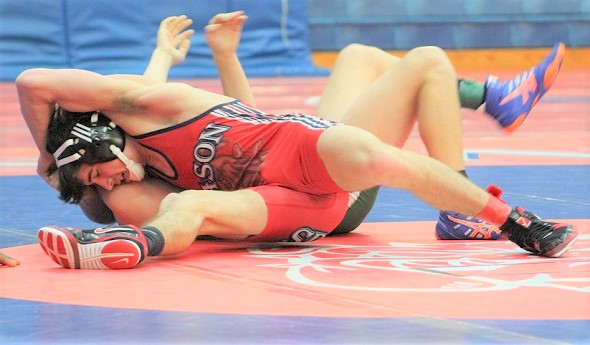
PHOTO: A Mason wrestler works toward a pin during Individual District competition Feb. 15. (Click for more from HighSchoolSportsScene.com.)