


New Math: Division & Multiplication Problems
July 25, 2017
By Jack Roberts
MHSAA Executive Director
This is the second part in a series on MHSAA tournament classification, past and present, that will be published over the next two weeks. This series originally ran in this spring's edition of MHSAA benchmarks.
High school tournament classifications went viral before there was social media and most of us knew what “viral” meant.
Much as a virus infects computers today or has created epidemics of disease around the world for centuries, high school tournament classification – once introduced – tends to spread uncontrollably. Once started, it tends to keep expanding and rarely contracts.
While we are still some distance from providing every team a trophy as a result of expanding high school tournament classification across the country, there is criticism nevertheless that we are headed in that direction – a philosophy which is supposed to exist only in local youth sports for our youngest children.
Michigan could be blamed for all this. Michigan is generally accepted as the first state to provide different classifications for season-ending tournaments for different sized schools. It started a century ago. Today, every state has various classifications for its tournaments in most if not all sports. And it is a bit ironic that Michigan – creator of the classification chaos – more than most other states has kept the number of tournament classes or divisions under control.
Yes, there is evidence that tournament classifications have expanded over the years in Michigan, especially with the relatively recent introduction of tournaments in football and the late 1990s’ move from classes to divisions in most MHSAA tournaments. But the MHSAA Representative Council has held true to its word when it expanded the playoffs for football from four classes to eight divisions: this is needed because of unique factors of football, factors that exist in no other sport; and all other sports should be capped at a maximum of four classes or divisions.
Kentucky is the preeminent defender of single-class basketball. All of its 276 high schools compete for the single state championship for each gender. In Indiana, there are still open wounds from its move in 1998 from one to four classes for its 400 schools in basketball.
Multi-class tournaments have tended to increase the number of non-public school champions, which some states are trying to lower through enrollment “multipliers,” and also tend to increase the number of repeat champions, which some states are trying to affect with “success factors” which lift smaller schools into classifications for larger schools if they take home too many trophies.
While there is considerable evidence that state tournaments do as much bad as good for educational athletics, state associations persist in providing postseason tournaments because, on balance, the experiences are supposed to be good for student-athletes. And once we reach that conclusion it is just a small leap to believe that if the tournaments are good for a few, they must be better for more – which leads to creating more and more tournament classifications. One becomes two classes, then three, then four and so forth.
While the argument is that more classifications or divisions provides more students with opportunities to compete and win, it is undeniable that the experience changes as the number of tournament classifications expands. It is not possible for state associations to provide the same level of support when tournament classifications expand to multiple venues playing simultaneously. For example, there is less audio and video broadcast potential at each venue, and less media coverage to each venue. Focus is diluted and fans diminished at each championship.
No one can argue reasonably that today's two-day MHSAA Football Finals of eight championship games has the same pizazz as the one-day, four-games event conducted prior to 1990.
In some states the number of divisions has grown so much that it is difficult to see much difference between the many season-ending state championship games and a regular-season event in the same sport.
It is a balancing act. And Michigan has been studying that balance longer than any other state, and charting a steadier course than most.
Addition by Division
The shift to Divisions for MHSAA Tournament play in numerous sports has added up to a greater number of champions for teams and individuals across the state. Following are the sports currently employing a divisional format, and the procedures for determining enrollment and classification.
In 23 statewide or Lower Peninsula tournaments, schools which sponsor the sport are currently divided into nearly equal divisions. They are:
- Baseball - 4 Divisions
- Boys Bowling - 4 Divisions
- Girls Bowling - 4 Divisions
- Girls Competitive Cheer - 4 Divisions
- LP Boys Cross Country - 4 Divisions
- LP Girls Cross Country - 4 Divisions
- LP Boys Golf - 4 Divisions
- LP Girls Golf - 4 Divisions
- Ice Hockey - 3 Divisions
- Boys Lacrosse - 2 Divisions
- Girls Lacrosse - 2 Divisions
- Boys Skiing - 2 Divisions
- Girls Skiing - 2 Divisions
- LP Boys Soccer - 4 Divisions LP
- Girls Soccer - 4 Divisions
- Girls Softball - 4 Divisions
- LP Boys Swimming & Diving - 3 Divisions
- LP Girls Swimming & Diving - 3 Divisions
- LP Boys Tennis - 4 Divisions
- LP Girls Tennis - 4 Divisions
- LP Boys Track & Field - 4 Divisions
- LP Girls Track & Field - 4 Divisions
- Wrestling - 4 Divisions
Lists of schools for each division of these 23 tournaments are posted on MHSAA.com approximately April 1. Listings of schools in Upper Peninsula tournaments for their sports are also posted on MHSAA.com. The lists are based on school memberships and sports sponsorships in effect or anticipated for the following school year, as known to the MHSAA office as of a date in early March.
In football, the 256 schools which qualify for MHSAA 11-player playoffs are placed in eight equal divisions annually on Selection Sunday. Beginning in 2017, the 8-player divisions will be determined in a like manner on Selection Sunday as well, with 32 qualifying schools placed in two divisions.
Schools have the option to play in any higher division in one or more sports for a minimum of two years.
The deadlines for "opt-ups" are as follows:
- Applications for fall sports must be submitted by April 15
- Applications for winter sports must be submitted by Aug. 15
- Applications for spring sports must be submitted by Oct. 15
Subsequent to the date of these postings for these tournaments, no school will have its division raised or lowered by schools opening or closing, schools adding or dropping sports, schools exercising the option to play in a higher division, or approval or dissolution of cooperative programs.
When the same sport is conducted for boys and girls in the same season (e.g., track & field and cross country), the gender that has the most sponsoring schools controls the division breaks for both genders.
Haslett Cancer Games Touch Close to Home
By
Rob Kaminski
MHSAA benchmarks editor
February 18, 2020
By Rob Kaminski
MHSAA benchmarks editor
By pure coincidence, it happened to be Valentine's Day.
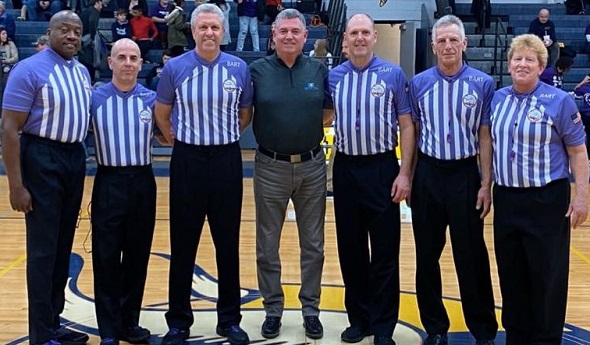
However, that date on the calendar served as the perfect backdrop when two schools and two officiating crews paired up for a "Coaches for Cancer" girls and boys basketball doubleheader Friday at Haslett High School.
Adding to the poignancy of this particular Feb. 14 were the still-raw emotions for the host school, which lost its longtime principal, Bart Wegenke, to pancreatic cancer a month earlier.
"This is our second year participating in a Coaches vs. Cancer event at a basketball game," said Haslett athletic director Darin Ferguson. "The event was actually planned before Bart’s passing."
Wegenke, 53, was widely recognized in educational circles for his excellence as an administrator, and also was an accomplished basketball official at the high school and collegiate levels, ascending to NCAA Division I status.
During a recent booster club meeting, there was discussion of the event, scheduled for the home doubleheader versus local rival Fowlerville. In attendance was Mike Conlin, whose son Jace is a member of the Haslett golf team. Conlin also assigns basketball officials for the Capital Area Activities Conference and is owner of Correct Call Officiating Outfitters, provider of licensed MHSAA officials apparel.
"They were displaying purple t-shirts that the teams would be wearing that night, and I thought, 'Why not have the officials join in that night?'" Conlin said. "Because of the situation with Bart and his positive influence and the respect given him by players, coaches and officials alike, we had patches created in his memory. So it seemed fitting to outfit the officials for this night with special shirts bearing Bart’s name."
Conlin and partner Joe DeRosa at Smitty Apparel had designed the commemorative patches for collegiate-style shirts that were worn in the Big Ten during a weekend shortly after Wegenke's passing. The shirts differ in style from MHSAA shirts; the area on the shoulder of the collegiate shirt provides greater visibility for the patch.
"I am not an advocate for high school officials wearing college shirts; that's not me," Conlin said. "But, in this case, we got to talking and thought the ragland sleeve would allow for a more prominent display. And, we wanted the shirts to be purple and white so that our crews that night could join in the cause."
Conlin contacted the MHSAA, and permission for the alternate gear – which also would include purple whistles – was granted. Following the games that night, Conlin collected the commemorative shirts to have them dry-cleaned. They were to be given to Bart's brother Brett, who will distribute them to family members.
There was another twist. When Conlin noticed who had been assigned – months before – to officiate the games that night, he decided that one more design would be needed.
 Working the girls game that night were Deb Traxinger, Rob Stanaway and Dennis Bickerstaff. The boys crew was Scott Barnes, Mike Maisner and Justin Terry. It was Terry's name that triggered additional response.
Terry lost his wife, Diana, last May 25 after a courageous fight with cancer.
"When I saw Justin as one of the officials for that night, it just made all the sense in the world to craft a special shirt for him with Diana's name on it since this hits so close to home," Conlin said. "We wanted something for him to take with him."
And Terry did just that, not only following the game, but for the game.
"I'm wearing that shirt for the game," Terry said the morning of the event. "Here it is, Valentine's Day, people exchanging cards, flowers, candy, and for the first time, I don't have that. But I'll be thinking about my honey when I take the floor, and she’ll be with me. My whole family will be there."
And he said he would be thinking of countless others enduring the same struggles his family experienced.
"My heart goes out to the Wegenke family. I know first-hand what it's like to lose the love of your life," Terry said. "I hope for this night to serve as a reminder that people need to be educated about cancer; about regular checkups and warning signs. Whether it's a spouse, child, uncle, aunt, these things creep into our lives and cause us to pause. Every one of us will be subjected to something similar someday. It's important to love hard and live life."
On a date signifying heart, there was plenty of adoration to go around.
PHOTOS: (Top) Mid-Michigan officials wear purple shirts for cancer awareness during Friday’s basketball games at Haslett. From left: Justin Terry, Scott Barnes, Mike Maisner, assigner Mike Conlin, Rob Stanaway, Dennis Bickerstaff and Deb Traxinger. (Middle) Terry wore this shirt honoring his late wife Diana, who died last May after a fight with cancer. (Photos courtesy of Mike Conlin.)