

New Math: Division & Multiplication Problems
July 25, 2017
By Jack Roberts
MHSAA Executive Director
This is the second part in a series on MHSAA tournament classification, past and present, that will be published over the next two weeks. This series originally ran in this spring's edition of MHSAA benchmarks.
High school tournament classifications went viral before there was social media and most of us knew what “viral” meant.
Much as a virus infects computers today or has created epidemics of disease around the world for centuries, high school tournament classification – once introduced – tends to spread uncontrollably. Once started, it tends to keep expanding and rarely contracts.
While we are still some distance from providing every team a trophy as a result of expanding high school tournament classification across the country, there is criticism nevertheless that we are headed in that direction – a philosophy which is supposed to exist only in local youth sports for our youngest children.
Michigan could be blamed for all this. Michigan is generally accepted as the first state to provide different classifications for season-ending tournaments for different sized schools. It started a century ago. Today, every state has various classifications for its tournaments in most if not all sports. And it is a bit ironic that Michigan – creator of the classification chaos – more than most other states has kept the number of tournament classes or divisions under control.
Yes, there is evidence that tournament classifications have expanded over the years in Michigan, especially with the relatively recent introduction of tournaments in football and the late 1990s’ move from classes to divisions in most MHSAA tournaments. But the MHSAA Representative Council has held true to its word when it expanded the playoffs for football from four classes to eight divisions: this is needed because of unique factors of football, factors that exist in no other sport; and all other sports should be capped at a maximum of four classes or divisions.
Kentucky is the preeminent defender of single-class basketball. All of its 276 high schools compete for the single state championship for each gender. In Indiana, there are still open wounds from its move in 1998 from one to four classes for its 400 schools in basketball.
Multi-class tournaments have tended to increase the number of non-public school champions, which some states are trying to lower through enrollment “multipliers,” and also tend to increase the number of repeat champions, which some states are trying to affect with “success factors” which lift smaller schools into classifications for larger schools if they take home too many trophies.
While there is considerable evidence that state tournaments do as much bad as good for educational athletics, state associations persist in providing postseason tournaments because, on balance, the experiences are supposed to be good for student-athletes. And once we reach that conclusion it is just a small leap to believe that if the tournaments are good for a few, they must be better for more – which leads to creating more and more tournament classifications. One becomes two classes, then three, then four and so forth.
While the argument is that more classifications or divisions provides more students with opportunities to compete and win, it is undeniable that the experience changes as the number of tournament classifications expands. It is not possible for state associations to provide the same level of support when tournament classifications expand to multiple venues playing simultaneously. For example, there is less audio and video broadcast potential at each venue, and less media coverage to each venue. Focus is diluted and fans diminished at each championship.
No one can argue reasonably that today's two-day MHSAA Football Finals of eight championship games has the same pizazz as the one-day, four-games event conducted prior to 1990.
In some states the number of divisions has grown so much that it is difficult to see much difference between the many season-ending state championship games and a regular-season event in the same sport.
It is a balancing act. And Michigan has been studying that balance longer than any other state, and charting a steadier course than most.
Addition by Division
The shift to Divisions for MHSAA Tournament play in numerous sports has added up to a greater number of champions for teams and individuals across the state. Following are the sports currently employing a divisional format, and the procedures for determining enrollment and classification.
In 23 statewide or Lower Peninsula tournaments, schools which sponsor the sport are currently divided into nearly equal divisions. They are:
- Baseball - 4 Divisions
- Boys Bowling - 4 Divisions
- Girls Bowling - 4 Divisions
- Girls Competitive Cheer - 4 Divisions
- LP Boys Cross Country - 4 Divisions
- LP Girls Cross Country - 4 Divisions
- LP Boys Golf - 4 Divisions
- LP Girls Golf - 4 Divisions
- Ice Hockey - 3 Divisions
- Boys Lacrosse - 2 Divisions
- Girls Lacrosse - 2 Divisions
- Boys Skiing - 2 Divisions
- Girls Skiing - 2 Divisions
- LP Boys Soccer - 4 Divisions LP
- Girls Soccer - 4 Divisions
- Girls Softball - 4 Divisions
- LP Boys Swimming & Diving - 3 Divisions
- LP Girls Swimming & Diving - 3 Divisions
- LP Boys Tennis - 4 Divisions
- LP Girls Tennis - 4 Divisions
- LP Boys Track & Field - 4 Divisions
- LP Girls Track & Field - 4 Divisions
- Wrestling - 4 Divisions
Lists of schools for each division of these 23 tournaments are posted on MHSAA.com approximately April 1. Listings of schools in Upper Peninsula tournaments for their sports are also posted on MHSAA.com. The lists are based on school memberships and sports sponsorships in effect or anticipated for the following school year, as known to the MHSAA office as of a date in early March.
In football, the 256 schools which qualify for MHSAA 11-player playoffs are placed in eight equal divisions annually on Selection Sunday. Beginning in 2017, the 8-player divisions will be determined in a like manner on Selection Sunday as well, with 32 qualifying schools placed in two divisions.
Schools have the option to play in any higher division in one or more sports for a minimum of two years.
The deadlines for "opt-ups" are as follows:
- Applications for fall sports must be submitted by April 15
- Applications for winter sports must be submitted by Aug. 15
- Applications for spring sports must be submitted by Oct. 15
Subsequent to the date of these postings for these tournaments, no school will have its division raised or lowered by schools opening or closing, schools adding or dropping sports, schools exercising the option to play in a higher division, or approval or dissolution of cooperative programs.
When the same sport is conducted for boys and girls in the same season (e.g., track & field and cross country), the gender that has the most sponsoring schools controls the division breaks for both genders.
Breslin Bound: Boys Report Week 9
February 11, 2020
By Geoff Kimmerly
Second Half editor
If you’re a regular reader to our “Breslin Bound: Girls Report” as well, what follows will sound pretty familiar – but remains extremely important.
 We’re winding down the boys basketball regular season, and we’re less than two weeks from seeding the top two teams in each District for the first time. But we need your help.
Teams earning the top spots will do so based on success and strength of schedule, and it’s imperative for MHSAA.com to list all games played and correct scores for each. Know a score we don’t or realize a game is missing that should be added? Send corrections or missing scores to [email protected]. Every result affects multiples of others, and we thank you for your help in advance.
“Breslin Bound” is powered by MI Student Aid and based on results and schedules posted for each school at MHSAA.com.
Week in Review
The countdown of last week’s five most intriguing results:
1. Benton Harbor 64, Grand Rapids Catholic Central 51 – Another Saturday showcase, another huge win for the Tigers, who followed up their previous Saturday victory over Ypsilanti Lincoln with this one against a possible postseason foe.
2. Frankenmuth 43, Bridgeport 38 – The Eagles avenged a 26-point defeat from Dec. 20 to hand the Bearcats their first of the season.
3. Grand Blanc 54, Muskegon 51 – The Bobcats dealt the Big Reds only their second loss this season and first to an in-state opponent.
4. Kalamazoo Central 66, Portage Central 44 – The Maroon Giants handed Central its first and only defeat this winter.
5. Beaverton 49, Sanford Meridian 45 – The Beavers moved into first place alone in the Jack Pine Conference by finishing a sweep of second-place Meridian.
Watch List
With an eye toward March, here are two teams in each division making sparks:
DIVISION 1
Grand Blanc (12-3) The Bobcats have clinched a share of the Saginaw Valley League Blue title and posted one of the most impressive runs in the state against a slate of opponents that has won just a tick under 70 percent of its games this winter – giving Grand Blanc the second-highest strength of schedule in Division 1. They started this week by finishing a sweep of Flint Carman-Ainsworth (10-5) to clinch that league title and also have wins over Muskegon (11-2), Kalamazoo Central (10-3), U-D Jesuit (9-6) and Detroit Douglass (14-3).
Orchard Lake St. Mary’s (13-1) The Eaglets have clinched the Detroit Catholic League Central title, and that’s just the start of the story. They also have handed the only losses to Clarkston and Hudsonville, and one of few to Grand Blanc with the only defeat against Division 3 contender Flint Beecher. The league title is St. Mary’s first in more than a decade and comes against a group that includes 2019 Division 1 runner-up Detroit U-D Jesuit among three nine-win teams that also were in the chase.
DIVISION 2
Benton Harbor (14-1) As noted above, Benton Harbor put up another big win at the Floyd Mayweather Classic on Saturday to go others over Ypsilanti Lincoln, Kalamazoo Central and Battle Creek Pennfield. Add in a loss to Beecher, and the Tigers’ strength of schedule ranks 10th in Division 2 – and they are one of only four teams in that top 10 with a winning record. And Benton Harbor isn’t done prepping for what should be another long tourney run, with River Rouge (15-1), Niles Brandywine (11-1) and Wyoming (12-1) rounding out the regular-season schedule.
Grand Rapids Christian (13-0) The Eagles are one of three undefeated teams left in Division 2. They handed Grand Rapids Catholic Central its first loss on Dec. 17 and also gave the only defeat to Wyoming. Grand Rapids Christian has survived its share of close games – two by two points apiece and two more by seven or fewer – but that’s pretty impressive too. They lead an Ottawa-Kent Conference Gold that also includes Wyoming (12-1) and East Grand Rapids (10-4).
DIVISION 3
Flint Beecher (13-1) The Bucs are unbeaten since falling to Division 2 Ferndale in their season opener, and they’ve loaded up the nonleague portion of their resume with wins over Benton Harbor, Orchard Lake St. Mary’s (both mentioned above) and Flint Carman-Ainsworth, with a matchup with Grand Blanc coming up. For any other team, it would be impressive alone that Beecher leads a Genesee Area Conference with two other teams at 11-3. But the Bucs have won five MHSAA Finals titles over the last eight seasons and will be in the statewide mix again.
Niles Brandywine (11-1) The Bobcats took over the top spot this week in Division 3 MPR thanks in part to a schedule against opponents that have won nearly 63 percent of their games. Of course it helps a ton that Brandywine is 11-1 against those teams. The Bobcats lead the Berrien-Cass-St. Joseph Conference Red by a game despite losing their first meeting with second-place Parchment in overtime Jan. 24. They meet again Feb. 28, and a March 3 matchup with Benton Harbor will be a great test heading into the postseason.
DIVISION 4
Kingston (14-0) The Cardinals appear to be closing in on the North Central Thumb League Stars championship and haven’t had a game closer than 11 points since Jan. 10 against Dryden – which happens to be tonight’s opponent and lost by just a point in their first meeting. Kingston shared the league title and won its District last season and could be poised to achieve that and more carrying the top Division 4 MPR into this week.
Southfield Christian (11-3) The reigning Division 4 champion has wrapped up at least a share of a ninth-straight league title despite having three games left to play in the Michigan Independent Athletic Conference Blue. They’ll be seeking a third-straight Finals championship carrying into the postseason a win over Division 3 contender Detroit Edison and good playoff-preparation losses to Division 1 West Bloomfield, Southfield Arts & Technology and Detroit Catholic Central.
Can't-Miss Contests
Be on the lookout for results of these games coming up:
Tuesday – Detroit Martin Luther King (13-3) vs. Detroit Douglass (14-3) at Cass Tech – This Detroit Public School League Tournament semifinal matches up the champion and runner-up, respectively, from the PSL East.
Tuesday – Detroit Communication Media Arts (12-3) at Detroit Cass Tech (15-1) – Similarly, the other PSL Tournament semifinal features the runner-up vs. the champ, respectively, in the West.
Tuesday – Detroit Edison (9-3) at Clarkston (12-1) – Both have championship aspirations, Edison as mentioned above in Division 3 and the Wolves in Division 1.
Thursday – Belleville (11-2) at Westland John Glenn (10-4) – Belleville holds a one-game lead in the Kensington Lakes Activities Association East thanks to a 58-50 win over John Glenn on Jan. 21.
Thursday – Escanaba (10-5) at Marquette (12-3) – This could decide the Greater Northern Conference championship outright, as the teams are tied for first with two league games to play and Marquette won the first meeting 63-56 on Jan. 7.
Second Half’s weekly “Breslin Bound” reports are powered by MI Student Aid, a part of the Office of Postsecondary Financial Planning located within the Michigan Department of Treasury. MI Student Aid encourages students to pursue postsecondary education by providing access to student financial resources and information. MI Student Aid administers the state’s 529 college savings programs (MET/MESP), as well as scholarship and grant programs that help make college Accessible, Affordable and Attainable for you. Connect with MI Student Aid at www.michigan.gov/mistudentaid and find more information on Facebook and Twitter @mistudentaid.
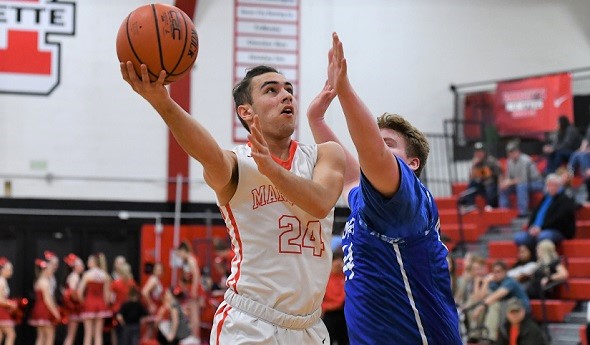
PHOTO: Marquette's Thomas Albarello drives to the basket while being defended by Ishpeming's Jacob Kugler during their game last month. (Photo by Cara Kamps.)